In 1994, AT&T bought one of the first online banner ads. That single placement opened the digital advertising era, and the industry has been rebuilding itself ever since. If you want the long view, our guide to how digital marketing strategies have evolved traces the path from that banner to AI-generated answers.
The newest chapter belongs to retailers. When someone opens a retailer app or search box, they are usually much closer to buying than a reader scrolling a news site. That intent is what advertisers are paying for.
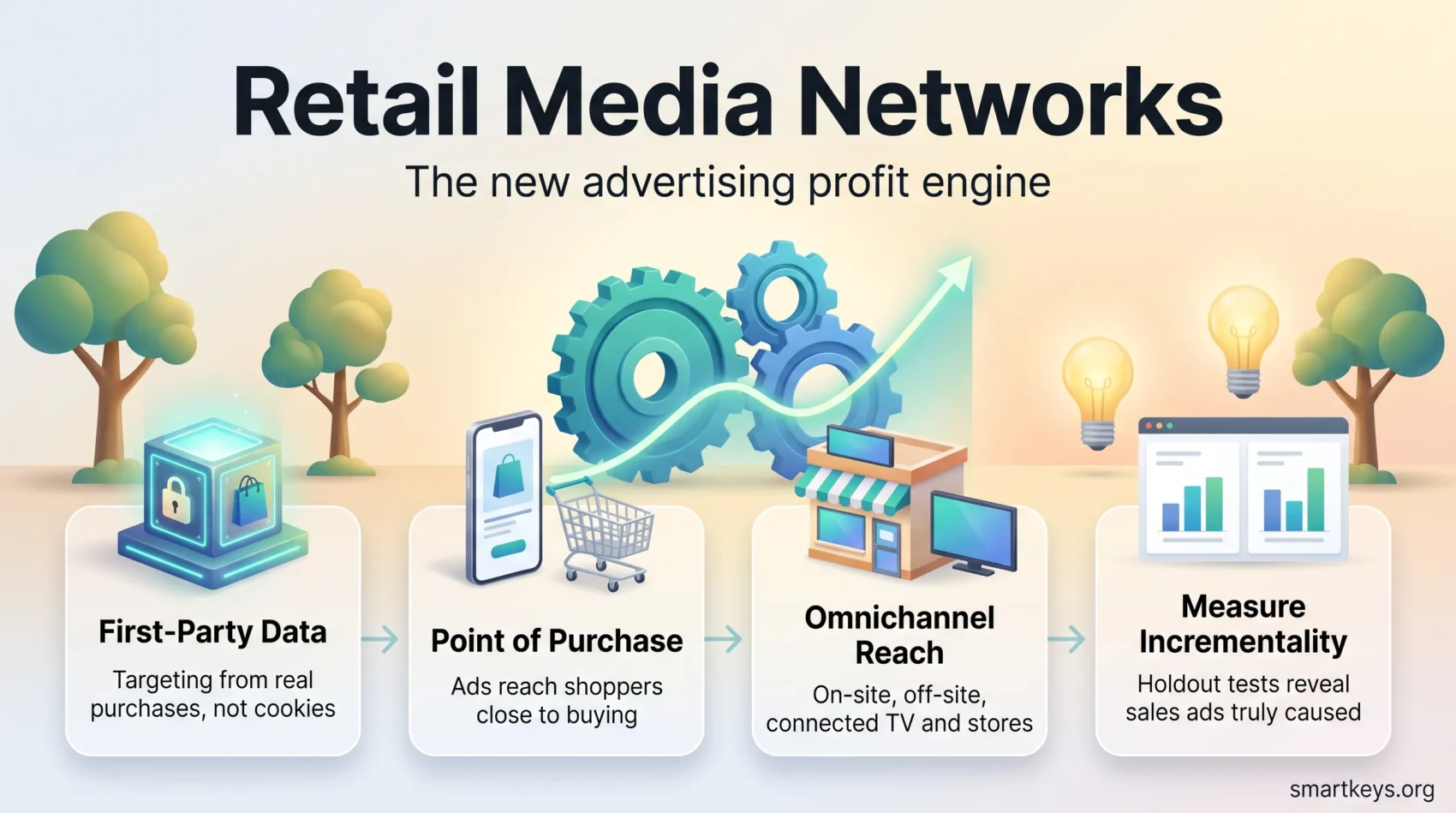
Retail media turns ecommerce sites, apps, and in-store channels into measurable advertising space. Retailers use first-party data to improve targeting and open a high-margin revenue line. Brands gain a direct path to shoppers at the moment of decision.
Many analysts call this the third major wave of digital advertising, after search and social. The numbers support that framing. EMARKETER expects worldwide ad spending to reach $1.170 trillion in 2026, after the market first crossed $1 trillion in 2025. Retail media growth has cooled from its early pace, but the channel keeps taking a larger share of digital budgets.
Key Takeaways
- US retail media ad spending approaches $70 billion in 2026.
- Retailer sites and apps capture shoppers with high purchase intent.
- First-party data replaces third-party cookies for targeting.
- Amazon and Walmart dominate, but a scaled second tier is forming.
- In-store measurement finally has an industry framework.
What Are Retail Media Networks?
A retail media network is an advertising platform operated by a retailer. It sells placements across the retailer’s own websites and apps, connected TV inventory (ad slots inside streaming services watched on a television), off-site campaigns, and physical stores. The targeting comes from the retailer’s own purchase and browsing data.

The model took hold when Amazon opened sponsored listings to third-party sellers in the early 2010s. A brand could suddenly appear beside a competing product at the exact moment a shopper compared options. Every large retailer has since asked the same question: if we already own the audience, why give the ad revenue away?
How Retail Media Differs From Commerce Media
Commerce media is the wider category. It covers any advertising that uses shopping signals, including inventory sold by delivery apps, travel sites, banks, and marketplaces that are not retailers in the traditional sense. Retail media is the retailer-owned subset. The distinction matters when you plan budgets, because platform business models outside retail now sell the same kind of purchase-intent audience.
Why the Digital Point of Purchase Matters
A retailer site catches people while they search, compare, and add to cart. The gap between seeing an ad and buying can be seconds. That compression is why measurement here is cleaner than in most channels. It is also why mobile commerce behaviour deserves close attention: the phone is where most of these sessions now start.
The Role of First-Party Data
First-party data is information a company collects from its own customers, rather than buying it from a data broker. Purchase history, loyalty accounts, email engagement, and on-site search build a picture no third-party cookie ever matched. Retailers hold that data directly, which is why a customer data platform sits at the centre of most retail media stacks. Layering behavioral analytics on top turns raw events into audiences a brand will actually pay to reach, and a documented first-party data strategy decides how much of that value the retailer can safely sell.
Why Retail Media Became a Profit Engine
Retail margins are thin. Advertising margins are not. That single fact explains most of the industry’s enthusiasm.
What the 2026 Numbers Show
Amazon reported $19.8 billion in advertising revenue in Q2 2026, up 26% year over year, which the company credited to AI tools, conversational shopping, and multi-sport streaming. EMARKETER projects Amazon’s retail media revenues will exceed $75 billion by 2028, more than $65 billion ahead of the next-largest network.
Walmart is the clearest challenger. Its global advertising business reached nearly $6.4 billion in fiscal 2026, a 46% increase. The pace has held since. In the quarter ended 31 July 2026, Walmart reported 38% growth in global advertising, with Walmart Connect up 43% in the United States once its VIZIO connected TV unit is stripped out. At market level, EMARKETER puts US retail media ad spending near $70 billion in 2026.
Read those together and the shape of the market is clear: one dominant network, one fast-scaling challenger, and a long tail of retailers competing for the remaining budget.
The Post-Cookie Advantage
As third-party tracking keeps eroding, logged-in retail environments hold an obvious advantage. The signal is deterministic, meaning it ties an ad to a known account rather than inferring identity from browsing patterns. It is also consented and linked to real transactions. This is the same shift driving investment in AI-led marketing strategies and in real-time data infrastructure across the wider industry.
- Relevant ads placed near the purchase decision
- Closed-loop reporting that follows a shopper from impression to receipt
- A revenue line that is not exposed to product margin pressure
Inside the Retail Media Ecosystem
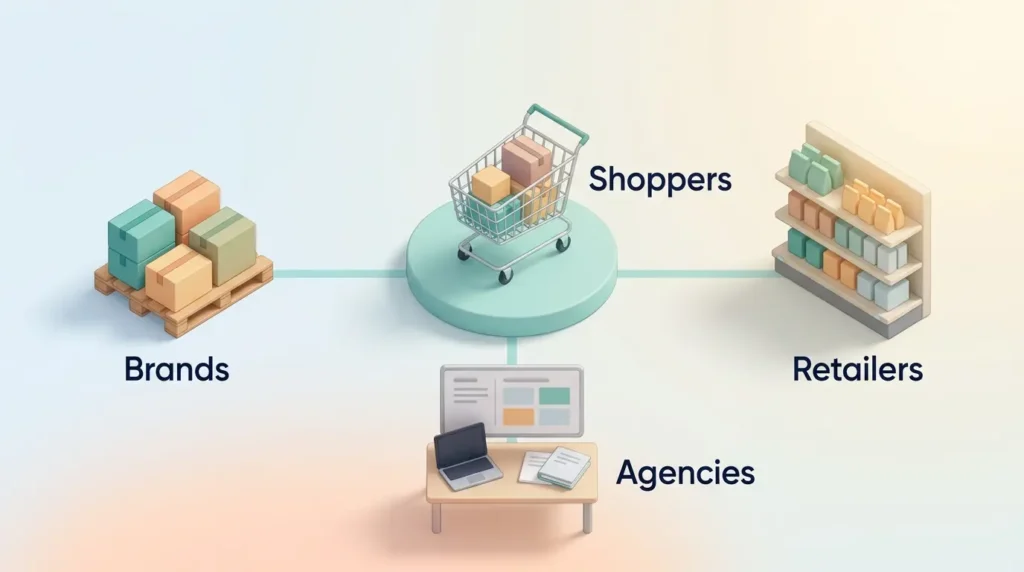
A working retail media programme depends on four groups pulling in the same direction: brands, retailers, agencies, and the shoppers whose attention is being sold.
Brands, Retailers, Agencies, and Shoppers
Consumer brands want shelf visibility and efficient sales. They increasingly treat retail media as a trade-marketing line rather than a pure media buy. The creative discipline still matters: a sponsored listing is a compressed piece of brand storytelling, and what neuromarketing research says about attention applies to a 300-pixel tile as much as to a television spot.
Retailers supply the audience, the inventory, and the transaction data. Agencies plan and buy across an increasingly fragmented set of networks, and they carry the burden of comparing metrics that no two retailers define identically.
Shoppers sit at the centre. When sponsored results crowd out relevance, trust erodes and the channel damages the retailer’s core business. Protecting the customer journey is not a soft concern here; it is the constraint that keeps the model viable.
Ad Formats Across the Shopper Journey
Each format serves a different moment. Matching creative, placement, and timing to intent is most of the work.
Sponsored Products for High-Intent Search
Sponsored products appear beside organic listings on search results and product detail pages. They capture shoppers who have already named what they want, which makes them the highest-converting and most competitive format in the mix.
On-Site Display for Consideration
Banners on category and homepage placements reach people who are browsing rather than searching. This is where product diversification pays off, because a shopper open to alternatives is a shopper you can move to a different line.
Off-Site and Connected TV for Reach
Off-site campaigns take retailer audiences onto the open web, publisher inventory, and streaming. The targeting still comes from retailer data; only the placement moves. Connected TV has become the fastest-growing extension, and it is where retail media starts competing directly with traditional brand budgets.
Emerging Formats
Retailers are also testing chat-based placements adjacent to conversational commerce, virtual try-on units drawn from augmented reality in e-commerce, and sponsored placements inside resale marketplaces. None of these carry meaningful budget yet. All of them are worth a test line.
Online, In-Store, and Omnichannel Opportunities
The store is the part of retail media that has lagged, and 2026 is when that started to change.
Digital Screens, Audio, and Store Media
On 9 December 2025, the IAB released A Viable Framework for Maturing In-Store Media Measurement. It covers QR-enabled screens, digital endcaps (the screens on the display unit at the end of a store aisle), smart displays, and in-store audio. Until then, every retailer counted store impressions its own way, which made comparison across networks close to impossible. A shared baseline is what unlocks real budget for these formats.
Store media also connects to the wider shift described in phygital retail, where the same shopper moves between app and aisle in one trip. Retailers experimenting with autonomous retail formats gain an additional advantage: checkout-free stores generate exactly the kind of clean, individual-level data that in-store advertising has always lacked.
Location and Trade-Area Insight
Store networks also make geospatial analytics commercially useful. A trade area is simply the catchment a store draws customers from. Comparing overlapping trade areas, cross-shopping behaviour, and store-level sales lift lets a brand see whether a campaign moved units in the specific markets it cared about, rather than only in aggregate.
How to Launch, Measure, and Improve a Programme
Your first decision shapes cost, speed, and control for years.
Build, Buy, or Partner
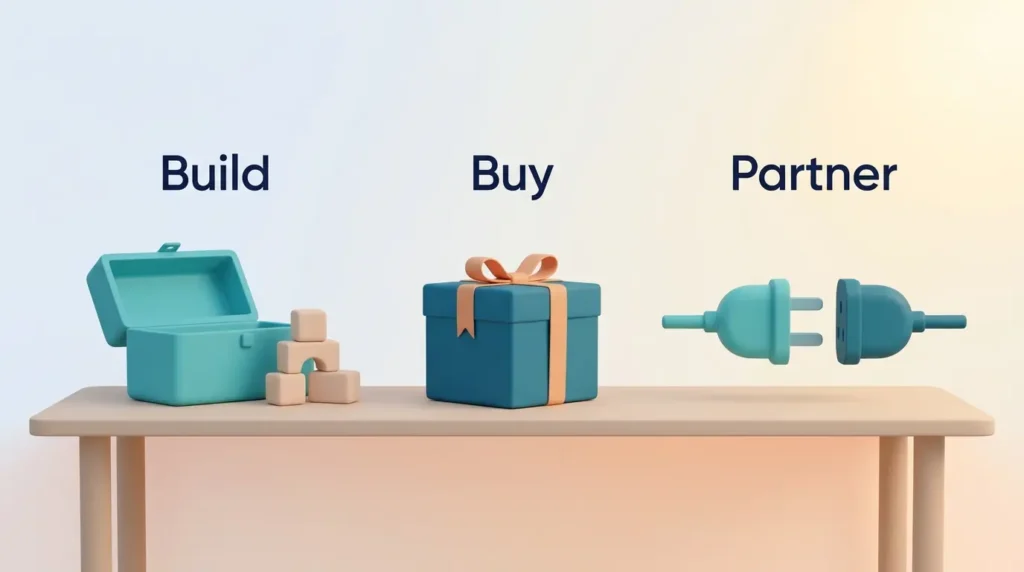
Amazon, Walmart, and Instacart built in-house for maximum control over data and demand. Most retailers should not. Buying a packaged platform gets a network live in weeks. Partnering with an established provider brings existing advertiser demand, which is usually the harder half of the problem. Treat the decision the way you would any partner ecosystem question: what do you gain by owning it, and what does owning it cost you every year?
Whichever route you pick, the launch itself needs a proper go-to-market strategy. A network without advertiser demand is just unused inventory.
Measure Incrementality, Not Just ROAS
Return on ad spend, or ROAS, is easy to report and easy to inflate, because much of the credited revenue would have happened anyway. Incrementality is the sales a campaign actually caused. You measure it by holding a comparable group of shoppers back from the ads and checking what they bought anyway, using geo splits or matched-market tests. That comparison is the only reliable way to separate influence from coincidence.
IAB Europe’s Retail and Commerce Media Committee names measurement as the industry’s biggest challenge and its biggest opportunity, pointing to shared definitions of ROAS, incrementality, and attribution as the work that still needs doing. Until those definitions converge, assume that two networks reporting the same metric are not measuring the same thing.
- Run holdout tests before you scale a budget.
- Ask each network how it defines a conversion window.
- Track sales of the individual product (the SKU), not campaign-level clicks.
- Keep first-party data governance and privacy compliance ahead of monetisation.
Conclusion
Retail media has stopped being an experiment. With US spending near $70 billion in 2026 and Amazon alone booking $19.8 billion in a single quarter, it is now a core channel with its own economics, its own vendors, and its own unresolved measurement problems.
The opportunity is real on both sides. Retailers get a high-margin revenue line that does not depend on product margin. Brands get placement at the point of decision with reporting that actually closes the loop. Neither benefit survives a bad shopper experience, which is the discipline the whole model rests on.
Start with one question: do you have enough first-party data and enough advertiser demand to justify owning a network, or are you better off buying access to someone else’s? Answer that honestly, measure incrementality from day one, and the channel can become a durable profit engine rather than an expensive experiment.
Found this useful?
Make SmartKeys a preferred source on Google, and our articles will surface more often in your Top Stories, AI Overviews, and AI Mode.
Add as Preferred Source