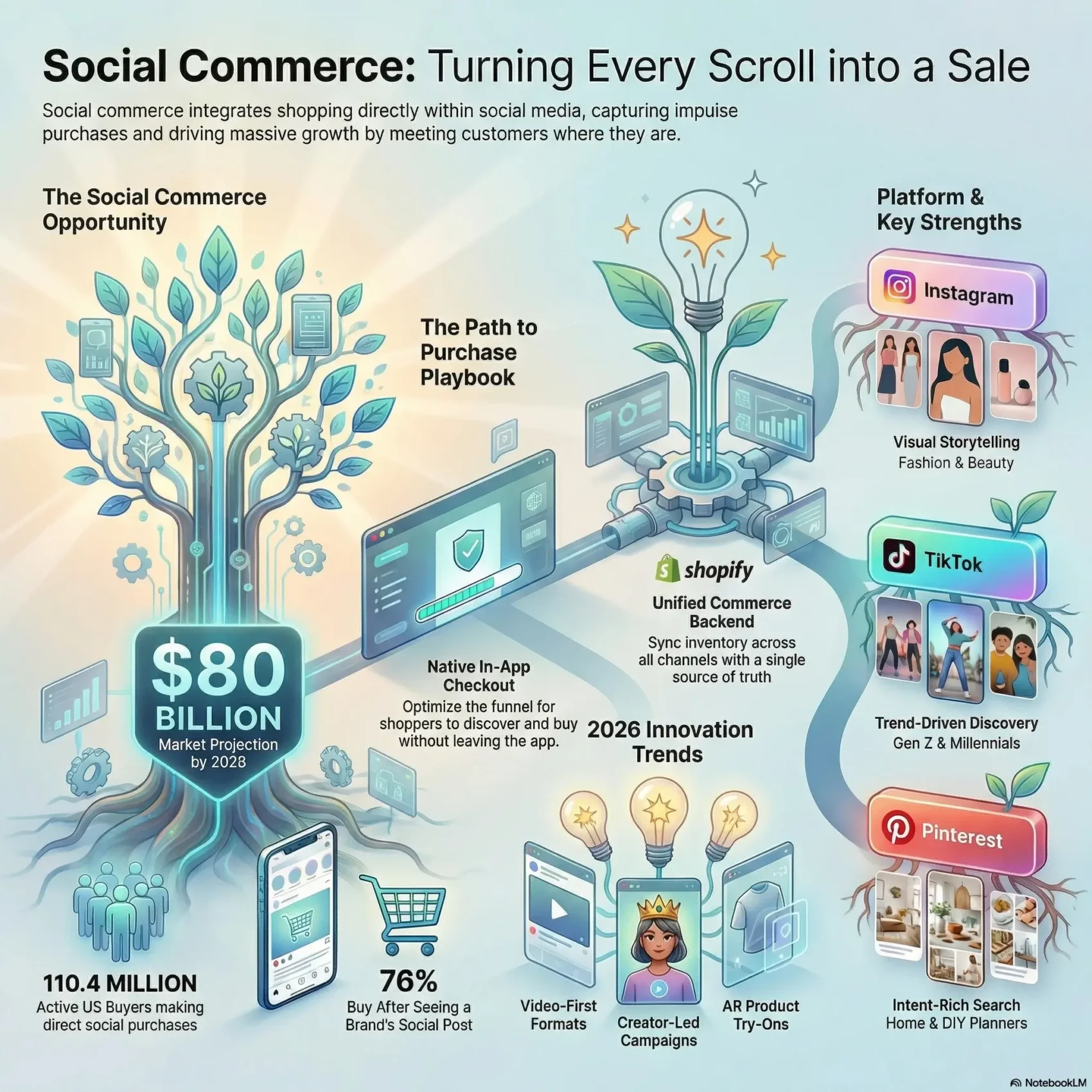
Social commerce means selling products inside social apps rather than only advertising them there. Someone sees a video, taps a product tag and buys, often without opening a browser. In 2026 this is no longer a side experiment. eMarketer expects US social commerce sales to pass $100 billion for the first time in 2026.
What changed in the last two years is not just the size of the market. It is who runs it. Meta pulled back from handling payments itself, TikTok Shop grew into the biggest single storefront on social, and regulators started paying attention to how products are recommended and reviewed. This article explains how social commerce works now, what the numbers actually support, where it fails, and what a business should do about it.
Key Takeaways
- US social commerce sales are forecast to pass $100 billion in 2026, according to eMarketer.
- Meta stopped processing payments inside Facebook and Instagram Shops in 2025. Buyers are now sent to the merchant’s own site to check out.
- TikTok Shop is the exception: it kept native checkout and reached $15.1 billion in US sales volume in 2025.
- Live shopping is real but smaller than the hype suggests. It was 14% of TikTok Shop’s global sales volume in 2025.
- Building your own customer list matters more than follower count, because platform rules change without warning.
What Social Commerce Actually Means
Traditional e-commerce sends people from an ad to a website. Social commerce keeps more of the journey inside the app: discovery, product details, reviews, and in some cases payment. The difference matters because every extra tap costs you buyers. It helps to separate three things that often get lumped together.
The Three Building Blocks
- Shoppable content: posts, videos or livestreams with tagged products. Tapping a tag opens the product without leaving the feed.
- Checkout: where the money changes hands. This can be native (inside the app) or redirected (on your own site).
- User-generated content, or UGC: photos, videos and reviews made by customers rather than by your marketing team. It is the social proof that makes a stranger trust a small brand.
Only the first and third are available everywhere. Native checkout is now the exception rather than the rule, which is the single biggest practical change since 2024.
Why It Matters for Your Business
Social commerce is best understood as a discovery channel with a shorter path to purchase. People are not searching for your product. They come across it while watching something else, which is why a well-made video can outsell a well-optimised product page.
That has a concrete consequence. If your product is visual, cheap enough to buy on impulse and easy to explain in 30 seconds, social platforms can move real volume. If it needs a demo, a quote or a procurement process, social will build awareness but the sale happens elsewhere. Knowing which of the two you are is the first strategic decision.
How Big Social Commerce Is in 2026
eMarketer forecasts that US social commerce sales will exceed $100 billion in 2026. That is a large number, and still a small share of total US online retail, so social is a meaningful channel rather than the whole game.
Adoption also splits sharply by age. In eMarketer survey data from 2025, about a third of US adults aged 18 to 34 had bought something through social media, against 23% of those aged 35 to 54 and 13% of those aged 55 to 65. If your customers are in the older groups, social commerce is a slower build, not a quick win.
The platform picture is lopsided. TikTok Shop alone is projected to generate $23.41 billion in US e-commerce sales in 2026, a 48% rise on the previous year, according to eMarketer. No other social platform is close on native selling.
How Social Commerce Got Here
The idea is older than the technology. The term is usually traced to Yahoo’s 2005 Pick Lists, which let users share curated product collections. For years after that, social platforms sent traffic to shops without touching the transaction.
From Share Buttons to Checkout Buttons
Smartphones changed that. Once most social use happened on a phone, the gap between seeing a product and buying it became one tap wide, and platforms started building storefronts, product catalogues and payment flows of their own. The commercial logic was simple: whoever owns checkout owns the customer data.
The Retreat That Reshaped the Market
That ambition did not last at Meta. From June 2025 Meta began phasing out native checkout in Facebook and Instagram Shops, with most shops moved over by the end of August 2025. Buyers still discover products in the feed, but they finish the purchase on the merchant’s own website. Order management, returns handling and payment processing through Meta’s Commerce Manager were retired at the same time.
For merchants this is a mixed result. You lose the frictionless in-app purchase. You gain the customer data, the email address and control of the post-purchase experience, which is exactly what a first-party data strategy depends on. It also makes your own site, checkout speed and mobile experience the bottleneck again, which is why mobile commerce fundamentals deserve attention before you spend anything on social ads.

The Features That Do the Selling
Three formats account for most social commerce activity.
Shoppable Posts and Checkout
A shoppable post carries product tags. Tapping one shows price and details immediately, which removes the moment of doubt where most people give up. On TikTok Shop the purchase completes inside the app. On Facebook and Instagram it now hands the buyer to your website.
Measure the drop-off at that handover. If many taps never reach your checkout, the problem is usually page speed or a clumsy mobile form, not the ad.
Live Shopping
Live shopping is a broadcast where a host demonstrates products and viewers buy during the stream. It works because questions get answered in real time and limited offers create urgency.
It is also smaller than the coverage suggests. Momentum Works put live commerce at 14% of TikTok Shop’s global sales volume in 2025, up from 10% a year earlier, while short video accounted for 50% and the Shop tab 36%. Live is growing, but recorded video still does most of the selling. Instagram retired its own live shopping feature back in 2023, so the format is concentrated on TikTok in Western markets.
Augmented Reality Try-On
Augmented reality, or AR, overlays a product onto a live camera view so you can see lipstick on your own face or a chair in your own room. Snapchat and TikTok both offer try-on effects, and the strongest case for them is returns: a customer who has seen the shade or the size on themselves is less likely to send it back. We cover the wider picture in our guide to AR in e-commerce. Treat it as a returns and confidence tool for visual categories, not as a growth strategy on its own.
What Social Commerce Is Genuinely Good At
Reaching People Who Were Not Looking for You
Search captures existing demand; social creates it. A skincare brand nobody has heard of can reach a buyer who never typed the product category into a search box. That is the channel’s real advantage, and it is why new direct-to-consumer brands lean on it so heavily.
Trust Through Other Customers
People believe other buyers more readily than they believe brands. Reviews, unboxing videos and comment threads do work that polished advertising cannot. This also makes social a strong channel for building customer loyalty, because the relationship continues in public after the sale.
A Lower Cost of First Contact
Working with smaller creators is usually cheaper per person reached than broad advertising, and the content can be reused across your site, email and ads. But that saving applies to first contact only. Fulfilment, returns and support cost what they always did.
Where Social Commerce Goes Wrong
Platform Dependency
Meta removed checkout with a few months of notice. Instagram removed live shopping. A ranking change can halve your reach overnight, and you have no vote.
Two things reduce the damage. First, sell on more than one platform so no single rule change takes your whole revenue. Second, convert social audiences into contacts you own, which usually means email or SMS. The ownership question also has a political edge now: TikTok’s US operations moved into a US-controlled joint venture involving Oracle, Silver Lake and MGX that closed in January 2026, with ByteDance and its investors retaining roughly half. The episode shows how much of your channel depends on decisions you do not make.
Privacy, Trust and Returns
Social selling runs on personal data: what you watched, paused, saved and bought. Being straightforward about what you collect is now part of the product, not a legal afterthought. Our overview of data privacy trends covers the compliance side, and zero-party data explains how to ask for information directly instead of inferring it.
Returns are the other quiet problem. Impulse buying produces impulse returning, and those returns can wipe out the margin the channel appeared to deliver. Track profit after returns, not revenue.
A Practical Playbook
Pick Platforms by Buyer, Not by Hype
Choose based on three questions. Where does your customer spend time? Can you produce the format that platform rewards, week after week? And does the platform support the checkout path you need? A B2B software company will get more from B2B influencer marketing on LinkedIn than from a TikTok storefront, even though TikTok has the bigger commerce numbers.
Start with one platform and one format.
Use Customer Content and Creators
Ask buyers for photos and short clips, and make it easy to send them. Then use that material in your ads, on product pages and in email. It is the cheapest persuasive content you will get.
Creator partnerships add reach on top. Smaller creators with engaged audiences often convert better than large accounts with passive ones, because their recommendations still read as personal. Judge them on sales and saved carts rather than views. The TikTok Shop figures are instructive here: during the 2025 Black Friday and Cyber Monday period, the platform reported more than $500 million in sales over four days and over 760,000 livestream sessions, with participating brands seeing 84% year-over-year sales growth from livestreams. That growth came from sustained creator activity, not from one broadcast.
Connect It to the Rest of Your Marketing
Social commerce fails when it sits in a silo. The same product story should appear in your digital marketing, your email flows and your service replies. An omnichannel approach is what turns a one-off impulse buy into a second order, and conversational commerce in direct messages is often where that second order actually happens.
The Rules You Have to Follow in 2026
Two regulatory developments matter for anyone selling through social.
In the United States, the Federal Trade Commission has been enforcing its Consumer Review Rule, which bans fake reviews, undisclosed insider reviews, paying for a specific sentiment and misrepresenting social media influence metrics. In December 2025 the FTC warned ten companies about possible violations. Penalties can reach $53,088 per violation. If you run a review programme or a creator programme, the disclosure rules apply to you.
In the European Union, the Commission has announced a Digital Fairness Act covering dark patterns, addictive design, unfair personalisation and influencer marketing practices. As of September 2026 it is an announced initiative rather than law: the Commission’s work programme points to a proposal in the fourth quarter of 2026, and any obligations would follow later.
Both point the same way. Undisclosed paid content and manufactured social proof are becoming legal exposure rather than clever tactics.
US and China: Two Different Markets
In China, live commerce grew into a mainstream retail format. ECDB put the market at roughly $695 billion in 2023 and forecasts it to pass $1 trillion by 2026, with Douyin and Kuaishou taking a large share of that volume from the earlier leader Taobao. Livestreaming there is a primary sales channel with professional hosts, dedicated studios and heavy logistics behind it.
In the US and Europe the pattern is different. Short video does most of the selling, live is a growing supplement, and a large part of the value still lands on merchant websites rather than inside the app. Copying the Chinese playbook wholesale rarely works, because the audience habits and the platform economics are not the same. The useful lesson from China is about production discipline and frequency, not about format.
What to Watch Next
Three developments are worth tracking.
AI-driven recommendation is the engine underneath all of this. Feeds decide what a buyer sees, and increasingly so do assistant-style product suggestions. Our guides to AI personalization in customer experience and e-commerce personalization go deeper, and AI in marketing covers the rules that now apply to automated recommendations.
Payment flexibility keeps shaping conversion. Instalment options change what people will buy on impulse, with real consequences for margins and returns, as our look at buy now, pay later sets out.
Finally, the line between online and physical retail keeps blurring. Resale marketplaces and in-store pickup both start with a social discovery moment, which is why recommerce and phygital retail are increasingly part of the same conversation.
What This Means for You
Social commerce in 2026 is a mature channel with an awkward middle step. Discovery happens in the app and works well. Checkout, for most brands, now happens on your own site again. The businesses doing well treat social as the top of a funnel they control, not as a shop they rent.
So the priorities are unglamorous. Make your mobile checkout fast. Collect customer contacts you keep. Produce short video consistently rather than brilliantly once. Disclose paid relationships properly. Measure profit after returns. Do those five things and the platform changes that will inevitably arrive next year become an inconvenience rather than a crisis. For the wider retail context, our overview of digital marketplace trends and our guide to customer experience trends are useful next reads.
Found this useful?
Make SmartKeys a preferred source on Google, and our articles will surface more often in your Top Stories, AI Overviews, and AI Mode.
Add as Preferred Source