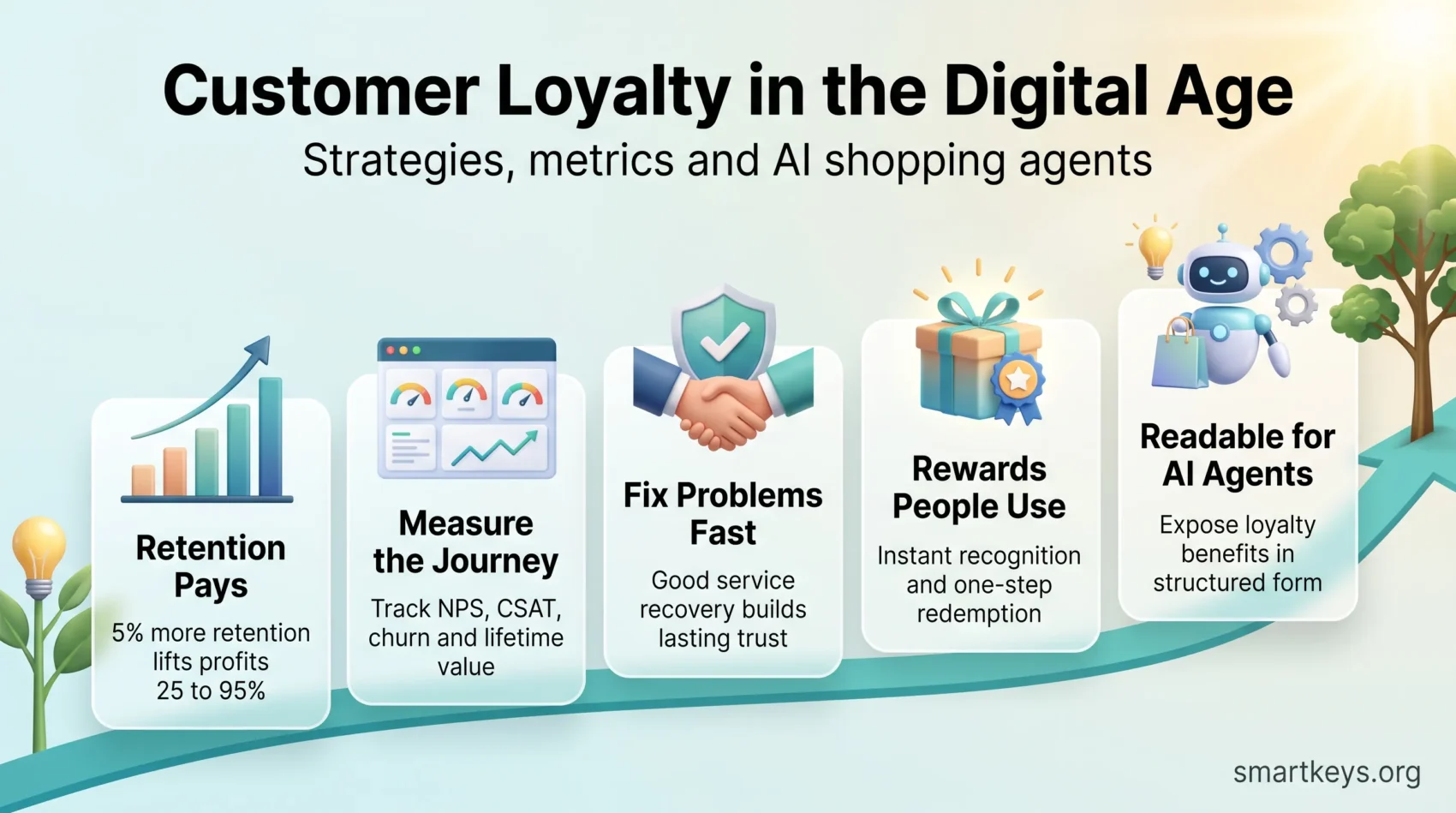
Repeat buyers are the cheapest growth you will ever buy. Winning a new customer still costs roughly five to twenty-five times more than keeping one you already have, and the odds of selling to an existing customer sit around 60–70%, against 5–20% for a cold prospect, according to the widely cited Marketing Metrics benchmark.
But 2026 added a twist that most loyalty programs were never designed for. AI shopping agents now sit between your brand and the buyer. They compare, filter, and check out on someone’s behalf. And they ignore every tier badge, point balance, and members-only perk they cannot read.
This guide treats loyalty as a growth engine rather than a marketing line item: the metrics that matter, the experience work that moves them, how to design rewards people actually use, and what to change now that an algorithm may be doing the shopping.
Key Takeaways
- A 5% lift in retention can raise profits by 25–95% (Bain). Keeping customers is still the highest-leverage investment you can make.
- Enrolment is not engagement: the average US consumer belongs to well over a dozen loyalty programs but actively uses only about half of them.
- Fast, fair service recovery often builds more trust than a flawless run.
- Agentic commerce is real. If your loyalty value is not machine-readable, agents will optimise you down to price.
- Personalisation only works on a clean, consented data foundation. Privacy and loyalty rise and fall together.
- Measure intent and behaviour. The gap between what people say and what they do is where your best fixes hide.
Why digital-first loyalty looks different in 2026
A fast, consistent digital experience is the price of entry, not a differentiator.
People move between web, app, messaging, and social without thinking about it, and they reward brands that keep up. Companies with connected omnichannel journeys keep a far higher share of their customers than those with fragmented ones, and shoppers who use several channels tend to be worth more over time.
What changed is the layer above that. AI-driven traffic to US retail sites accelerated sharply through the first quarter of 2026, and regular use of AI shopping tools nearly doubled in three months according to research Merkle presented at Shoptalk 2026. Adoption is still uneven, and most consumers say they rarely or never shop with AI. The direction, however, is not in doubt.
Digital-first in 2026 means unified customer profiles, proactive service, consistent answers across every channel, and a value proposition that is legible to both humans and machines. Privacy-by-design keeps that engine trustworthy as personalisation gets sharper.
Start with quick wins: add the channels your customers actually prefer, cut response times, and make self-service genuinely useful. Then track retention rate, NPS, CSAT, and repeat purchase frequency so the team can see what moved.
What customer loyalty actually means
True loyalty is emotional and identity-driven. It means someone intends to keep the relationship going. It does not mean they buy again out of habit, contract lock-in, or lack of alternatives.
Share of wallet tells you how much category spending you capture, but a high share can come from inertia rather than genuine attachment. Consumer surveys are a useful reality check here: a large share of people who call themselves loyal say they would still switch for a cheaper competitor. Loyalty is rented, and the rent is due every quarter.
Beyond transactions: trust, identity, and share of wallet
Think of loyalty as a spectrum: intent, behaviour, advocacy, and identity. Some people buy for convenience. Others treat your product as part of who they are. Phones, apparel, and cars regularly reach that level.
That identity-level bond is what makes a customer resistant to a competitor’s discount and willing to recommend you unprompted. Building it is a company-wide job, which is why a genuine customer-centric culture outperforms a well-funded loyalty program bolted onto an indifferent organisation.
Why service recovery can beat flawless service
A quick, transparent fix turns a bad moment into evidence that you can be trusted. When you honour promises (accurate delivery dates, reliable quality, honest updates), people notice, and they notice most when something has gone wrong.
“A resolved problem often strengthens trust more than a problem-free experience.”
Systematise it: clear SLAs, agents empowered to resolve without escalation, and a follow-up that confirms the issue is closed. Recovery is too important to leave to individual goodwill.
- Define loyalty as emotional commitment, not repeat transactions.
- Separate share of wallet from real attachment.
- Systematise recovery so bad moments become trust-building ones.
The business case: retention, repeat purchases, and lifetime value
Small changes in how long people stay compound quickly. The Bain and Harvard Business Review finding still holds: a 5% increase in retention can lift profits by 25–95%. Example: a subscription box that keeps members for 14 months instead of 12 earns two extra orders per customer without spending a cent more on ads.
Benchmarks vary enormously by sector: banks and insurers keep far more customers each year than online shops do. So compare yourself to your own trend line first. A “good” rate is one that improves year over year. For the formulas behind retention rate, churn, and CLV, plus a step-by-step plan to raise them, see our hands-on guide on how to calculate and improve customer retention.
CLV and the bottom line
Customer lifetime value (CLV) quantifies the long-term worth of a relationship and lets you tie experience investment to predictable revenue.
The catch: many companies admit they cannot measure CLV reliably. Fix the measurement before you optimise against it. Once the number is trustworthy, use it to decide who deserves investment, which offers raise average order value, and where subscriptions or cross-sell genuinely deepen the relationship rather than just extracting more from it.
Word-of-mouth and brand champions
Advocates are an acquisition channel with no media budget. Customers who arrive through a referral tend to stay longer than those won through paid ads, because a friend has already vouched for you.
“People are far more likely to trust a recommendation from someone they know than any ad you can buy.”
- Connect retention to profitability by tracking CLV per segment, not as a single company-wide average.
- Reward advocacy explicitly: referrals, reviews, and community contributions.
- Align finance and CX on cohort analysis so both sides read the same story.
Know your loyal customers: types, behaviours, motivations
Segmenting who comes back, and why, makes every retention dollar work harder.
Price- and convenience-driven buyers vs. true advocates
Price-focused buyers hunt deals and respond to clear, provable value. Convenience-focused shoppers pay for speed, availability, and a checkout that does not fight them.
True advocates buy often, give feedback without being asked, and defend you in public. They justify a materially higher investment per head.
Program-only buyers and how to deepen the bond
Program-only buyers stay for the perks and leave when a better perk appears. To move them up the ladder, layer recognition, access, and community on top of the discount. Those are the things a competitor cannot simply undercut. A brand community that members help run is one of the strongest versions of this.
- Differentiate the message: guarantees for deal-seekers, faster fulfilment for convenience-seekers, exclusive access and status for advocates.
- Track product breadth: buying across categories is one of the earliest signals of deepening commitment.
- Build re-engagement plays that fire before a lapse, not after.
“Recognition and visible status turn perks into pride.”
For practical channel design, review our omnichannel strategies guide to match offers to behaviour across touchpoints.
How to measure customer loyalty across the journey
What you track shapes what improves. Build a metric stack that covers the whole journey, then wire it to owners and thresholds.
NPS and recommendation intent
Net Promoter Score (NPS) asks how likely someone is to recommend you on a scale from 0 to 10. Its real value is the verbatim comments behind the score. Route those to product and support so you act on themes rather than chasing a number.
CSAT and customer effort
Use CSAT (customer satisfaction score, usually a quick 1 to 5 rating) immediately after key touchpoints to surface friction fast. Effort is the quiet killer: the more work an experience demands, the more likely people are to leave, regardless of how much they liked your product. Track first-response and resolution time alongside satisfaction so you can see cause and effect.
Churn, retention, and repeat purchases
Measure churn by cohort (customers who started in the same month) at 30, 60, and 90 days to isolate onboarding and pricing problems. For subscription models, separate voluntary churn from involuntary (failed payment) churn. The fixes are completely different: one needs a better product or offer, the other a better payment retry flow. Modern customer success tools make that split visible and let you intervene before the renewal date.
A loyalty index that combines intent and behaviour
Adopt a Customer Loyalty Index that blends NPS, repurchase intent, and cross-buy plans, then pair it with engagement data: logins, reviews, support contacts, community activity. Scaling the qualitative side is now realistic: voice of customer AI can cluster thousands of open-text responses into themes your team can actually act on.
- Core stack: NPS, CSAT, churn/retention, repeat frequency, CLV.
- Link operational metrics (delivery, response time) to experience scores.
- Alert on thresholds, and put a KPI-to-revenue dashboard in front of leadership.
“Track both what people say and what they do. That gap is where your best improvements live.”
Customer experience that keeps customers loyal
Clear, timely help across channels is what keeps people confident in your brand.
Support is where loyalty is won or lost fastest. A single bad service experience is enough for a large share of customers to stop buying, while most say they would forgive a mistake that was handled well. The wider shifts here are covered in our overview of customer experience trends.
Proactive, omnichannel support that respects time
Make proactive the default. Status updates, delay warnings, and anticipatory help remove the need to contact you at all. Then make the answers consistent across chat, voice, email, and messaging so nobody has to explain themselves twice.
Automation earns its place when it removes waiting rather than adding steps. Our breakdown of AI chatbots in customer support covers where deflection helps and where it quietly destroys trust, and the broader picture sits in our guide to customer service trends.
Empathy, ownership, and closing the loop
Train for rapport and problem ownership, and give agents the authority to finish what they start. Handoffs are where satisfaction leaks.
- Build self-service that works: searchable, current, and honest about limitations.
- Close the loop by telling customers what you changed because of their feedback.
- Measure outcomes with CSAT, first-contact resolution, and effort scores.
Personalisation, data, and reward design
Personalisation works when it rests on clean, consented data. Most businesses now run some form of AI-driven personalisation, and the payoff is real: McKinsey puts the typical revenue lift at 10–15%. That only holds where the underlying customer profile is accurate.
Using customer data responsibly
Collect what you need, secure it, and be explicit about why. A customer data platform gives you the unified profile that makes recognition possible in the first place, while a zero-party data strategy (preferences people volunteer directly, such as sizes or favourite categories) is both more accurate and more durable than inference. Keep it aligned with current data privacy trends, because a consent failure costs more trust than any campaign will ever build.
Real-time recognition (instant point credits, visible progress, on-site status) lifts return visits far more reliably than a larger reward delivered slowly. The mechanics behind that are covered in our guide to AI-powered personalisation.
Designing rewards: points, tiers, subscriptions, referrals
Match the structure to your business model: points for high-frequency purchases, tiers for status and aspiration, subscriptions for predictable benefit, referrals to convert satisfaction into acquisition.
The numbers are encouraging where programs are run well: most companies report a positive return, and active members spend noticeably more per year than non-members. The problem is participation, not economics. The average US consumer is enrolled in well over a dozen programs and actively uses roughly half. Design for engagement, not sign-ups.
Be realistic about saturation, too. Our analysis of subscription fatigue explains why another paid tier is often the wrong answer in a market where people are actively pruning recurring costs.
Make it easy: instant recognition, simple redemption
- Clear rules and instant credit, because ambiguity kills participation.
- Visible progress and a redemption path that takes seconds, not support tickets.
- Perks with genuine value: early access, exclusive products, service upgrades, not just a discount you would have given anyway.
“Instant rewards and easy redemption increase participation and return visits.”
Loyalty in the age of AI shopping agents
This is the structural change of 2026, and most loyalty programs are not ready for it. Agentic commerce means AI assistants that search, compare, and buy for a person, often without that person visiting your site.
When an AI agent shops on someone’s behalf, it works from a brief: price ceiling, delivery window, preferred brands, maybe a sustainability filter. It does not see your homepage banner, your re-engagement email, or the fact that a customer is 500 points from a reward. It optimises for what it can read.
What actually changed
The plumbing arrived fast. OpenAI’s Instant Checkout launched in late 2025 on the Agentic Commerce Protocol. Google introduced the Universal Commerce Protocol at NRF in January 2026 with partners including Walmart, Target, and Shopify, and its March 2026 spec update added identity linking via a standard OAuth 2.0 flow (the same secure login handshake behind “Sign in with Google”). That finally lets an agent act as a known customer rather than an anonymous guest. Talon.One’s Unified Incentives Protocol, also introduced in January 2026, defines how loyalty and promotions can be exposed in machine-readable form.
Bain estimates agentic AI could account for 15–25% of US e-commerce by 2030. You do not need to believe the high end of that range to see the risk: if your benefits are invisible to agents, you compete on price by default.
Make your loyalty value machine-readable
- Expose the mechanics, not just the existence of your program: earn rates, tier thresholds, member pricing, and shipping benefits in structured form.
- Support identity linking so member pricing and personalised offers apply during agent-led checkout.
- Quantify non-price value in terms an agent can weigh: guaranteed delivery windows, free returns, extended warranty, service inclusions.
- Instrument agent traffic separately so it does not quietly corrupt your conversion and attribution reporting.
Keep the human relationship alive
Agents are rational by design and respond poorly to emotional positioning. That does not make brand irrelevant. It makes the direct relationship more valuable, because a customer who names you in the brief has already made the decision the agent is executing. Post-purchase excellence also trains agents to prefer you next time.
The same logic applies to the mobile layer, where much of this behaviour originates; our guide to mobile commerce trends covers how the agentic layer is reshaping checkout.
Emotional connection and employee experience as multipliers
Emotional bonds and employee wellbeing are the quiet engines behind lasting repeat behaviour.
Trust, shared values, and clear storytelling turn a product into part of someone’s identity. Authentic brand storytelling speeds that up, but only when your returns policy, guarantees, and privacy practices match the story you tell.
How treating employees well shows up in the experience
Invest in your teams and every interaction improves. Starbucks has long attributed much of its customer affinity to how staff are treated, and the mechanism is not mysterious: supported people deliver better service, and better service produces customers who come back.
Turning that into a deliberate programme is covered in our guide to employee advocacy.
- Train leaders and front-line staff to communicate with empathy, and give them time to.
- Recognise employees publicly to humanise the brand.
- Measure engagement and correlate it with retention by team or location.
“When your people believe in the mission, customers feel it too.”
From insights to action: your 2026 loyalty roadmap
Turn all of this into something your teams can execute in one quarter. Start by agreeing on a single KPI stack so everyone knows what success looks like.
Set KPIs and iterate with feedback
Define NPS, CSAT, CLV, churn, repeat purchase rate, and multi-product adoption as your core metrics. Launch a feedback engine (surveys, reviews, open-text analysis) and close the loop publicly on what you changed.
Prioritise quick wins that reduce effort
Pick low-effort, high-impact fixes first: better self-service, faster responses, simpler returns. These cut friction and lift satisfaction within weeks.
- Build a KPI dashboard tying NPS, CSAT, CLV, churn, repeat purchases, and cross-buy to revenue outcomes, and fix CLV measurement before optimising against it.
- Map initiatives by impact vs. effort so retention gets attention before you spend more on acquisition.
- Audit your program for obvious value and instant redemption; cut anything that requires explanation.
- Publish your loyalty mechanics in machine-readable form and support identity linking for agent-led checkout.
- Train teams in empathy and give them resolution authority so issues convert into repeat business.
- Run A/B tests on offers and service flows, then scale only what moves satisfaction and repeat purchases.
Review quarterly and integrate product, marketing, and CX roadmaps so the whole company pulls toward the same retention outcome.
Conclusion
Loyalty is a compounding asset, and in 2026 it is also a technical one.
The economics have not changed: loyal customers spend more, forgive more when service is good, and refer others at almost no cost. What changed is who is doing the evaluating. A growing share of purchase decisions now passes through an agent that reads specifications, not stories.
So run both plays. Measure what matters, cut effort, personalise responsibly, and reward the behaviour you actually want. At the same time, make your value legible to the machines increasingly doing the shopping.
Pick one quick win and one structural initiative this quarter. Tie both to your metrics so product, marketing, service, and operations are working from the same definition of a loyal customer.
Found this useful?
Make SmartKeys a preferred source on Google, and our articles will surface more often in your Top Stories, AI Overviews, and AI Mode.
Add as Preferred Source