You’ve sat through long calls and lost track of who owns what. This introduction shows how clear minutes and a simple template cut that waste. You’ll learn which fields matter — title, date, attendees, agenda, decisions, action items, and next meeting — so your team can follow through.
Good minutes don’t transcribe every word. They capture high-level themes, decisions, and assigned tasks. Use light formatting like bullet lists to make the page scannable, and add links to recordings or docs for people who missed the session.
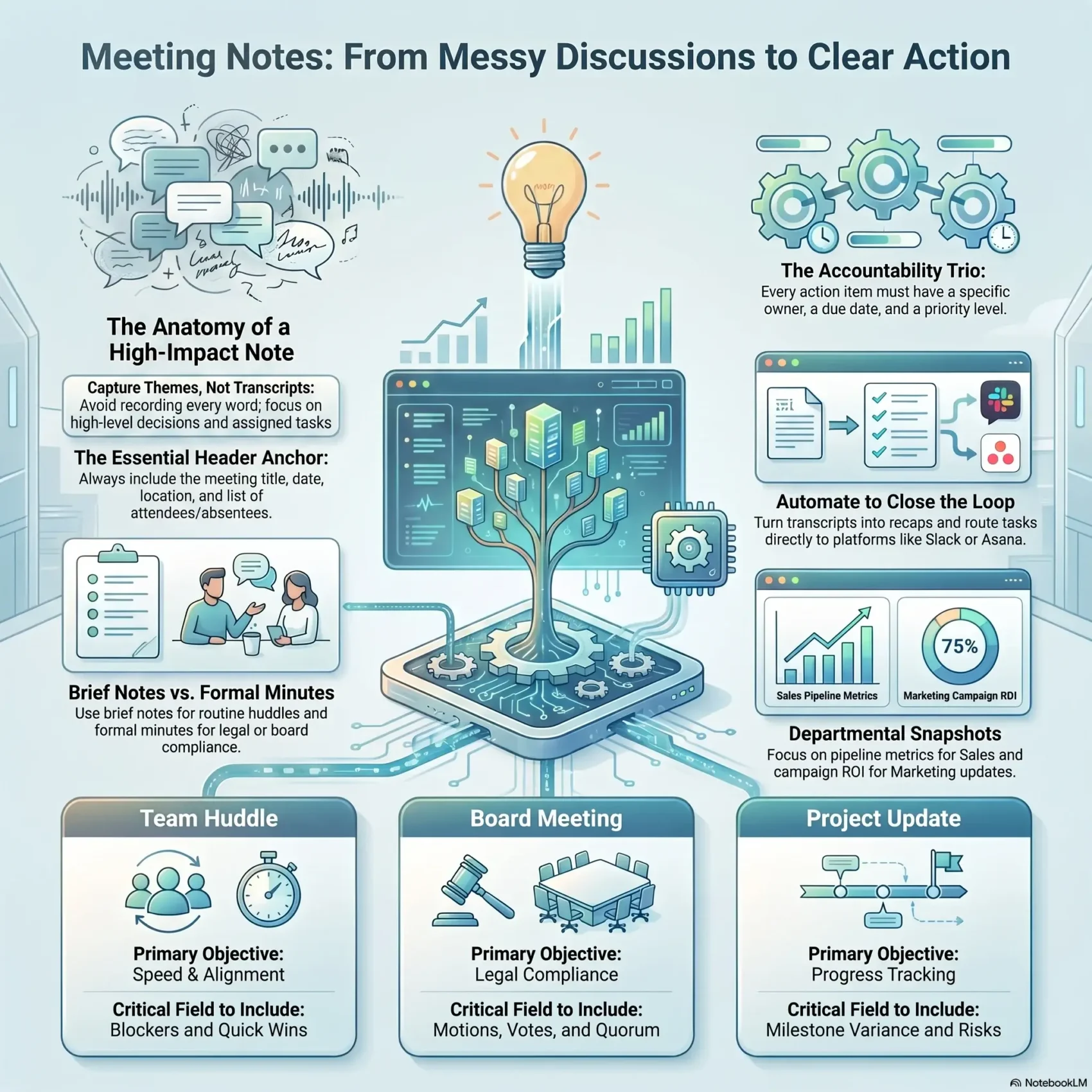
The right template helps teams stay organized and speeds up follow-up. Automation can turn transcripts into recaps and assigned tasks, then post summaries to Slack or email so work actually gets done.
Key Takeaways
- Use a consistent template to capture decisions and action items quickly.
- Include date, time, attendees, agenda, decisions, and next meeting for clarity.
- Favor bullet lists and links to recordings for fast scanning.
- Automate transcripts into recaps and task assignments to save time.
- Choose simple notes for check-ins and formal minutes for audits.
What you’ll get from this list of meeting note templates
Use proven layouts to turn messy discussions into clear action. These structures give you consistent sections for attendees, agendas, decisions, and action items so teams and boards capture what matters fast.
Who these are for:
Who these templates are for: teams, boards, and clients
Whether you’re running a small team check-in, a client review, or a board session, these formats scale. You’ll find options tailored for quick updates and for formal records. Each version lists attendees and absentees, agenda points, and links to recordings or resources so absent members can catch up.
How these templates help you capture action items and next steps
Every minutes template centers on clear ownership. Use fields for owners, due dates, and priority so action moves from discussion to delivery. Collaborative features let you tag people, co-edit the document, and add links to shared docs for follow-through.
- Ready-to-use structures for teams, boards, and clients.
- Essential fields—attendees, agenda, decisions, and action items—kept front and center.
- Options from basic to formal so you match the level of rigor to your meeting.
For a curated set of productivity formats you can start using today, see our productivity templates.
Meeting notes vs. meeting minutes: what’s the difference and why it matters
Choosing the right record format changes what gets captured and who is held accountable. For everyday huddles you want speed and clarity. For leadership or legal contexts you need accuracy and formality.
When to use basic meeting notes for team huddles
Use lightweight notes for fast updates, blockers, and next steps. Capture owners, due dates, and quick wins so work moves forward. Avoid verbatim transcription; focus on clear action and short summaries.
When to use formal meeting minutes for audits and board records
Save formal meeting minutes when the session requires an official record. These often list old business, new business, motions, voting records, and detailed agenda items. Formal meeting minutes protect the organization for audits and legal review.
- For day-to-day alignment pick a short template that highlights action items and owners.
- For the board or executive sessions use a formal meeting minutes template that records discussions and decisions made.
- When unsure, ask the chair whether the goal is compliance or rapid execution.
Standard meeting minutes template for recurring team meetings
Start each recurring team update with a predictable layout so follow-up becomes routine, not guesswork.
Why it works: A consistent format anchors your record and makes it easy to scan. Use a clear header: meeting title, date, time, location, and the list of attendees and absentees.
Structure the body by listing agenda topics, then record decisions under each item. Capture action items with owners and due dates so accountability is visible at a glance.
- Header: title, date, time, location, attendees/absentees.
- Agenda: short bullets; decisions listed under each point.
- Action items: owner + due date; roll last week’s list forward and mark completed tasks.
- Wins & blockers: one-line highlights to surface cross-team help.
- Next meeting: date/time and a provisional agenda to set expectations.
Keep the format simple so anyone can open it in Word or a shared doc. Automate email or Slack recaps after you finalize notes to close the loop and keep your weekly cadence tight.
Detailed project meeting template to track progress and roadblocks
Organize updates around status, risks, and next steps so your project stays on schedule.
Progress, milestones, and issues logs that keep projects on track
Start with an overall status: green, yellow, or red, and a one-line summary of recent progress.
List milestones with target dates and any variance. That makes slippage visible early.
Assigning owners and deadlines so tasks actually get done
Every action must have an owner and a due date. This stops items from lingering and turns discussion into tasks.
Keep an issues log with severity, owner, and mitigation steps. Add cross-team dependencies and who must respond by what time.
How to summarize decisions made without transcribing
Under each agenda point, capture decisions made in two short bullet-style items. Preserve context but avoid verbatim logs.
Finish with a brief priorities list for the next check-in and a rolling parking-lot of follow-up items.
For a ready set of productivity formats that pair well with this layout, see our productivity templates.
Formal meeting minutes template for executive and board meeting compliance
A rigorous minutes format turns conversations into an auditable trail of actions and approvals. Use a clear header that records quorum, attendees, and any conflicts of interest to establish who participated.
Structure matters. Divide the agenda into old business and new business. For each agenda items record motions, who seconded, and the outcome.
Record voting results exactly — counts for, against, and abstentions — and attach tally sheets when needed. Note approvals of previous minutes and any amendments so your records form a continuous audit trail.
What to include for legal protection and accountability
- Neutral summaries of key discussions; avoid editorializing.
- Committee and financial reports with referenced attachments.
- Clear action follow-ups with responsible parties and deadlines.
- Reasons for deferrals or referrals to committee to show governance choices.
- Signed minutes and supporting documents stored in an accessible archive.
When you use this minutes template for a board meeting, the record becomes a legal document recognized by auditors and courts. Schedule approval at the next meeting so today’s minutes are formally adopted.
Informal brainstorm meeting template to capture creative ideas
A loose structure keeps ideas flowing while still capturing the best concepts for later work.
Start light. Open with a 60-second icebreaker so attendees settle in and feel safe to share.
Icebreakers, creative corner, and parking lot ideas
Use a “creative corner” to list raw ideas in quick bullets. Keep the pace fast so momentum stays high.
Maintain a parking lot for off-topic but valuable items. That keeps the session focused without losing good points.
- Summarize the strongest items and tag owners to test feasibility.
- Add a simple impact-vs-effort filter to prioritize without killing flow.
- Record a few mini-experiments with short deadlines to turn ideas into action.
Encourage shoutouts to reward bold thinking and build psychological safety.
Close with a short recap of next steps and when you’ll regroup. Save fuller minutes and links to inspiration boards so follow-up is fast and useful.
Annual meeting minutes template for consistent company records
A good annual record highlights company progress, fiscal realities, and where leaders will focus next. Use this section to create a single document that archives the year and points to next steps.
State of the organization
Open with a concise summary of performance highlights and major challenges since the last annual cycle. Keep it to a few bullets that show trends and context for decisions.
State of the organization, financial review, and strategic initiatives
Include a financial review with year-end results, auditor opinions, and notable variances. Note strategic initiatives launched or completed and list priorities for the coming year.
Recognition, announcements, and employee questions
Reserve space for awards and recognitions to reinforce values. Log major announcements—policy changes, benefits, or org shifts—with effective dates.
Provide a transparent Q&A record so members can reference answers later.
- Record resolutions, elections, or appointments and attach votes or signed forms as needed.
- Track follow-up items with owners and target dates to ensure momentum.
- Attach supporting decks, financial statements, and auditor notes for full context.
Close with key points and next-year milestones so everyone leaves aligned on priorities and actions.
Client meeting minutes template to align on expectations
A client-focused minutes template keeps expectations clear and reduces scope drift. Use it to record agreements, split responsibilities, and store proof points so both sides know what success looks like.
“Record decisions plainly and share the recording so nothing is open to interpretation.”
Agreements, action items for both sides, and report findings
Document scope, deliverables, timelines, and acceptance criteria in plain language. Split action items into “you” and “client” sections with owners and due dates to avoid ambiguity.
Where to add links: recordings, resources, and shared docs
Include a dedicated field for the recording link and all shared resources. Link dashboards, reports, and supporting docs so stakeholders can dig deeper.
- Capture the objective and agenda items at the top.
- List attendees and roles to show who approved decisions.
- Summarize findings, note risks/assumptions, and keep a running log of changes.
Finish with a clear recap and a confirmed next milestone. Then send the notes and recording link so everyone can review and add clarifications.
Training meeting notes template for workshops and onboarding
Kick off training sessions with clear outcomes so learners leave knowing what to do next. Start with a short header: objectives, agenda, and expected time. This helps everyone show up prepared and focused.
Training objectives, materials, and key takeaways
List three clear objectives—what participants should be able to do by the end. Include links to slides, labs, and recordings so learners can revisit materials on their own time.
- Summarize key points as short bullets for quick review.
- Add practice tasks that reinforce skills between sessions.
- Track attendance if certification or compliance is required.
Participant feedback and follow-up questions
Capture feedback immediately with a quick survey and record pacing issues where learners needed more time. Maintain a Q&A section and assign owners to open items so responses arrive on a stated timeline.
“Collect feedback now so the next cohort gets a smoother experience.”
Close with next steps: list owners, due dates for follow-up tasks, and the contact person for further help.
Department-ready formats: sales, marketing, and staff meeting templates
A compact departmental format turns dashboards into decisions and action items for every team.
Sales: pipeline, forecast, and enablement action items
Use a sales template to snapshot pipeline by stage. Capture high-value deals, record wins and losses with reasons, and note forecast adjustments in the minutes.
List activity metrics and enablement needs so reps get fast support. End the section with owners and due dates for priority tasks and one clear action item per deal.
Marketing: campaign performance, content and SEO, budget
Summarize traffic, conversions, and ROI in a single row per campaign. Highlight content and SEO wins and upcoming themes so calendars align across team members.
Track launch timelines, creative status, and dependencies. Add budget notes and prioritize experiments that can lift results quickly. Attach dashboards and drafts for shared context.
Staff: operational updates and decisions
Keep a short agenda that focuses on exceptions and blockers. Capture operational friction, announcements, and decisions that affect day-to-day work.
Finish every department section with action items, owners, and due dates so accountability is visible. Reuse these formats weekly to build a predictable rhythm and cut prep time.
- Snapshot key metrics by exception, not full dashboards.
- Log wins/losses with reasons to inform enablement.
- Close each section with owners, tasks, and due dates.
Formats and tools: Word, Excel, and collaborative minutes templates
Pick the right editor and file type to match how your team shares and acts on decisions. Choose a format that supports quick distribution and clear ownership so follow-up happens without extra work.
Word and Excel minutes templates for simple distribution
Use a Word file when you need a plain document everyone can open and print. A Word template keeps headings and signatures consistent.
Switch to Excel when tabular structure helps. Track attendees, agenda items, owners, due dates, and status in rows so it’s easy to filter and sort.
Collaborative tools for attendees, members, and teams
Adopt shared spaces where members can co-edit and tag attendees in real time. Platforms like Atlassian or Evernote-style checklists make action tracking visible and fast.
- Share your screen while you document so people validate what you capture.
- Standardize bullet points and headers so every scribe follows the same format.
- Automate transcripts into tasks: route Zoom or Google Meet text to Asana and post a polished summary to Slack.
Archive finalized records by type so you can find the right meeting minutes templates on demand and save time when you need past minutes.
Conclusion
A concise closing recap turns discussion into clear, trackable work.
Use a simple template to capture the key points, decisions, and action items so your meeting minutes become practical records. Reuse the same layout week to week to save prep time and build consistency across your team.
Automate where you can: turn transcripts into tasks and post a short recap before the next meeting. Store finalized minutes by type and link recordings on the same page so anyone can catch up fast.
Pick a starting template today, list owners and due dates clearly, and you’ll get work done with fewer follow-ups and fewer surprises.