Paying a distributed team across borders is still one of the slowest and most expensive parts of running a global company. Wires take three to seven business days, cut-off windows ignore time zones, and the all-in cost of an international transfer routinely lands somewhere between 1.5% and 6%. Crypto payroll is the workaround that stopped being experimental.
The numbers moved fast. Roughly 25% of businesses worldwide used digital currencies for employee or contractor payments in 2025, up from 15% in 2023, and industry projections put that figure at 35–40% by the end of 2026. Stablecoin supply crossed $313 billion in mid-2026, up about 23% year over year.
But the more important change in 2026 is not adoption — it is maturity. Two things happened that make this a different conversation than it was even eighteen months ago: regulators wrote actual rulebooks (the GENIUS Act in the U.S., MiCA in the EU), and the tax authorities caught up (Form 1099-DA landed for the 2025 tax year). Crypto payroll is no longer a compliance grey zone you either tolerate or avoid. It is a payment rail with paperwork.
This guide covers what changed, how the models actually work, and how to pilot one without disrupting the payroll stack you already run.
Key Takeaways
- Adoption is scaling, not spiking: ~25% of businesses in 2025, projected 35–40% by end of 2026.
- It’s really stablecoin payroll: USDC and USDT dominate; volatile-asset salaries have receded into a niche.
- Regulation is now a tailwind: the GENIUS Act (U.S.) and MiCA (EU) replaced ambiguity with licensing regimes.
- Reporting got real: Form 1099-DA, wallet-level cost basis, and Travel Rule coverage in 85 of 117 surveyed jurisdictions.
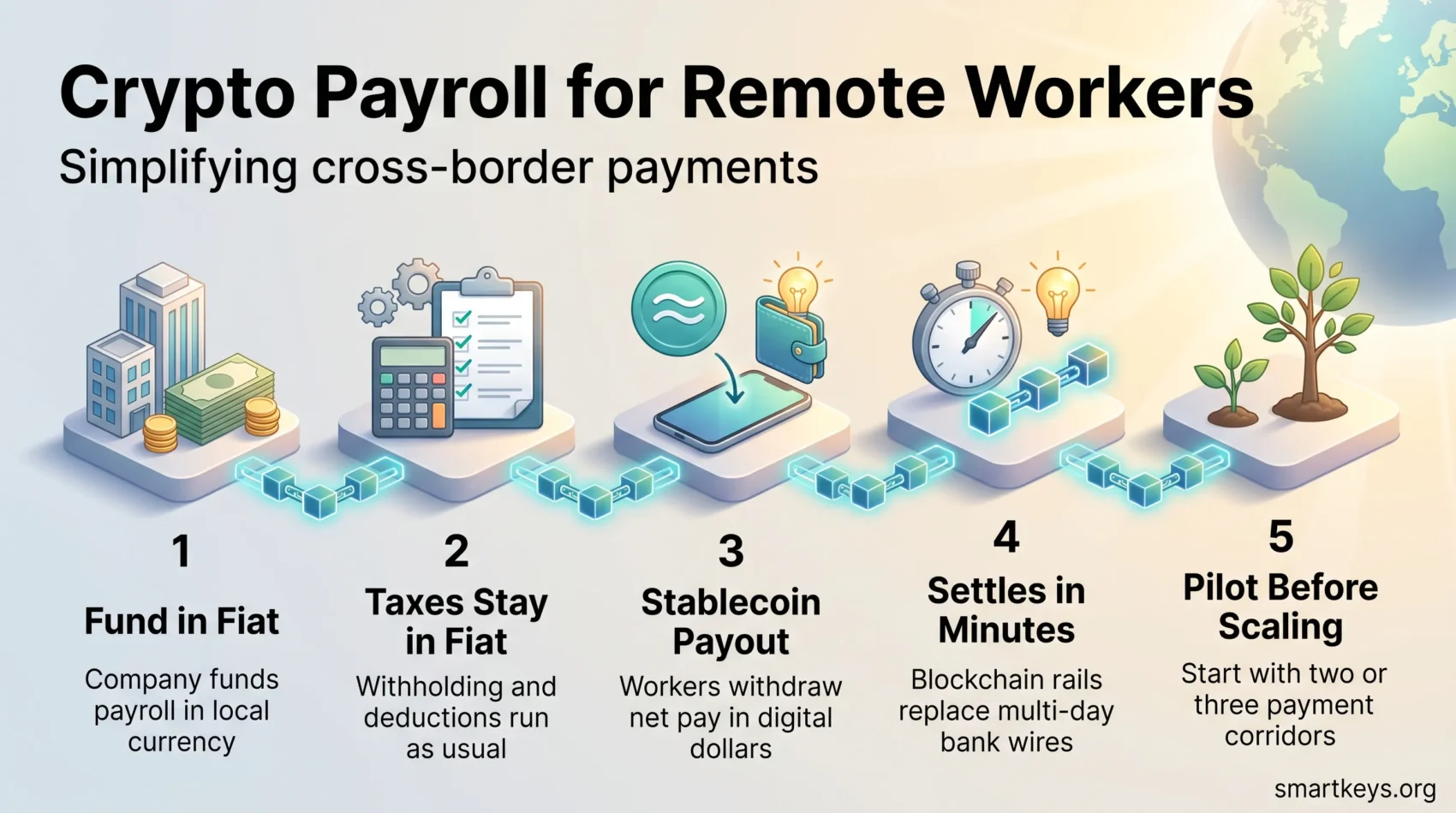
- Hybrid is the default model: fund in fiat, run gross-to-net in fiat, let workers withdraw in stablecoins.
- Pilot before you scale: two or three corridors, measured on settlement time, off-ramp quality, and error rate.
What Crypto Payroll Actually Means in 2026
The term covers four fairly different things, and conflating them is where most implementation problems start.
In practice, a crypto payroll setup in 2026 falls into one of these patterns:
- Fiat in, stablecoin out. The company funds payroll in USD, EUR or GBP and workers choose to withdraw part or all of their net pay in USDC or USDT. This is the dominant model.
- Stablecoin in, fiat out. A crypto-native treasury funds in USDC and workers convert to local currency at the off-ramp.
- Direct contractor settlement. Invoices from freelancers and agencies are paid straight in stablecoins, with no fiat leg at all.
- Fiat-denominated, crypto-routed. Salary stays legally denominated in local currency for employment-law reasons, but part of the transfer moves over blockchain rails for speed.
Why “stablecoin payroll” Is the More Accurate Term
The volatile-asset version of this idea largely lost. Paying someone in Bitcoin means the fiat value of their paycheck depends on the market price at the moment of conversion — which is a fine choice for an individual and a poor one for an employer with wage-protection obligations.
Stablecoins removed that problem, and workers voted accordingly. On one major platform, stablecoin withdrawals exceeded stablecoin deposits by $154.5 million in Q1 2026 alone, meaning people receiving digital dollars are holding them rather than immediately cashing out.
The demand is also less ideological than the headlines suggest. An Argentine developer watching triple-digit inflation, or a Nigerian contractor paying 6% on every inbound transfer, does not need a thesis on decentralisation to prefer digital dollars. This is the same logic that drives interest in digital wallets for work payments more broadly — reduce friction, protect purchasing power.
Where It Fits Alongside Traditional Payroll
Crypto rails almost never replace a payroll system. They sit inside one. You still need gross-to-net calculation, statutory withholding, employment contracts, and local filings — all the machinery covered by conventional global payroll solutions. The crypto layer is a payout preference bolted onto the last mile.
That framing matters when you pitch it internally. “We’re switching to crypto” scares a CFO. “We’re adding a withdrawal option that settles in 90 seconds instead of five days” does not.
Crypto Payroll vs. Traditional Payroll: The Honest Comparison
The differences show up in four places: speed, cost, currency risk, and worker choice.
Speed and Settlement
Correspondent banking moves money in three to seven business days, and only during banking hours in both jurisdictions. Blockchain settlement on networks like Polygon, Base or Arbitrum completes in seconds to a couple of minutes, on weekends and holidays included.
For teams operating across many time zones — a recurring headache for anyone managing cross-border remote teams — that difference shows up as fewer “where is my salary” tickets rather than as a line item.
Total Cost, Not Just Transaction Fees
On-chain transfer fees are trivial; the real cost sits at the edges. A stablecoin transfer might cost cents in gas, but you still pay for the on-ramp, the off-ramp, the FX spread, the platform subscription, and the compliance overhead.
Compare total cost of ownership, not headline fees. The honest version of the savings claim is that crypto rails compress the middle of the transaction while leaving the ends roughly where they were — which is still a meaningful win on corridors where traditional remittance costs run above 6%.
Currency Conversion and FX Exposure
Dollar-pegged stablecoins cut conversion steps out of the chain. Instead of USD → correspondent bank → local currency → worker, you get USD → USDC → worker’s choice of hold or convert. Fewer hops means fewer spreads and less exposure sitting on your balance sheet mid-transfer.
If your company already holds digital assets, coordinate this with your broader crypto treasury management policy rather than treating payroll as a separate pot.
Worker Choice — and Its Limits
Offering fiat, stablecoins, or a split is what drives adoption. Forcing one option is what kills it.
But choice has legal limits. In most jurisdictions, wage-protection law requires that salary be denominated in legal tender, which is why the mainstream products let employees allocate a percentage of net pay after taxes and deductions rather than restructuring gross salary. This is also where global pay parity questions resurface: a worker choosing USDC in a high-inflation market is making a very different decision than one in the Eurozone.
The 2026 Regulatory Picture
This is the section that changed most since the last version of this guide.
United States: the GENIUS Act
The GENIUS Act was signed into law on 18 July 2025 and created the first federal framework for payment stablecoins in the U.S. It establishes a new regulated entity — the Permitted Payment Stablecoin Issuer — and subjects issuers to Bank Secrecy Act obligations, including AML and sanctions compliance programmes.
Throughout 2026 the implementing rulemaking has been running: the OCC issued a comprehensive proposed rule, the FDIC and NCUA published narrower proposals covering issuance through subsidiaries, and FinCEN and OFAC jointly proposed the illicit-finance provisions. The Act takes effect on the earlier of 18 January 2027 or 120 days after final rules are issued.
What this means for you as an employer: you are not the regulated party — your payroll provider and the stablecoin issuer are. Your job is vendor diligence. Ask which issuers a platform supports and whether those issuers are on a path to permitted status.
European Union: MiCA Is Fully Live
MiCA’s transitional period ended on 1 July 2026. Any firm providing crypto-asset services to EU clients without MiCA authorisation is now in breach of EU law, and several member states — Germany, the Netherlands, Ireland, Austria and others — closed their grandfathering windows even earlier.
Practically, that means an EU-facing payroll vendor must either hold a CASP authorisation from a national competent authority (BaFin, AMF, FIN-FSA) and passport it, or partner with someone who does. MiCA also splits stablecoins into e-money tokens pegged to one currency and asset-referenced tokens pegged to a basket, and prohibits paying interest to holders of either — so any “yield on idle payroll balances” feature will look different in the EU than in the U.S.
The European Commission opened a consultation on MiCA’s functioning on 20 May 2026, so expect refinement rather than stability here. Regulatory drift of this kind is exactly what RegTech solutions exist to track.
The Travel Rule
FATF’s 2025 update found that 85 of 117 surveyed jurisdictions — about 73% — had passed legislation implementing the Travel Rule, up from 65 the year before. In plain terms: originator and beneficiary information now travels with the transfer in most markets you’re likely to pay into.
This is good news operationally. It means the identity data your platform collects is standardised rather than bespoke per corridor.
Employment Law Still Rules the Last Mile
None of the above overrides local labour law. Whether crypto can constitute wages, whether it can be mandatory, and how it interacts with minimum wage floors varies sharply by country — a live issue in the broader debate around gig economy regulation. If you employ people directly rather than contracting, get local counsel before you enable a market.
Tax, Accounting, and Reporting
The reporting story shifted from “unclear” to “documented, and therefore auditable.”
Form 1099-DA and Wallet-Level Basis
The IRS introduced Form 1099-DA, Digital Asset Proceeds From Broker Transactions, for transactions on or after 1 January 2025. Brokers had to furnish the first forms by 17 February 2026.
Two details matter for payroll teams:
- Cost basis reporting lags. For tax year 2025, brokers were not required to report basis to the IRS. Basis reporting begins with 2026 transactions, meaning the first forms carrying it arrive in early 2027.
- Stablecoins get a de minimis threshold. Sales of qualifying stablecoins are reported on an aggregated basis once annual proceeds exceed $10,000 — a meaningful simplification versus per-transaction reporting.
Revenue Procedure 2024-28 also requires basis to be tracked at the wallet level. If fair market value is not documented at the moment of payout and the IRS presumes zero basis, the worker faces double taxation and the employer faces exposure on payroll-tax and information-reporting accuracy. Document FMV at payout. Every time.
What Finance Will Ask For
Build the reporting before you build the pilot, not after:
- Gross-to-net by worker, with the fiat-denominated figure as the source of truth.
- Fair market value at the exact payout timestamp, per transaction.
- Itemised fees: platform, on-ramp, network, off-ramp, FX spread.
- On-chain transaction hashes mapped to worker records and invoice numbers.
- Clean separation of employee and contractor reporting streams.
Choose a platform that syncs to your ledger rather than exporting CSVs someone reconciles by hand — the same principle that drives finance automation generally. If you run Xero or QuickBooks Online, confirm the connector posts fee breakdowns as separate lines rather than netting them into one lump.
Blockchain Records Help, But They Aren’t Enough
On-chain records are tamper-evident and timestamped, which auditors like. They are also not a general ledger. You still need internal payroll registers, bank statements, and tax documents reconciled against the chain — the audit trail is a supplement, not a substitute. The same limitation applies to smart contracts in B2B transactions: cryptographic proof of execution is not proof of correct accounting treatment.
Currencies, Stablecoins, and Wallets
Why USDC and USDT Lead
Both are dollar-pegged, deeply liquid, and supported by nearly every off-ramp that matters. USDC held roughly 63% of crypto payroll transaction share in 2025 reporting, with USDT leading worker-side withdrawals in several major non-U.S. markets — a split worth checking against your actual corridors rather than assuming.
Euro-denominated options exist and are growing under MiCA, including Circle’s EURC and Société Générale FORGE’s EURCV, though EU payroll adoption remains early.
When Bitcoin or Ethereum Make Sense
Offer them as an opt-in for workers who specifically want that exposure. Keep the default in stablecoins and set a cap on volatile-asset allocation so a market swing never becomes a wage dispute. For context on the broader corporate use case, see how cryptocurrencies affect global business transactions.
Chains and Wallets
Ethereum mainnet is universally supported but expensive. Most platforms default to Polygon or Base for cost reasons; Arbitrum, Optimism and Solana are widely available. Visa added Polygon to its stablecoin settlement pilot in April 2026, alongside Base and several newer networks.
On custody, match the wallet to the job:
- Hot wallets for operational payout speed, with strict spending limits.
- Cold storage for treasury reserves that don’t move weekly.
- Multi-signature for approval control on anything above a threshold you define.
Standardise which currencies, chains and wallet types are available per country. Ad-hoc exceptions are how funds get stuck.
Security, Compliance, and Risk Management
The controls are not exotic — they’re the same ones you’d demand of any payroll vendor, plus custody.
Certifications and Data Protection
SOC 2 and GDPR alignment are table stakes for anything storing employee records. Require multi-factor authentication, encryption in transit and at rest, and a documented incident response process. Check how the vendor’s data handling maps to your obligations under evolving data privacy regulations, particularly if you’re processing EU employee data.
The endpoint side matters too: a payroll platform is only as secure as the laptops your finance team logs in from, which is why cybersecurity for remote work belongs in the same conversation.
KYC/AML and Identity
Robust identity verification speeds onboarding and keeps you defensible across jurisdictions. Verifiable credentials and decentralized identity approaches are increasingly used to supplement traditional checks, though they don’t replace jurisdictional KYC obligations.
A broader point on why this infrastructure is trustworthy at all: the transparency and verification properties that make blockchain useful for securing remote work are the same ones that make payroll auditable on-chain.
Treasury Policy and Volatility
- Define which stablecoins you hold, in what proportion, and when you convert.
- Set rebalancing thresholds and dual-approval controls for anything above them.
- Document every movement with a business reason, not just a hash.
- Assess issuer concentration risk — holding one stablecoin exclusively is a single point of failure.
The Platform Landscape in 2026
The market split into native providers and HR platforms adding rails, and the difference shows up in edge cases.
Native Providers
Bitwage has run crypto payroll since 2014 and has paid 90,000+ workers across 4,500+ companies. Rise built modern native infrastructure in 2022 and has processed roughly $1.37 billion in lifetime payroll volume, with more than half of it in the trailing twelve months — settlement typically completes in 15 to 90 seconds across five networks, covering 190+ countries. Toku positions itself as an integration layer for companies that already have a payroll system and want to bolt on stablecoin support.
HR Platforms Adding Rails
Deel announced a stablecoin payout partnership with MoonPay’s Iron infrastructure on 10 February 2026, rolling out to UK and EU workers from March. On 20 May 2026 it launched stablecoin salary payouts on Polygon for full-time employees in the U.S. and Eurozone, where employees allocate a share of net salary after taxes and deductions. In June 2026 Deel introduced DLUSD, its own USD-backed stablecoin, with early access in Argentina — where roughly 85% of its contractors prefer dollar-denominated payment. Remote launched via Stripe in December 2024; Toku and Papaya followed in early 2026.
What to Actually Compare
- Off-ramp quality per corridor. The single biggest differentiator, and the one vendors talk about least.
- Token support. USDC-only versus native USDC and USDT — check against where your workers actually are.
- W-2 and statutory filing capability if you employ rather than contract.
- Licensing footprint: money transmitter coverage in the U.S., CASP authorisation in the EU.
- Fee transparency at the line-item level, including FX spread.
- Support SLAs with people who understand both payroll and wallet operations.
“The strongest part of stablecoin payroll is also its hardest operational requirement: getting money out cleanly, in every market you operate in.”
Onboarding and Managing Global Contractors
Clean handoffs at onboarding prevent most downstream payment errors.
Capture identity documents, contracts, tax forms and wallet preferences in one pass. Verify wallet addresses with a small test transaction before the first real payout — an irreversible transfer to a mistyped address is not recoverable.
- Record whether each wallet is custodial or self-custody; the support burden differs enormously.
- State payment currency, timing, fee responsibility and tax responsibility in the contract itself.
- Communicate exchange rates and fees before the run, not after.
- Validate the platform’s rails and chain support for a market before you onboard at scale there.
Keep employee and contractor documentation strictly separate — the reporting obligations diverge, and mixing them is a classification risk. If contractors make up a large share of your workforce, the practices in managing freelancers and sourcing through freelance talent platforms apply directly here.
For employees who relocate, tie payout eligibility to your digital nomad policy so that tax residency and payment method stay in sync.
How to Evaluate and Implement
Scope Before You Shortlist
List the countries and currencies you must support, then the regulatory constraints in each. Most vendor demos look identical until you test them against your actual footprint — and that’s where half the shortlist falls away.
Document three things per market: whether crypto payout is legally permissible for your worker classification, whether the vendor has coverage there, and what the off-ramp actually looks like for a worker on the ground.
Run a Narrow Pilot
Pick two or three corridors, ideally including one high-friction market where the benefit is obvious. Run parallel with your existing process for at least two cycles.
Measure:
- Settlement time from initiation to worker-confirmed receipt.
- All-in cost per payment versus your current rail.
- Failed or delayed transaction rate.
- Support tickets per 100 payments.
- Reconciliation time at month-end.
Then Scale Deliberately
Phase currency and country enablement rather than switching everything at once. Train payroll and finance staff on the wallet mechanics before go-live, and give workers plain-language documentation covering withdrawal, fees, and tax responsibility.
Expect adoption to be uneven. In some markets nobody will opt in; in others it will be the majority within two cycles. Both outcomes are fine. This is closer to the pattern seen across embedded finance generally — the rail succeeds where it solves a real local problem, and quietly goes unused where it doesn’t.
“Pilot, measure, and scale with clear treasury and compliance guardrails.”
Conclusion
Crypto payroll in 2026 is less dramatic and more useful than the 2024 version of the story suggested. It didn’t replace payroll systems. It became a settlement layer inside them.
The practical takeaway: fund in fiat, keep salary denominated in legal tender, and offer stablecoin withdrawal as a net-pay option for workers who want it. Choose a provider with real licensing coverage in your markets, insist on line-item fee transparency, and document fair market value at every payout.
Start with two corridors. Measure settlement time, off-ramp friction and reconciliation effort for two cycles. If the numbers hold, expand. If they don’t, you’ve spent a quarter learning something concrete about your payment stack — which is more than most payroll modernisation projects deliver. For the wider context on where this is heading, our overview of how DeFi is changing business transactions covers the infrastructure layer underneath.
Found this useful?
Make SmartKeys a preferred source on Google, and our articles will surface more often in your Top Stories, AI Overviews, and AI Mode.
Add as Preferred Source