Blockchain is a shared record that many computers keep at once. Every entry is copied across the network, and once an entry is confirmed, changing it later means changing every copy at the same time. That single property, records that are hard to alter quietly, is the reason the technology keeps coming up in conversations about remote work security.
Remote work is no longer an experiment that needs defending. Stanford’s Survey of Working Arrangements and Attitudes found that about 25% of paid days in the United States in May 2026 were worked from home. Company data now sits on home routers, personal laptops and hotel Wi-Fi. This guide looks at where blockchain genuinely helps a distributed team, where the claims fall apart, and what European regulators decided in 2026 that changes the answer.
Key Takeaways
- Blockchain’s real strength for remote teams is tamper-evident records, not general security.
- The EU data protection board finalised guidance in July 2026: keep personal data off the chain.
- Credential checks and cross-border payment are the two use cases with the clearest payoff.
- Smart contracts automate payment on agreed conditions, which suits freelance work well.
- For most small remote teams, ordinary access controls deliver more security per euro spent.
Why Remote Teams Started Looking at Blockchain
Distributed teams create a specific problem. When nobody shares an office, you cannot verify anything by walking over to a colleague’s desk. You are trusting records: that the contractor holds the certificate they claim, that the invoice matches the work, that the file was not altered after approval.
Most companies solve this with a central system. One server holds the truth, and everyone trusts the company that runs it. That works until the server is breached, the vendor goes out of business, or two parties in different countries disagree about whose records count.
Blockchain offers a different answer. Instead of one trusted keeper, the record is held by many parties at once, and each entry is chained to the one before it. Alter an old entry and the chain breaks visibly. That is genuinely useful for a narrow set of problems. It is not a replacement for the security basics that protect a remote workforce day to day.
Understanding Blockchain Basics
A blockchain stores data in batches called blocks. Each block holds a set of entries, a timestamp, and a fingerprint of the block before it. That fingerprint is a cryptographic hash: a short code calculated from the block’s contents. Bitcoin, for example, uses a hash function called SHA-256. The hash is what links the blocks into a chain. Change anything in an old block and its fingerprint changes, which breaks every block that follows.

The network agrees on which blocks are valid through a process called consensus. Public networks such as Bitcoin and Ethereum let anyone join and pay participants to do this work. Bitcoin uses proof of work, where computers compete to solve an expensive puzzle. Ethereum switched to proof of stake in 2022, where participants lock up their own funds as a guarantee of honest behaviour. Private, permissioned networks limit membership to known organisations, which is the model almost every business project actually uses.
That distinction matters more than most articles admit. A public chain gives you openness and censorship resistance, which few companies need. A permissioned chain gives you control over who sees what, which most companies do need. If you are evaluating a vendor and they cannot tell you which model their product uses, that is your first question. Our overview of blockchain adoption in business covers where each model has found real footing.
One more term is worth learning. A smart contract is a small program stored on the chain that runs automatically when its conditions are met. It is not a legal contract. It is code that moves value or updates a record without waiting for a person to approve the step.
What Blockchain Actually Changes for Distributed Teams
Strip away the marketing and three benefits hold up.
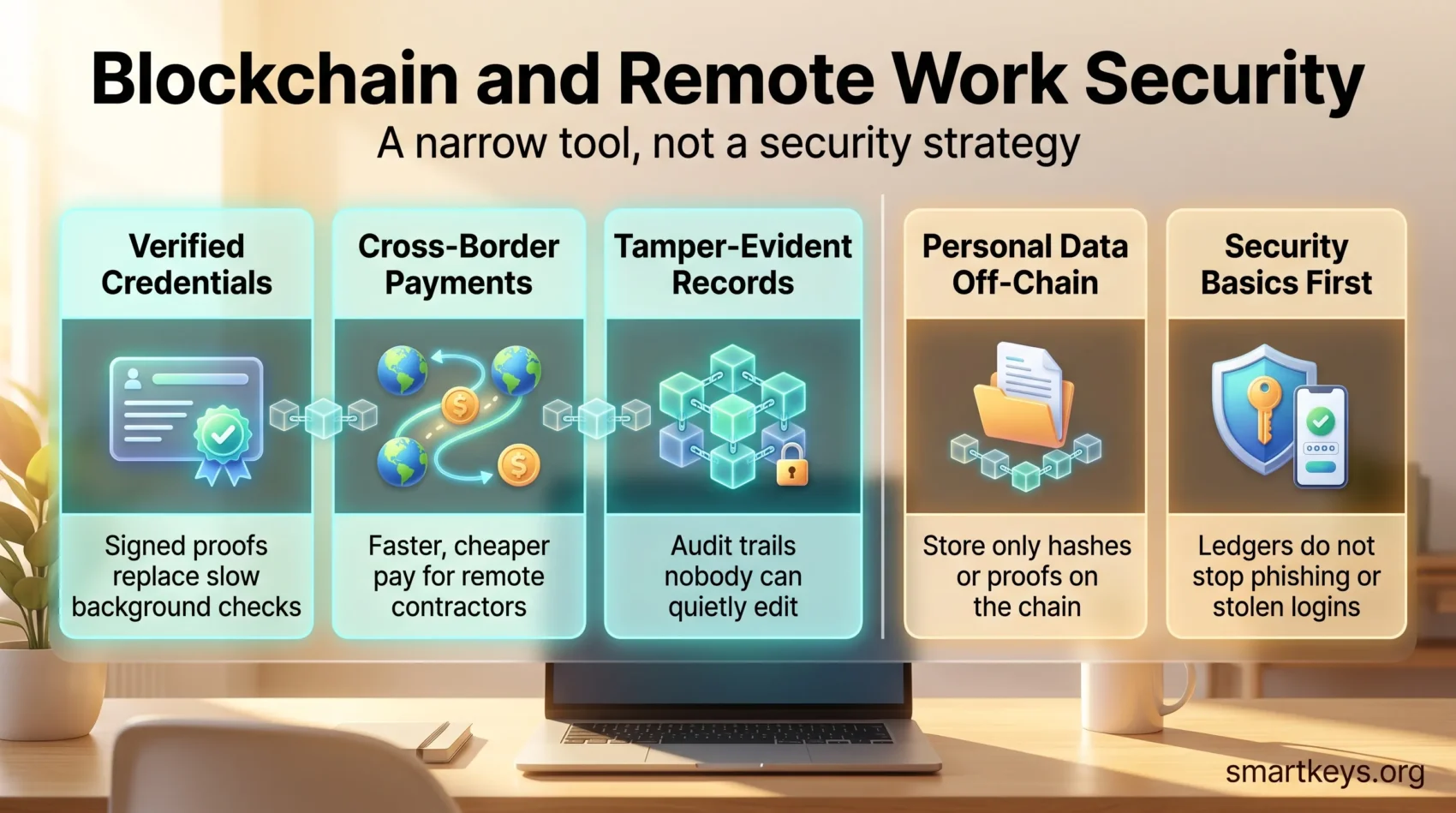
Tamper-evident audit trails. If your approval log lives on a permissioned chain, nobody can quietly backdate an entry. In a regulated industry that has to prove who signed off on what, that is worth something concrete. A finance team can show an auditor that the approval sequence has not been edited after the fact.
Automation without a middleman. A smart contract can release payment the moment a delivery is confirmed, rather than routing through an accounts payable queue. For freelancers working across borders, this removes days of waiting. Our guide to smart contracts in business transactions explains how the mechanics work in practice.
Portable proof. A credential issued as a cryptographically signed record travels with the person. A new employer can verify it without calling the issuing university, which is slow and often impossible across time zones.
Now the honest limits. Blockchain does not stop phishing, which is how most breaches actually start. It does not secure an employee’s laptop. It does not prevent a contractor from pasting confidential text into a public chatbot. If your remote security programme has gaps in access control and device management, a distributed ledger fixes none of them. A zero-trust approach, where every request is verified regardless of where it comes from, addresses far more of the real risk surface.
Two controls often turn up in blockchain sales pitches even though neither needs a ledger. Multi-factor authentication asks for a second proof, such as a code on your phone, before granting access. End-to-end encryption keeps a message readable only by its sender and recipient. Every remote team should have both, with or without blockchain. IBM’s Cost of a Data Breach Report 2026 puts the global average cost of a breach at 4.99 million US dollars, a record high, which shows what is at stake when the basics are missing.
There is also a cost most vendors gloss over. Running a permissioned network means running infrastructure, agreeing governance with other members, and maintaining integrations. That overhead is justified when several organisations that do not fully trust each other need a shared record. It is rarely justified inside a single company.
Enhancing Cybersecurity with Blockchain
The security case for blockchain is narrower than the marketing suggests, but it is real in specific places.
The Role of Tamper-Evident Ledgers
The word usually used is “immutable”, which overstates things. A blockchain record is not literally unchangeable; it is expensive and visible to change. That is the useful property. If someone edits a historical entry, the chain no longer validates, and every participant can see it.
For a remote team, the practical application is logging. Access logs, document version histories and approval chains stored this way become evidence rather than assertion. When an incident happens six months later, you can show what the record said at the time, and nobody has to take your word for it.
Where It Does Not Help
Blockchain protects the integrity of what was written. It does nothing about whether what was written was true in the first place. If a compromised account submits a fraudulent entry, the chain will faithfully preserve that fraud forever.
It also does not protect confidentiality by itself. Data on a shared ledger is visible to everyone on that ledger. Keeping it private requires encryption or off-chain storage, which brings back the key management problem you were trying to escape.
The network itself can be attacked, too. On a chain with few validators, anyone who controls more than half of the validating power can rewrite recent history. This is called a 51% attack, and smaller public networks such as Ethereum Classic have suffered it. The private keys that sign entries can also be phished like any password, so the weakest point is still the person holding them. Permissioned networks reduce the first risk by limiting who can validate; nothing on the chain removes the second. Our overview of cybersecurity trends puts these controls in context.
Smart Contracts and Getting Paid on Time
Payment is where distributed ledgers have found the clearest product-market fit for remote work, and the reason is unglamorous. Traditional cross-border transfers are slow and expensive.
Automating Contract Management
A smart contract executes when its conditions are satisfied. A freelancer submits deliverables, a client or an automated check confirms receipt, and payment releases without an invoice sitting in a queue.
The benefit is predictability rather than speed alone. Both sides can see the rule before the work starts. That removes a common source of friction in freelance relationships, where payment terms are agreed verbally and remembered differently later. Platforms that connect companies with freelance talent increasingly build this logic in.
Two cautions. Code that runs automatically also fails automatically, and a bug in a deployed contract can be difficult to fix. Any contract that moves real money should be reviewed by an independent auditor before launch and again after every change. And a smart contract is not enforceable on its own; you still need a written agreement that a court would recognise.
Cross-Border Payment and Stablecoins
This is where the numbers get interesting. Moody’s Ratings puts the cost of settling a cross-border transaction in stablecoins, which are tokens designed to hold a steady value against a currency such as the dollar, at roughly 0.1% to 0.5% of the transaction value. Average remittance costs sit above 6%. For a company paying dozens of contractors in different countries every month, that gap is material.
Regulation caught up in 2025. The United States passed the GENIUS Act, signed into law on 18 July 2025, which created a federal framework for payment stablecoins. The EU’s MiCA rules cover the same ground in Europe. Both mean a business can now use regulated stablecoin rails without operating in a legal grey zone.
That does not make it simple. Tax treatment, payroll compliance and currency reporting still apply in every country where you have a worker. Our guide to crypto payroll for remote workers goes through what that involves, and digital wallets in work payments covers the wider shift in how staff get paid.
Building Trust with Transparency
Trust in a remote team is mostly a management problem, not a technical one. It is worth saying plainly, because blockchain is often sold as a fix for something it cannot reach.
Shared Records and Accountability
What a shared, tamper-evident record does provide is a single version of events that no party controls alone. In a joint venture, an agency relationship or a supply chain, that removes a recurring argument about whose spreadsheet is correct.
Inside one company, the same effect is usually achieved with ordinary permissions and audit logging at a fraction of the cost. The honest test is whether the parties involved have a reason to distrust each other’s records. If they do not, you are buying a solution to a problem you do not have. Building digital trust in remote teams starts with clear policies, not with infrastructure.
Project Management and Clear Expectations
Transparent goal setting, visible progress and consistent feedback do more for a distributed team than any ledger. Give people the tools and the context to do the work, then track outcomes rather than activity. Our guide to how remote work reshaped the workplace covers the practices that hold up.
Credentials, Hiring and HR Records
Verifying qualifications is slow and gets slower when the candidate, the employer and the issuing institution sit in three countries. This is the HR use case with a genuine future, and it is already moving.
The mechanism is a verifiable credential: a digitally signed statement from an issuer, such as a university or a certification body, that the holder keeps and can present to anyone. The verifier checks the signature against the issuer’s public key. No phone call, no waiting, and the chain itself only holds a proof rather than the person’s data.
Europe has put a deadline on it. Under Regulation (EU) 2024/1183, the eIDAS 2.0 framework, every member state must offer citizens an EU Digital Identity Wallet by the end of 2026. That wallet is designed to hold exactly this kind of credential. Acceptance obligations for relying parties are phased in afterwards, starting with very large online platforms.
The practical effect for hiring is that credential verification becomes a routine check rather than a project. Our articles on decentralized identity, blockchain HR records and micro-credentials in hiring go deeper on each piece.
One warning. Verified credentials confirm that a claim came from a real issuer. They say nothing about whether the person can do the job. Screening still matters, and the legal duties around automated screening are tightening, as our guide to AI hiring tools sets out.
Decentralized Applications in Daily Work
Decentralized applications, usually shortened to DApps, run their core logic on a blockchain rather than on a company’s server. In remote work they show up as payment tools, shared storage and collaborative workspaces.
Storage is the most mature category. Decentralized storage splits an encrypted file across many nodes, so no single provider holds the whole thing. That removes one point of failure, though it introduces others: retrieval can be slower, and if you lose your keys, the file is gone permanently.
Collaboration DApps remain immature. Teams that adopt them usually do so for governance reasons, not because the software is better. If your priority is getting work done, the mainstream tools in our guide to remote work productivity will serve you better. For people building a location-independent career, the practical constraints are covered in our guide to digital nomad visas.
Compliance: What Changed in 2026
This section used to be the easy part of any blockchain article. It is now the hardest, and anyone selling you a ledger for compliance reasons should be asked about it directly.

The European Data Protection Board finalised its Guidelines 02/2025 on processing personal data through blockchain technologies in July 2026, after a public consultation the previous year. The conclusions cut against the usual sales pitch.
Personal data should stay off the chain. The EDPB’s recommendation is that only hashes or proofs go on-chain, with the underlying data held elsewhere where it can be corrected or deleted. Encrypting data does not remove it from GDPR’s scope; encrypted personal data is still personal data. Organisations must run a Data Protection Impact Assessment before processing personal data this way where the risk is high. And because a blockchain blurs who is a controller and who is a processor, governance has to be agreed in writing before launch, not after.
The board also asks a blunt question: is blockchain the appropriate technology here, or would a conventional database serve the purpose with fewer rights problems? For most workforce data, the honest answer is the database. Where a ledger is used, the EDPB points towards private, permissioned networks rather than public ones.
None of this makes blockchain unusable in Europe. It does mean the design has to put personal data off-chain from day one, because retrofitting is close to impossible once entries are written. Our guide to the 2026 rules for employee data covers the surrounding obligations.
What to Expect Next
Three developments are worth watching, and none of them requires believing that blockchain transforms work.
Digital identity becomes infrastructure. The EU wallet deadline at the end of 2026 will push verifiable credentials into ordinary hiring and onboarding, whether or not anyone calls it blockchain. Employers hiring across borders will feel this first, as our guide to managing cross-border teams discusses.
Stablecoin payment rails mature. With US and EU frameworks now in place, paying contractors this way moves from novel to available. Adoption will follow the cost gap, which is largest for small, frequent, cross-border payments. That fits the on-demand hiring model more than it fits salaried staff.
Ledger use gets quieter and narrower. The visible successes are in supply chain documentation and trade finance, where several companies that do not trust each other need one record. Our piece on blockchain in logistics tracks that. Inside a single company, expect blockchain to disappear into the plumbing of specific products rather than appear as a strategy.
Conclusion
Blockchain is a useful tool with a narrow blade. For remote teams, it earns its place in three jobs: proving a credential is genuine, moving money across borders cheaply, and keeping a shared record that no single party can quietly edit.
It is not a security strategy. The threats that actually hit distributed teams are stolen credentials, unpatched devices and social engineering, and a ledger addresses none of them. Spend on access control and device management first.
If you are evaluating a blockchain product for your remote workforce, ask three questions. What specifically would break if you used a normal database? Where does personal data live, and can it be deleted? Who governs the network, and what happens if that vendor disappears? A product worth buying has clear answers to all three.
Found this useful?
Make SmartKeys a preferred source on Google, and our articles will surface more often in your Top Stories, AI Overviews, and AI Mode.
Add as Preferred Source