Every time you open an account, you send a company a copy of your passport, your address or your payslip. That company stores the copy. So does the next one. Ten sign-ups later, ten databases hold the same sensitive file, and each one is a place it can leak from.
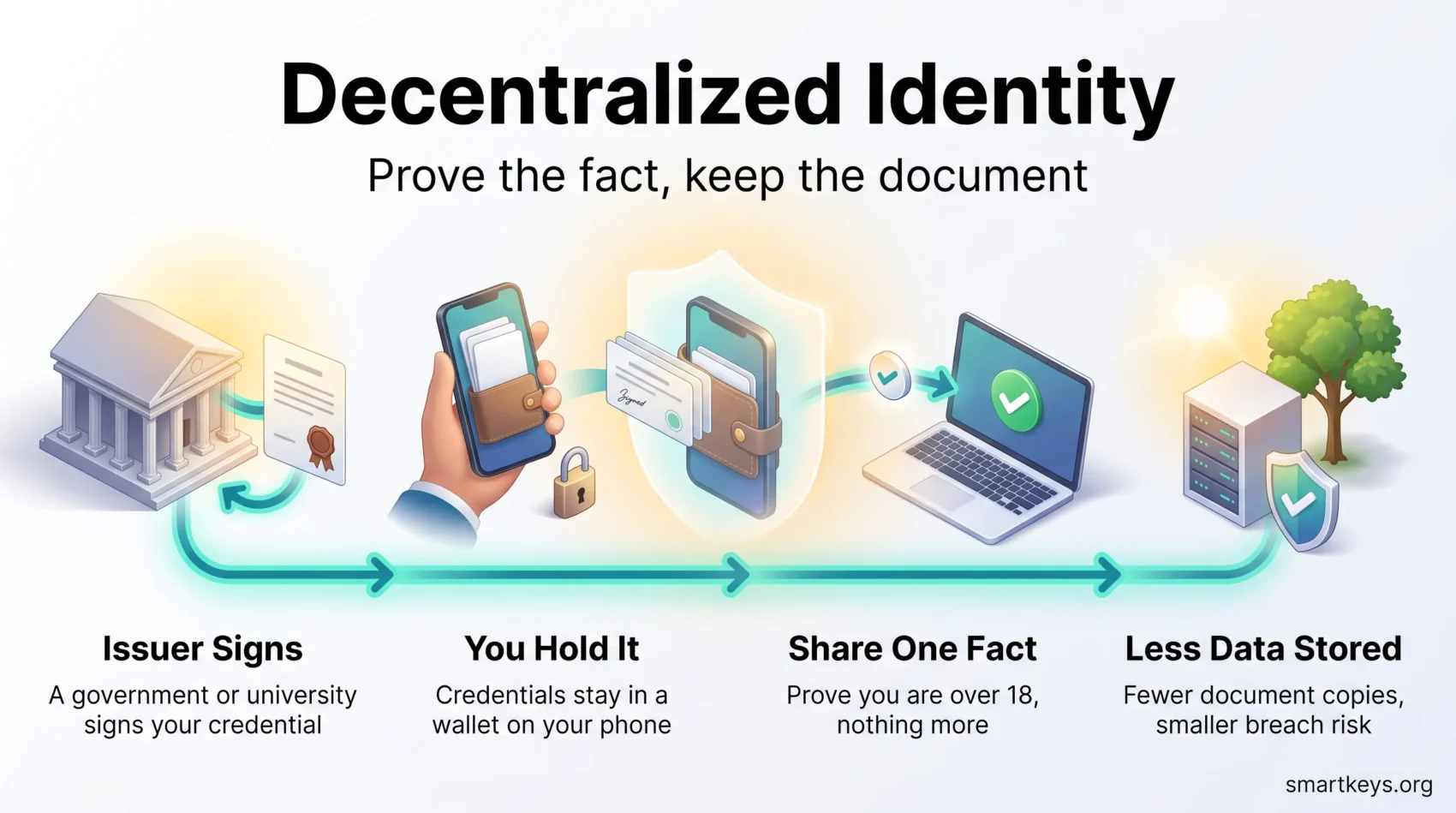
Decentralized identity turns that around. Your official documents are issued to you as signed digital records, you keep them in an app on your phone, and you prove single facts on demand. A bar learns that you are over 18. It never learns your birthday, your address or your licence number.
This is no longer a research topic. The core specifications are finished, the European Union set a legal deadline for national identity wallets, and more than twenty US states already issue a digital driving licence. This guide explains how the pieces fit together, what they change for customer onboarding, and where the model still falls short.
Key Takeaways
- You hold your credentials yourself, so a breach at one company exposes far less.
- Verifiable credentials let you prove a single fact without handing over the whole document.
- Reusable proofs cut sign-up friction and shorten manual identity checks.
- A blockchain is optional. It is useful for looking up keys, not for storing personal data.
- Adoption is real but uneven: strong in the EU and UK public sector, patchy elsewhere.
Why the Current Model Is Breaking Down
The problem is not that identity checks exist. The problem is that every check leaves a permanent copy of your documents somewhere you cannot see.
Central stores are a standing target
When one company holds millions of identity files, attackers only need one way in. Stolen documents then get reused: the same passport scan can be replayed at dozens of other services.
The forgery side has moved fast. In its 2026 Identity Fraud Report, drawn from more than a billion identity checks, Entrust found that injection attacks rose 40% year over year. An injection attack means feeding a prepared image or video straight into the verification system instead of holding a real face to a camera. Entrust also reports that deepfakes account for roughly one in five attempts to fool a biometric check.
That matters here. A photo of a document is only as good as the software judging it. A signed credential either verifies or it does not, which is far harder to fake. Our overview of current cybersecurity trends covers how attack patterns are shifting.
Repeated checks, and no visibility for the user
You upload the same documents again and again. You have no way to see who still holds them, or for how long. Rules such as the GDPR in Europe and the CCPA in California push companies to collect less and delete sooner, but proving that you did so is expensive when the data sits in five systems.
The result is friction on both sides. Customers abandon sign-up flows. Compliance teams spend their time on retention schedules instead of risk. Our guide to a privacy compliance framework works through those obligations, and our summary of data privacy trends tracks where the rules are heading.
What Decentralized Identity Actually Means
Three ideas do most of the work. Learn these and the rest follows.
A decentralized identifier, usually shortened to DID, is an address for you that no single company owns or can switch off. It is a string of characters that points to a small public record containing your public keys. Anyone can look it up to check a signature you made.
A verifiable credential is a digital document signed by whoever issued it: your government, your university, your bank. The signature makes it tamper evident. Change one character and the signature no longer matches.
An identity wallet is the app that holds both. It stores your credentials, asks for your consent before sharing anything, and builds the proof it sends out.
What changes for you
You decide what leaves your phone and when. You can withdraw consent. You are not locked to one login provider, because the credential works anywhere the issuer is trusted.
For the company on the other side, the shift is just as practical. It verifies a signature rather than storing a scan. That reduces what it has to protect and what it has to explain to a regulator later. The same logic drives the wider push for digital trust between people and organizations.
The Building Blocks: Identifiers, Credentials, Wallets and Roles
Decentralized identifiers
DIDs are defined by the W3C, the body that sets web standards. Decentralized Identifiers v1.0 became an official W3C Recommendation in 2022, which means the format is stable and different vendors can implement it the same way.
A DID resolves to a DID document. That document holds public keys and service endpoints, never personal data. Think of it as a nameplate, not a file.
Verifiable credentials
The W3C published the Verifiable Credentials 2.0 family of specifications as a Recommendation on 15 May 2025. This is the piece that had been missing for interoperability: a common way to express a signed claim so that a wallet built by one company can present a credential to a verifier built by another.
A credential can say anything an issuer is willing to attest: date of birth, professional licence, employment status, degree awarded. Each one can be revoked, unlike a laminated card.
Identity wallets
The wallet encrypts what it stores, usually locks behind your device biometrics, and prompts you before every share. Good wallets show a plain-language summary of exactly which attributes a verifier is asking for.
Wallets also handle backup and recovery, the hardest part of the user experience.
Three roles, one flow
- Issuer: signs a credential and gives it to you. Example: a university issues a diploma.
- Holder: that is you. You store the credential and choose when to present it.
- Verifier: checks the signature and the revocation status. Example: an employer confirming the diploma is genuine.
Notice what is missing. The verifier never has to call the university. It checks the maths instead, which is why this works across borders and outside office hours.
How It Works in Practice
From issuance to presentation
The lifecycle has four steps. An issuer signs a credential and sends it to your wallet. You store it. A verifier requests proof of something. Your wallet builds a response and you approve it.
The verifier then checks two things: that the signature matches the issuer’s public key, and that the credential has not been revoked. Both take milliseconds.
Selective disclosure and zero-knowledge proofs
Selective disclosure means sharing one field instead of the whole document. Your driving licence contains a dozen attributes. A car rental desk needs two of them.
A zero-knowledge proof goes further. It proves a statement is true without revealing the underlying value. Your wallet can prove “this person is over 21” without transmitting the date of birth at all. Age checks are the obvious use, but the same technique works for income thresholds, residency and membership.
Verification with and without a blockchain
Plenty of deployments use no blockchain whatsoever. Public keys can live on a normal web server under a domain the issuer controls, and revocation can be published as an ordinary status list. That is how much of the European wallet work is being built.
Where a distributed ledger helps is neutrality: no single company can quietly change or remove an entry. Where it does not help is storage. Personal data must never go on a ledger, because a ledger cannot forget, and the right to erasure is not optional in Europe.
“Use the ledger for discovery and status, not for storing personal documents.”
Where Blockchain Fits, and Where It Does Not
A public ledger makes a reasonable directory. It is tamper evident, it has no single owner, and it stays reachable when one vendor has an outage. Those are genuine properties, and they explain why so much early work in this field grew out of blockchain projects in business.
They are also narrow properties. The ledger holds public keys, revocation lists and schema definitions. It does not hold your passport. Any design that puts personal data on chain will not survive a data protection review.
The same discipline shows up in other regulated uses of distributed ledgers, including the settlement and contract work covered in our guide to decentralized finance in business transactions.
Centralized and Decentralized: The Honest Trade-Offs
Single sign-on, where one account logs you into many services, is genuinely convenient. It is also why so many companies still choose it.
The cost is concentration. One provider holds the keys to everything, so an outage locks users out of unrelated systems and a breach reaches further than it should. You also get no say in what that provider records about your logins.
Decentralized identity reverses both sides of that trade. You gain control and the company stores less. In exchange, users learn a new habit, and recovery becomes something you plan for rather than something a helpdesk fixes.
Most organizations will run both for years. Federated login for low-risk access, verifiable credentials for anything that needs real assurance. That hybrid is the realistic path, not a clean switchover.
What This Does for Customer Onboarding
Passwordless sign-up and faster KYC
KYC, short for know your customer, is the identity check regulated firms must run before opening an account. Today that usually means uploading a document photo and waiting.
With reusable credentials, a customer who has already been verified once can present a signed proof instead. A bank can accept a proof of address issued by a utility rather than asking for a fresh PDF. Onboarding drops from days to minutes for the cases that qualify. The compliance automation angle is covered in our piece on RegTech solutions.
Fewer manual checks, less fraud
Reviewing document images is slow and it does not scale. Checking a signature does both well.
Signed credentials also close off the most common forgery routes. A fabricated document has no valid issuer signature. A stolen credential can be revoked. Neither defence removes the need for liveness checks and fraud monitoring, especially given the injection attack numbers above, but it raises the floor considerably.
Less data to store, less to defend
The quiet win is what you stop keeping. If you verify a proof and retain only the result, there is no document archive to secure, classify or delete on schedule.
That aligns neatly with data minimization requirements, and it simplifies the cross-border picture too, since fewer copies means fewer places where data localization laws apply. Getting the retention rules right in the first place is a governance job, which our guide to a data governance strategy works through.
Security and Privacy Gains You Can Measure
Vague claims about being “more secure” are no use to a budget holder. These are the things you can count.
- Records held: how many identity documents your systems still store after the change. Lower is the point.
- Time to verify: median minutes from sign-up to approved account.
- Manual review rate: the share of applications a human has to open.
- Fraud rate at onboarding: confirmed fraudulent accounts per thousand approvals.
- Password reset volume: a decent proxy for how much credential friction you removed.
The approach also fits a zero trust posture, where every request is verified rather than trusted because of where it came from. A signed proof presented per transaction is exactly the kind of fresh evidence that model asks for, and it composes well with a distributed cybersecurity mesh architecture.
Two caveats are worth stating plainly. First, none of this removes the need for session monitoring and anomaly detection. Second, the cryptography behind today’s credentials will eventually need replacing, which is why quantum-safe encryption planning belongs in the same roadmap.
Use Cases Across Industries
Finance
Reusable KYC proofs shorten account opening and cut repeat checks across a banking group. Verified counterparty credentials also help in payments, an area already moving toward device-held identity as our review of biometric payment systems describes. Bank-to-bank data sharing under open banking raises the same consent questions and is heading in a similar direction.
Healthcare
Patients can grant a clinic access to a record rather than emailing a copy of it. A referral becomes a permission, not a duplicate file. That reduces the number of systems holding sensitive records, a persistent weak point in the sector, as our look at HealthTech trends notes.
Education and hiring
Universities can issue signed diplomas that an employer verifies in seconds. Background screening gets faster and cheaper, and forged qualifications become much harder to pass off.
Recruiters should be careful here. Faster verification is not the same as fairer selection, and automated screening carries its own risks, which we cover in our piece on AI hiring bias.
Government and travel
This is where the public deployments are. National wallets, digital driving licences and border checks all follow the same pattern: prove the claim, do not hand over the document.
Retail and connected devices
Age-restricted sales work well with zero-knowledge proofs, since the shop never needs the date of birth. Loyalty schemes can be built on customer-supplied attributes rather than tracking, which is the same logic behind zero-party data and a first-party data strategy.
Machines get identities too. Each sensor or gateway can hold its own identifier instead of a shared device password. Workplace access is moving the same way, as our overview of biometric authentication at work shows.
Where Adoption Really Stands in 2026
The standards are finished
The two specifications that mattered are now stable: DIDs v1.0 as a W3C Recommendation since 2022, and the Verifiable Credentials 2.0 family since 15 May 2025. Vendors can build against a fixed target, which is what unblocked the procurement side.
Europe is on a legal deadline
Under the revised eIDAS regulation, often called eIDAS 2.0, every EU member state has to make at least one certified digital identity wallet available to its citizens by December 2026. Large online platforms will have to accept it.
Progress is uneven. Denmark moved a national wallet into production during 2026, and countries including France and Germany have opened test environments so that companies can try out wallet-based verification. Many other member states are still at the pilot stage, and industry trackers expect parts of the ecosystem to arrive later than the headline date.
The UK is building a government wallet
The GOV.UK Wallet launched with a digital veteran card in October 2025 and ran a limited digital driving licence trial in December 2025. A wider rollout of the digital driving licence is planned across England, Wales and Scotland, with the stated goal of making government credentials available in the wallet by 2027.
The US route runs through the states
There is no federal wallet. Instead, individual states issue mobile driver’s licences, generally called mDLs, that live in Apple Wallet, Google Wallet or a state app. More than twenty states plus Puerto Rico now issue one. Acceptance is the harder half: an mDL is only useful where a verifier is set up to read it, and that coverage is still thin outside airports and some retail.
Enterprise tools exist too
Microsoft Entra Verified ID is the most visible commercial example, used for cases such as employee onboarding and helpdesk verification. It shows the pattern works inside a company even before the public infrastructure is finished.
What still gets in the way
- Recovery: losing a phone must not mean losing your credentials. Backup and social recovery designs are improving but are not yet uniform.
- Verifier coverage: a credential is worthless if nobody accepts it. This is the real bottleneck.
- Governance: someone has to decide which issuers are trusted, and publish that list.
- User understanding: people are used to logins, not wallets. Onboarding has to teach without lecturing.
- Workplace boundaries: stronger identity signals can slide into surveillance, a line we examine in our piece on AI in employee monitoring.
How to Start
You do not need a strategy document to begin. You need one painful verification: the check with the longest queue, the highest drop-off or the most manual review.
Work out which fact you are actually trying to establish, then test whether a signed credential could establish it instead. Choose tools that follow the W3C specifications rather than a vendor’s own format, pilot with a small group, and keep the old path running alongside it.
Conclusion
Decentralized identity is a straightforward trade. Companies stop hoarding copies of documents. People start proving facts instead of surrendering files. Both sides are better off, because the data that never gets stored cannot be stolen.
The technical groundwork is done, and the public infrastructure is arriving on a schedule rather than a hope. The open question is acceptance: how many verifiers will be ready to read a credential when a customer offers one. That is the number worth watching, and the one you can influence by going first.
Found this useful?
Make SmartKeys a preferred source on Google, and our articles will surface more often in your Top Stories, AI Overviews, and AI Mode.
Add as Preferred Source