Cybersecurity mesh is a way of organising security tools so they work as one system instead of a dozen separate ones. Your people, applications and data no longer sit behind a single office firewall. They are spread across cloud services, home offices, factory floors and connected devices, so the old protective wall has nothing left to enclose.
A cybersecurity mesh, often shortened to CSMA (cybersecurity mesh architecture), answers that without asking you to throw out the tools you already pay for. It connects your firewall, identity provider and endpoint software through shared rules, shared identity checks and shared threat data.
Gartner, which coined the term, describes it as a composable and scalable approach to extending security controls across widely distributed assets. In plainer language: write your security rules once, and let every tool enforce them wherever your work actually happens.
Key Takeaways
- A cybersecurity mesh unifies security across scattered environments without replacing your tools.
- Identity, not network location, becomes what your controls check.
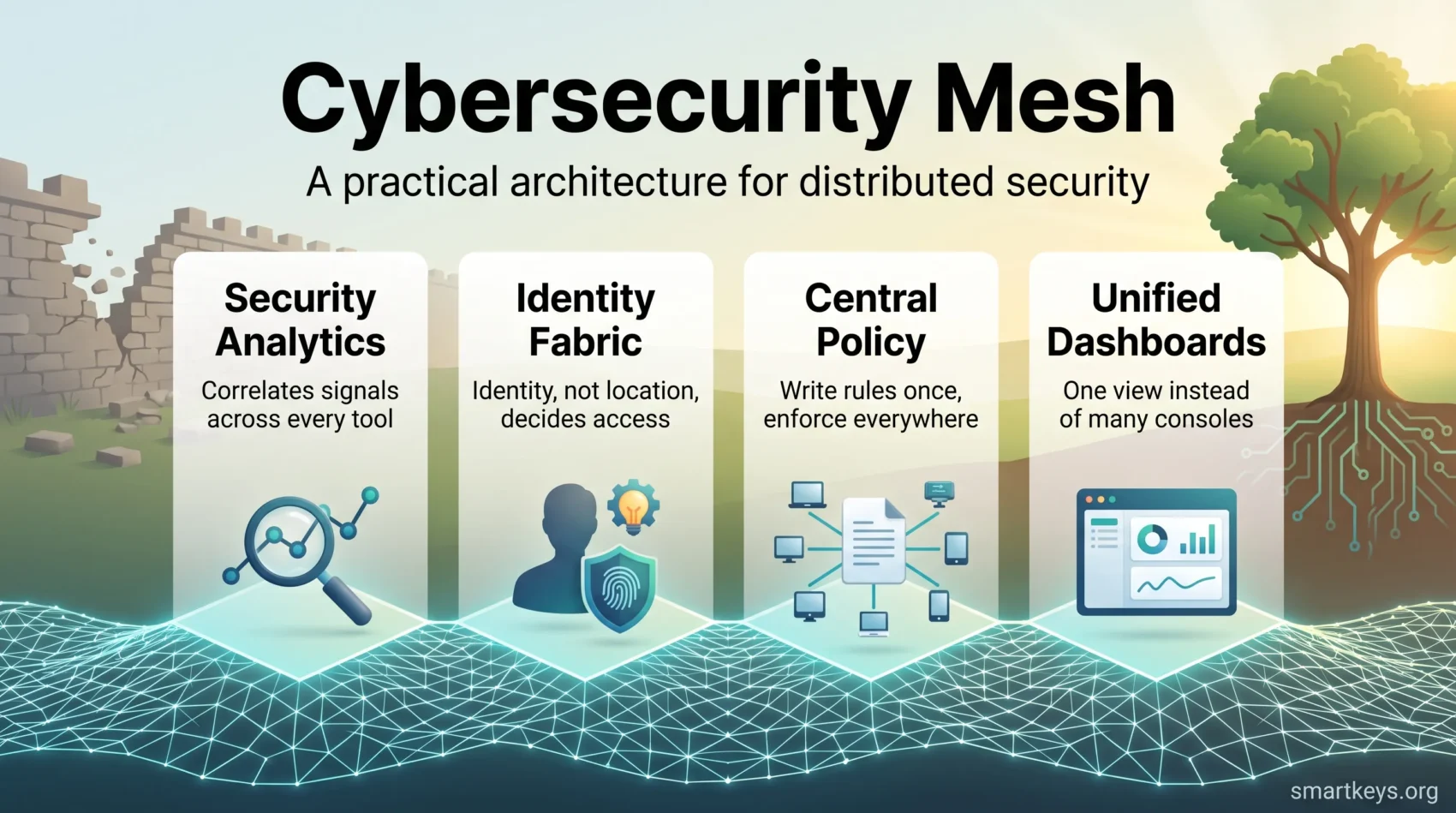
- Gartner defines four layers: analytics, identity fabric, policy management and shared dashboards.
- The 2026 pressure points are AI agents, shadow AI and post-quantum planning.
- Progress is measurable against NIST CSF 2.0 and its Govern function.
What Cybersecurity Mesh Actually Means
Nobody chose fragmented security. It happened one purchase at a time: a cloud security tool here, an email filter there, a separate identity system for the factory. Each product works, yet together they leave gaps nobody owns. A mesh treats security as a fabric of cooperating services rather than a stack of independent products.
The problem it solves: security sprawl
Security sprawl is what happens when every tool has its own console, its own rules and its own idea of who a user is. An employee leaves, HR closes the account in the main directory, but the person still has a login to a marketing platform one department bought and never connected to central identity. That gap is a coordination failure, not a technology one.
A mesh closes it by making identity and policy shared services rather than per-tool settings. The same problem turns up in policies for employee-chosen apps, where discovery and offboarding matter more than blocking.
From a fixed perimeter to identity-led control
Perimeter thinking assumed that being inside the network meant being trusted. Today a finance manager may open a payroll system from hotel Wi-Fi on a personal tablet, so location tells you almost nothing useful.
Identity-led control asks different questions. Who is this, on what device, with what recent behaviour, reaching which data? The answers travel with the user across hybrid cloud estates, SaaS applications and edge-driven architectures. It is the same principle behind zero-trust security models, applied at the level of your whole toolset rather than one product.
The Four Layers of a Cybersecurity Mesh Architecture
Gartner’s model has four layers. They tell you what to buy, what to connect and what to measure.
1. Security analytics and intelligence
This layer collects signals from endpoints, cloud services, email and the network, then looks for patterns across them. A single failed login is noise. The same account failing in three systems within a minute, from a country nobody works in, is a signal. Pulling that data together is what lets an alert in one place trigger a block somewhere else.
2. Distributed identity fabric
The identity fabric handles directory services, adaptive access and entitlement checks, meaning the ongoing question of who may do what. Adaptive access means the strictness of the check changes with the risk: routine access from a managed laptop passes quietly, an unusual request asks for a second factor. Approaches such as decentralized identity and biometric authentication plug into this layer rather than replace it.
3. Consolidated policy and posture management
This layer translates a rule written in business language into the settings each tool understands. You state that contractor accounts may not download customer records; the layer turns that into configurations for your cloud storage, CRM and endpoint agent.
The benefit is less drift. When rules live in one place, tools stop quietly disagreeing, and audits get shorter. Teams already running a data governance strategy or a privacy compliance framework have half the groundwork done.
4. Consolidated dashboards
The last layer gives teams one view instead of eight browser tabs. That matters for speed: fewer places to look means fewer minutes lost deciding which alert is real.
What Changed by 2026
The mesh idea is not new. What changed is the pressure on it. Gartner’s top cybersecurity trends for 2026 name several shifts pushing companies toward shared identity and policy.
AI agents became a new kind of user
Software agents now book meetings, query databases and file tickets on their own. Each needs credentials and permissions, and identity systems were designed for humans. Gartner lists both agentic AI oversight and the adaptation of identity and access management to AI agents among its 2026 trends. If you are rolling out AI assistants at work, this layer decides what they can reach.
Shadow AI turned into a measurable cost
IBM’s Cost of a Data Breach Report 2025 put the global average breach cost at $4.44 million, down 9% year on year, with a mean time to identify and contain of 241 days. Shadow AI, meaning unapproved AI tools used at work, added roughly $670,000 to the average breach cost. IBM also reported that 97% of organisations hit by an AI-related incident lacked proper AI access controls, and 63% had no AI governance policy at all.
That is an identity problem before it is an AI problem. Clear generative AI usage guidelines enforced through the identity layer address both. A Gartner survey in the same 2026 trends report found more than 57% of employees use personal generative AI accounts for work, and 33% admit entering sensitive information into unapproved tools.
Post-quantum planning moved onto real roadmaps
Gartner states that advances in quantum computing will render the asymmetric cryptography organisations rely on unsafe by 2030. That is one planning cycle, not several. The first step is an inventory of where cryptography is used, which is exactly the asset mapping a mesh rollout needs anyway. Our guide to quantum-safe encryption covers the migration.
Regulation now reaches the boardroom
Gartner’s 2026 list also flags regulatory volatility, with regulators increasingly holding boards and executives liable for compliance failures. Evidence matters as much as controls. Rules such as the EU AI Act and tightening employee data privacy rules reward companies that can show, not just claim, consistent enforcement.
The Benefits Worth Expecting
Be careful with vendor promises. A mesh does not stop attacks on its own. What it changes is how fast you notice and how consistently you respond.
- Fewer blind spots. Assets that no single console covered become visible.
- Faster containment. A detection in email can trigger an endpoint block with no human relay.
- Shorter audits. Centralised policy produces centralised evidence.
- Cheaper change. Adding a service means connecting it, not rebuilding rules.
The honest limit: none of this helps if your identity data is wrong. A mesh built on a directory full of stale accounts will enforce those mistakes faster than before.
How to Implement a Cybersecurity Mesh
The order matters more than the tooling; each step makes the next possible.
Step 1: Map assets, identities and data flows
List cloud tenants, on-premises systems, endpoints, remote users and connected devices. Note where sensitive data actually sits, which is rarely where the architecture diagram says. This inventory is the most common reason projects stall, and the step you cannot skip.
Step 2: Centralise policy, then translate it
Write the rules once in plain language, then map each to the native controls of each tool. Expect disagreements to surface immediately; that is the point.
Step 3: Connect tools through APIs
Detections and blocks should propagate without someone copying an IP address between consoles. If you already use integration platforms for business systems, the same discipline applies.
Step 4: Operationalise and measure
Give teams one dashboard, shared threat intelligence and written runbooks that say who does what. Then measure against NIST CSF 2.0, published in February 2024, which organises work into six functions: Govern, Identify, Protect, Detect, Respond and Recover. Govern was the notable addition, and it is where board-level accountability now lands. Start with mean time to detect, mean time to contain, policy coverage across assets, and the share of enforcement that runs automatically. Report these inside your wider risk management framework.
How Mesh, Zero Trust and AI Fit Together
Zero trust is the principle: verify explicitly, grant least privilege, assume breach. A mesh is one way to make that principle operational across tools you did not buy together.
NIST published SP 1800-35, “Implementing a Zero Trust Architecture”, as a final document on 11 June 2025. It documents 19 example implementations built with 24 vendors, mapped to the NIST Cybersecurity Framework and SP 800-53r5. For teams who want a reference design rather than a vendor pitch, it is the most useful free starting point.
AI sits on both sides of this. It correlates signals faster than analysts can and cuts false positives. It also adds new identities to govern, and Gartner expects AI-driven security operations to unsettle team structures and skills in 2026. The same balance applies to AI in employee monitoring, where capability has outpaced the rules.
For distributed teams the payoff shows up in ordinary places: consistent controls for remote workers, sensible handling of connected devices, and a design that keeps up with the wider threat landscape.
Conclusion
A cybersecurity mesh is less a product than a decision about where your rules live. Move identity and policy into shared services, connect the tools you already run, and let enforcement happen wherever the work happens.
Start in order: inventory, policy, integration, measurement. Report progress against NIST CSF 2.0 so leadership sees movement rather than activity. Done this way, a mesh reduces the number of places security can quietly fail, a more honest goal than promising fewer attacks.
Found this useful?
Make SmartKeys a preferred source on Google, and our articles will surface more often in your Top Stories, AI Overviews, and AI Mode.
Add as Preferred Source