You can turn shared code into a clear business advantage, but only if you treat it as a governed asset rather than a free download. This guide shows how to frame an open source plan so leadership, legal and engineering move together from day one.
Almost every commercial product already contains open source. Black Duck audited 947 commercial codebases for its 2026 Open Source Security and Risk Analysis report and found open source in essentially all of them. The question is no longer whether you use community code. It is whether you can say which components you use, under which licences, and who fixes them when something breaks. The sheer volume is easy to underestimate: Sonatype counted 9.8 trillion package downloads across npm, PyPI, Maven Central and NuGet during 2025.
By the end of this article you will know where open source fits across your software portfolio, how to show early wins, and how to manage licence and security risk while growing participation responsibly.
Key Takeaways
- Write the strategy down. A short document with owners, licence rules and KPIs beats good intentions spread across three teams.
- Governance pays for itself: an Open Source Program Office turns scattered usage into decisions you can defend to legal and to customers.
- Security is the weak point. Black Duck found 87% of audited codebases carried at least one known vulnerability, and 93% held components with no development activity for two years.
- Registries are an attack surface, not just a supply. Sonatype identified more than 454,600 new malicious packages in 2025, and over 99% of them sat on npm.
- New EU rules apply. Cyber Resilience Act reporting duties started for manufacturers on 11 September 2026, with open source stewards following on 11 December 2027.
- Pick a monetization model early. Open core, dual licensing and hosted services each demand different community behaviour.
What an Open-Source Strategy Is, and What It Is Not
A clear blueprint turns scattered downloads into coordinated business outcomes you can measure.
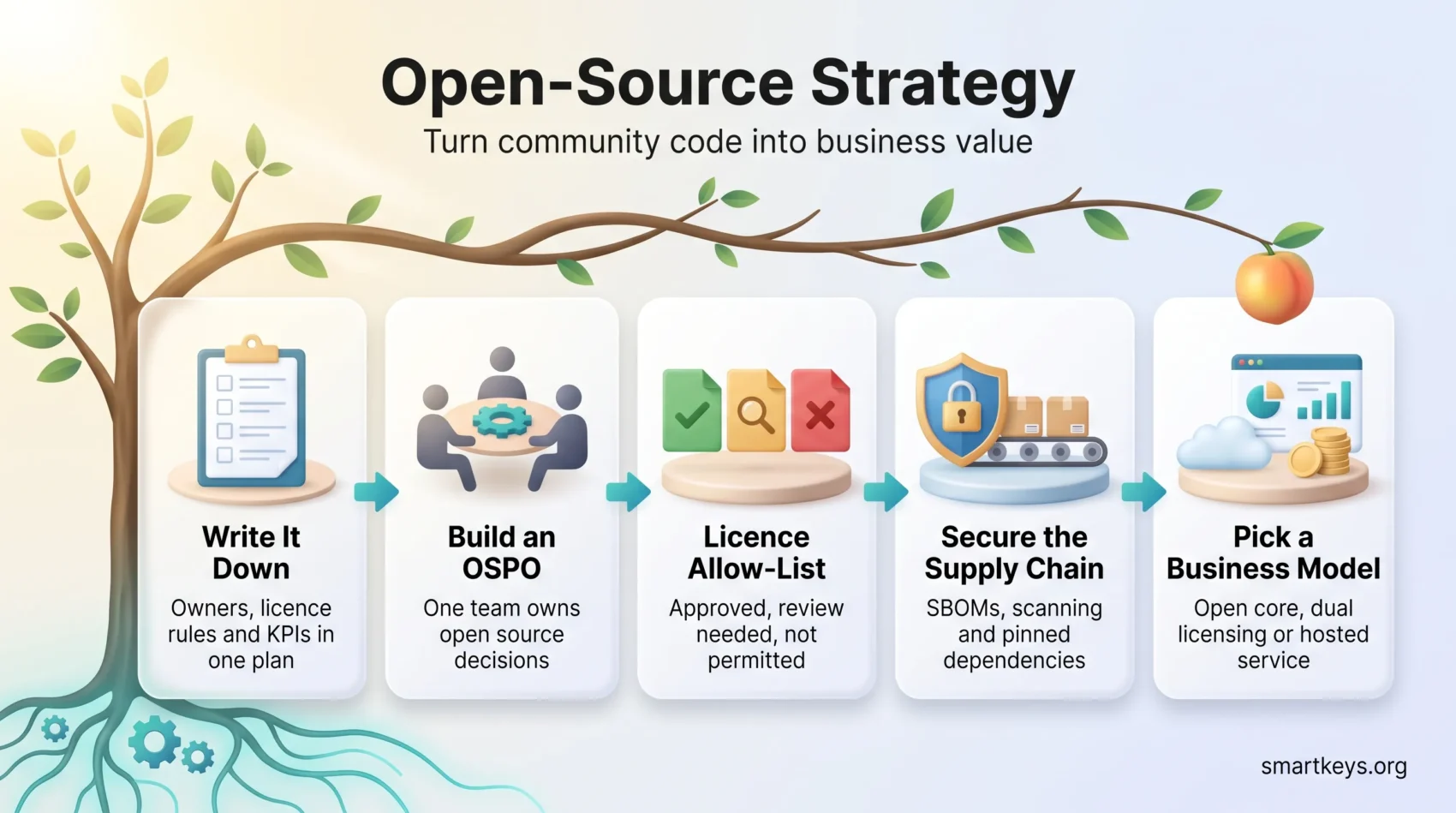
An open source strategy is a written plan that answers five questions. Which components do you depend on? What are you trying to achieve by using or publishing them? Who owns the decisions? Which licences are acceptable? How will you know whether it worked?
It is not a philosophy statement, and it is not a decision to stop buying software. Open and proprietary code sit side by side in most products. Your job is to decide, deliberately, which parts of your stack are commodity (use community code) and which are your actual differentiation (build and keep it).
Core elements to include
- Goals, scope (whole company or one department) and a named accountable owner.
- Service levels and KPIs, so teams know how fast a licence review or a security patch should happen.
- Inbound rules (what your teams may bring in) and outbound rules (what they may publish or contribute back).
- A licence allow-list and an escalation path for anything outside it.
Templates save weeks here. The TODO Group, a vendor-neutral community of open source programme leads hosted by the Linux Foundation, publishes free policy templates. Google’s open source documentation and GitHub’s Open Source Guides cover the same ground from a practitioner angle. Treat this as one part of your wider digital transformation roadmap rather than a standalone engineering project.
The Business Case: Where Open Source Actually Pays Off
Shared code cuts time to market and frees engineers to build the parts customers pay for.
Faster delivery, lower total cost, less vendor lock-in
The mechanism is simple. A payments team that adopts an established cryptography library instead of writing its own ships months earlier and inherits years of security review. The saving is not the licence fee. It is the engineering time not spent rebuilding a commodity layer.
Lower total cost of ownership comes from reuse and from designs that work with more than one vendor. If your data pipeline runs on a widely adopted open engine, switching hosting provider is a migration rather than a rewrite. That matters most in infrastructure, where lock-in gets expensive slowly, and it drives decisions in cloud strategy and hybrid cloud architecture.
Where the savings do not appear
Open source is free to download, not free to run. You take on patching, upgrades and the risk that a maintainer walks away. Black Duck’s 2026 audit found that 92% of codebases contained components four or more years out of date, and only 7% of components in use were the current version. Those stale dependencies are the bill arriving late.
Budget for maintenance from the start: whatever you save in build time, spend a visible fraction of it keeping the dependency tree current. Teams running formal FinOps practices make that trade explicit more easily, because they already track what running software costs rather than what buying it costs.
Governance: Building an Open Source Program Office
An Open Source Program Office (OSPO) is the small internal team that owns open source decisions for the whole company. It is the answer to the question “who says yes?” when an engineer wants to publish code or adopt a library with an unusual licence.
An OSPO typically spans three functions. Legal handles licences, trademarks and contributor agreements. Engineering writes contribution guidelines and review flows. A business owner links projects to the product roadmap so the work is visible to leadership.
The Linux Foundation’s research on open source programme offices reports that organisations running one show higher rates of upstream contribution, better software quality and stronger ecosystem influence. It also names the usual blockers: no clear strategy, weak executive buy-in and difficulty proving return on investment. Plan for those three from day one.
What to set up first
- A licence allow-list. Three tiers work well: approved, approved with review, and not permitted.
- Lifecycle rules. How a project starts, who maintains it, and when it gets archived rather than quietly abandoned.
- InnerSource practices. InnerSource means applying open source habits (public repositories, pull requests, visible roadmaps) inside your own firewall, so teams can contribute to each other’s code instead of filing tickets.
- A small set of KPIs. Policy adoption, review turnaround time, licence compliance rate and upstream contributions.
Bring sceptics in early. The finance lead who worries about support costs and the security lead who worries about unvetted code will surface real blockers faster than a friendly pilot group. That approach mirrors what works in AI governance, where the hard part is agreeing who decides, not writing the policy.
Policy, Licensing and Compliance You Can Actually Use
When policies are short, contributors spend time on code instead of paperwork.
Start with a compact document: objectives, owners, KPIs, and service levels for reviews and releases. Then handle three areas properly.
Licences. Two families matter. Permissive licences (MIT, Apache 2.0) let you use and redistribute code with minimal obligations, usually just attribution. Copyleft licences (the GPL family) require that derivative works you distribute carry the same licence, which can affect proprietary products built on top. Pick your allow-list to match business intent, and get legal input once rather than per project.
Contributor agreements. If you accept outside contributions, decide between a Contributor Licence Agreement (a signed document granting you rights to the contribution) and a Developer Certificate of Origin (a lightweight sign-off line in each commit). A CLA gives more legal certainty; a DCO creates less friction and attracts more casual contributors.
Software Bills of Materials. An SBOM is a machine-readable inventory of every component in a product, like an ingredients list. It is what lets you answer “are we affected?” within hours rather than weeks when a vulnerability lands. Generate SBOMs in your build pipeline, not by hand.
Black Duck found licence conflicts in 68% of the codebases it audited, which is a reminder that compliance failures are usually silent until an acquisition or an enterprise procurement review exposes them. If you sell into regulated sectors, fold this into your privacy compliance framework and your risk management framework rather than running it as a separate process. Buyers increasingly ask for this evidence during digital procurement.
Security by Design: Managing Open Source Risk
Treat dependencies as first-class assets and monitor them continuously.
The 2026 numbers are blunt. Across 947 audited commercial codebases, Black Duck found a mean of 581 vulnerabilities per codebase, more than double the previous year. 87% contained at least one known vulnerability, 78% contained a high-risk one and 44% carried a critical-risk issue. The report links the jump to AI-assisted coding pulling in far more components, far faster.
Layered defences work better than any single tool:
- At build time: dependency scanning and automated update pull requests, plus a policy gate that fails a build on a critical finding.
- At inventory level: SBOM generation on every release, stored somewhere you can query.
- At runtime: monitoring for components that are reachable and exposed, not just present.
When the package itself is the attack
Known vulnerabilities are accidents. There is a second category that behaves nothing like them: packages published on purpose to get your build to install them. Sonatype identified more than 454,600 new malicious packages across the major registries during 2025, pushing the cumulative total past 1.2 million. More than 99% of that activity was on npm.
Most of it is crude. Around 56% of what Sonatype classified in 2025 was repository abuse, meaning automated spam and manipulation of the registry itself, and a further 27% were empty or credential-stuffed packages. The dangerous minority is small but targeted: packages that read your environment variables, exfiltrate developer credentials or pull down a second payload once the build finishes.
Vulnerability scanning does not catch any of this. A package uploaded this morning has no CVE attached to it. Three controls do most of the work:
- Pull through one door. Point builds at an internal mirror or a curated registry rather than at the public index directly. You then control what enters, and you can quarantine a package after the fact instead of hunting for every build that used it.
- Pin and verify. Lock dependency versions with hashes in a committed lock file, and check package signatures or provenance attestations where the registry supports them.
- Slow the last mile. A new dependency that reaches production within the hour gives nobody a chance to notice anything. Staged rollouts buy that window cheaply.
Typosquatting is worth naming specifically. Attackers register names one character away from a popular library and wait for someone to mistype an install command. An allow-list of approved packages stops that better than any scanner, because it turns an unknown name into a rejected build rather than a judgement call late on a Friday.
End-of-life planning
The stale-component figures matter more than the vulnerability counts. A library with no commits for two years has no one to write a patch when the next flaw appears. Keep a list of your critical dependencies, check maintainer activity twice a year, and decide in advance whether you would fork it, fund it or replace it.
Measure three things: mean time to remediate, SBOM coverage across releases and dependency freshness. These fit naturally inside a broader distributed security architecture, and the same inventory discipline underpins quantum-safe encryption migration, where you cannot replace algorithms you cannot find.
What the Cyber Resilience Act changes
The EU Cyber Resilience Act sets security requirements for products with digital elements sold in the EU. Reporting duties for manufacturers began on 11 September 2026: an early warning within 24 hours of learning about an actively exploited vulnerability, a fuller notification within 72 hours, and a final report once a fix is available. Open source software stewards, meaning foundations and similar bodies that support projects without selling them, face their own reporting duties from 11 December 2027. Full application of the regulation follows in December 2027.
Individual contributors who are not acting commercially generally fall outside the manufacturer obligations. If you ship a product built on open source into the EU, you do not. Treat this as part of the same software supply chain resilience work rather than a separate compliance project.
Open Source in AI and Machine Learning
AI has made open distribution normal again. Widely used open-weight models, where the trained parameters are published for download, include Meta’s Llama family, Mistral’s models and Alibaba’s Qwen series. Around them sit open tooling, serving frameworks and fine-tuning libraries that most enterprise AI stacks now depend on.
Two things are worth understanding before you build on them.
“Open weights” is not the same as “open source”. Many popular model licences restrict commercial use above a size threshold, or forbid certain applications. Read the model licence with the same care you would read a code licence, and check the licence on the training data where it is disclosed.
Running a model yourself trades one cost for another. You drop per-token API fees and gain control over where your data goes, which matters for regulated workloads. In exchange you take on GPU capacity, serving reliability and evaluation. That trade shows up clearly in LLMOps planning and in how teams choose between general models and industry-specific AI solutions.
Governance follows the same pattern as code. Define acceptable use, log which model version served which decision, and set evaluation gates before release. Your generative AI usage guidelines should cover self-hosted models explicitly, and EU deployers should check obligations under the EU AI Act.
Adoption and Monetization Models That Work
Pick a model that fits your users and keeps community trust intact.
Open core: publish a capable base, charge for enterprise features such as single sign-on, audit logs and support commitments. Works when the paid features are clearly aimed at large organisations rather than at everyone.
Dual licensing: offer the software under a copyleft licence for free and a commercial licence for companies that cannot accept copyleft terms. Works when your users build products on top of your code.
Hosted service: sell the convenience of running it, as Databricks does with Apache Spark and Hugging Face does around shared models. Works when operating the software well is genuinely hard.
Support, training and certification: the oldest model, and still a durable one. Free developer programmes and low-cost certifications build a talent pool that prefers your stack.
Two failure modes are common. Pulling features back out of the open version after people have adopted them destroys trust quickly. Leaving the open version so limited that nobody adopts it removes the reason for the strategy in the first place. Decide where the line sits before launch, publish it and hold it. If you are weighing these options seriously, the trade-offs sit alongside broader business model innovation and platform business model decisions, and they get harder as SaaS consolidation reshapes buyer expectations.
Community and Developer Relations
Build a developer experience where contributors spend time writing code, not working out how to start.
Treat documentation as a product. A good project has a quickstart that works, clear API examples, a contribution checklist and issues labelled as suitable for newcomers. Publish your review standards so a first-time contributor knows what “done” looks like.
Pair new contributors with maintainers and recognise reviewers publicly. Review capacity, not contributor interest, is usually the bottleneck.
Funding is the part most companies skip. If a library is load-bearing for your product, a sponsorship or a handful of paid engineering hours upstream costs far less than the private fork you will otherwise end up maintaining alone. Budget it as a dependency cost and name the projects it covers, so it survives the next round of spending cuts.
Separate user support from maintainer workload. A forum absorbs questions that would otherwise land in the issue tracker and slow down the people fixing bugs. Publish transparent decision rules so contributors understand how project leadership changes hands.
Track issue response time, pull request throughput and release cadence. These tell you whether the project is healthy long before contributor counts do. The underlying dynamic is the same one described in open innovation models: outside contributions arrive only when the cost of contributing is low.
Resources That Speed Up Your Program
Proven templates and courses shorten the path considerably.
Start with vendor-neutral bodies. The Linux Foundation runs training and hosts many of the projects enterprises depend on. The TODO Group publishes free policy templates. InnerSource Commons documents patterns for applying these practices internally. The Open Source Security Foundation (OpenSSF) provides security guidance and free courses, including material on Cyber Resilience Act readiness.
Then build internal enablement. Short sessions, a one-page policy summary and a worked licence review do more than a handbook nobody opens. Where teams lack the underlying skills, handle it through your skills gap analysis rather than hoping the OSPO can carry it.
Measure what changed. Track policy adoption, licence review turnaround and contribution velocity. If none of those move after a quarter, the process is usually too slow, not the training too thin.
Your Implementation Playbook
Treat implementation as a series of small experiments that build credibility fast.
Step 1: Map stakeholders and pick your pilot
List the groups with a stake: legal, security, engineering, product and finance. Ask each what would make them say no. Then choose one low-risk project as your pilot, ideally something already in production so the results are real.
Step 2: Put the gates in the pipeline
Add dependency scanning, automated licence checks and SBOM generation to continuous integration. Compliance that runs automatically gets followed. Compliance that requires a form does not.
Step 3: Publish the policy and the turnaround time
A one-page policy with a committed review time (for example, three working days for a licence question) is worth more than a comprehensive document with no service level attached.
Step 4: Report against KPIs your leadership already uses
- Adoption: share of repositories covered by the policy, and number of licence reviews completed.
- Security: mean time to remediate, SBOM coverage, dependency freshness.
- Community: upstream contributions made and accepted.
- Business: time to market on the pilot, support cost and revenue tied to open-source-based services.
Run a quarterly review, tune the process and retire whatever nobody used. The most common reason these programmes stall is not resistance. It is that the first version was too heavy and quietly got bypassed.
Case Studies: Networks, Data and Platforms
AT&T: multi-vendor open network architecture
AT&T moved core network functions off single-vendor, proprietary hardware towards open, software-driven designs running on commodity equipment. The stated goals were faster upgrades and less dependence on any one supplier. The lesson transfers: decoupling hardware from software is where open architectures pay off most, because that is where lock-in costs compound.
Databricks and Apache Spark: open core plus managed platform
Databricks was founded by the creators of Apache Spark, which is governed by the Apache Software Foundation, and it continues to contribute upstream. The commercial product adds governance, performance work and cloud operations. The pattern is instructive: contribute to the engine, sell the operation of it.
Netflix: publishing production-hardened tooling
Netflix publishes internal tooling for orchestration, resilience and platform operations through its open source programme. The return is not licence revenue. It is outside maintenance, recruitment reach and influence over the tools its own engineers depend on.
The repeatable pattern
- Decouple components so you can replace any single layer.
- Contribute back to what you depend on, so it stays alive.
- Sell what enterprises actually pay for: operations, guarantees and support.
For practical guidance on aligning projects and channels, see the omnichannel playbook that helps map products, services, and partner ecosystems to your roadmap.
Conclusion
Open source stopped being a choice some time ago. It is in your products whether or not anyone decided it should be. What is still a choice is whether you manage it.
The work is not complicated: write the policy down, automate the checks, keep an inventory, name the owners and report a handful of numbers. Do that and you get faster delivery, lower lock-in and a security posture you can describe to a customer without flinching. Skip it and the same dependencies become an audit finding or an incident nobody can scope.
Start small: one pilot, one policy page, one set of pipeline gates. Scale what survives a real release.
Found this useful?
Make SmartKeys a preferred source on Google, and our articles will surface more often in your Top Stories, AI Overviews, and AI Mode.
Add as Preferred Source