AI hiring bias means an automated screening tool produces systematically worse outcomes for one group of applicants than another. It rarely looks like discrimination. It looks like a ranked list.
Most large employers now run applications through software before a person reads them. That software saves real time. It can also carry forward patterns from old hiring data, and courts have started treating those patterns as legally significant.
This guide covers what the research found, which rules applied in 2026 and which ones moved, and the checks you can add without slowing your hiring.
Key Takeaways
- The effect is measurable: controlled tests show identical resumes scored differently once the name changes.
- Deleting name and gender fields is not a fix: models infer the same traits from other clues.
- Liability now reaches the vendor: a court let a nationwide age claim proceed against a screening platform, not just the employer.
- The rules moved in 2026: Colorado rewrote its AI law and the EU pushed its hiring rules to December 2027.
- Testing is the control that works: run your own resume experiments and log every override.
Why AI hiring bias matters right now
Screening software is no longer an experiment. Jobscan’s 2023 review of Fortune 500 careers pages found 98.4% of those companies using an applicant tracking system, the database that stores and sorts applications. Newer tools sit on top of that layer and score, rank or reject candidates automatically.
That saves time and concentrates risk. When one model sits between a million applicants and a hiring manager, a small distortion repeats on every application.
Regulators have been consistent on one point: using a tool does not transfer your legal duty to the tool. If your process rejects a protected group at a lower rate, you own that outcome. For the wider picture, see our guides to AI hiring tools and AI-driven talent acquisition.
What AI hiring bias is and how it shows up in screening
A screening model learns from your past hiring. If that hiring favored one profile, the model treats it as the definition of a strong candidate. Nothing in the code says “prefer this group.” The preference is inherited.
Four patterns account for most cases:
- Representation bias: training data with too few examples of a group, so the model has little to learn from.
- Algorithmic bias: weightings that push scores toward one type of profile.
- Predictive bias: the model consistently misjudges how well one group will perform.
- Measurement bias: the label you train on is wrong. “Was hired” is not the same as “was good at the job.”
A proxy is a harmless-looking field that stands in for a protected trait. A postcode can act as a proxy for race. A graduation year acts as a proxy for age. A career gap often acts as a proxy for parenthood or illness. The model never sees the protected trait and still reproduces its effect.
Reuters reported in 2018 that Amazon scrapped an internal recruiting tool after finding it downgraded resumes containing the word “women’s” and graduates of two all-women’s colleges. It had learned from a decade of applications dominated by men. That remains the clearest public example of a proxy at work.
What the evidence shows about names, resumes and model decisions
The strongest evidence comes from controlled tests: researchers change one thing on an otherwise identical resume and watch what the model does.
The University of Washington resume experiment
Kyra Wilson and Aylin Caliskan of the University of Washington ran 554 real resumes against 571 job descriptions, swapping in 120 first names associated with different races and genders. That produced roughly three million comparisons. They presented the results at the AAAI/ACM Conference on AI, Ethics and Society in 2024.
The models preferred white-associated names 85% of the time. Female-associated names were preferred in 11% of comparisons. Nothing changed except the name at the top.
Intersectional harm is worse than either average suggests
Intersectionality means looking at combined groups rather than one trait at a time. It matters here because averages hide the worst cases. In the Washington study, Black male names fared worst of all: the models preferred other candidates over them close to 100% of the time. A race-only report and a gender-only report would both have missed that.
Why removing protected attributes is not enough
Stripping name, gender and date of birth feels like the obvious fix. It does not work on its own, because language carries identity. Vocabulary, school names, volunteer work, locations and phrasing all correlate with demographics in the training data.
The practical response is to test, not to trust. Send matched pairs of resumes through your own pipeline, change one attribute, and compare selection rates. If one version ranks consistently higher, you have found something no policy document would have shown you.
AI hiring bias in the courts
Disparate impact is the legal idea doing most of the work here. It means a neutral-looking practice can be unlawful if it disadvantages a protected group in effect, even with no intent to discriminate. That is exactly the shape of an algorithmic screen.
Mobley v. Workday: the vendor is in the room
Mobley v. Workday is the case employers watch. The plaintiff argued that a screening platform used by many employers rejected older applicants at scale. In May 2025 the court allowed a nationwide collective to proceed under the Age Discrimination in Employment Act (ADEA), the federal law protecting workers aged 40 and over.
The collective covers applicants aged 40 and over who applied through the platform from September 2020 onward. In March 2026 the court rejected the vendor’s argument that the ADEA does not cover job applicants, and the case moved into discovery. The point for employers is simple: the software provider was treated as part of the hiring decision, not as a neutral supplier.
EEOC v. iTutorGroup: the first AI settlement
In 2023 the Equal Employment Opportunity Commission settled its first case involving automated screening. iTutorGroup paid $365,000 after its recruiting software automatically rejected women aged 55 and over and men aged 60 and over. The rule was crude, but the enforcement principle carries over to subtler models.
The same theories outside employment
Housing cases show where this is heading. In November 2024 tenant screening firm SafeRent agreed to a $2.28 million settlement over a scoring tool alleged to disadvantage Black and Hispanic applicants and housing voucher holders, and to stop using the score for voucher tenants. The legal reasoning transfers directly to hiring.
The 2026 rulebook: where the rules actually bind
The regulatory picture changed a lot during 2026, mostly in the direction of lighter obligations. Knowing which rules still bite is now part of vendor selection. Our overview of AI regulation in 2026 covers the wider landscape; the points below are the hiring-specific ones.
New York City: audits on paper
New York City’s Local Law 144 requires an annual independent bias audit and a published summary for automated employment decision tools, plus notice to candidates. Enforcement has been thin. Researchers surveying 391 NYC employers found only 18 published audit reports and 13 published transparency notices, and presented the results at the 2024 ACM FAccT conference under the title “Null Compliance.”
The law also exempts tools described as merely assisting a human reviewer. Labeling a system “human in the loop” while nobody meaningfully reviews its output is not a defense against a discrimination claim, whatever it does for the audit requirement.
Illinois, California and Texas
Illinois amended its Human Rights Act through HB 3773, effective 1 January 2026. Employers must tell applicants when AI is used in an employment decision, and discriminatory effect is enough to breach the law. California’s civil rights regulations, effective 1 October 2025, apply a disparate impact standard to automated decision systems, treat vendors as agents of the employer, and require four years of record retention. Texas took the opposite route: its AI law, also effective 1 January 2026, requires intent to discriminate, and says disparate impact alone does not establish it.
Colorado rewrote its law
Colorado’s 2024 AI Act was the strictest US framework and never took effect. Its start date slipped from February to June 2026, a federal court blocked enforcement in April 2026, and in May 2026 the governor signed SB 26-189 to replace it. The replacement takes effect on 1 January 2027 and is far lighter. It drops the impact assessments, risk management program and attorney general reporting. It keeps pre-use notice, a plain-language explanation within 30 days of an adverse decision, a right to correct inaccurate data, human reconsideration where commercially reasonable, and three-year record retention.
Europe pushed its hiring rules to 2027
The EU AI Act classes recruitment and selection tools as high risk. Under the Digital Omnibus agreement reached in May 2026, those obligations were postponed to 2 December 2027. The transparency duties that took effect on 2 August 2026 still apply, so candidates interacting with a chatbot or generated content must be told. Our guide to EU AI Act compliance sets out the risk tiers in full.
The federal picture in the United States
Federal guidance went the other way. The EEOC removed its AI and algorithmic fairness material, including its technical assistance on adverse impact in selection procedures, from its website in January 2025. Title VII, the ADA and the ADEA are unchanged: only the interpretive guidance disappeared. The practical effect is less official direction and the same exposure, with state law filling the gap. See our summary of future of work legislation for the broader employment picture.
What this means for your hiring process
The most common failure is not a rogue model. It is automation bias, the tendency to accept a recommendation because it came from a system. Once reviewers stop questioning scores, the tool sets the threshold and nobody notices.
Where the risk actually sits
Look at three points: the score threshold that decides who gets a human read, automated rejections sent without review, and interview rubrics fed by tool output, where a low score frames the conversation before it starts.
Each can quietly remove qualified people. That costs you twice: a smaller talent pool now, and a discovery request later asking how those decisions were made. The same questions apply to any system that judges people, which is why algorithmic management and AI employee monitoring raise familiar problems.
Turn the statutes into checkpoints
- Write down your selection criteria and test their effect on groups protected by Title VII, the ADA and the ADEA.
- Keep records of the tests you ran, the changes you made and why each candidate passed or failed a step.
- Give recruiters a documented route to escalate an exception, so a rigid rule does not cost you a strong candidate.
- Ask vendors for audit history, subgroup metrics and a remediation commitment before you sign, not after.
How to make AI recruitment fairer
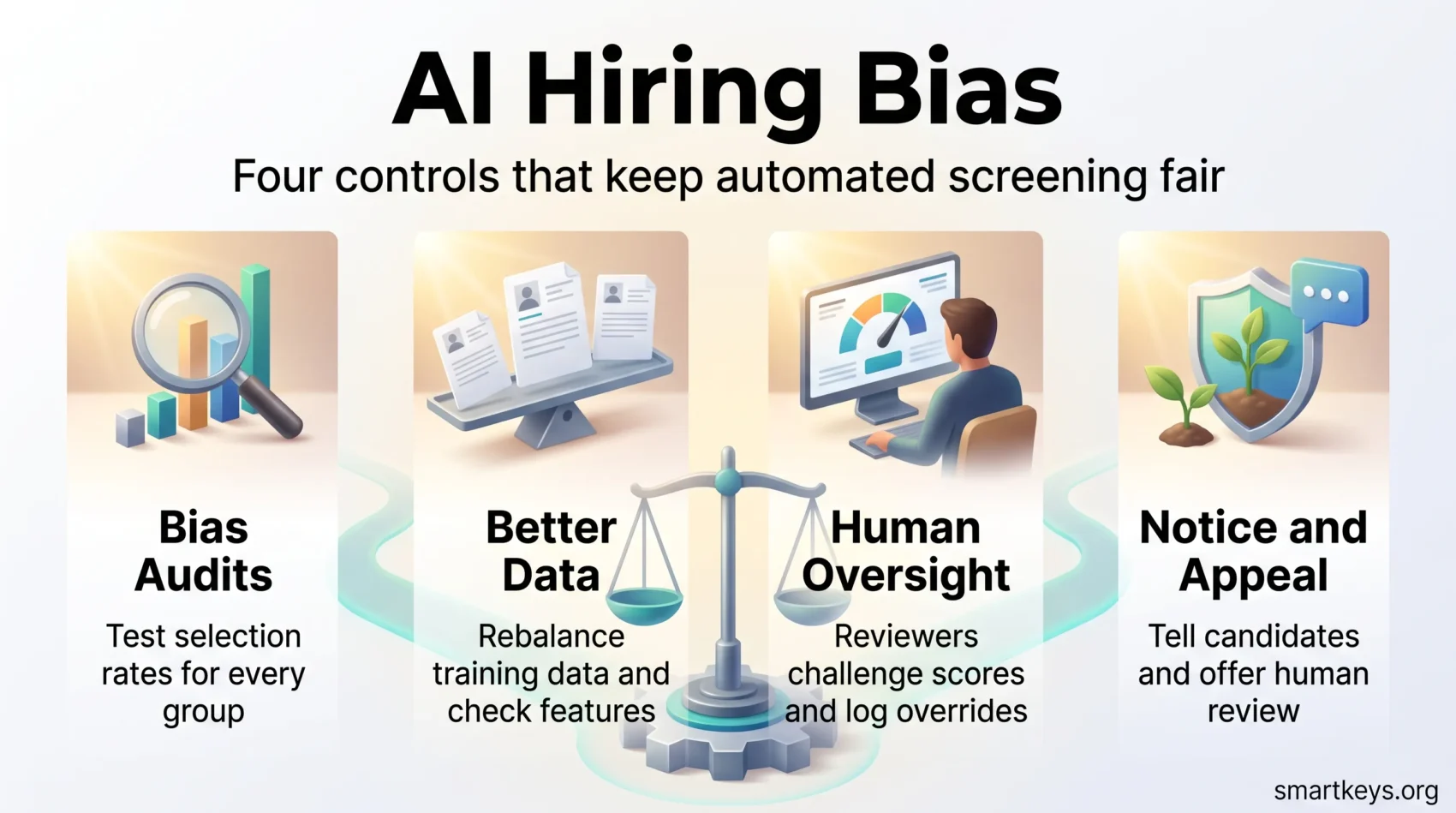
Four controls do most of the work. None of them requires you to stop using automation.
Independent bias audits
An audit tests your tool on benchmark data and on your own hiring data, then reports selection rates by subgroup. A useful one covers combined groups, not just race and gender separately, and comes with a remediation plan and a repeat date. A single audit describes one moment; models and applicant pools both drift.
Fix the data and the features
Rebalance training data so under-represented groups are actually represented, and check that the features driving scores relate to the job. If a model weights a school name heavily, ask what that predicts. Pair its pattern matching with candidate-specific context, so a strong but unusual profile is not filtered out for looking unfamiliar. Hiring that values micro-credentials and skills over pedigree gives the model better material.
Human oversight that challenges rather than confirms
Reviewers need three things: the reasons behind a score, subgroup performance data for the tool, and permission to disagree. Require a written reason for every override and every accepted borderline score. That habit produces a better decision and the audit trail you will want later. Our AI ethics framework and AI governance model show how to write the rules.
Notice, consent and a real appeal route
Tell candidates in plain language when an automated tool is part of the process, and give them a way to ask for human review of an adverse result. Ask vendors for model cards, a short standard document describing what a model does, what data it was trained on and how it performs across groups. Colorado, Illinois and the EU are all converging on the same idea, so building this once covers several jurisdictions. It also sits naturally alongside your employee data privacy obligations and the expectations set out in AI ethics at work.
Conclusion
The aim is to make hiring decisions traceable, testable and defensible.
Map where automated tools touch your process. Run matched resume tests and log the results. Document overrides. Give candidates notice and an appeal route. Ask vendors hard questions before you buy.
The rules will keep moving, as 2026 showed. The duty behind them has not: if your process rejects one group more often, you must be able to explain why. Building that evidence now is far cheaper than assembling it during a dispute. Skills and oversight go together, which is why data literacy and upskilling belong in this conversation, and why the AI ethics officer is becoming a normal role.
Found this useful?
Make SmartKeys a preferred source on Google, and our articles will surface more often in your Top Stories, AI Overviews, and AI Mode.
Add as Preferred Source