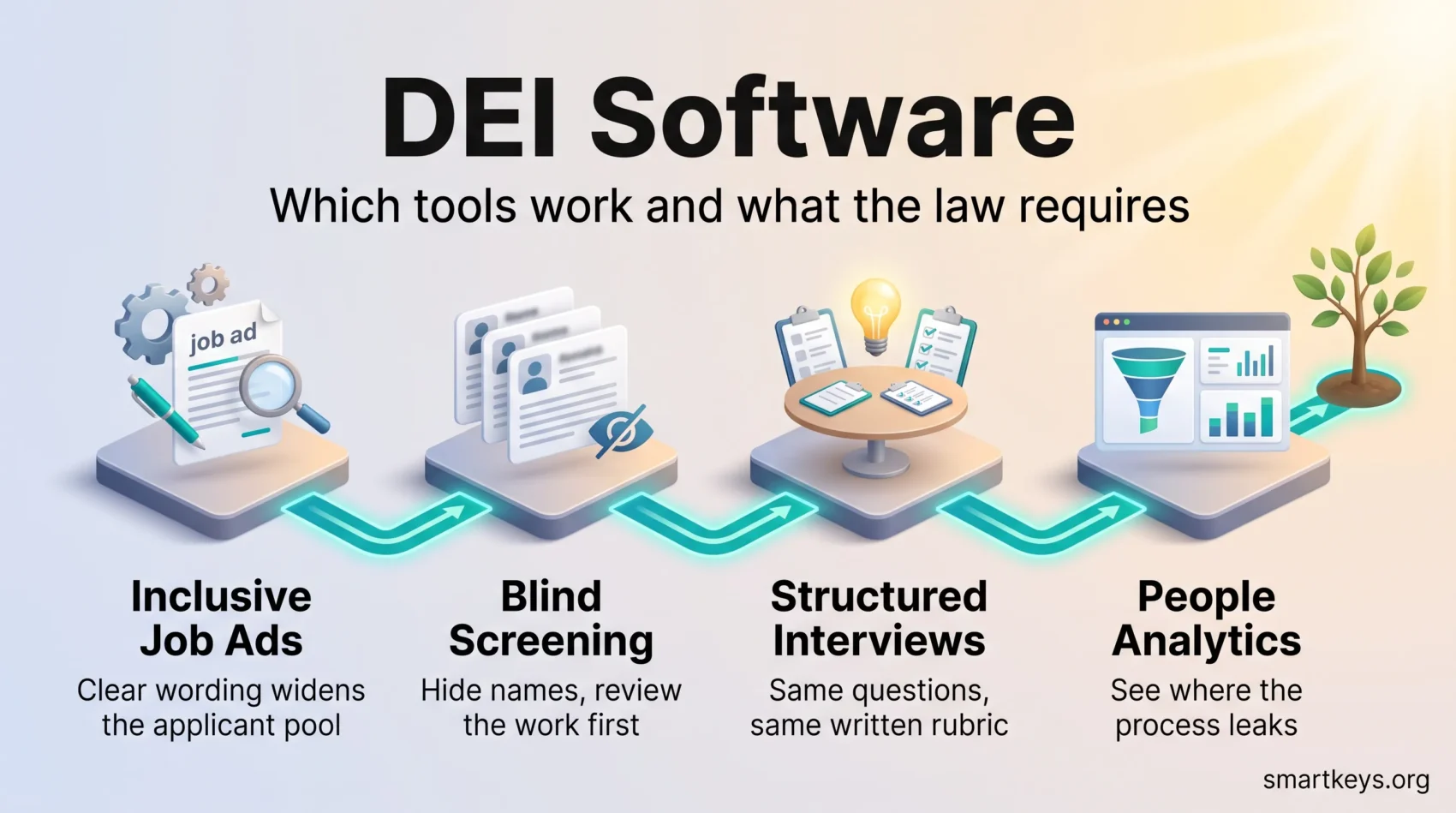
DEI tech tools, often sold simply as DEI software, are the products companies use to make hiring and people decisions more consistent: tools that rewrite job ads, hide names on applications, score interviews against a fixed rubric, and show where representation and pay actually stand. DEI stands for diversity, equity and inclusion, the practice of making sure people from different backgrounds get a fair shot at the same opportunities. For the wider business case behind it, read our guide on why diversity and inclusion matter for business. This article stays with the software.
The market around these tools changed sharply in 2026. In the United States, the rules that pushed federal contractors toward formal diversity plans have been withdrawn. At the same time, a new set of laws on automated hiring decisions has taken effect in Illinois, New York City and California. The software survived the shift, but the reason to buy it moved from compliance paperwork to something simpler: a hiring process that treats comparable candidates the same way, and that you can explain afterwards.
This guide covers what these tools do, what the 2026 rules require of you, and how to pick a small stack that earns its cost.
Key Takeaways
- Software exposes patterns in hiring and pay. It does not fix them on its own.
- The OFCCP rules requiring affirmative action plans from federal contractors end on 26 October 2026. EEO-1 demographic reporting continues.
- Illinois, New York City and California now regulate AI in hiring decisions, mostly through notice and audit duties.
- Start with two tools, not ten: inclusive job ads and structured interviews give the fastest measurable change.
- Any assessment you buy needs validation evidence from the vendor and your own pass-rate monitoring.
What counts as a DEI tech tool
The label covers four different jobs, and mixing them up is the most common buying mistake.
Writing tools check the wording of a job ad before you publish it. Screening tools remove or delay identifying details so reviewers look at the work first. Interview tools enforce the same questions and scoring for every candidate. Analytics tools pull data out of your HR systems and show representation, promotion and pay patterns over time.
An HRIS, the core system that stores employee records, usually holds the demographic fields already. Everything else either feeds that system or reads from it.
A concrete example makes the difference clear. A 200 person company that keeps losing qualified applicants at the resume screen has a screening problem, not an analytics problem. Buying a dashboard will show the drop-off in more detail. It will not change it. A blind screening step will.
Two practical rules follow. Pick one tool per workflow step so you avoid paying twice for the same function. And check what the tool writes back into your applicant tracking system, because data that stays inside a vendor portal is data your team will stop looking at.
What changed in 2026: the rules around this software
Anyone evaluating these tools in 2026 is working with a different rulebook than two years ago. Two shifts matter. They land on a market that has already adopted the technology: in Littler’s 2026 Annual Employer Survey of more than 300 executives, in-house lawyers and HR professionals, 54% said their organisation already uses AI in HR functions, and 45% named discrimination and bias as a leading area of AI litigation risk (Littler, May 2026).
US federal contractor obligations have been withdrawn
Executive Order 11246 required federal contractors to build written affirmative action plans with placement goals by race and sex. Those implementing regulations have been rescinded. The final rule removes 41 CFR Parts 60-1, 60-2, 60-3, 60-4, 60-20, 60-40 and 60-50, effective 26 October 2026 (Federal Register, 21 August 2026).
Three things survive. Section 503 of the Rehabilitation Act and VEVRAA still cover workers with disabilities and protected veterans. EEO-1 reporting continues, so covered employers still file annual workforce demographics by job category, sex, race and ethnicity with the EEOC. And Title VII still prohibits discrimination, which means a process that produces unequal outcomes is still a legal risk.
The practical effect on tooling: software sold mainly as OFCCP audit-file generation has lost its core use case. Software that documents a consistent, evidence-based process has not.
AI in hiring is now regulated at state level
If a tool scores, ranks or filters candidates, several rules now apply directly to you rather than to the vendor.
New York City Local Law 144 has been in force since July 2023. It requires an annual independent bias audit of automated employment decision tools, publication of the results, and candidate notice at least ten business days before use. Penalties run from $500 to $1,500 per violation.
Illinois HB 3773 took effect on 1 January 2026. Employers must tell applicants and employees when AI is used in hiring, promotion, discharge or discipline. Using ZIP codes as a stand-in for protected characteristics is explicitly barred.
California updated its FEHA regulations in October 2025 to confirm that existing employment discrimination law applies to automated decision systems, with expanded demographic reporting due from 2027.
Colorado’s original AI Act was paused in litigation and replaced by a narrower framework signed in May 2026.
In the EU, the AI Act treats recruitment and promotion systems as high risk. Under the Digital Omnibus agreement reached in May 2026, those high-risk duties move to 2 December 2027, while the Article 50 transparency rules still apply from 2 August 2026. The delay only takes legal effect once the Omnibus is published in the Official Journal, so treat it as likely rather than settled.
The common thread across all five: you need to know which of your tools makes or materially influences a decision, tell people it is being used, and keep evidence that you checked it for unequal outcomes. Our guide to AI hiring bias and how to keep screening defensible goes through the audit process in detail, and algorithmic management covers the same duties once someone is already employed.
Job ad tools: fixing the text before anyone applies
The wording of a job ad decides who reads it as an invitation. Long requirement lists, seniority-coded phrases and dense corporate language all narrow the applicant pool before a single resume arrives.
Textio analyses job posts and candidate messages and flags tone, sentence length and age-coded phrasing as you write. It plugs into Outlook, Gmail, LinkedIn Recruiter and most applicant tracking systems, so writers get suggestions in the tool they already use.
Datapeople works from templates and a shared job description library, adds inclusive-language checks and connects postings to pay grades. Its main benefit is version control: approved wording lives in one place instead of in twelve managers’ drafts.
Gender Decoder is a free check that flags masculine- and feminine-coded words in a posting. It is crude compared with a paid platform, but it costs nothing and makes the concept obvious to a skeptical hiring manager.
For readability, the built-in statistics in Microsoft Word or a tool like Readable are enough. Aim for short sentences and plain words. A posting written at postgraduate reading level filters for reading stamina, not job ability.
One caution worth stating plainly. Rewriting an ad widens the top of the funnel. It does nothing about what happens at the screen or the interview. Treat it as the cheapest first step, not the programme.
Blind screening and skills-first assessment
Blind screening hides names, photos, school names and other identity signals until a later stage, so the first review is about evidence of ability.
Applied strips identifying detail, shows answers question by question rather than as whole applications, and randomises the review order so no candidate benefits from being read first.
MeVitae and similar redaction layers sit on top of your existing applicant tracking system and mask identifiers without changing how recruiters work.
Pinpoint anonymises applications and locks resume access until a stage is cleared, which gives you control over who sees identity fields and when.
For skills testing, Criteria, Bryq and Harver run structured assessments, with Bryq adding cognitive and personality measures and Harver focusing on job-specific scenarios. Codility and HackerRank do the same for coding ability with standardised tasks. Eightfold matches candidates to roles on inferred skills rather than job titles.
Two things decide whether any of this helps.
First, validation. Ask the vendor for evidence that test scores actually predict job performance for roles like yours, and for their own adverse impact analysis, meaning a check of whether pass rates differ sharply between demographic groups. A vendor that cannot produce either is selling you legal exposure alongside the software.
Second, accommodations. Set out in advance how extra time, screen reader compatibility and alternative formats are handled. A timed test that has never been checked for accessibility quietly screens out disabled candidates. Our piece on neurodiversity and inclusive workplace design covers what those adjustments look like in practice.
Structured interviews: the step with the best evidence behind it
Of everything in this article, structured interviewing has the strongest research support. The idea is simple: every candidate for a role gets the same questions, in the same order, scored against the same written rubric.
Sapia.ai, previously known as PredictiveHire, runs untimed, text-based first-round interviews that stay anonymous to the reviewer. Candidates answer in writing and receive personalised feedback regardless of the outcome.
GoodTime handles the scheduling side and assembles mixed interview panels without adding days to the process, which is usually the reason panels quietly stop being mixed.
The software is the smaller half. The practice matters more:
- Write an interview kit per role: four to six questions, a rubric for each, and examples of a weak, average and strong answer.
- Have interviewers submit scores independently before the debrief. Shared impressions before scoring are how one confident voice decides a hire.
- Debrief on evidence only: what the candidate said or produced, mapped to the rubric.
- Review scores by interviewer every quarter. An interviewer who rates everyone highly adds no signal.
- Tell candidates the format in advance. Predictability helps people who prepare and hurts nobody.
Sourcing and reach
A fair process applied to the same narrow candidate pool produces the same narrow result. Sourcing is where reach actually widens.
Community networks and professional communities such as Jopwell, Elpha and referral platforms like Teamable extend referrals past the personal networks of current staff, which is where look-alike hiring starts. Circa distributes postings to community and regional outreach partners.
Circa’s positioning deserves a note. Its main selling point used to be OFCCP compliance documentation for federal contractors. With those regulations rescinded, judge it on distribution reach and cost, not on audit-file generation you may no longer need.
Track one number per channel: how many applicants from each source reach the interview stage. A channel that delivers volume but never converts is costing you screening time, not solving a pipeline problem.
People analytics: seeing where the process leaks
Analytics platforms pull data from your applicant tracking system, HRIS and surveys, then show patterns over time.
Visier analyses hiring pipelines and employee records and benchmarks results against comparable organisations by geography and industry. Tableau and similar business intelligence tools let you build your own dashboards across multiple sources, which is cheaper but needs someone in-house to maintain. Workday embeds reporting into the HR workflow itself for companies already on that platform.
The useful question these tools answer is not “what is our representation”. It is “at which step does it change”. Representation at application, at screen, at interview, at offer and at twelve months tells you where to spend money. A single headline number tells you nothing actionable.
Pay analysis is a related and more sensitive job. Compensation platforms run pay equity reviews that compare people doing similar work and flag unexplained gaps, then feed the result into merit and promotion cycles. Do the analysis under legal privilege where your counsel advises it, since a gap you have documented and not addressed is worse than one you never measured. Our guides to pay transparency and global pay parity cover the disclosure side.
After the hire: engagement, mobility and accessibility
Hiring tools bring people in. Everything after that decides whether they stay.
Culture Amp measures engagement and inclusion with regular short surveys and flags attrition risk. Diversio combines HR data with anonymous feedback and returns prioritised recommendations. A general survey tool such as SurveyMonkey is fine for quick pulse checks if you do not need benchmarking. The mechanics of running these well are covered in our pieces on AI-powered engagement surveys and employee experience platforms.
There is a hard rule with survey tools: do not ask a question you are not prepared to act on. Surveying people about belonging and then publishing nothing costs more trust than never asking.
Internal mobility platforms such as Gloat match existing employees to open roles and projects based on skills rather than who a manager happens to know. This is often the highest-return step available, because it works on people you have already hired and assessed. See internal talent marketplaces and career lattices for how those programmes are structured.
Accessibility is the cheapest inclusion work most companies skip. Live captions and transcripts in Teams, Zoom, Google Meet and tools like Otter.ai let colleagues who are deaf or hard of hearing follow a meeting in real time. Document templates with adequate contrast, clear headings and generous line spacing help everyone reading on a laptop at the end of a long day.
Onboarding and development matter here too. Remote onboarding, gamified onboarding, cross-training and continuous performance management each shape whether early-career and underrepresented hires get the same access to good work as everyone else.
How to choose without buying a stack you will not use
Start from a problem you can name, with a number attached. “Our resume screen passes 8% of applicants but 3% of applicants from non-target schools” is a buying brief. “We want to improve diversity” is not.
Then work through this order:
- Name the step. Sourcing, job ads, screening, interviews, or post-hire. Buy for one at a time.
- Check the integration first. If it does not connect to your applicant tracking system and HRIS, someone will do the work twice and then stop.
- Ask the compliance questions. Where is the data stored, who can access it, what does the vendor do with it, and can they produce a bias audit for the jurisdictions you hire in.
- Run a real pilot. One job family, one quarter, with the success metric written down before you start.
- Set a renewal test. Decide now what result would justify paying again next year.
Budget for change management, not just licences. A screening tool nobody was trained on becomes a step recruiters route around within a month.
Two governance points deserve their own line. Decide who may see demographic data and at what level of aggregation, since small teams make individuals identifiable. And write down which systems influence decisions about people, because that list is what every notice and audit duty in the previous section refers to. Our generative AI usage guidelines, privacy compliance framework and employee data privacy guide cover the paperwork side.
What to measure once the tools are live
Keep the metric set small enough that someone actually reviews it each month.
Track conversion at every funnel stage rather than a single headline figure, offer acceptance rate, time to fill, promotion rate and voluntary attrition, each broken out by the groups your reporting already covers. Add pass rates for any assessment you use, since a widening gap there is your earliest warning that a tool has drifted.
Three governance habits keep the numbers honest. Agree one definition per metric, so finance and HR are not reporting different headcounts. Log every change to a dashboard definition, because an unexplained jump is usually a definition change rather than a real shift. And schedule a fixed review where each number has an owner who can say what they are doing about it.
For a broader view of how this fits into workforce strategy, see our guides to multigenerational teams, measuring upskilling ROI and AI hiring tools.
The bottom line
DEI tech tools are process infrastructure. They make a hiring process consistent, documented and measurable. That is genuinely valuable, and it is also all they do.
The 2026 legal picture pushes in the same direction. With the federal contractor plan requirements gone and state AI notice rules arriving, the defensible position is no longer a filed plan. It is a process you can describe, evidence you checked it, and a record showing comparable candidates were treated the same way.
Start with two things: better job ads and structured interviews with written rubrics. Measure conversion at each funnel stage for six months. Buy the third tool only when the data tells you which step is actually leaking.
For practical strategy guidance on the wider reporting picture, see ESG SaaS strategies.
Found this useful?
Make SmartKeys a preferred source on Google, and our articles will surface more often in your Top Stories, AI Overviews, and AI Mode.
Add as Preferred Source