Recruitment has changed faster in the last two years than in the previous decade, and AI hiring tools are at the centre of it. Screening, scheduling, sourcing and first-round interviewing are being handed to software, while the rules governing that software are rewritten in Brussels, Springfield, Denver and Sacramento at the same time.
The picture in 2026 is more mixed than vendor marketing suggests. In SHRM’s survey of 1,722 HR professionals, conducted in December 2025, recruiting was the most common place AI showed up in HR, at 27% of organisations. It was equally true that 54% had adopted no AI in HR at all and had no plans to in 2026.
This guide covers what these tools do, from job adverts and sourcing to screening and interviews. It also explains what the 2026 legal landscape demands, and how to buy and run these tools without creating a discrimination claim.
Key Takeaways
- Recruiting is the top HR use case for AI, used by 27% of organisations in SHRM’s December 2025 survey.
- Just over half of organisations still use no AI in HR at all, so this is an early market, not a settled one.
- Illinois, California and New York City already impose specific duties on employers using AI in hiring, and Colorado follows on 1 January 2027.
- The EU AI Act classifies recruitment AI as high-risk, with the main obligations now due from 2 December 2027.
- The Mobley v. Workday lawsuit shows that buying a vendor tool does not shield anyone from liability.
The Rise of AI in Recruitment
AI in recruitment has moved past keyword matching. Today’s platforms rank candidates, draft outreach, run structured interviews and push data back into the applicant tracking system (ATS), the database where employers store and manage every application. The pressure driving that shift is volume. High-visibility roles attract more applications than any human team can read in full, and many of those applications were themselves written with generative AI.
What the 2026 Adoption Data Actually Shows
SHRM’s 2026 research puts recruiting ahead of every other HR use case for AI, at 27% of organisations, followed by HR technology management at 21%, learning and development at 17% and employee experience at 14%. A majority of organisations are sitting the year out entirely.
Treat market-size forecasts with caution: published projections vary widely depending on which vendor commissioned them, so they are a poor basis for a budget decision. Your own funnel metrics are better evidence. For a broader view of where the function is heading, our overview of the HR trends reshaping the function is a useful companion piece.
Shifting Trends in Recruitment Technology
Three shifts stand out. Conversational agents now handle screening questions, availability and status updates. Asynchronous video interviews, where candidates record answers to set questions in their own time, have become routine. The industry has, however, retreated from analysing faces. HireVue publicly dropped facial analysis from its assessments in January 2021 after criticism and an algorithmic audit, and language and skills signals replaced it.
The third shift is defensive. Because candidates use AI too, employers are rebalancing towards work samples, structured scoring and verified credentials. That is one reason interest in micro-credentials in hiring keeps rising.

Understanding AI Hiring Tools
AI hiring tools are software applications that automate or assist parts of recruitment: parsing applications, ranking candidates, scheduling, communicating and scoring assessments. They learn patterns from historical data, which is why their governance matters as much as their accuracy.
What Are AI Hiring Tools?
Most tools fall into one of two groups. Assistive tools help a recruiter work faster: drafting a job advert, summarising a CV, suggesting interview questions. Decision tools rank, filter or score candidates, and regulators call this second group automated employment decision tools. The distinction matters, because notice, audit and record-keeping duties usually attach to it.
Types of AI Hiring Tools
- Resume parsers: extract structured fields so applications can be searched and compared.
- Matching and ranking engines: score candidates against a role profile, often the highest-risk component.
- Recruiting chatbots: answer questions, collect screening answers and book interviews.
- Asynchronous and simulated interviews: record and score structured responses, including VR-based job interviews.
- Sourcing and outreach tools: find passive candidates and personalise first contact.
- Analytics layers: the workforce analytics tools that measure funnel health and quality of hire.
For the wider context, see our piece on AI in the workplace.

Benefits of AI-Driven Recruitment
The gains are real, but operational rather than magical. AI compresses the administrative middle of the funnel; it does not tell you who will succeed in the job.
Time and Cost Savings
The clearest wins are scheduling, screening question collection, CV summarisation and candidate communication: high-volume, low-judgement tasks whose removal shortens time to first interview. Vendors publish dramatic before-and-after numbers; treat them as marketing until you have replicated them on your own requisitions. Baseline time to hire, cost per hire and drop-off rate before you switch anything on.
Improved Hiring Success Rates
Where AI genuinely helps quality is consistency. Structured, scored interviews compare candidates on the same criteria, reducing the drift that creeps into unstructured conversations. What these models cannot do is validate themselves: one trained on your past hires will reproduce your past preferences, including the ones you would rather not repeat.
Popular AI-Powered Recruiting Solutions
Resume Parsers
Parsing turns unstructured CVs into comparable records. It is mature, unglamorous and genuinely useful. The risk sits one step later, when parsed fields feed a ranking model and proxies for protected characteristics slip in. Illinois now explicitly prohibits using zip codes as a proxy for a protected class.
Newer parsers use natural language processing (NLP), software that reads text for meaning rather than exact words. That lets a system recognise that “account management” and “client success” can describe similar experience. As a result, qualified people who phrase things differently from the job advert are less likely to be filtered out. The same caution applies, though: better matching still needs a human to check who is being ranked down and why.
Job Advert Tools
Many recruiting platforms now draft job adverts and flag wording that may discourage good applicants, such as long lists of must-have requirements or phrasing that reads as aimed at one group. Some also report which job boards and channels bring in applicants who actually progress, so you can move budget away from sources that only add volume.
Two checks keep this useful. A hiring manager should confirm that every requirement in a generated advert is genuinely needed for the job. And because ad platforms decide for themselves who sees a posting, look at who your adverts reach rather than assuming delivery is neutral. Our guide to AI job descriptions goes deeper on writing them well.
Sourcing and Candidate Rediscovery
Sourcing tools search professional networks and public profiles for passive candidates: people who are not job hunting but might move for the right role. They can widen a shortlist beyond whoever happened to apply this week.
An often overlooked source is the data you already hold. Your ATS contains past applicants who reached a late stage, and your HR system knows which employees want their next move. Rediscovery features score those records against a new opening. A recruiter can then contact last spring’s strong runner-up before paying for fresh outreach. Check your data rules first: under the GDPR you need a lawful basis and a defined retention period to keep and reuse applicant data. For the internal side, see our article on the internal talent marketplace.
Chatbots in Recruitment
Recruiting chatbots answer questions, collect knock-out criteria and book interviews, and candidates generally prefer a fast answer to silence. Two rules keep them safe: say clearly that the candidate is talking to software, and make sure any knock-out question is job-related and has a human escalation path. The customer-service lineage of these tools is covered in our article on AI-powered chatbots.

The 2026 Legal Landscape
Using AI in hiring is now a regulated activity in several major markets.
United States
There is no single federal AI hiring law, so the duties come from states and cities. New York City’s Local Law 144 requires an annual independent bias audit of automated employment decision tools, meaning an outside check of whether the tool’s results differ by sex and race or ethnicity. Employers must also publish the results and notify candidates in advance. A New York State Comptroller audit published on 2 December 2025 found enforcement to be weak. The city’s Department of Consumer and Worker Protection identified one compliance problem across 32 reviewed companies, while the auditors found at least 17 potential instances. Weak enforcement is not a defence, because private litigation fills the gap.
Illinois amended its Human Rights Act through HB 3773, effective 1 January 2026, requiring notice when AI is used in recruitment, hiring, promotion, discipline or discharge, and prohibiting zip-code proxies. California’s automated decision system regulations took effect on 1 October 2025 and extend record-keeping to four years.
Colorado changed course. A federal court blocked enforcement of its original AI Act in April 2026, and the state replaced it with SB 26-189, signed in May 2026 and effective 1 January 2027. The new law takes a notice-based approach. Employers must tell people when automated decision technology is used in an employment decision, explain an unfavourable outcome on request, and offer meaningful human review where commercially reasonable.
The case to watch is Mobley v. Workday. The Age Discrimination in Employment Act (ADEA) protects workers aged 40 and over, including against disparate impact: neutral-looking practices that disproportionately screen out a protected group. In March 2026 the court held that this protection reaches job applicants. That keeps alive a nationwide collective action (a group lawsuit) covering applicants aged 40 and over rejected through the platform from September 2020 onward. In June 2026 it largely refused to dismiss the amended complaint, so disability and California state-law claims also go forward. The practical lesson: buying a vendor tool does not outsource your liability. Our overview of future of work legislation tracks how this area keeps moving.
Europe
The EU AI Act classifies AI used for recruitment, selection and employment decisions as high-risk. That brings duties around risk management, data quality, logging, human oversight and transparency, plus an obligation to inform worker representatives and affected employees before deployment. The original date for these obligations was August 2026. In June 2026, EU lawmakers approved the Digital Omnibus amendment, which moves the deadline for stand-alone high-risk systems, including recruitment tools, to 2 December 2027. The extra time is for preparation, not a sign the requirements are going away. See our EU AI Act compliance guide and our wider look at AI regulation.
Ethical Considerations in AI Recruitment
Addressing Bias in AI Algorithms
Bias in hiring models comes from the training data, not from malice in the code. If your historical hires skew, the model learns the skew and applies it at speed and at scale. Independent audits, outcome monitoring by group and funnel stage, and a documented process for acting on what you find are the minimum. In California, bias-testing evidence is now expressly relevant to discrimination claims and defences, so testing quality matters. Our deep dive on AI hiring bias covers the mechanics, and explainable AI covers what you should be able to show a regulator.
Privacy Concerns in Candidate Data
Candidate data is personal data. Collect only what the role requires, tell applicants what is processed and by which systems, set retention to the legal minimum rather than the vendor’s default, and check where inference data is stored. Video and voice recordings deserve particular care, and emotion inference at work faces specific EU restrictions, a topic we cover in emotion recognition at work. See also our guide to data privacy at work.
Best Practices for Integrating AI in Recruitment
Training HR Teams on AI
The EU AI Act’s human oversight requirement is only meaningful if the humans are competent to exercise it. Training should cover how the tool produces its output, its known limitations, the notice obligations in each jurisdiction you hire in, and the escalation path when a candidate challenges a decision. Set expectations in writing through generative AI usage guidelines and give the policy a named owner.
Selecting the Right AI Tools
- Identify the specific bottleneck. Buy for that, not for the demo.
- Ask for the bias audit, model documentation and supported notice jurisdictions. Get it in the contract.
- Confirm integration with your ATS and HRIS (HR information system) before committing, since manual re-keying erases the time saved.
- Pilot on one requisition family with a human control group, measured against your baseline.
- Agree in advance what result would make you turn the tool off.
Our AI ethics framework and AI in HR management articles go further on governance.
Machine Learning, Human Judgement and What Comes Next
Machine learning is what makes matching, ranking and forecasting possible. It reads far more applications than a team can and surfaces patterns across the funnel. It is also confidently wrong in ways that are hard to spot, because a ranked list looks equally authoritative whether the model is well calibrated or not.
That is the core argument against replacing recruiters. AI is fast at processing and poor at context: the career break with a good reason behind it, the non-obvious transferable skill, the candidate whose best work is not on the CV. Human oversight is not only a legal requirement in the EU; it is where the quality comes from. The realistic near-term trajectory is job augmentation, with recruiters spending less time on administration and more on assessment, closing and internal mobility.
Two developments are worth watching. The first is agentic tools, which chain sourcing, outreach and scheduling without a human at each step and so sharpen the oversight question. The second is verification, as employers answer AI-written applications with work samples rather than longer CVs.
Conclusion
AI in hiring is no longer speculative, but neither is it universal: roughly a quarter of organisations use it in recruiting, and roughly half use no AI in HR at all. The gap between those two numbers is where the advantage sits over the next two years, provided the tools are deployed carefully.
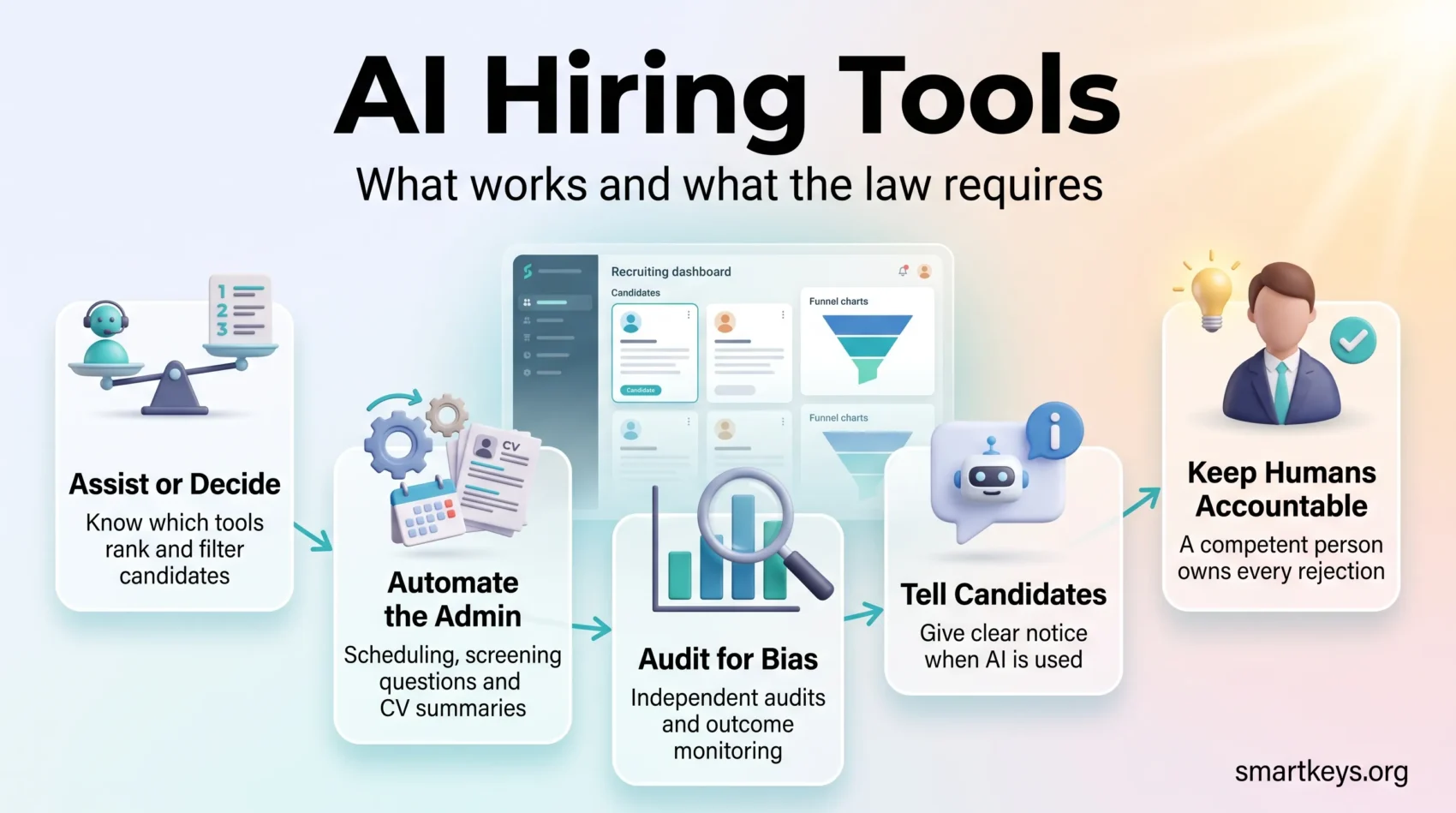
Careful means three things in 2026. Know which of your tools make decisions rather than assist them. Meet the notice, audit and record-keeping duties in every jurisdiction you hire in. Keep a competent human accountable for every rejection. Do that, and AI will widen your talent pool and shorten your cycle time. Skip it, and the efficiency gain arrives with a legal bill attached. For the bigger picture, see our overview of AI in business.
Found this useful?
Make SmartKeys a preferred source on Google, and our articles will surface more often in your Top Stories, AI Overviews, and AI Mode.
Add as Preferred Source