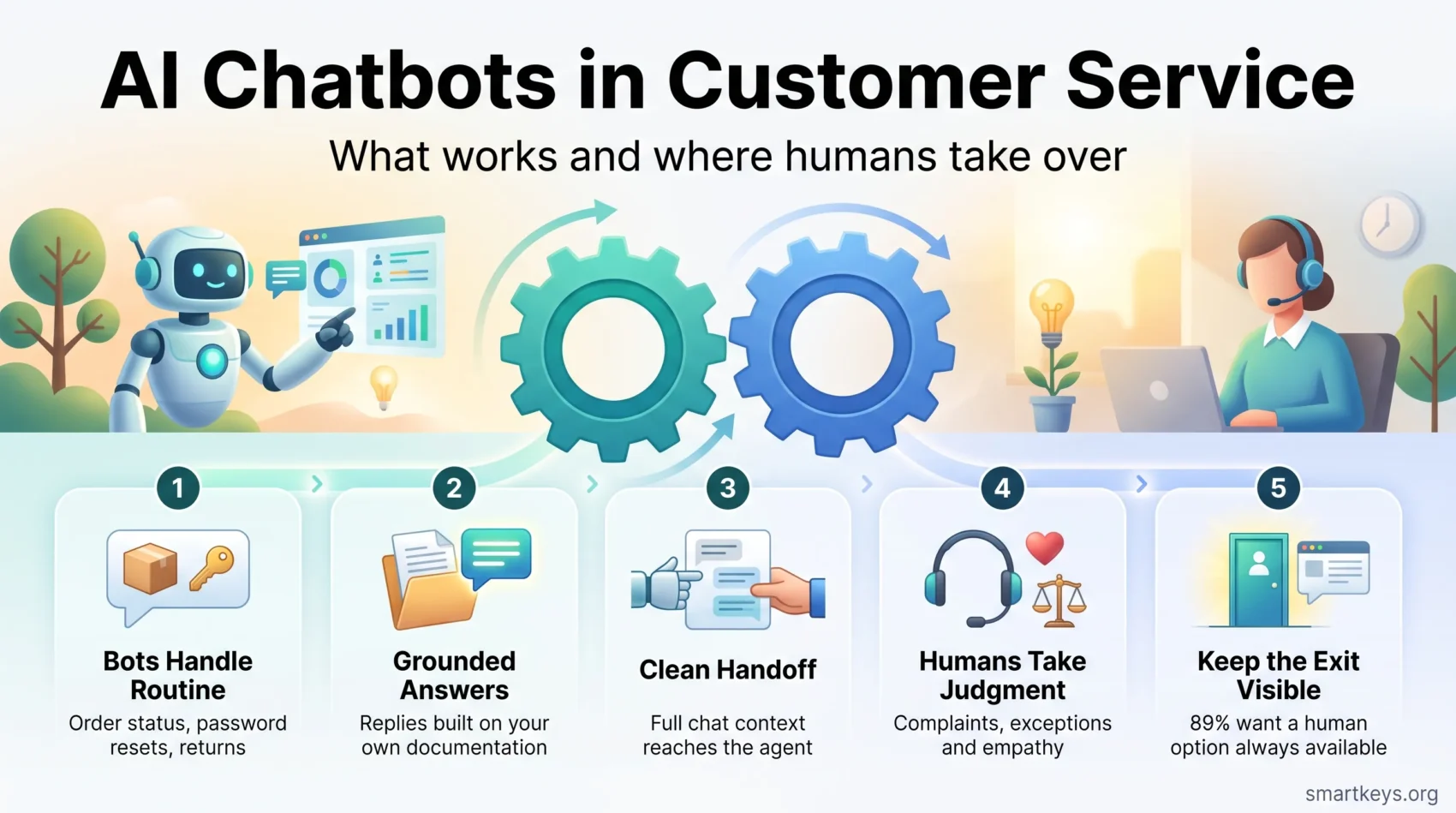
Customer service in 2026 runs on two tracks. AI chatbots absorb the routine volume at a scale no support team could staff for, and human agents take everything that needs judgment. Companies are still working out where that line sits. This guide covers what AI chatbots in business deliver today, how customers react, how to hand conversations over to people, and which rules now apply when you put a bot in front of customers.
The hype has cooled and the data has gotten more interesting. Gartner expects agentic AI to autonomously resolve 80% of common customer service issues by 2029, with a 30% cut in operating costs. Gartner also predicts that half of the organizations that reduced service headcount because of AI will rehire under different job titles by 2027. Both forecasts come from the same research house, and planning for only one of them is how automated customer service projects go wrong.
Key Takeaways
- Gartner expects agentic AI to resolve 80% of common service issues without a human by 2029, cutting operating costs by around 30%.
- Gartner also predicts that by 2027, half of the companies that cut service headcount for AI will rehire under new job titles.
- SurveyMonkey (December 2025, 2,017 US adults): 79% strongly prefer a human agent and 89% want a human option always available.
- Klarna’s assistant still handles roughly two thirds of chats, yet the company resumed recruiting human agents in May 2025 for complex cases.
- From 2 August 2026, the EU AI Act requires that people are clearly told when they are interacting with an AI system.
Where AI Chatbots Stand in 2026
The technology behind chatbot solutions changed more between 2023 and 2026 than in the decade before. Rule-based bots that matched keywords to canned replies have given way to systems built on large language models, which handle open phrasing, follow-ups and context across a conversation. The newer generation also takes action: checking an order, issuing a refund inside policy limits, rebooking an appointment without a handoff.
The gap between demo and production is just as real: a model that answers well in testing still needs your policies, your product data and a clear escalation path before it faces live customers.
The honest summary for 2026: AI chatbots are very good at high-volume, well-defined, low-emotion work, and still weak wherever the answer depends on judgment, exceptions or empathy. The value sits in getting that split right, not in maximizing the automation rate. Our overview of current customer service trends covers how support teams are restructuring around it.
What Are AI Chatbots?
AI chatbots are conversational systems that engage users through chat windows, messaging apps, in-product widgets and increasingly voice channels. They use natural language processing to work out what someone means, not just which keywords they typed. Many products still sold as chatbots are closer to AI agents, because they can call internal systems and complete a task rather than only reply.
Three components decide how well one performs. The language model handles understanding and phrasing. The retrieval layer grounds answers in your own documentation, so the bot quotes your refund policy instead of inventing one. The action layer connects to your CRM, billing or ticketing system. Weak retrieval is the usual cause of confident wrong answers, so grounding matters more than model size.

Modern conversational AI carries context between turns, detects sentiment and switches language mid-conversation. That raises the stakes: a fluent system that is wrong is harder to catch than a clumsy one.
Comparing tools rather than concepts? Our reviews of Intercom and Tidio cover the trade-offs, and the Drift versus LiveChat comparison suits sales use cases.
The Growth of AI Chatbots in Customer Service
Adoption is broad but uneven. Most consumer-facing brands of size run some form of automated first-line support, but the depth varies enormously between a deflection widget and a system that closes tickets end to end. Retail, telecoms, travel, banking and SaaS moved first, because their inbound volume is repetitive.
The workforce picture is less dramatic than the headlines. In a Gartner survey of 321 customer service and support leaders conducted in October 2025, only 20% said they had actually reduced agent staffing because of AI, and Gartner attributed most recent reductions to broader economic conditions rather than automation alone.

The clearest growth is the shift from deflection to resolution. Buyers stopped asking how many tickets a bot avoids and started asking how many it closes correctly, against the same quality bar as a human agent. That pushed vendors toward grounded answers, audit trails and confidence thresholds.
Commerce is the other growth area, where chatbots feed into marketing and sales flows. Sizing, availability and delivery windows are the repetitive questions automation handles well, which is why conversational commerce keeps expanding.
AI Chatbots in Business: Transforming Customer Engagement
Adopting automated service solutions changes more than response times. It changes what your team spends its day on and how customers judge you when something goes wrong.
Meeting Customer Expectations
Customers benchmark support against the fastest experience they have had anywhere, not against your industry. An accurate answer at 2am is the standard; a queue with no visible progress is the failure mode. Automation closes the speed gap, but only if the answer is right. A fast wrong answer costs more trust than a slow correct one, so accuracy thresholds should gate what the bot attempts.
24/7 Availability and Real-Time Support
Continuous coverage is the least disputed benefit. A bot has no night shift, no holiday period and no Monday backlog, and it absorbs spikes without a hiring cycle. For international businesses it pairs well with real-time translation tools, since one automated layer can serve many markets before a local team comes online. Publish when humans are available, so nobody waits in a loop at 3am.
Key Benefits of AI Chatbots in Customer Service
Three benefits of AI chatbots show up consistently in production.
Instant Resolution of Routine Requests
Order status, password resets, delivery windows, plan changes and returns make up a large share of inbound volume in most consumer businesses. They are structured, verifiable and low-emotion, which is exactly where automation is strongest, and resolving them instantly removes waiting from your most common interactions.
Cost Reduction and Increased Efficiency
AI-driven personalization and support cut cost per contact by removing repetitive work rather than removing people. Gartner’s 30% cost reduction forecast for 2029 assumes automation is paired with process redesign, not bolted onto an unchanged workflow. Teams that only put a bot in front of an existing queue tend to see modest savings and rising escalations.
Helping Agents Write Better Replies
Not every deployment talks to customers directly. A quieter model uses AI to draft answers that an agent checks and sends. Octopus Energy, the UK energy supplier, described this setup in 2023: AI drafted personalized email replies, a team member reviewed them, and CEO Greg Jackson said the output matched the work of around 250 people. He also reported an 80% customer satisfaction rate for these emails, compared with 65% for emails written by staff alone.
The appeal is lower risk. A person still approves every answer, so a wrong draft gets caught before it reaches the customer. For teams in regulated industries, or with a thin knowledge base, this is often the safer first step before full automation.
Better Customer Insight
Every conversation is data about what customers want and where your documentation fails. Feeding that into a customer data platform turns support into a source of product intelligence, and voice of customer analysis surfaces the pattern faster than manual ticket review. For the wider roadmap, see our guide to AI in business.
How AI Chatbots Enhance Customer Experience
The experience gain comes from relevance and speed together. A bot that knows the order history answers a better question than one starting from zero.
Personalization Through Customer Profiling
Connected to account data, a chatbot can skip the identification ritual and answer in context: this order, this plan, this open ticket. That removes the most irritating part of support, which is repeating information the company already has. The limit is consent and data governance, and customers notice when personalization tips into feeling surveilled. Our overview of customer experience trends covers where that line sits.
Speed and Efficiency in Query Resolution
A bot handles unlimited conversations in parallel, so queue length stops being a function of staffing. The gain is largest during spikes: a launch, an outage, a delivery disruption. Human teams degrade under that load, while automation holds response times steady and lets agents work the exceptions.

Challenges and Limitations of AI Chatbots
Customer sentiment is the part most implementation plans underweight. In a SurveyMonkey survey of 2,017 US adults conducted in December 2025, 79% said they strongly prefer interacting with a human over an AI agent, 84% said human agents are more accurate, and 81% believed companies use AI mainly to save money rather than improve service. Notably, 89% said companies should always offer a human option.
That does not mean automation fails. It means the escalation path is not a detail, it is the product. A bot that resolves quickly and hands off cleanly is accepted; one that hides the exit generates the backlash those numbers describe.
Klarna is the reference case in both directions. Its AI assistant took on a large share of chats from early 2024 and the company reduced hiring accordingly. By May 2025 the CEO had reversed position publicly, saying investment in the quality of human support was the way forward, and Klarna began recruiting agents again for complex cases while the assistant kept handling roughly two thirds of volume.
The technical limits are familiar. Ungrounded systems generate plausible wrong answers, stale source documents produce outdated policies, and imperfect sentiment detection can trap a frustrated customer in a loop. Bias in training data can surface in how different customers are treated, which is why explainable AI and clear ethical AI practices belong in the deployment plan rather than the appendix.
Data protection is the other limit. A bot connected to account systems sees names, addresses, order histories and sometimes payment or health details. Give it access only to the data each task needs, and check where the vendor stores and processes transcripts. Healthcare, insurance and financial services add sector rules on top of general privacy law. Our overview of data privacy trends covers the wider picture.
Designing the Handoff Between Bot and Human
The handoff is where most customers form their opinion of your automation. A bot that passes a case on cleanly feels helpful. A bot that makes the customer start over feels like a wall.
Set Clear Escalation Triggers
Decide in advance when the bot must pass a conversation to a person. Common triggers are an explicit request for a human, two failed attempts to answer the same question, signs of anger or distress, and high-stakes topics such as cancellations, complaints or billing disputes.
Pass the Full Context Along
When a case moves to an agent, the agent should see the full chat transcript, the identified account and what the bot already tried. The customer should never have to repeat an order number they typed two minutes earlier. Most helpdesk platforms support this, but someone has to configure it.
Train the Team and Keep Improving
Agents need to know what the bot can and cannot do. After launch, review a sample of transcripts every week. Track resolution quality, escalation rate and repeat contacts, then fix the source documents behind recurring wrong answers. A chatbot improves mainly through better content and rules, not through waiting for a new model.
What the EU AI Act Requires From August 2026
If you serve customers in the EU, transparency is now a legal obligation rather than a courtesy. Article 50 of the EU AI Act applies from 2 August 2026 and requires that AI systems intended to interact directly with people are designed so users are informed they are dealing with an AI. The disclosure must come at the latest at the first interaction, and it must be clear and noticeable rather than buried in terms and conditions.
A narrow exception exists where AI involvement is obvious to a reasonably informed person, but guidance warns against leaning on it. The practical answer: label the bot, keep the label visible, log what it said. Our notes on EU AI Act compliance and the wider AI regulation landscape cover the surrounding obligations, and internal rules such as generative AI usage guidelines keep teams consistent.
Future Trends in AI Chatbot Development
The next phase is less about better conversation and more about reliable action. Vendor differences are shifting to grounding, permissions and auditability.
From Answering to Acting
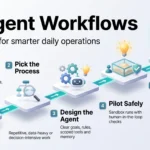
Agentic systems that complete multi-step tasks are the main direction of travel, and they are why Gartner’s 80% forecast is framed around agentic AI rather than chat. A system that can look up, decide within policy and execute closes tickets instead of describing what the customer should do next. Our guide to AI agent workflows covers how these are structured.
The constraint is governance. Once a bot can issue a refund or change an account, you need permission boundaries, confidence thresholds and a full audit trail. In serious deployments, most engineering effort now goes there rather than into the conversation.
Integration With Other Systems
Value comes from connection. A chatbot wired into CRM, order management and knowledge sources performs on a different level from a standalone widget. Voice is converging too, since the same models power voice AI assistants.
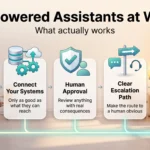
By combining AI-powered assistants with conversation analytics and tighter system integration, businesses deliver support that is faster and more accurate at once. The companies that get there treat automation as a redesign of the service model, not a widget added to the old one.
Found this useful?
Make SmartKeys a preferred source on Google, and our articles will surface more often in your Top Stories, AI Overviews, and AI Mode.
Add as Preferred SourceFAQ
What are AI chatbots and how do they work?
AI chatbots are conversational systems that use natural language processing to interpret what a person means and then respond. Modern versions run on large language models, so they handle open phrasing and follow-up questions rather than matching fixed keywords. Three parts determine quality: the language model that understands and phrases the reply, a retrieval layer that grounds answers in your own documentation, and an action layer that connects to systems such as CRM or billing so the bot can complete a task. Without grounding, a chatbot can produce fluent answers that are simply wrong, which is why connecting it to verified company content matters more than model size.
How can AI chatbots benefit my business?
The main gains are continuous availability, instant handling of repetitive requests, and better data on what customers actually ask. Order status, password resets, delivery questions and plan changes are structured and verifiable, so automation handles them well and frees agents for cases that need judgment. Gartner forecasts a 30% reduction in customer service operating costs by 2029 for organizations using agentic AI, but that figure assumes process redesign rather than a bot placed in front of an unchanged queue. Treat the savings as a result of restructuring the workflow, not as an automatic outcome of buying software.
Do customers actually want to talk to a chatbot?
Most say they would rather not. In a SurveyMonkey survey of 2,017 US adults in December 2025, 79% said they strongly prefer interacting with a human over an AI agent, 84% considered human agents more accurate, and 89% said companies should always offer a human option. That does not make automation unworkable. Customers accept a bot that resolves their issue quickly and hands off cleanly when it cannot. Resistance builds when the escalation path is hidden or the bot loops. Design a visible, fast route to a person, and measure how often customers take it.
What challenges do AI chatbots face?
The recurring problems are wrong answers delivered confidently, stale source documents that produce outdated policies, and poor handling of emotionally charged cases. Sentiment detection is imperfect, so a frustrated customer can stay stuck in an automated loop past the point where the relationship is recoverable. Bias in training data can also surface in how different customers are handled. Klarna’s experience is instructive: its assistant absorbed a large share of chats from 2024, but by May 2025 the company was recruiting human agents again for complex cases, because the automation ceiling was lower than first projected.
What should happen when a chatbot hands a customer over to a human agent?
The agent should receive the whole conversation so the customer never has to repeat themselves. That means the chat transcript, the identified account or order, and a note of what the bot already tried. Define clear triggers for the handoff, such as a direct request for a person, repeated failed answers, signs of frustration, or sensitive topics like complaints and cancellations. Tell the customer that a person is taking over and how long it will take. A clean handoff often decides whether customers accept automation at all.
Is it safe to let an AI chatbot handle customer data?
It can be, if you limit what the bot can reach and check how the vendor treats transcripts. Give the chatbot access only to the data a task requires, such as order status rather than full payment details. Confirm where conversations are stored, how long they are kept and whether the vendor uses them to train its models. Regulated sectors such as healthcare, insurance and finance carry extra rules on top of general privacy law, so involve your data protection lead before launch.
Do I have to tell customers they are talking to an AI?
In the EU, yes. Article 50 of the EU AI Act applies from 2 August 2026 and requires that AI systems intended to interact directly with people are designed so users are informed they are dealing with an AI. The notice must come at the latest at the first interaction and must be clear and noticeable, not hidden in terms and conditions. A narrow exception exists where AI involvement would be obvious to a reasonably informed person, but official guidance advises against relying on it. The practical approach is to label the assistant visibly, keep the label present throughout, and log what it told each customer.
How do I integrate an AI chatbot into my existing customer service strategy?
Start by listing your highest volume request types and separating the structured, verifiable ones from those that need judgment. Automate the first group only. Connect the bot to your knowledge base and core systems so answers are grounded in real data, then set a confidence threshold that routes anything uncertain to a person. Define and publish the escalation path before launch. After go-live, review transcripts weekly for wrong answers and gaps in documentation, and track resolution quality rather than deflection rate. Automation rate is a vanity metric if escalations and repeat contacts rise behind it.