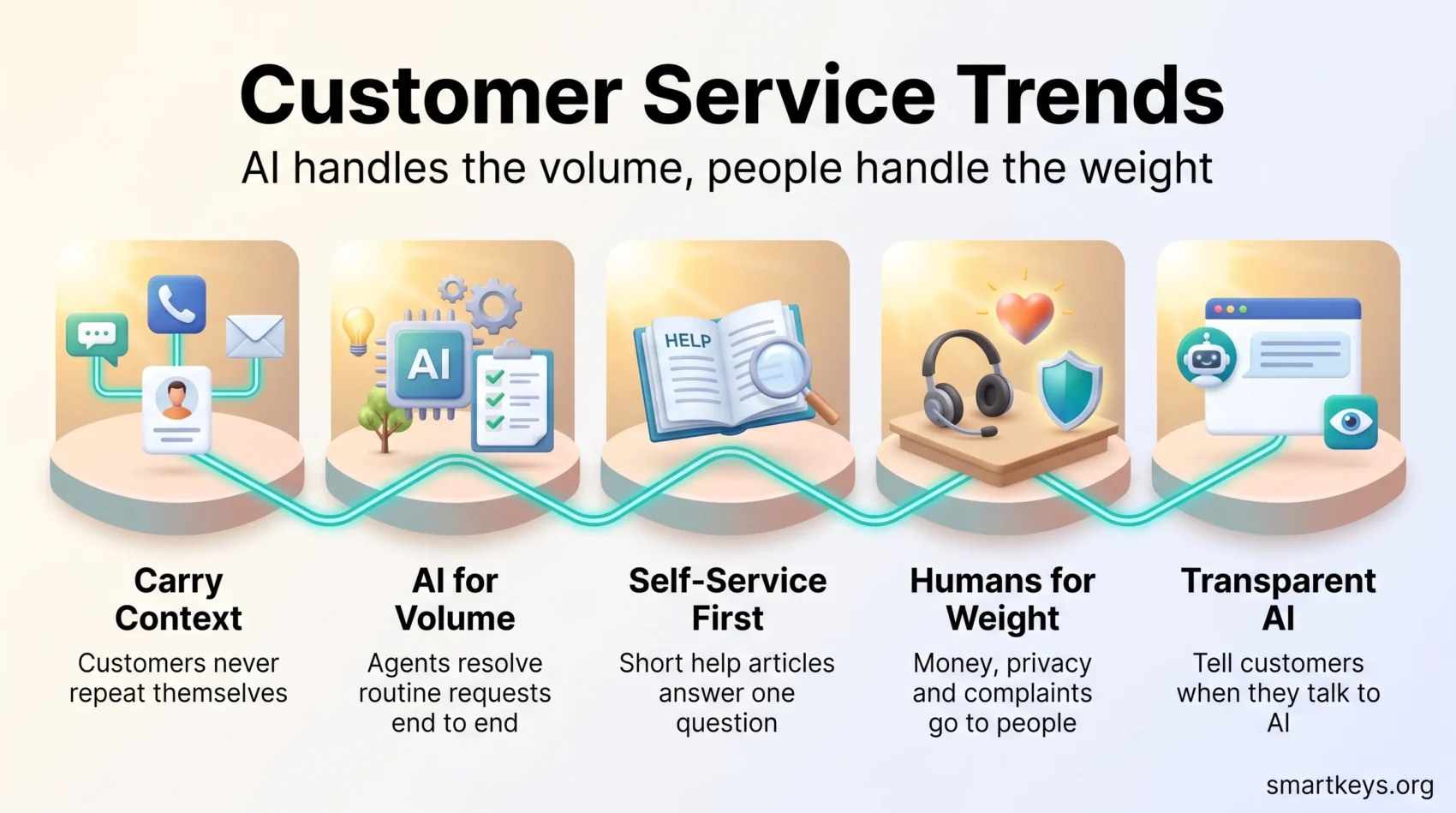
Customer service in 2026 is judged on one thing above all: whether the person on the other end has to explain themselves twice.
AI can answer faster, self-service can answer around the clock, and analytics can spot a problem before anyone calls. None of it helps if the customer still repeats their order number to a third person.
This guide covers the shifts that matter this year, what the evidence supports, and what to start in the next 90 days. One note on vocabulary: CX means customer experience, the whole path a customer takes with you, not just the ticket at the end.
Key Takeaways
- Carrying context across channels is the biggest lever. Zendesk found 74% of consumers are frustrated when asked to repeat information.
- Let self-service handle routine questions so your team can spend time on the hard ones.
- Use AI for volume, keep humans for money, privacy and anything emotionally charged.
- From 2 August 2026, EU rules require you to tell people when they are talking to an AI.
- A 90 day roadmap beats a three year strategy. Pick two or three high volume questions and start there.
Why 2026 Raises the Stakes for Customer Service
Support used to be a cost centre leadership reviewed once a quarter. That changed once customers started leaving quietly instead of complaining.
In its 2026 CX Trends Report, published in November 2025, Zendesk found that 85% of CX leaders say they lose customers after a single unresolved issue, and that 74% of consumers get frustrated when asked to repeat information they have already given. A customer who explains their problem three times has usually decided something about your company before the third explanation ends.
- Fix the repeat explanations first. It is cheaper than any new tool and customers notice immediately.
- Watch for silent disengagement: fewer logins, unopened emails, a ticket closed but never really solved.
- Treat satisfaction scores as an early warning system for revenue. Our guide to customer retention strategies covers how to act on them.
What That Means Before You Buy Anything
Customers want three things that pull in different directions: speed, context, and a human when it counts. Zendesk found 81% of consumers want a representative to pick up where the last interaction left off, and 67% expect support personalized on what happened before.
So look at your own data before you look at tools. If your customer records sit in four systems, an AI agent inherits that mess and repeats it back at speed. B2B adds stakeholders and a contract, but the fix is the same: one place where the full history lives, plus unglamorous work on help articles, routing and quality reviews.
AI Handles the Volume, People Handle the Weight
AI in support has moved from suggesting answers to completing tasks. The industry term is agentic AI: software that carries out a multi step job (look up the order, check the policy, issue the refund) rather than just replying with text.
Gartner predicted in March 2025 that agentic AI will autonomously resolve 80% of common customer service issues by 2029, cutting operational costs by around 30%. Note the word “common”. That forecast is about routine, repeatable requests, not the hard cases.
Where AI Agents Actually Earn Their Keep
Start with your highest volume, lowest ambiguity requests: password resets, order status, delivery changes, plan upgrades. These have a clear right answer and a clear finish line.
Build the exit door before you launch. Every automated flow needs a fast route to a person, and that handoff must carry the full conversation. A bot that hands over a blank ticket makes things worse.
AI Copilots: Helping Agents Instead of Replacing Them
A copilot sits beside your agent rather than in front of the customer. It drafts a reply, summarizes a long thread, pulls up the relevant policy. The agent edits and sends.
This is the lower risk half of AI in support and often the faster win, because the agent stays accountable for what goes out.
Voice AI and the Phone Line
Phone support was the slowest channel to modernize and is now catching up. Zendesk reports 83% of CX leaders believe Voice AI can meaningfully improve the experience, and 76% of consumers prefer companies that let them move between text, voice and images inside one conversation. The test for voice automation is not whether it sounds human. It is whether the caller gets an answer without being transferred.
Measuring Whether Any of It Worked
Four numbers tell you most of what you need:
- Deflection or containment rate: the share of contacts resolved without a human.
- Time to resolution: how long from first contact to a solved problem, not to a first reply.
- CSAT: customer satisfaction, a short rating asked right after an interaction.
- First contact resolution: the share of issues solved without the customer coming back.
Track them together. A deflection rate that climbs while satisfaction falls means you hid the queue rather than shortening it. Our overview of AI chatbots in business goes deeper on where automation pays off.
Self-Service Becomes the Default First Step
Self-service means the customer solves the problem themselves, using a help article, a chatbot or an automated phone menu. Done well it is the fastest support anyone gets, because there is no queue. Done badly it is a wall, and the difference is almost always content quality rather than technology.
Knowledge Bases People Actually Use
A help centre earns its keep when someone finds the right article in one search and stops reading halfway through because the problem is solved.
Write short articles that answer one question and give each an owner and a review date. Then look at what people searched for and did not find, and write those next. That search gap report is the most useful document in most support teams and the least read, as our piece on knowledge management explains.
Chatbots That Know When to Step Aside
Design bots around a short list of things they do well, and make the handoff to a person quick and visible.
- Match the bot’s tone to how your brand writes, and never let it pretend to be a named person.
- Feed failed conversations back into your help articles. Every question the bot could not answer is a content brief.
- Set a service level for escalations, so “talk to a human” does not mean a 40 minute wait.
Voice Self-Service Without the Maze
IVR stands for interactive voice response, the automated menu you reach when you call a company. Modern speech recognition lets callers say what they need instead of pressing four numbers to find out you are closed. Used well it identifies the caller, handles simple requests, and routes everything else to the right person first time. For conversational routing and bot design, see our conversational commerce playbook.
Omnichannel Consistency Is the Baseline, Not a Bonus
Omnichannel means the customer can switch between chat, email, phone and social media without starting over. It is a plumbing problem more than a strategy problem, and Zendesk’s finding that 81% of consumers want representatives to continue where the last interaction stopped is the whole requirement.
Carrying Context Across Channels
Build one customer record that every channel writes to and reads from, holding the history, recent actions and the state of any open issue. Then define what happens when a conversation moves from bot to human, or chat to phone. The rule: context travels with the customer, not the other way round.
Choosing Your Channel Mix
Do not guess which channels your customers prefer. Measure volume, satisfaction and resolution rate per channel, then invest where the gap between demand and performance is widest. Keep real phone capacity: younger customers are often assumed to avoid calls, but the phone is still where urgent problems get solved.
- Keep tone and response times consistent, so the brand feels like one company.
- Route by history and urgency rather than by queue order alone.
- Look at whole journeys, not single tickets, to find where people give up. Our guide to omnichannel marketing covers the same principle on the acquisition side.
Personalization at Scale, Empathy at the Hard Moments
Personalization means using what you know about someone to save them effort. It is not a first name in a template. Zendesk found 85% of CX leaders consider personalization critical to the journey, and the practical version is unglamorous: show the agent the last three tickets and the current order status before they say hello.
Turning Data Into Less Work for the Customer
Use purchase history, recent behaviour and past interactions to skip questions you already know the answer to. Then be explicit about the trade: say what information improves their experience and let them control how and how often you contact them. Our article on AI personalization for customers covers the mechanics, and zero party data explains how to collect preferences people volunteer rather than data you infer.
Designing Escalations Where a Human Takes Over
Some interactions should never be automated. A SurveyMonkey survey of 2,017 US adults in December 2025 found that for a billing or financial dispute, 85% want a human and only 5% want AI. For data security issues it is 78% human against 10% AI, and 89% believe companies should always offer a way to reach a person.
That is your escalation policy, written by your customers. Route money, privacy, complaints and anything emotionally charged to a person by default, and give the agent a short summary at the top of the ticket so they can start with reassurance instead of research.
Privacy and Security Move From Compliance to Advantage
Data protection has become part of the product. When customers can see what you collect and switch it off, they share more, not less. Zendesk found 95% of consumers expect clear explanations for AI decisions, and 80% of CX leaders expect transparency to become a legal requirement for customer facing AI. In Europe it already is.
What the EU AI Act Requires From August 2026
Article 50 of the EU AI Act took effect on 2 August 2026. The core duty is short: if an AI system interacts directly with a person, you must tell that person they are dealing with AI, unless it is already obvious.
It binds both the company that builds the system and the company that deploys it, and reaches any organization whose AI is used in the EU wherever it is headquartered. Penalties run up to 15 million euro or 3% of worldwide annual turnover, whichever is higher. Providers of existing generative AI systems have until 2 December 2026 for content marking duties. Our explainer on EU AI Act compliance sets out the wider obligations.
Privacy by Design in Practice
Privacy by design means deciding what you will not collect before you build, rather than bolting consent onto a finished system. Offer granular choices, explain how each piece of data improves the service, and collect only what you use. Encryption and access controls should be the default on every channel, including the recorded phone call.
Run regular audits and review the security of vendors inside your support stack. Train agents to recognise phishing, since a support desk is an attractive door in.
- Align policies with GDPR and applicable state privacy laws, and say so in language a customer can read. See our privacy compliance framework and data privacy trends.
- Agree in advance who decides, who fixes and who notifies if something goes wrong.
Real-Time Insights and Feedback Loops
If you only learn about a problem in next month’s report, you fix it two months late. The goal is to shorten the distance between a customer’s frustration and someone acting.
From Surveys to Signals
NPS, or Net Promoter Score, asks how likely someone is to recommend you. It works as a trend line and says little on its own about why.
Combine it with signals that arrive without asking: in product behaviour, repeated tickets on one topic, sentiment in chat transcripts. Zendesk reports 82% of CX leaders say analytics they can query in plain language surface insights in seconds rather than weeks.
- Link comments to scores, so you know what a falling number is about.
- Measure time to insight and time to action, not just the score.
- Tell customers what you changed after they told you something. Closing the loop visibly is what makes people answer next time.
Predicting Churn and Acting Early
Look for patterns that preceded past cancellations: a drop in usage, a ticket reopened twice, an unpaid invoice sitting quiet. Intervene with help rather than a discount, because a discount rarely fixes the reason. Feed what you learn back into help articles and escalation triggers. Our guides to voice of customer analysis and big data in customer experience go further on turning signals into decisions.
Your Team Is the Experience
Tools change what a team can do. Training decides whether it happens.
Teaching Agents to Work With AI
Run short, hands on sessions using real tickets rather than tidy examples. Teach agents to treat AI output as a draft: check the facts, keep the promise realistic, own the reply. Two habits matter most. Verify anything the AI states as fact about an account or policy, and rewrite the tone, because a technically correct answer delivered coldly is still a bad answer.
The Soft Skills That Still Decide Outcomes
Coach active listening, de-escalation and plain language. As routine questions move to automation, the tickets reaching agents get harder, not easier.
- Write playbooks for common situations, then let agents adapt within them.
- Measure quality, resolution time and satisfaction together, never one alone.
- Protect learning time in the schedule or it is the first thing cut on a busy week.
Involve agents when you update help articles. They know which explanation works, because they have watched customers misunderstand the other one. Our piece on AI performance coaching covers the enablement side.
Your 90-Day Roadmap
Ambitious multi year plans die in month four. A short plan with visible results survives.
Days 1 to 30: Quick Wins
Automate your two or three highest volume requests and nothing else. Refresh the ten help articles people open most. Get context into one place so agents and bots see the same history. Turn measurement on from day one, otherwise you will be arguing about opinions in month two.
Days 31 to 60: Build Momentum
Pilot voice automation in a single queue and measure containment before expanding. Automate quality checks to find coaching opportunities rather than to police agents. Use behavioural signals for proactive contact, but keep it useful: a message that saves someone a call is welcome, one that sells something is not.
Days 61 to 90: Check the Platform
Confirm the foundations before you scale: unified customer data, working security controls, analytics you can query, and open interfaces between tools.
- Write down the playbooks, response time commitments and rollout milestones.
- Tell customers what improved. Silent progress earns no credit.
For tooling, see our reviews of Zendesk and Intercom, the Zendesk vs Freshdesk comparison, and customer success tools for the retention side.
Conclusion
The customer service trends that matter in 2026 are less exotic than the vendor pitches suggest. Carry context so nobody repeats themselves. Let automation handle volume and keep people for the moments that carry weight. Tell customers when they are talking to software, because in the EU you now have to.
Pick one of those, run it for 90 days, and measure whether customers came back. That teaches you more than another strategy document. Our broader look at customer experience trends and customer loyalty puts these shifts in context, while CRM trends covers the systems underneath.
Found this useful?
Make SmartKeys a preferred source on Google, and our articles will surface more often in your Top Stories, AI Overviews, and AI Mode.
Add as Preferred Source