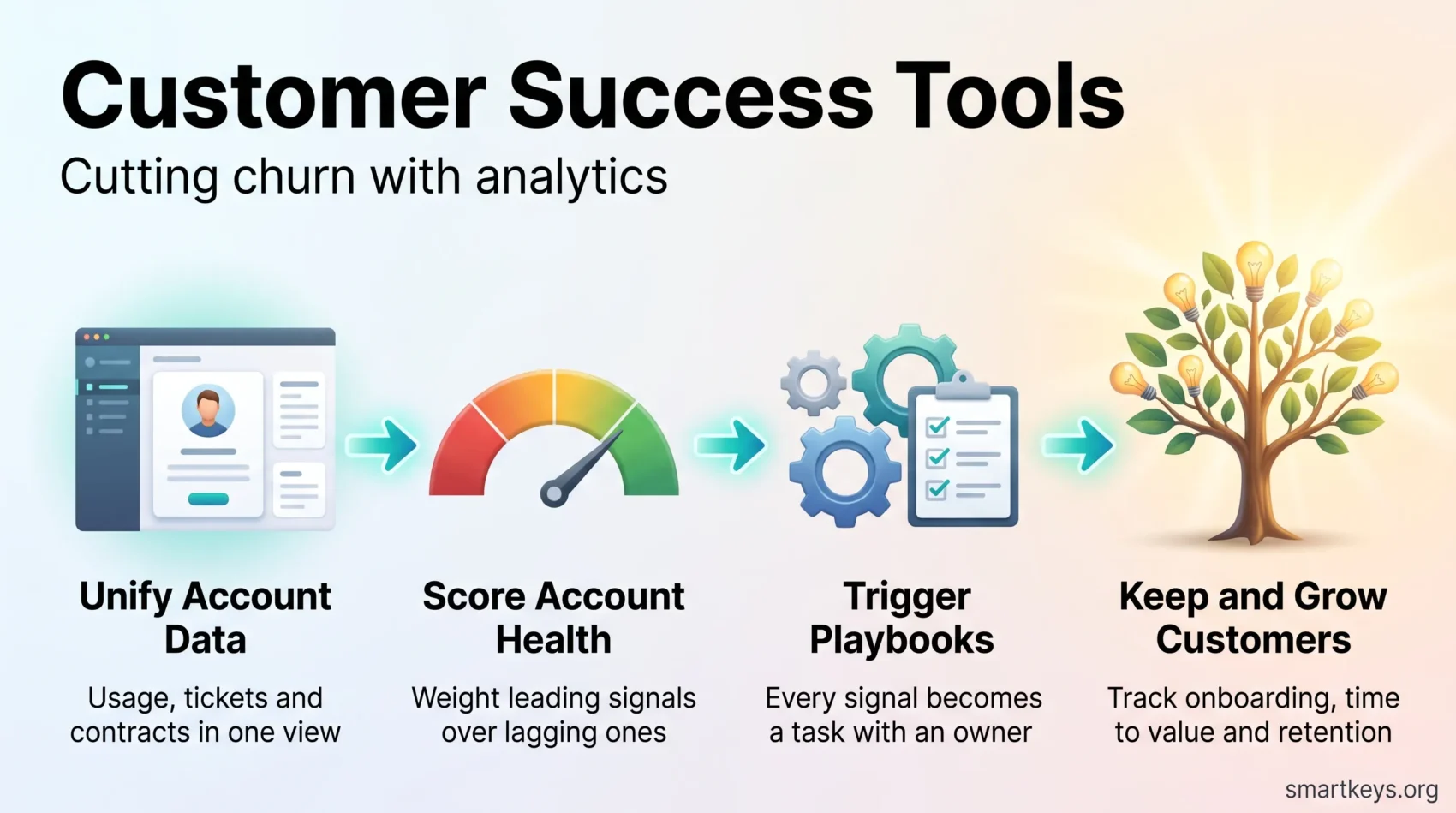
Customer success tools are the software your team uses to keep existing customers, not to win new ones. They pull product usage, support tickets, survey answers and contract data into one place, then flag the accounts that look like they are about to leave.
That last part is the whole point. Churn is the share of customers, or of recurring revenue, that you lose in a given period. Winning a replacement customer almost always costs more than keeping the one you have, so a few percentage points of churn move the whole business.
This guide explains what these platforms actually do, which categories exist, what the current pricing looks like, and how to pick one. Every price below was checked against the vendor’s own pricing page in September 2026. Where a vendor does not publish prices, we say so instead of guessing.
Key Takeaways
- One platform can hold onboarding, health scores and playbooks, so nothing falls between teams.
- Analytics only helps if each signal is tied to a specific action someone owns.
- Proactive outreach works, but sloppy outreach creates support tickets instead of preventing them.
- Most vendors in this market quote privately. Published pricing is the exception.
- Track onboarding completion, time to first value, and net revenue retention rather than activity counts.
What customer success software does
A customer success platform is a customer database with a memory for behaviour. A CRM, the system your sales team uses to track deals, mostly records what people said. A customer success platform records what they did: which features they opened, how often they logged in, how many support tickets they filed, whether they finished onboarding.
Once that data sits in one profile, three things become possible. You can score each account for risk. You can trigger a task automatically when a score drops. And you can see, across the whole book of business, which customer segments are quietly slipping.
Here is a concrete example. A finance software vendor sells to 400 companies. Sixty of them have stopped using the reconciliation module that justified the purchase. Nobody noticed, because each account manager only sees their own twenty accounts. A customer success platform surfaces those sixty as one list, ranked by contract value, with a suggested next step for each.
- What they do: centralise account data, score health, run playbooks, raise alerts.
- What they replace: spreadsheets, saved CRM views and one person’s memory.
- What they do not do: fix a product people do not want.
For the wider picture on where this data comes from, see our guide to the customer data platform and how it differs from a CRM.
How analytics actually reduces churn
Analytics reduces churn only when a number turns into a task with an owner and a deadline. A dashboard nobody acts on is a decoration.
Pick signals that predict cancellation
The signals worth watching are the ones that appear before a renewal conversation goes wrong. Usage dropping month over month. Licences bought but never assigned. An onboarding checklist stuck at step three for six weeks. The internal champion who signed the contract leaving the company.
Each of those should map to a named play. Unassigned licences trigger an enablement email. A departed champion triggers a call to find the replacement. That mapping is the work; the software just enforces it.
Build a health score you can defend
A health score blends several inputs into one number, usually red, amber or green. Keep two kinds of input separate in your head. Leading indicators, such as adoption breadth and time to first value, tell you what is likely to happen. Lagging indicators, such as renewal history and survey sentiment, tell you what already happened.
Weight the leading indicators more heavily. A score built mostly on lagging data will confirm churn rather than prevent it.
Survey at milestones, not at random
NPS, or net promoter score, asks how likely someone is to recommend you. CSAT measures satisfaction with a single interaction. Both are useful at fixed moments: end of onboarding, ninety days in, sixty days before renewal. Route low scores straight into a recovery play instead of into a report.
Be careful with proactive outreach
Reaching out before the customer complains does work, but it is easy to do badly. Gartner surveyed more than 4,800 customers in late 2021 and found that proactive service raised value enhancement scores by 9%. The same research found that two thirds of consumer customers, and 82% of business customers, contacted the company after receiving proactive outreach. Around 24% of business customers got in touch simply to confirm the message was not a scam.
The lesson is practical. Outreach must be specific, recognisably from a person your customer knows, and clear about whether a reply is needed. Vague “just checking in” messages create tickets.
“Visibility into usage and timely, specific outreach turns signals into retention. Vague outreach turns signals into support volume.”
Core capabilities to expect
Every serious platform in this market now bundles the same five things. Judge vendors on how well each works, not on whether it exists.
Guided onboarding
Checklists, in-product tours and milestones that move a new user to their first real result. The metric here is time to value: how long from signup to the moment the customer gets something useful out of the product.
A single account view
Product telemetry, support history, contract terms and feedback in one profile. This is usually called a customer 360. Without it, your team spends the first ten minutes of every call rebuilding context.
Dashboards and predictive flags
Two audiences need different views. Operators need a queue of accounts to work today. Executives need portfolio health and revenue risk. Predictive flags should point at a specific account and a specific reason, not a general score.
Workflow automation
Rules that turn a signal into a task, assign it to a person and escalate it if nothing happens. If your team is building this in a separate automation tool, read our overview of integration platforms before you commit.
Self-service and AI support
Help centres, in-app answers and AI chat handle the routine questions so your team can spend time on the accounts that need judgement. Our guide to AI chatbots in customer service covers where automated answers hold up and where they annoy people.
One compliance note for teams in Europe. Since 2 August 2026, the EU AI Act’s transparency duties apply to general purpose AI systems, which affects how you disclose automated interaction to customers. Our summary of EU AI Act compliance explains what that means in practice.
Tools for onboarding and product adoption
These platforms focus on the first weeks, when most churn is decided.
Intercom
Intercom combines a support inbox, in-app messaging, product tours and an AI agent called Fin. It suits companies that want onboarding guidance and customer support in one tool rather than two.
Pricing, taken from Intercom’s own page in September 2026, runs at $29 per seat per month on Essential, $85 on Advanced and $132 on Expert, billed annually. Fin is billed separately from $0.99 per resolved conversation, so your bill scales with volume rather than headcount. Our full Intercom review goes deeper on the trade-offs, and Intercom versus Help Scout compares it with a lighter alternative.
UserGuiding
UserGuiding is a no-code layer you drop on top of your existing product to build tours, checklists, resource centres and in-app surveys. It is quick to launch because it needs almost no engineering time.
Pricing is based on monthly active users rather than seats. Starter begins at $174 per month and Growth at $349 per month when billed yearly, with Enterprise quoted individually. Check your actual monthly active user count before comparing, because that number, not your team size, drives the price.
OnRamp
OnRamp targets complex business-to-business onboarding, the kind that runs for weeks and involves the customer’s own staff. It offers templated projects, branded customer portals, task logic that adapts to answers, and reporting on where implementations stall. Pricing is quoted on request.
“Measure activation rate, time to first action and milestone completion. Those three tie onboarding directly to renewal.”
Platforms built around churn prevention
This group leads with health scoring and risk alerts.
ChurnZero
ChurnZero is known for detailed segmentation, blended health scores, real-time alerts and journey orchestration. It also includes in-app messages and walkthroughs, so you can act inside the product rather than only by email. ChurnZero does not publish a price list; every deal is quoted.
Totango and Catalyst
This is the biggest structural change in the category. Totango and Catalyst merged in 2024 and now sit under one company. As of September 2026 the vendor sells three products around a shared data layer: the Totango Customer Success Platform, the Catalyst Customer Growth Platform, and Unison, its customer intelligence engine. If you shortlisted them as two competing options, you are now comparing two products from the same supplier.
Totango is still the one to look at for pre-built programmes, which it calls SuccessBLOCs, and Catalyst for its visual journey builder and revenue-focused plays. Neither publishes pricing any more. Consolidation like this is common right now, and our piece on SaaS consolidation explains what to check in your contract when a vendor is acquired.
ZapScale
ZapScale keeps things narrow: health analytics, prediction alerts, outcome tracking and playbooks. It is one of the few vendors here with public pricing. Startup costs $500 per month for up to 100 customers, and Growth costs $2,000 per month above that, with unlimited users on both.
Customer 360 and data centralisation
These platforms lead with the unified profile and build the workflows on top.
Planhat
Planhat centralises account data and layers health scores, churn predictions and custom triggers on top. It now sells a CRM, a customer success platform and a professional services module that share one data model, plus paid add-ons for AI and email. Pricing is quote-based.
Custify
Custify offers a full customer 360 with dashboards, automation, calculated metrics, surveys and a customer-facing portal. It is aimed at small and mid-sized software companies and includes hands-on onboarding help. Custify does not publish prices, though it confirms it charges no setup fee.
Akita
Akita is the budget option and publishes its rates. As of September 2026 it charges $49 per month for small teams, $99 for growing teams and $499 for enterprise teams. For a company with a handful of customer success managers and a modest account base, that is an order of magnitude below the enterprise platforms.
Whichever you pick, the profile is only as good as the pipes feeding it. If your usage data lives in three systems, read our guide to real-time data and to data governance before you buy.
Feedback and voice of the customer
Listening tools capture what customers say; success platforms capture what they do. You want both. InMoment collects responses from surveys, chat, email and in-app prompts, then routes them into case management so a comment becomes an assigned task rather than a chart.
Two habits make this work. Ask at the moment of experience rather than in a quarterly blast. And close the loop visibly, so the customer sees that the complaint changed something. Our article on AI in voice of the customer programmes covers how automated analysis handles free-text answers, and customer experience trends sets the wider context.
For guidance on linking feedback across channels and designing omnichannel listening programs, see omnichannel strategies.
Workflows, journeys and scalable playbooks
A playbook is a written sequence of steps triggered by a specific signal. Without playbooks, every customer success manager improvises, and quality depends on who happens to own the account.
ClientSuccess
ClientSuccess is deliberately light. It covers onboarding flows, journey maps, renewal workflows and reporting, and teams report going live without a dedicated administrator. That matters if you do not have operations staff to configure a heavier system.
SmartKarrot
SmartKarrot centralises journeys with what it calls SmartPlaybooks, plus early warning alerts and dynamic segmentation. It adds call sentiment analysis, which scores recorded conversations so the right account gets escalated. Our overview of augmented analytics explains how that kind of automated interpretation works and where it misreads context.
Design playbooks to be standard in structure and flexible in wording. A rep who has to send a template verbatim will stop using it. If you are building the same discipline on the revenue side, our guide to RevOps forecasting covers the same principle applied to pipeline.
What this actually costs in 2026
Published pricing is rare in this category, and that is the single most useful thing to know before you start. Of the platforms above, only Intercom, UserGuiding, Akita and ZapScale list rates publicly. ChurnZero, Totango, Catalyst, Planhat, Custify, OnRamp, SmartKarrot and InMoment all quote privately.
That has two consequences. First, budget for a procurement process, not a checkout. Second, ask every vendor the same three questions in writing: what is the annual list price at our seat and account count, what is billed separately, and what does the price do at renewal.
Watch for the pieces that sit outside the headline number. AI features are increasingly metered per outcome rather than per seat, as Intercom’s per-resolution Fin pricing shows. Implementation and data mapping are often a separate line. Our explainer on usage-based pricing covers how to forecast a metered bill before you sign it.
How to choose
Start from the number you are trying to move, then work backwards to features.
Net revenue retention is the usual target. It compares this year’s revenue from last year’s customers, after upgrades, downgrades and cancellations. A figure above 100% means your existing base grew without any new logos. For context, SaaS Capital’s 2025 survey of private business-to-business software companies found median net revenue retention of 102% for firms with average contract values between $25,000 and $50,000, with the top quartile at 111% and the bottom quartile at 97%. Those are useful goalposts, not a promise.
- Match the tool to the failure: if customers leave in month two, buy onboarding software. If they leave at renewal, buy health scoring.
- Count your integrations first: the platform is worthless if it cannot read your product telemetry and your billing system.
- Trial with your own accounts: load real data for twenty customers and see whether the health score agrees with what your team already knows.
- Check the admin burden: ask who configures playbooks after launch, and whether that person exists on your team.
- Verify security early: single sign-on, role-based access, data residency and certifications, before the commercial conversation.
If retention is a company-wide priority rather than a team project, our guides to customer retention strategies and building a customer-centric culture cover the parts software cannot fix. For product-led businesses, the product-led growth playbook shows how retention and expansion connect, and product-led versus sales-led growth explains which motion fits your market.
Conclusion
Pick the category first, the vendor second. Onboarding problems point to Intercom, UserGuiding or OnRamp. Renewal risk points to ChurnZero, Totango, Catalyst or ZapScale. Scattered data points to Planhat, Custify or Akita. Missing feedback points to a voice of the customer tool such as InMoment.
Then do the unglamorous part. Load real accounts into a trial, check whether the health score matches your team’s instinct, and confirm what the price does in year two. A platform that surfaces the right sixty accounts and tells one person what to do about each of them will beat a more sophisticated tool nobody has time to configure.
Found this useful?
Make SmartKeys a preferred source on Google, and our articles will surface more often in your Top Stories, AI Overviews, and AI Mode.
Add as Preferred Source