Real-time data reaches you while the event it describes is still happening, or close enough that you can still act on it. That is the whole promise, and the whole difficulty. A dashboard refreshing every second is worthless if nobody watches it, and a nightly batch report is fine for a decision made once a quarter.
What changed recently is not the technology. Streaming platforms have been production-ready for years. What changed is that AI agents now sit on top of the data and act without waiting for a person, which makes stale input expensive in a way that a slow dashboard never was. ISG’s 2026 research expects more than three quarters of enterprises to adopt information architectures that include streaming data and event processing by 2028, and more than a third to wire data streaming directly into AI and generative AI inferencing in the same period.
This guide covers what real-time data delivers, what the stack looks like, where the money goes, and the failure modes that show up long before the promised benefits do.
Key Takeaways
- Real-time data pays off where the decision window is short. Where it is not, batch processing is cheaper to run.
- ISG expects streaming data and event processing in most enterprise architectures by 2028, driven largely by AI agents.
- Data quality decides the outcome. Faster delivery of wrong numbers produces wrong decisions sooner.
- The stack has three layers: ingestion, stream processing, and delivery to dashboards, alerts or agents.
- Since September 2025 the EU Data Act gives users a right to the data their connected products generate, in real time where feasible.
- Programmes fail on governance, ownership and cost control, not on the streaming technology.
The Importance of Real-Time Data in Modern Business
Every operational decision has a window. Beyond it, the decision either makes itself or the opportunity is gone. Fraud screening has a window of milliseconds, dynamic pricing minutes to hours, quarterly headcount planning weeks. Matching data freshness to that window is the design question most teams skip.
Understanding Real-Time Data
There are three tiers, and the vocabulary matters because vendors blur it. Hard real time means a guaranteed response inside a fixed deadline, as required in industrial control and payment authorisation. Near real time means seconds to a few minutes of end to end latency, which covers most of what businesses call real-time analytics. Batch means scheduled runs, typically hourly or nightly.
Costs rise steeply up that ladder. Near real time is usually affordable on managed cloud services; hard real time means redundant infrastructure, careful capacity planning and a permanent on-call rotation. If you cannot name the decision that needs sub-second data, you do not need it.
How Real-Time Data Impacts Decision-Making
The genuine gains cluster in three places. Detection improves, because anomalies surface while they can still be contained rather than in a report the next morning. Feedback loops tighten, so a pricing or campaign change can be measured and reversed the same day. And coordination improves, because teams argue over one shared current number instead of three stale exports.
What real-time data does not do is make an organisation decisive. If a decision needs four approvals, faster input changes nothing; that is a process problem worth fixing before the pipeline is rebuilt. For the wider picture, see this overview of business analytics trends and the steps in an analytics maturity model.
The Foundations Of Real-Time Analytics
A real-time system is judged on two numbers: freshness, meaning how old the data is when it reaches the decision point, and latency, meaning how long the pipeline takes to move it. Both are measured end to end, from the moment the event is created to the moment something acts on it. Measuring only dashboard query time hides most of the delay.
The market has grown accordingly. Fortune Business Insights values the streaming analytics market at 57.08 billion US dollars in 2026, up from 44.55 billion in 2025, and projects 146.72 billion by 2034 at a compound annual growth rate of 12.52 percent. Treat any single market estimate as an order of magnitude rather than a precise number.
Two forces explain that growth. The first is the number of event sources: connected devices, application logs, point of sale systems and vehicle telemetry all emit continuously, and the volume has made scheduled extraction awkward. The second is AI agents, which read state and act without a human pause, so what they read has to be current. That connection is set out in more detail in this piece on AI agent workflows and in the broader digital transformation picture.
Real-Time Data Business: Transforming Organizational Strategies
Moving to real-time data is mostly an organisational change with a technical component, not the other way round. The pipeline can be built in a quarter; getting people to trust and use a live number takes longer.
Shifting Mindsets to Embrace Real-Time Insights
A live figure behaves differently from a monthly report, and this trips teams up. It moves, it disagrees with the finance close, and it shows partial data for the current period. Unless somebody explains which number is authoritative for which purpose, people revert to the spreadsheet they already trust. Three things help more than any tooling decision:
- Define the source of truth per metric. Write down which system owns revenue, which owns active users, and when each is final.
- Teach the caveats, not just the tool. A short data literacy program covering sampling, late-arriving events and confidence intervals prevents more bad decisions than another dashboard.
- Give access deliberately. Data democratization without agreed definitions produces contradictory numbers in every meeting.
Integrating Real-Time Data into Business Models
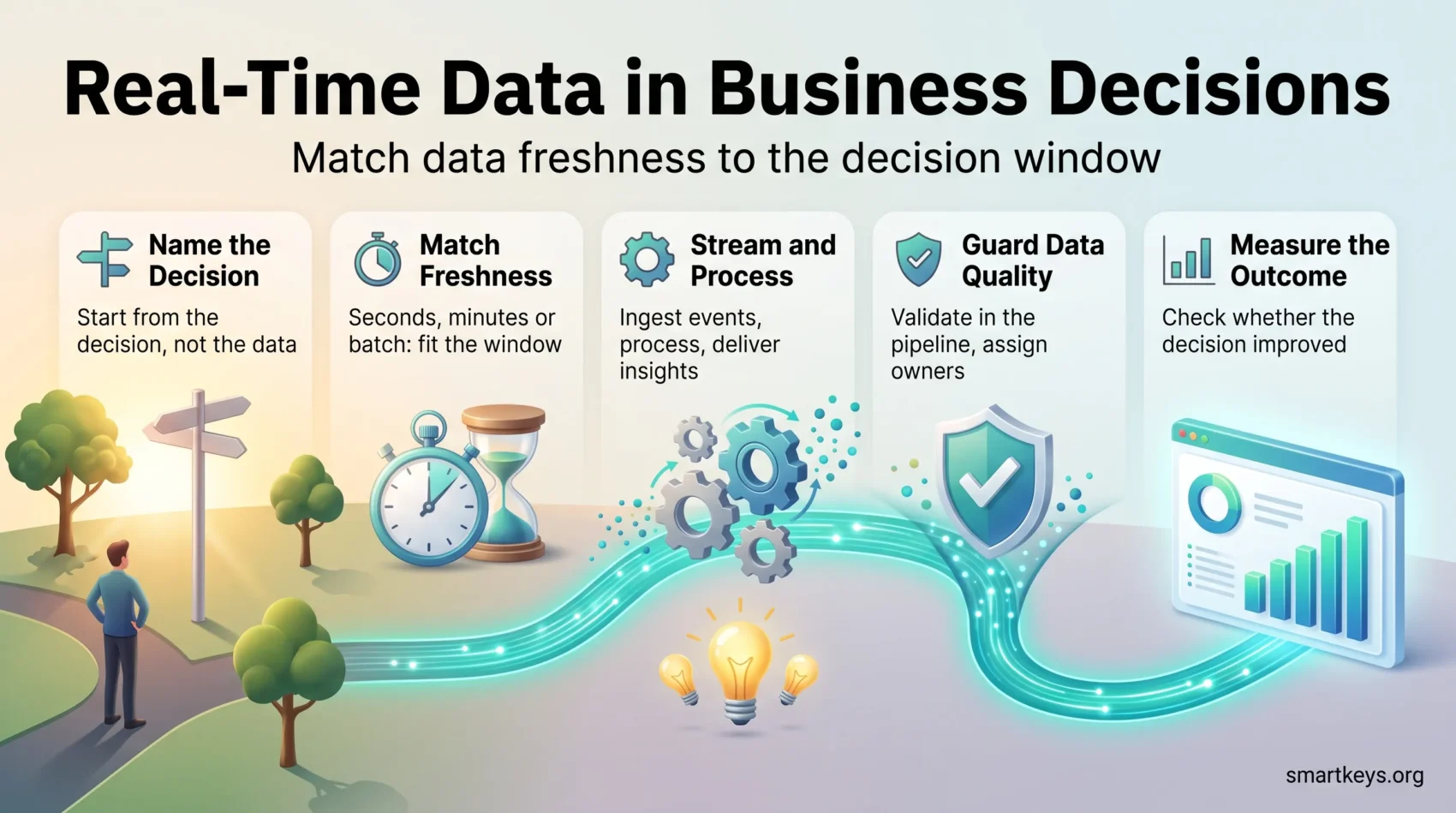
Start from the decision, never from the data source:
- Name one decision currently made too late, and state what being late costs.
- Work backwards to the minimum freshness it requires. Often that is minutes, not milliseconds.
- Instrument only the smallest set of events that supports it.
- Decide who or what acts on the signal: a person, an alert, a rule, or an agent.
- Measure whether the decision improved, not whether the dashboard loads faster.
That last step is the one most often skipped, and it is why so many streaming projects cannot demonstrate value at review time. Two patterns with a naturally short decision window are worth studying: dynamic pricing strategies and predictive maintenance.
Case Studies In Transformation: Success Stories Across Industries
Two long-running examples show what the technology looks like once embedded rather than piloted.
Delta Air Lines: Improving Operational Efficiency
Delta has tracked checked bags with RFID for years and exposes the resulting scan events to passengers through its app, so a bag’s location updates as it moves through the handling system. Delta has published its own account of the rollout, including the extension to London Heathrow. The interesting part is not the tracking but where the data goes: the same event stream feeds ground operations. Real-time visibility becomes valuable when one stream serves both the customer and the team that can fix the problem.
Netflix: Leveraging Viewer Data for Growth
Netflix has built its recommendation and delivery infrastructure around continuously collected playback and interaction data, and its engineering teams have written extensively about the streaming pipelines behind it. What is worth copying is the discipline, not the scale: Netflix instruments a narrow set of events extremely well rather than capturing everything and hoping value emerges later. For most companies the equivalent starting point is a well-defined customer data platform or a clear first-party data strategy.
Harnessing Real-Time Data Analytics Tools
Almost any modern platform can move events quickly. What separates a useful deployment from an expensive one is what happens after the data lands.
Best Practices for Utilizing Data Analytics Platforms
- Buy managed unless you have a reason not to. Running your own streaming cluster means capacity planning, upgrades and an on-call rotation, a headcount cost rarely justified below serious scale.
- Budget for the query layer, not just the pipeline. Continuous ingestion into a warehouse that bills per query produces a bill nobody forecast. The practices in cloud cost optimization apply directly.
- Keep the schema under version control. Streaming systems fail loudly when an upstream field changes shape, and silently when it changes meaning.
- Automate the routine reporting. If a person assembles the same view every morning, that is a pipeline waiting to be written.
Key Features of Effective Real-Time Reporting Tools
When comparing real-time reporting tools, weigh these against the decision you identified earlier:
- Custom dashboards scoped to one team’s metrics rather than a single view for everyone.
- Clear visualisation showing trend and uncertainty, not just the current value. The principles in data storytelling matter more than chart variety.
- Alerting with tunable thresholds. An alert that fires constantly is ignored within a week, which is worse than no alert.
- Integration breadth, since most of the effort in a real-time project is connecting systems. An iPaaS integration layer often does this more cheaply than custom connectors.

Internal And External Sources: Tools Powering Instantaneous Insights
Most real-time programmes start with internal event streams, then hit a ceiling and reach for external data. Both carry governance implications that are easier to handle before the data arrives than after.
Different Sources of Data: Internal vs. External
- Internal data covers transactions, application events, sensor readings and support interactions. You control the schema and the retention, which makes it the sensible foundation. Sensor and machine data has become easier to work with, as covered in this look at IoT in business.
- External data covers market feeds, weather, pricing intelligence and licensed third-party sets. It broadens the picture but arrives with contractual limits on use, which is why data-as-a-service contracts deserve legal review rather than a procurement rubber stamp.
One regulatory change is worth knowing. The EU Data Act has applied since 12 September 2025 and gives users a right of access to the data their connected products generate, including in real time where that is technically feasible, plus the ability to have it shared with a third party. For manufacturers this is an obligation; for buyers of industrial equipment it opens up data that used to sit only in the vendor’s cloud.
The Role of Web Scraping in Data Collection
Scraping remains a common way to collect public external data and the part of the stack most likely to cause a legal problem. The rules differ by jurisdiction and by what is collected, and terms of service, database rights and data protection law can each apply independently. Personal data pulled from a public page is still personal data under the GDPR.
The practical guidance is unglamorous: prefer an official API or a licensed feed where one exists, keep a written record of what you collect and why, respect rate limits, and get sign-off before scraping anything that identifies people. Fold the outcome into your data governance strategy.
Real-Time Data Processing Techniques for Improved Decision-Making
Real-time data processing splits into a small number of well-understood patterns, and choosing between them is mostly a question of how much state the computation needs to hold.

The main approaches in production use today:
- Event streaming as the transport layer. Apache Kafka is the de facto standard, self-hosted or managed, with Amazon Kinesis and Google Pub/Sub filling the same role inside their clouds.
- Stream processing for computation over moving data. Apache Flink handles stateful processing and windowed aggregation; Kafka Streams and Spark Structured Streaming cover lighter cases.
- Change data capture to stream database changes without rewriting the source application, often the fastest route to a live view of data that already exists.
- Edge processing to filter and aggregate close to the source, cutting both bandwidth and latency. See edge computing in business for where that pays off.
Two design choices matter more than the framework. First, decide what happens to late-arriving and out-of-order events, because a distributed system produces plenty of both. Second, decide whether the pipeline needs exactly-once processing or whether at-least-once with idempotent handling is enough, since the second is markedly cheaper to operate. A sound cloud-native architecture is what keeps the system affordable as volume grows.
The Future Of Decision-Making
The direction of travel runs from humans reading dashboards toward systems that read the stream and act, with humans setting the boundaries and reviewing outcomes.
Emerging Trends in Real-Time Analytics
Three shifts are visible in 2026. Streaming and analytical storage are converging, narrowing the old split between a fast operational path and a slow analytical one. Analytics is moving closer to the point of decision, appearing inside the application people already use rather than in a separate BI tool. And forecasting is being applied to live streams rather than historical extracts, the subject of this guide to predictive analytics in business, alongside the automated question generation described in augmented analytics.
The Impact of AI on Data-Driven Decisions
AI agents are what made real-time data an infrastructure priority rather than a reporting nicety. An agent that reads state and acts is only as good as the freshness of what it reads, and unlike a human it will not notice that a number looks wrong.
That raises the governance stakes. Where an automated decision affects people, in hiring, credit or employment, EU AI Act transparency obligations began applying in August 2026, and several US states have their own rules; the practical summary is in this guide to EU AI Act compliance. Logging what the agent saw and why it acted is not optional, because it is the only way to investigate afterwards.
Challenges in Implementing Real-Time Data Solutions
The failure modes are consistent enough to be predicted.
Data quality is the big one. Streaming removes the overnight window in which somebody used to catch obvious errors, so a duplicated event or a mis-mapped field now reaches a decision within seconds. Validation has to move into the pipeline itself, with schema enforcement, deduplication keys and a quarantine path for failed records.
Cost surprises come second. Ingestion, storage and querying each bill continuously. Teams budget for the streaming platform and forget the warehouse charges it generates. Set a cost per pipeline before building it, and check it monthly.
Ownership is the quiet one. A stream nobody owns degrades silently: fields change meaning, an upstream service stops emitting, and nobody notices until a decision is visibly wrong. Every stream needs a named owner and a documented contract with its consumers.
Security and compliance apply throughout. Encryption in transit and at rest, least-privilege access and a retention policy matching the applicable rules are baseline; the current landscape is summarised in this review of data privacy trends. Where real-time data covers employees, the constraints are tighter still.
Making Data-Driven Decisions: A Culture Shift
Adopting a data-driven culture is what lets an organisation use business intelligence tools for something other than reporting on the past. The technical work is the smaller half.
Creating a Data-Driven Organizational Culture
Culture here means something specific and testable: when the data contradicts a senior view, the data gets a hearing. If that does not happen, no amount of pipeline investment will change a decision. Practically it means agreed definitions, a visible owner for each metric, and leaders who ask what the numbers say before stating a conclusion.
It also means accepting an uncomfortable point. Live data makes problems visible earlier, including problems that reflect badly on the team presenting them. If surfacing an issue early is punished, reporting quietly slows back down to a comfortable pace.
Training Employees to Use Real-Time Insights Effectively
Training works best when tied to a real decision rather than a tool tour. Pick a metric a team already acts on, show them the live version, and walk through how it differs from the report they have been using: what it counts, when it updates, where it is incomplete. Keep the metric set small, because a handful of numbers a team genuinely understands beats a dashboard of thirty they scan past. Where behaviour is the subject, the methods in behavioral analytics are a good next step, and geographic operations often benefit from geospatial analytics.
Enhancing Performance Tracking with Real-Time Data
Performance tracking is where real-time data most often justifies itself, because the feedback loop is short and the actions are concrete. The gain is not the live chart; it is the shortened gap between something going wrong and somebody acting on it. Practical uses that hold up:
- Reallocating budget or staff during a campaign or a shift instead of after it.
- Stopping an underperforming ad set or a failing deployment within hours rather than at the weekly review.
- Watching customer behaviour shift during a promotion, so the next one can be adjusted.
- Catching data quality problems, since a metric moving impossibly fast is usually a broken pipeline, not a business event.
Two cautions. Real-time targets encourage short-term optimisation, so pair every live operational metric with a slower quality or retention measure. And resist putting everything on one screen: a dashboard that tries to serve every team serves none. Where the tracking covers people rather than systems, transparency about what is measured matters as much as the measurement.

Conclusion
Real-time data is not a strategy in itself. It shortens the distance between an event and a response, and it is worth the cost only where that distance is currently costing you something measurable.
The organisations that get value from it do the same unglamorous things. They pick a small number of decisions with genuinely short windows, match freshness to those windows instead of buying the lowest latency available, invest as much in data quality and ownership as in the pipeline, and check afterwards whether the decision actually improved.
With AI agents acting on live state, streaming is becoming part of the standard architecture rather than a specialist add-on. That makes the discipline more important, not less. An agent acting on bad data at high speed is simply a faster way to be wrong.
Found this useful?
Make SmartKeys a preferred source on Google, and our articles will surface more often in your Top Stories, AI Overviews, and AI Mode.
Add as Preferred Source