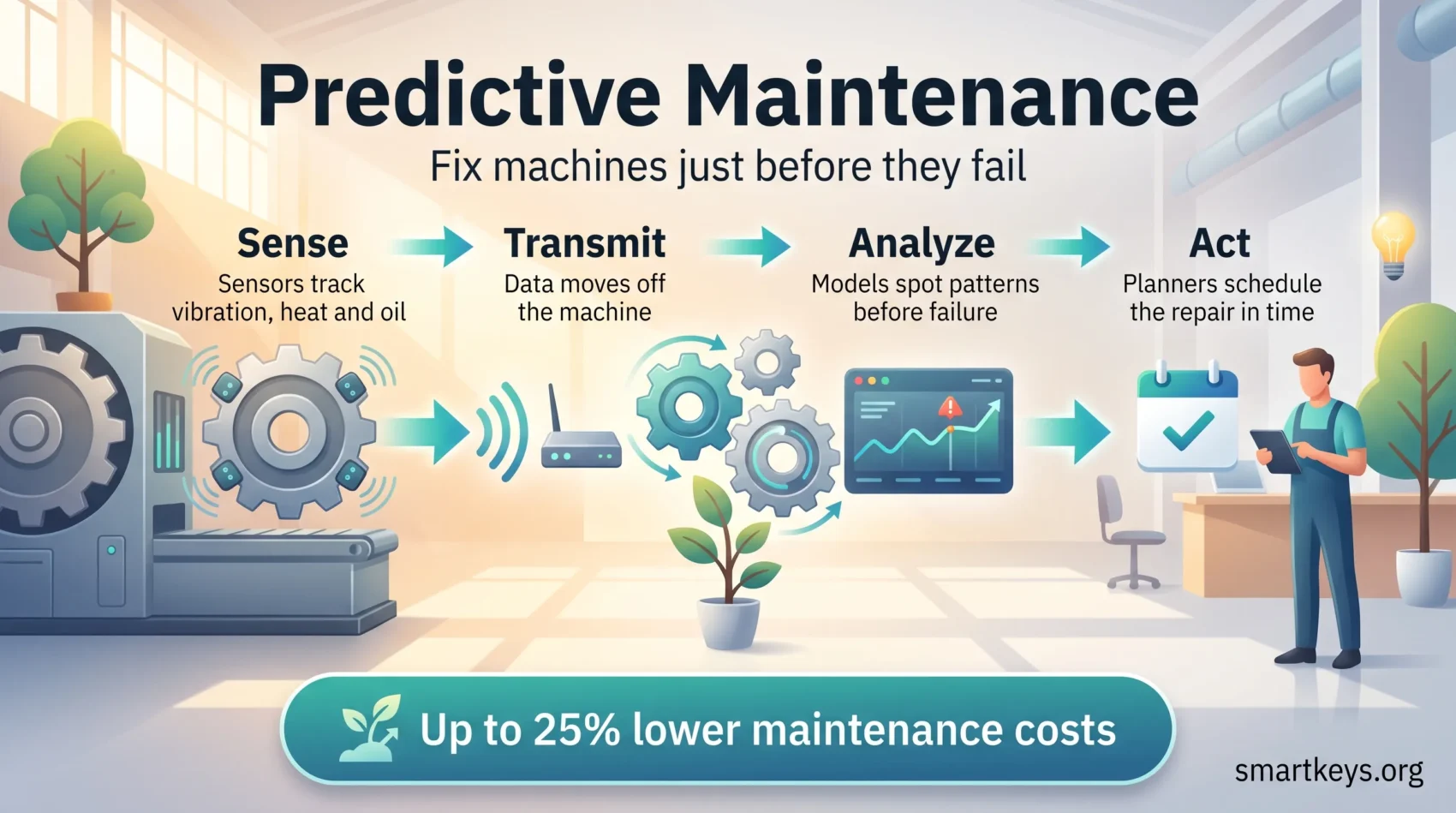
Predictive maintenance has moved from pilot project to budget line. Instead of waiting for a machine to fail or servicing it on a fixed calendar, predictive maintenance reads sensor data from the asset itself and schedules the intervention shortly before something breaks. The result is fewer surprises, longer asset life and a maintenance budget that follows evidence rather than habit.
What changed by 2026 is the economics. Sensors and connectivity are cheap, machine learning models are commodity infrastructure, and the cost of an unplanned stoppage has climbed faster than inflation. This guide covers where the market actually stands, what the credible savings numbers are, how the technology works, where projects fail, and which industries are adopting it next.
Key Takeaways
- Predictive maintenance schedules work based on asset condition, not on a fixed calendar or on failure.
- Adoption is still early: a May 2026 Fluke Reliability survey found only 18% of maintenance organisations running predictive programmes.
- Deloitte puts the typical impact at up to 25% lower maintenance costs and 10–20% higher uptime.
- The binding constraint is skills and data quality, not sensors or algorithms.
- The strongest business cases sit where an hour of downtime is expensive: automotive, heavy industry, energy and aviation.
Understanding Predictive Maintenance
Predictive maintenance (PdM) uses condition data — vibration, temperature, acoustics, oil chemistry, electrical signatures — to estimate when a component will fail and to act just before it does. Reactive maintenance fixes what has already broken. Preventive maintenance replaces parts on a schedule whether or not they need it. Predictive maintenance sits between the two and tries to spend maintenance money only where and when it earns its keep.
The market reflects that shift. Grand View Research valued the global predictive maintenance market at USD 14.2 billion in 2025 and projects USD 17.5 billion in 2026, growing to USD 98.1 billion by 2033 at a 27.9% CAGR. Those are vendor-side revenue estimates rather than realised savings, but the direction is consistent across analyst houses.

Asset-heavy industries move first, because that is where a stopped line is most expensive. Siemens’ True Cost of Downtime 2024 study estimates that the world’s 500 largest industrial companies lose roughly USD 1.4 trillion a year to unplanned downtime — around 11% of turnover. In automotive, an idle line at a major plant can cost up to USD 2.3 million per hour. Against numbers like that, a condition-monitoring programme does not need a dramatic hit rate to pay for itself.
Why Traditional Maintenance Methods Fall Short
Calendar-based servicing has two failure modes, and both cost money. Service too early and you scrap components with useful life left, plus you take the machine offline for no reason. Service too late and you get the breakdown you were trying to avoid, usually at the worst possible moment.
Reactive maintenance is worse still. Emergency repairs carry premium labour rates, expedited parts and knock-on effects across the production plan. The same Siemens research found that although the number of downtime incidents has fallen since 2019 — from an average of 42 per month to 25 — the cost of each hour lost has risen sharply, by 113% in automotive between 2019 and 2023 against 19% US price inflation over the same period. Fewer stoppages, far more expensive ones.
The practical problem is that most maintenance teams have the data and do not use it. Machines log faults, CMMS systems record work orders, and sensors stream readings that nobody correlates. A Computerised Maintenance Management System is a necessary foundation, but on its own it is a filing cabinet. The value appears when condition data is joined to work history and someone acts on the result.
Predictive Maintenance Trends
Three things define the current phase: adoption is real but still narrow, AI has replaced dashboards as the headline investment, and the bottleneck has shifted from technology to people.
Where Adoption Actually Stands in 2026
A Censuswide survey of more than 600 senior maintenance decision-makers in the US, UK and Germany, published by Fluke Reliability in May 2026, found that predictive maintenance adoption doubled year over year, from 9% to 18%. Reactive maintenance stayed flat at 36%, while proactive (largely preventive) approaches fell from 55% to 45%.
Read that carefully: doubling sounds dramatic, but more than a third of organisations still run reactive programmes, and fewer than one in five have a predictive one. If your plant is considering PdM, you are early rather than late.
Where the Money Is Going
The same survey found generative AI (36%) and industrial AI (35%) at the top of the investment list, with organisations putting 16–30% of maintenance budgets into new technology. Spending has rotated away from exploratory AI experiments — 44% priority in 2024 — toward the unglamorous foundations: cybersecurity at 37% and data management at 36%. That is what a market looks like when it stops piloting and starts operating.
How Predictive Maintenance Technology Works
A working system has four layers: sensing, transport, analysis and action. Weakness in any one of them makes the other three worthless.
Role of IoT and Data Collection
Industrial IoT sensors monitor the parameters that precede failure:
- Vibration signatures on rotating equipment
- Temperature drift in bearings, motors and electrical cabinets
- Ultrasonic emissions from leaks, arcing and lubrication problems
- Oil particulates and chemistry
- Current and voltage patterns in drives
This is the same sensing layer that underpins how IoT is changing business operations more broadly. Big data technologies improve the process by handling high-frequency sensor streams alongside maintenance records and historical failures.
Where bandwidth or latency is tight, processing moves closer to the machine. Edge AI lets a controller flag an anomaly locally instead of shipping raw waveforms to a data centre, and the same architectural shift is reshaping wider industrial workflows. For geographically dispersed assets — wind farms, pipelines, rail — geospatial analytics adds the location layer that turns alerts into routed field work.
Advanced Analytics in Predictive Maintenance
Models look for the patterns that precede a known failure mode and estimate remaining useful life. In practice most programmes start with simple threshold and trend rules, then add machine learning once enough labelled failures exist to train on. That ordering matters: teams that begin with a model and no failure history usually end up with confident nonsense.
Digital twins extend this by simulating the asset, so you can test a maintenance decision before making it. Generative AI has added a practical layer on top — technicians query equipment history in plain language instead of navigating a reporting tool.
Key Benefits of Predictive Maintenance
The credible benefit numbers are narrower than vendor marketing suggests, but they are still substantial.
Extending Equipment Lifespan
Condition monitoring catches degradation while it is still repairable. A bearing replaced at the first vibration signature costs a fraction of one that seizes and damages a shaft, and the asset keeps its design life instead of losing years to a single catastrophic event.
There is a sustainability argument here too. Assets that run longer and fail less consume fewer replacement parts and less emergency logistics, which feeds directly into green technology targets and the emissions figures tracked by carbon accounting software.
Reducing Downtime and Lowering Costs
Deloitte’s analysis of predictive maintenance in the smart factory puts the typical effect at up to 25% lower maintenance costs and a 10–20% increase in equipment uptime. Siemens estimates that full adoption of condition monitoring and predictive maintenance across Fortune 500 industrial firms would save roughly 2.1 million hours of downtime and USD 233 billion in maintenance costs annually.
Treat those as ceilings, not forecasts. Realised savings depend on how expensive your downtime is, how good your failure data is, and whether maintenance planners actually change the schedule when the model raises a flag.
Challenges in Implementing Predictive Maintenance
Most failed programmes fail for the same two reasons, and neither is the algorithm.
Data Management and Integration Issues
Sensor data is voluminous, noisy and often badly labelled. Before any modelling is possible you need to:
- Establish data quality and consistent asset identifiers
- Size storage, bandwidth and compute for continuous streams
- Validate and clean readings, and handle sensor drift
- Connect condition data to work orders in the CMMS or ERP
Connecting machines also enlarges the attack surface. Operational technology networks that were once air-gapped now carry telemetry, which is why distributed approaches such as a cybersecurity mesh have become part of the PdM conversation rather than an afterthought.
The Skills Gap and Resistance to Change
This is now the dominant constraint. In the 2026 Fluke Reliability survey, skills-related issues accounted for roughly 78% of all reported barriers to digital maturity — lack of expertise (23%), skilled labour gaps (19%), knowledge shortages (18%) and workforce skills shortages (17%).
Cultural resistance compounds it. Technicians who have kept plants running for decades are reasonably sceptical of a model that tells them a healthy-sounding machine needs attention. The programmes that stick are the ones that treat early alerts as hypotheses to be checked by an experienced technician, log the outcome, and feed it back into the model. Trust is earned per verified alert.
Predictive Maintenance Strategies for Success
Start with one asset class where failure is expensive and reasonably well understood, prove the loop end to end, then expand.
Selecting the Right Tools and Technology
Match the technique to the failure mode rather than buying a platform first:
- Vibration analysis — imbalance, misalignment and bearing wear in rotating equipment
- Infrared thermography — electrical connections, insulation faults, overheating components
- Ultrasonic acoustic monitoring — compressed air leaks, arcing, lubrication problems
- Oil analysis — wear particles and contamination in gearboxes and hydraulics
- Motor current signature analysis — rotor and stator faults without stopping the drive
- Partial discharge analysis — insulation degradation in medium and high-voltage assets
Spare parts strategy belongs in the same conversation. If a model predicts a failure three weeks out, the part has to be there — which is why on-demand manufacturing and 3D printing in the supply chain pair naturally with PdM, and why parts provenance through blockchain-based logistics is being trialled in regulated industries.
Creating a Data-Driven Culture
The technical build is the easy half. What decides the outcome is whether the maintenance planner changes the weekly schedule because of a model output, and whether the technician records what they actually found. Three habits separate working programmes from expensive dashboards:
- Every alert gets an outcome logged, including false positives
- Planners have authority to reschedule based on condition, not just calendar
- Model performance is reviewed with the same rigour as equipment performance
None of this is exotic, and it is largely the same discipline that robotics on the factory floor demands: the technology only pays off when the surrounding process changes with it.

The Future of Predictive Maintenance
Two developments are shaping the next few years: AI moving from detection to recommendation, and PdM spreading well beyond the factory.
Impact of AI and Machine Learning
Detection is largely solved for well-instrumented assets. The open problem is prescription — telling a planner not just that a pump is degrading but what to do, when, and what it costs to wait. Expect maintenance systems that draft the work order, check parts availability and propose a slot in the production plan, with a human approving rather than assembling it.
Foundation models trained on cross-fleet data also reduce the cold-start problem that has held back smaller operators, who never had enough failure history of their own to train a useful model.
Expansion Beyond Traditional Industries
Predictive techniques are moving into sectors that were never asset-management-led:
- Renewable energy, where turbine and inverter reliability drives project returns
- Smart city infrastructure, from lifts and HVAC to traffic systems
- Commercial buildings, where proptech platforms now bundle equipment monitoring with tenant services
- Healthcare, where connected medical devices make imaging and diagnostic uptime measurable
- Telecommunications, predicting hardware failures across distributed network sites

Predictive Maintenance in Practice
Published examples are useful mainly for the shape of the problem they solve, not for their headline savings — which are rarely audited.
Duke Energy Renewables built a model on years of turbine operating data and identified faults in wind turbine contactors before they caused generator damage, a case documented in AVEVA’s operations-management case studies. Rolls-Royce has run engine health monitoring on jet engine sensor data for years, using it to plan shop visits rather than react to removals. Siemens added a generative AI assistant to its Senseye predictive maintenance product so technicians can interrogate asset history conversationally. GE Aerospace — renamed from GE Aviation in 2024 — applies machine learning to fleet sensor data to anticipate maintenance needs.
The pattern across all four: a fleet large enough to learn from, a failure mode expensive enough to justify the effort, and an operations team that acted on the output.
Conclusion
Predictive maintenance is no longer speculative, but it is not yet mainstream either — 18% adoption in 2026 says the opportunity is still open. The credible payoff is meaningful rather than magical: Deloitte’s up-to-25% maintenance cost reduction and 10–20% uptime gain, applied to whatever an hour of your downtime actually costs.
The technology is the least of it. Sensors work, models work, and cloud infrastructure is a solved problem. What decides whether a programme delivers is data quality, the skills to interpret output, and a maintenance organisation willing to change its schedule when the evidence says so. Start with one expensive failure mode, prove the loop, and expand from there.
Found this useful?
Make SmartKeys a preferred source on Google, and our articles will surface more often in your Top Stories, AI Overviews, and AI Mode.
Add as Preferred Source