An occupational exoskeleton is a wearable frame that takes part of a physical load off your body while you work. It does not lift for you. It holds your arms up during overhead work, or it shares the load on your lower back when you bend and lift. That is a narrow promise, and it is exactly why the technology has moved from trade-show curiosity to standard kit at IKEA, MAN Truck & Bus, Toyota North America and DB Schenker.
This guide is for the person who has to make the call: an operations lead, a safety manager, or an owner looking at a warehouse full of tired shoulders. It covers what the injury data supports, what the research measured, which devices you can buy in 2026, and how to run a pilot that produces numbers finance will accept.
Key Takeaways
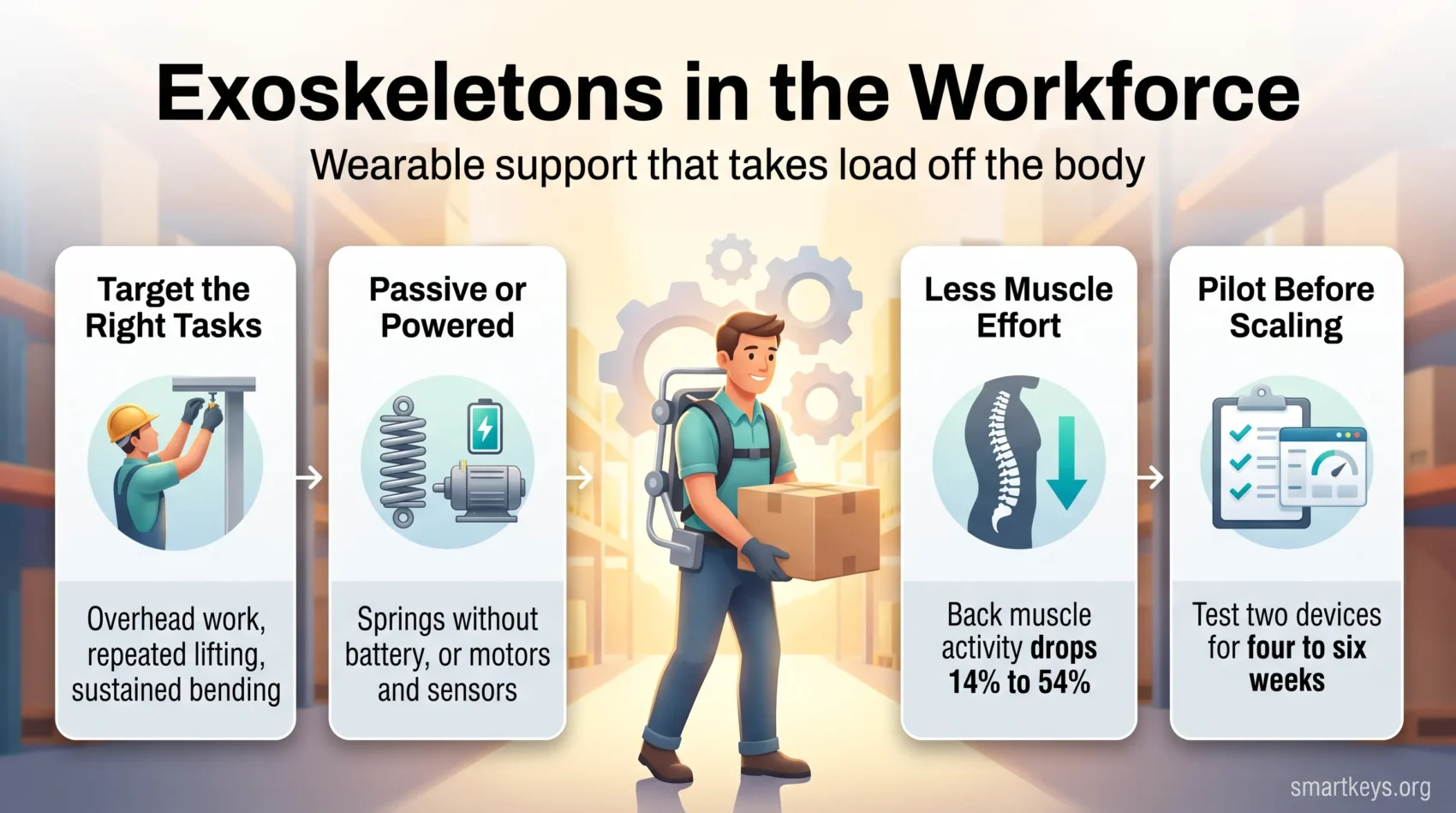
- Exoskeletons pay off on steady, high-load tasks: overhead assembly, repeated lifting, sustained bending. They do little for varied or light work.
- Passive models (springs and elastic, no battery) dominate real deployments because they are lighter, cheaper and need almost no maintenance.
- Published reviews report meaningful reductions in back muscle activity, but with wide ranges between devices and no long-term proof of fewer injuries yet.
- Comfort and heat, not capability, are the usual reasons a rollout dies. Budget for fitting sessions and let workers choose when to wear the device.
- Check vendor stability as carefully as the hardware. Ownership in this sector changed hands in 2026.
Why now: the injury problem and the 2026 market
The business case starts with the injuries these devices are meant to prevent. Overexertion means strain from lifting, carrying, pushing, holding or repeating a movement too often. It is one of the largest single categories of workplace injury in the United States.
What the US injury data actually shows
The National Safety Council, working from Bureau of Labor Statistics figures, counted 946,290 US cases of overexertion, repetitive motion and bodily conditions across 2023 and 2024 that involved days away from work, job transfer or restriction. Of those, 492,140 involved days away from work altogether.
Those are people off the line, covered by overtime or temporary hires. Shoulders and lower backs account for much of it, which is precisely where exoskeletons apply support. If you already run an ergonomics program, you will recognise the same task list: overhead fastening, case handling, repeated bending at a pick face.
A note on numbers you will see elsewhere. Vendor decks often quote millions of injuries and hundreds of millions of lost days. Those figures usually mix global estimates, all musculoskeletal complaints and modelled productivity loss. Measure your own rate before and after instead: your insurer will ask for your data, not the industry’s.
Where the market stands in 2026
This is still a specialised market rather than a mass one. Research and Markets values industrial exoskeletons at roughly $1.08 billion in 2026, up from about $0.97 billion in 2025, with growth of around 11% a year projected to 2030. Small market, real products: treat it as you would any emerging category in digital procurement, with short contracts, trial periods and a written exit if the supplier changes hands.
Start with the outcome, not the device
Turn your goal into two or three numbers you can collect on the shop floor. Vague goals produce vague pilots, and vague pilots never get funded twice. Good targets: fewer discomfort reports on the overhead station, less time lost to rotation during peak picks, a measurable drop in perceived effort at shift end. Bad targets: “improve safety” or “increase productivity”.
Map tasks to expected gains
Match the device to the job step, not the job title. A maintenance technician might spend 40 minutes of an eight-hour shift with arms above shoulder height. That 40 minutes is where a shoulder device earns its keep; the rest of the shift it is dead weight. Walk the job with a supervisor and list the steps by posture and duration. If a step involves frequent kneeling, crawling or twisting, most current models will get in the way.
- Pick the two or three steps with the highest sustained load and the steadiest rhythm.
- Set your safety metrics before the devices arrive: discomfort reports, perceived strain, requests for help on heavy lifts.
- Involve the crew in the shortlist. People who helped choose a device are far more likely to wear it.
Say what the device is for. Tell workers plainly that the goal is less physical effort on specific tasks, not a faster cycle time. If crews suspect the device is a speed-up in disguise, adoption stalls. This is a change management problem as much as an equipment decision.
Quick buyer snapshot: who benefits most
The strongest returns come from physically demanding, repetitive settings. Case handling, overhead assembly, and frequent load repositioning are the classic fits.
Logistics is the clearest example. IKEA franchisee Ingka Group announced in November 2024 that it had deployed more than 400 exoskeletons across 14 countries in stores and warehouses. The vendor, SUITX by Ottobock, reported sensor measurements showing user posture improving by up to 65% over several weeks. That figure comes from the supplier, so treat it as a promising signal rather than an independent result.
Vehicle maintenance is the second clear fit. MAN Truck & Bus began rolling out shoulder and back devices across 20 German sites in July 2024, pairing each site with in-person coaching from ergonomics specialists.
- Best fit: steady cadence work, worn through a block of high-load steps.
- Buyer priorities: comfort, fast on and off (vendors call this “don and doff”), adjustability across shifts and body sizes, low maintenance.
- Poor fit: varied work, tight crawl spaces, full torso rotation, or loads a hoist already handles.
Blue-collar roles are seeing several technologies arrive at once, from automation in blue-collar jobs to remote operation of physical work. Exoskeletons are the option that keeps the person on the task and makes the task cheaper on the body.
Exoskeleton types explained: passive, powered, and body regions
Two distinctions decide almost everything about fit, cost and comfort: whether the device has a motor, and which part of the body it supports.
Passive devices use springs, gas cylinders or elastic elements. They store energy when you move one way and release it when you move back. No battery, no charging, little to maintain. Powered (active) devices add motors and sensors, so support can adapt to the movement and the load, at the cost of weight, charging routines and service.
Shoulder and upper-body support for overhead work
Shoulder devices take the weight of your arms and any tool you are holding. They matter most when you work above shoulder height, where muscle activity climbs fast and fatigue sets in within minutes.
Ottobock’s IX SHOULDER AIR, for example, uses two shaped energy stores behind the back to assist arm lifting and holding. Ekso Bionics’ Ekso EVO is a passive upper-body device with large armholes and few contact points, designed to keep a worker’s natural range of motion.
Back support for lifting and repeated bending
Back devices reduce the load on the lower spine during lifts and repeated forward bends. Ottobock’s IX BACK AIR is passive, weighs around 3 kg, needs no battery, and the manufacturer states it reduces lower back load by up to 15 kg. The powered IX BACK VOLTON weighs about 5.7 kg with its battery, runs up to ten hours and supports loads up to 17 kg.
The trade-off is visible in those specs. Powered support is stronger, and you carry nearly twice the weight and a charging routine to get it.
Range of motion and natural tracking
“Naturally tracking” means the frame follows your movement instead of fighting it. This is not marketing detail. A systematic review in Frontiers in Bioengineering and Biotechnology found one back device reduced wearers’ range of motion by around 10%, roughly 13 degrees. On some tasks that is irrelevant. On others it is the reason the device ends up in a locker.
- Check headroom and harness clearance before you buy, especially for work at height.
- Plan wear windows so devices go on for high-load blocks and come off for the rest.
- Watch for rubbing and heat at contact points during the first week.
Where exoskeletons work best: tasks and settings
Predictable, high-repetition steps deliver the fastest gains. The device does not change your process. It changes what the process costs the person.
Overhead work, assembly and construction
Sustained arm elevation is the clearest use case. Holding a drill, fastening a ceiling bracket, finishing a weld above head height: each raises shoulder muscle activity and forces frequent breaks. Shoulder support extends how long a worker can hold position before fatigue forces a change. Favour models that stay clear of hard hats and fall-arrest harnesses, so crews are not choosing between comfort and compliance.
Logistics, warehouse and fulfilment
In distribution, shoulder and back support lower perceived effort during frequent lifting and case handling. Many operations use devices only for peak picking and replenishment rather than all shift. That keeps heat load down and wear time meaningful.
Exoskeletons sit alongside the other physical-layer investments in logistics, from warehouse robotics to automated picking. The cheapest of these investments is usually the one you wear.
Healthcare and operating rooms
Arm-support devices help during long procedures where a clinician holds a steady posture for an hour or more. In clinical settings, hygiene and cleaning matter as much as biomechanics: the device has to survive a cleaning protocol and stay clear of sterile fields. Hospitals running wider digital transformation programmes increasingly treat these devices as staff-retention tools rather than gadgets.
- Target: overhead fastening, tool holding, part positioning, repeated bending at a fixed station.
- Watch for: fit across body sizes, heat, and any task requiring full trunk rotation.
- Pilot advice: schedule wear windows for high-load blocks instead of full-shift use.
What you can buy in 2026
The market is concentrated in a handful of credible suppliers, mostly selling passive hardware.
SUITX by Ottobock: the IX series and AIRGO XP
Ottobock reports more than 2,000 customers for its SUITX line, including Toyota North America, DB Schenker and IKEA. The IX range covers back-intensive and overhead work: IX BACK AIR (passive), IX BACK VOLTON (powered, using Bosch AmpShare batteries) and IX SHOULDER AIR for sustained arm elevation.
AIRGO XP is a different category. Instead of supporting the body, it is a sensor and app that analyses movement and gives posture feedback on specific tasks. That makes it useful for finding out where you need support before buying any, and it sits closer to workplace wearable technology than to hardware.
Ekso EVO and the Ekso Bionics ownership question
Ekso EVO remains a well-regarded passive upper-body device. The company behind it changed shape in 2026, and buyers should know this before signing a multi-year service agreement.
In May 2026, Ekso Bionics completed a business combination and the listed parent became ChronoScale Holdings Corporation. The board then classified the legacy exoskeleton business as held for sale and as discontinued operations, with completion expected during fiscal 2027. No buyer has been announced.
Products continue to ship, and a sale could land the line with a stronger owner. But on a five-year horizon, ask directly about warranty transfer, spare parts commitments and who answers the phone in 2028.
Standards and evaluation
ASTM International runs a dedicated technical committee, F48, on exoskeletons and exosuits, with published standards covering areas such as safe use, labelling and guidance for return-to-work situations. Ask a vendor which of those standards its device is tested against. A specific answer tells you a lot; a vague one tells you more.
What the research actually shows
The evidence here is real but narrower than the marketing suggests. Understanding that difference protects your credibility internally.
Muscle activity: real reductions, wide ranges
Most studies measure muscle activity using surface electromyography, or EMG: electrodes on the skin that record how hard a muscle is working. A systematic review in Frontiers in Bioengineering and Biotechnology pooled results for back-support devices. It found reductions in erector spinae activity (the muscles running alongside the spine) of roughly 14% to 54% for passive devices and 23% to 34% for powered ones. Individual devices landed across that whole spread.
Two conclusions follow. Support genuinely reduces muscular effort. And the gap between devices is larger than the gap between wearing one and wearing none, which is why piloting more than one model matters.
What the evidence does not show yet
Lower muscle activity is not the same as fewer injuries. The same review flagged the absence of long-term injury outcome studies and of standardised test protocols. Most trials run for hours or days, not the years an injury trend needs.
Be honest about this in your business case. Claim reduced strain and lower perceived effort, both of which are measurable in a pilot. Do not promise an injury reduction percentage you cannot support.
Comfort, fit and heat
Discomfort, poor fit and heat build-up are the main reasons workers abandon a device in week two, and they are also the most fixable. Iterative fitting, short hands-on training and a fast feedback loop turn most early complaints into adjustments. Supervisor behaviour matters more than buyers expect: if the shift lead wears one and talks about it, the crew follows. The same dynamic shows up in workload and burnout programmes, where visible management buy-in is what makes an intervention stick.
Building the business case
Tie reduced strain to something finance already counts. That usually means avoided injury costs, less time lost to rotation, or fewer first-aid visits at a specific station.
From strain reduction to time on task
Map the exact steps where support lowers shoulder or back load, then record two things during the pilot: time per task and discomfort reports. Both are cheap to collect and hard to argue with. Add your insurance position, since workers’ compensation experience ratings respond to claim history, so a reduced-claims story compounds over years in a way a productivity story does not.
Training, maintenance and lifecycle costs
Total cost of ownership, meaning everything you pay across a device’s life and not just the purchase price, is where passive models pull ahead. Budget for:
- Fitting and training: initial sessions plus refreshers, ideally delivered on shift rather than in a classroom.
- Consumables and spares: padding, straps and contact surfaces wear out first.
- Service: repair turnaround, on-site spares, and battery management for powered models.
Powered devices add charging infrastructure, battery replacement and software updates. If a passive device covers the task, it is almost always the cheaper answer over five years. Teams already tracking equipment life through predictive maintenance can fold exoskeleton inspections into the same schedule.
Selection criteria: choosing the right device
A clear selection path keeps the decision on measurable ground. Start from the tasks, not the catalogue.
Match to tasks and range of motion
Prioritise the steps with sustained effort: overhead fastening, tool holding, repeated lifting. Then check the device preserves the movement those steps need. One that cuts muscle load by 30% but slows the job by 10% is a bad trade.
Fit, comfort and adjustability
Evaluate comfort during real shifts, not demos. Fewer contact points and generous armholes mean fewer hotspots and longer wear times. Test multiple sizes and check how long a size change takes: if it needs a tool and ten minutes, shared devices will not work across shifts.
Durability, support level and PPE compatibility
Passive models with no electronics generally handle dust, weather and washdown better, which is why they dominate construction and heavy maintenance. Verify compatibility with the personal protective equipment (PPE) crews already wear: hard hats, harnesses, eyewear, hearing protection. Anything that forces a worker to remove required PPE is a non-starter. Formalising this in a wearable technology policy saves argument later.
- Verify helmet and harness clearance before purchase, not at delivery.
- Pilot at least two devices on the same task so you can compare.
- Score vendors on service, training and parts availability, not only unit price.
Pilot to scale: implementation and change management
Begin small. Run a tightly scoped pilot on one or two stations where tasks repeat and data is easy to collect.
Structured pilots, metrics and feedback loops
Set your metrics before day one: time in task, perceived effort (a simple 1 to 10 rating works), comfort, and any first-aid or assistance events. Collect daily notes on hotspots, tool interference and how easily the device goes on and off.
Four to six weeks is a reasonable first pilot. Shorter captures only the novelty period; longer delays the decision without adding much.
- Choose stations where the work is concentrated and repeatable.
- Rotate devices between workers to capture fit variation across body types.
- Report early results to leadership while interest is still high.
On-the-job training and ergonomics coaching
Train workers on putting the device on, taking it off and making fine adjustments, during real shifts with their own tools. Pair the coaching with supervisors so correct use is reinforced daily rather than once.
MAN Truck & Bus paired its 20-site rollout with personal training from ergonomics specialists, the pattern most successful deployments follow. To scale coaching, immersive formats such as VR employee training and augmented reality training can carry the procedural part while a human handles fit.
Fitting devices into your safety program
Treat the device as task-specific equipment inside your existing system, not as a separate initiative. Start by mapping devices to tasks with known overexertion risk and adding clear use criteria to your job hazard analyses.
Write the details down: required training, fit checks, inspection intervals, cleaning and who signs off. Track the results on the safety dashboard you already use, so the device appears in normal reporting rather than a side spreadsheet.
Be explicit about what it does not replace. Hoists, lift assists, safe technique and task redesign all still apply. An exoskeleton is one layer of control and sits well down the hierarchy: eliminating a lift always beats assisting it.
- Coordinate the policy with your safety committee and, where relevant, worker representatives before rollout.
- Log near misses tied to device use so you learn about interference early.
- Review the device-to-task match whenever tools or workflows change.
For wider context, see our overviews of robotics in workplaces and how workers are adapting to automation.
A note on the data these devices collect
Sensor-equipped devices and posture-analytics apps record how individual people move. That is employee data, and in the EU and several US states it carries obligations around purpose, consent and retention. Decide up front whether you need individual-level data at all: aggregated, station-level reporting answers most safety questions without creating a surveillance problem. The same tension runs through AI employee monitoring and workplace data privacy more broadly, and getting it wrong costs trust you will need for adoption.
What workers say
Workers judge new gear on two things: whether it respects their skill, and whether it hurts by hour six.
Social signals decide adoption. When peers and supervisors treat the device as a sensible tool, uptake climbs. When it reads as a comment on someone’s strength, it stays in the locker.
One MAN mechanic described the first fitting in the company’s own account of the rollout: “My first wow moment came right when I was testing the exoskeleton for the first time, when I noticed someone was helping me so I didn’t have to carry my arms myself anymore.”
Addressing discomfort and usability limits
Acknowledge discomfort directly instead of waiting for complaints. Run short fit checks in the first week, fix hotspots quickly, and let crews decide when to wear support within defined tasks. Autonomy is a stronger driver of sustained use than any mandate.
- Fit: run fitting sessions with sizes on hand so adjustments happen the same day.
- Heat: schedule wear windows in cooler parts of the shift, choose breathable designs, and rotate devices on hot days.
- Limits: exclude tasks involving kneeling, crawling or tight spaces rather than forcing a poor match.
Vendor evaluation checklist
Choosing the partner matters as much as choosing the device. Look past the spec sheet and test how the vendor behaves during a trial.
Fitting, warranties and field support
Require vendor-led fitting, compare warranty terms and repair turnaround, and ask for named references in your own sector. Include on-shift coaching and refreshers rather than a single handover session. Given the ownership changes in this sector, add a stability question: who owns the company, who holds the service obligation, and what happens to your spares if the business is sold.
Analytics and data options
If a vendor offers analytics, ask what it measures, where the data lives, who can see individual records and how long it is kept. Useful answers are specific. Confirm too that the portfolio covers your full task mix, so you can scale on one service standard instead of three.
- Verify PPE and tool compatibility in a live workflow, not a showroom.
- Use a simple scorecard: fit success rate, comfort satisfaction, adoption by station.
- Negotiate a trial period with measurable exit criteria before any large order.
Case highlights: logistics, automotive and industry
IKEA: 400 plus devices across 14 countries
Ingka Group, IKEA’s largest franchisee, reported in November 2024 that it had deployed more than 400 SUITX exoskeletons across 14 countries, with rollouts planned for India, the Netherlands, Poland, Romania, Serbia, Japan and China. The stated aim was reducing musculoskeletal injury risk during heavy lifting and repetitive movement in stores and warehouses.
The supplier’s reported posture improvement of up to 65% over several weeks is a vendor measurement, not a peer-reviewed result. What makes the case useful is its scale and duration: this is a multi-country programme that survived past the pilot stage.
MAN Truck & Bus: workshops and maintenance
MAN introduced more than 50 shoulder and 25 back exoskeletons across 20 German locations starting in July 2024, after testing at its Hildesheim, Duisburg and Leipzig sites. According to the manufacturer’s figures from that testing, the back device cut lumbar spine pressure by around 70 kg per lifting operation. The shoulder device provided over 60% relief during overhead work with tools, and shoulder joint torque fell by up to 10 newton metres.
All of those numbers come from the vendor and its customer, measured on their own tasks. They are a reason to run your own pilot, not a substitute for it.
Toyota, DB Schenker and the wider picture
Toyota North America and DB Schenker both appear among SUITX customers, and DB Schenker has explored formalising devices as PPE for defined tasks. That is a meaningful signal. Once a device enters the PPE category it carries inspection, training and documentation duties, which is how a technology stops being a trial and becomes standard practice.
Manufacturers pursuing broader shop-floor modernisation often run exoskeletons alongside digital twins and private 5G networks. Exoskeletons are the cheapest and fastest of that group to deploy.
What is coming next
Expect refinement rather than a revolution. Engineering effort is going into fewer contact points, better weight distribution and frames that track movement more closely. Sensing is also separating from support: products like AIRGO XP measure the posture problem first, so you can decide what hardware it justifies. Modular frames with task-specific attachments are making it cheaper to cover a mixed task list.
Buy for the task you have now and pick suppliers with clear upgrade paths. In a market growing at double digits from a small base, hardware bought in 2026 will look dated by 2030, so short amortisation and honest exit terms beat future-proof specifications. Where physical presence is genuinely optional, telepresence robots sometimes solve the same problem by removing the person from the task.
Conclusion
Exoskeletons are a narrow tool that works well inside its range. On steady overhead and lifting work, they measurably reduce muscular effort and perceived strain, and several large employers have run them past the pilot stage into multi-country deployments.
The limits matter just as much. Long-term injury evidence is not there yet, results vary widely between devices, and comfort decides whether anything gets worn at all.
That points to a clear method. Pick two or three high-load tasks. Pilot more than one device for a month. Measure effort and discomfort rather than promising injury reductions, and involve the crew from the shortlist onward. Do that and you will know whether exoskeletons belong in your operation, with numbers from your own floor.
Found this useful?
Make SmartKeys a preferred source on Google, and our articles will surface more often in your Top Stories, AI Overviews, and AI Mode.
Add as Preferred Source