Robotics automation means using programmable machines to do defined work with little human input. Those machines can be physical robots, software robots, or both working together. It is no longer an experiment: at the end of 2024, about 4.66 million industrial robots were running in factories worldwide, according to the International Federation of Robotics (IFR).
That changes the question you should ask. It is no longer should we automate? It is which work cell, inspection step or back-office queue pays back first?
This guide helps you answer it. First, you will learn the four automation types and which platform features matter. Then it looks at what humanoid robots really do in 2026 and what the 2025 safety rewrite means for you. It ends with a 90-day plan from first pilot to a managed program.
Key Takeaways
- Robots are now normal production equipment: 542,000 industrial robots were installed worldwide in 2024, and US installations grew again in 2025.
- Choose the automation type based on product mix and how often products change, not on a vendor pitch.
- Measure a process before you automate it. Without a baseline, you cannot prove the return later.
- Humanoid robots are doing real work in 2026, mostly moving parts and boxes. They are not ready for fast, high-precision tasks.
- ISO 10218:2025 reset the safety rules for industrial robots. Risk assessments based on the 2011 edition need review.
- Access control, audit trails and a plan for errors are what turn a pilot into a lasting program.
Robotics Automation in 2026: The Numbers That Matter
Market data shows where companies are adding capacity and how fast. The latest full-year figures come from the IFR’s World Robotics 2025 report, which covers 2024.
- 542,000 units were installed worldwide in 2024. It was the fourth year in a row above 500,000.
- 4.66 million robots were in operation, about double the level of ten years earlier.
- Asia took 74% of new installations. China alone installed 295,000 units, or 54% of the global total.
- The IFR expects about 575,000 installations in 2025 and more than 700,000 a year by 2028.
The United States is recovering after a weak 2024. Installations there fell 9% to 34,200 in 2024. Preliminary IFR figures published in June 2026 show about 38,000 units for 2025, an 11% rise, with the food industry growing fastest.
Software robots are moving just as quickly. Gartner predicts that 40% of enterprise applications will include task-specific AI agents by the end of 2026, up from less than 5% in 2025. The same firm expects more than 40% of agentic AI projects to be cancelled by the end of 2027, mainly because of rising costs, unclear value or weak risk controls.
Both facts matter for your planning. The technology is arriving fast, but careful project selection decides which programs survive. For the software side of the picture, see our overview of business automation trends from RPA to AI integration.
What Robotics Automation Actually Means
Three terms often get mixed up, and the difference affects what you buy.
Robots, automation and RPA
- Robotics covers physical machines that carry out a controlled sequence of movements, such as robot arms, mobile platforms and gantry systems.
- Automation is the broader idea: using technology to run any process with little human input, physical or digital.
- Robotic process automation (RPA) is software only. These “bots” click through screens, read documents and move data between systems, like a very fast clerk.
Mature programs usually run both. Picture a packaging line: a robot arm stacks the boxes, and a software bot creates the shipping documents. Connecting those two layers is what people call hyperautomation.
Attended vs. unattended automation
Attended automation works alongside a person and waits for their decision at key points. Unattended automation runs on a schedule or trigger with no one watching. This is a management decision, not just a technical one. Keep a person involved wherever a mistake would be expensive or hard to undo.
Four Types of Industrial Automation and When Each Fits
Three factors should drive your choice: volume, variety and how often your product changes.
Fixed automation
A line built for one high-volume, repeatable process, such as a welding line in a car plant. It has the lowest cost per unit and the highest cost to change.
Programmable automation
Work cells you reprogram in software when the product changes. This fits when you need steady cycle times but switch products every few months or years.
Flexible automation
Modular stations that switch between product variants with little retooling. This is the right answer when demand varies and batches are small.
Intelligent automation
An AI layer on top of the machine controls. It spots unusual patterns, checks quality with cameras and predicts failures before they happen. This is where predictive maintenance lives. A digital twin of the line, a virtual copy you can test changes on, earns its cost here too.
Rule of thumb: invest first where the gap between current and target performance is largest. Do not add an AI layer to a process that is not yet stable.
Physical AI and Humanoids: What Is Real in 2026
Physical AI means AI that controls machines in the real world, not just software. Humanoid robots are its most visible form. In 2026 they do real work, but at a small number of sites and on a narrow set of tasks. Separating documented results from marketing matters, because companies are making investment decisions on the difference.
What is documented:
- BMW and Figure AI. In an 11-month pilot in 2025, Figure 02 robots at BMW’s Spartanburg plant inserted sheet-metal parts for welding and supported production of more than 30,000 BMW X3 vehicles. In June 2026, BMW announced a follow-up project in which Figure 03 sorts parts into trolleys for the assembly line.
- BMW Leipzig. BMW brought humanoids to European production for the first time with the AEON robot from Hexagon Robotics. It supports high-voltage battery production and moves material to the line.
- Agility Robotics. The company reports that its Digit robot has logged more than 65,000 operating hours at customer sites, with GXO, Schaeffler and Toyota Motor Manufacturing Canada among named customers. It announced a successor, Digit 5, in September 2026, with general availability planned for the end of 2027.
- Schaeffler and Humanoid. In May 2026 the UK company Humanoid signed a deal with Schaeffler to deploy a four-digit number of wheeled robots by 2032. First deployments are planned between December 2026 and June 2027, starting with box handling.
What is not ready: fast work that needs sub-millimetre precision. Welding, stamping and precision assembly still belong to fixed robot arms and collaborative robots (“cobots”, smaller robots designed to work near people). Wider use of humanoids depends on better reliability, lower hardware costs and safety certification, which is still being written (see the safety section below).
Treat deployment counts carefully and check whether a figure comes from the company itself. For more on how these machines change the shop floor, see our articles on workplace robots and productivity and the role of robotics in future workplaces. Where a task needs human judgement plus extra physical strength, exoskeletons are often a better fit than a full robot.
Platform Capabilities Worth Paying For
A good automation platform serves two groups at once: business staff who want speed, and engineers who need control.
Low-code and professional development tools
Low-code tools let non-programmers build automations with visual drag-and-drop editors. That speeds up delivery. Professional development features such as version control, reusable components and automated testing keep quality from falling apart as the number of automations grows. You need both. Low-code platforms without engineering discipline produce automations nobody can maintain.
Process discovery based on your own data
Process discovery tools analyse system logs and user clicks to show how work really flows and which steps are worth automating. That beats a workshop where the loudest team decides the roadmap.
Open integration and deployment choice
Robots and bots must connect to old and new systems. Look for support for screen-based, API-based and AI-based integration. Cloud, on-premises and hybrid options matter because response time and data location rules limit where processing can run. It is the same trade-off behind edge computing decisions. On a modern plant network, private 5G in manufacturing is now a practical option for connecting mobile robots.
Governance built in, not added later
Governance means the rules and controls that keep automation safe and traceable. The essentials are role-based access control (each person only gets the permissions their job needs), audit trails, central logging and a defined process for handling errors. Without them, you cannot grow past a handful of automations without creating problems you will pay for later.
Orchestration, Governance and Provable ROI
Turning pilots into value depends on how work is coordinated, not on the robot alone.
Route work by skill, deadline and capacity
Orchestration software acts like a dispatcher. It decides whether a task goes to a machine, a software agent or a person, and it passes along the context as work moves between them. That means fewer handoffs and faster throughput. The idea behind it is collaborative intelligence: people handle judgement and exceptions, machines handle volume and consistency. Our guide to AI augmentation covers the same principle for office work.
Plan for exceptions first
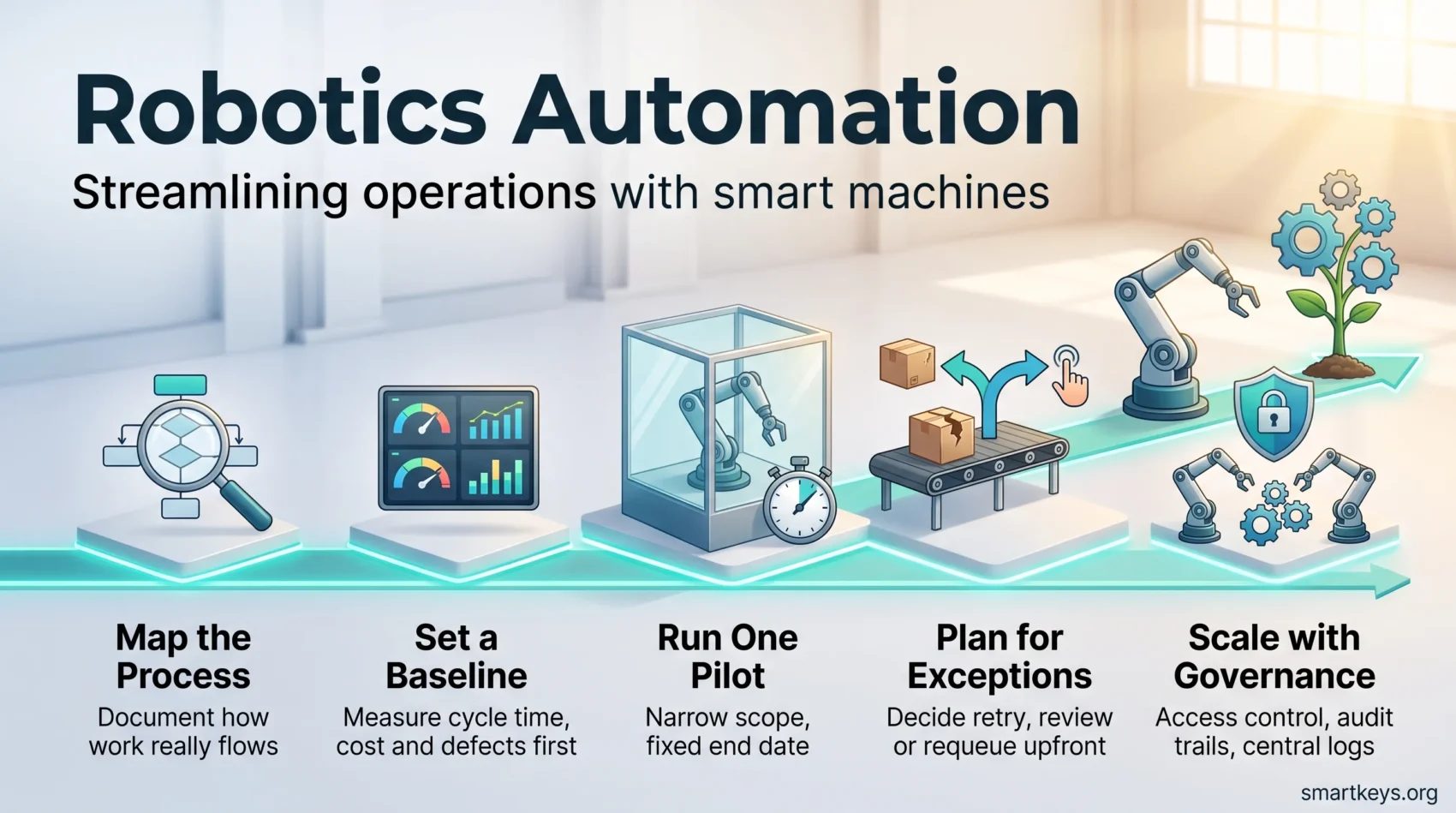
An exception is any case the automation cannot handle, such as a damaged part or a missing field on an invoice. Decide before go-live what happens then: an automatic retry, a human review or a return to the queue. Unplanned exceptions quietly destroy uptime.
Measure the baseline before you build
Record four numbers before the automation exists: cycle time, defect rate, cost per transaction and first-pass yield (the share of units made right the first time). You cannot reconstruct them afterwards. An unprovable return is one of the most common reasons a second project never gets funded.
How to Implement Robotics Automation: Six Steps
- Map the real process. Document how work actually flows, where decisions happen and how long tasks really take, not what the written procedure says.
- Score the candidates. Rank them by volume, clarity of rules, predictability of inputs and how often exceptions occur. Check that the data you need exists.
- Set the baseline. Agree on success metrics and current values with the people who will be judged on them.
- Run one isolated pilot. Keep the scope narrow, set a fixed end date and log every exception instead of patching it quietly.
- Standardise before you scale. Treat documentation, logging, alerts and version control like you would for any production software.
- Make it permanent. Give the program a lasting home. An automation center of excellence, a small central team that sets standards, stops every project from reinventing the rules.
Safety and Compliance: ISO 10218:2025 Reset the Baseline
ISO 10218 is the core international safety standard for industrial robots, and it was rewritten in 2025. It was the first major revision since 2011. If your risk assessments refer to the 2011 edition, they need a review.
The main changes:
- Cobot rules moved into the main standard. Most requirements from the separate technical specification ISO/TS 15066 are now part of ISO 10218. “Collaborative” now describes the application, not the robot. The same robot can be safe in one setup and unsafe in another.
- Robot classes were introduced, each with matching safety functions and test methods.
- Cybersecurity became part of safety planning, because a hacked or misconfigured network can make a robot cell unsafe.
- Functional safety requirements are spelled out explicitly, which makes it easier to show compliance.
- The US version, ANSI/A3 R15.06-2025, replaced the 2012 edition. It also renamed the “safety-rated monitored stop” to “monitored standstill”.
One gap matters for humanoids. ISO 10218 assumes machines that stand stably on their own. Robots that must actively balance, such as legged humanoids, are covered by a separate standard still in development, ISO 25785-1. If a supplier offers you a legged robot for a production cell, ask which safety framework the installation will be certified against. The A3 guidance on the revision is a good starting point for integrators.
Where Robotics Automation Pays Off Fastest
High-volume processes with good measurement data return capital soonest.
Manufacturing and electronics
Robot arms handle circuit board testing, assembly and inspection. They keep the production pace steady and raise first-pass yield. This is the most mature category and the easiest business case to write.
Food, beverage and aerospace
Enclosed robot cells support hygienic food preparation and packaging. The food industry was the fastest-growing robot buyer in the US in 2025, according to the IFR. In aerospace, robots help with repeatable fastening and composite layup, where tolerances are tight and every step must be traceable.
Logistics and supply chain
Picking, pallet stacking and moving boxes help warehouses cope with labour shortages and demand swings. That is why automation now appears in almost every supply chain resilience plan, not just in efficiency projects.
Healthcare and agriculture
In healthcare, robots assist in surgery, sterile packaging and cleaning. In agriculture, sensor-driven systems handle irrigation, fertilising and harvesting. In both fields, the main benefit is precision and fewer errors rather than labour savings.
When Not to Automate
Some processes should stay manual, and choosing them on purpose protects the credibility of your program. Leave the work alone when:
- The process is unstable or undocumented. You would only make the chaos faster.
- Exceptions are frequent. When a large share of cases need special handling, building that logic can cost more than the automation saves.
- Volume is low and the task is about to change. An investment needs time to pay back.
- The step exists mainly for judgement, negotiation or accountability. Doing it faster rarely improves the result.
- You cannot measure the current state. No baseline means no business case.
People: Roles, Skills and Redeployment
How you handle the workforce often decides whether a rollout sticks. Programs that go badly are often communication failures, not engineering failures.
Demand grows for people who install, troubleshoot and improve these systems. Employers look for electrical basics, knowledge of PLCs (programmable logic controllers, the industrial computers that control machines), robot programming and preventive maintenance. According to the US Bureau of Labor Statistics, electro-mechanical and mechatronics technicians earned a median of $73,900 a year in May 2025. The typical entry route is an associate degree or a postsecondary certificate.
For existing staff, plan the transition before the robot arrives. A digital skills gap analysis shows what your teams are missing. An automation risk assessment identifies which roles will change most. Then look at how other employers handle redeploying workers into new roles instead of hiring replacements later. Mid-career staff can move into automation support, and structured retraining is what makes that work. For the wider picture, see how automation is changing blue-collar jobs and how workers are adapting to job automation.
Your First 90 Days
- Days 1-15: List candidate processes. Score each on volume, clarity of rules and exception rate.
- Days 16-30: Pick one. Measure its current cycle time, cost and defect rate for two full weeks.
- Days 31-60: Build and run the pilot in a limited scope. Log every exception instead of fixing it quietly.
- Days 61-75: Compare the results with the baseline. Decide honestly whether it worked, and write down why.
- Days 76-90: Document your standards, name an owner and choose the second process based on what you learned.
Conclusion
Robotics automation delivers when you treat it as an operations discipline, not a technology purchase. The machines are proven. Success depends on how you select, measure and govern them.
Pick a few high-impact processes. Measure them before you change anything. Run one narrow pilot, keep an honest exception log and build governance in from the start. Make sure your safety documents reflect the 2025 standards, not the 2011 ones.
Do that, and the second project is easy to fund, because you can prove what the first one was worth. Start this week by writing down what one process currently costs you. Everything else follows from that number.
Found this useful?
Make SmartKeys a preferred source on Google, and our articles will surface more often in your Top Stories, AI Overviews, and AI Mode.
Add as Preferred Source