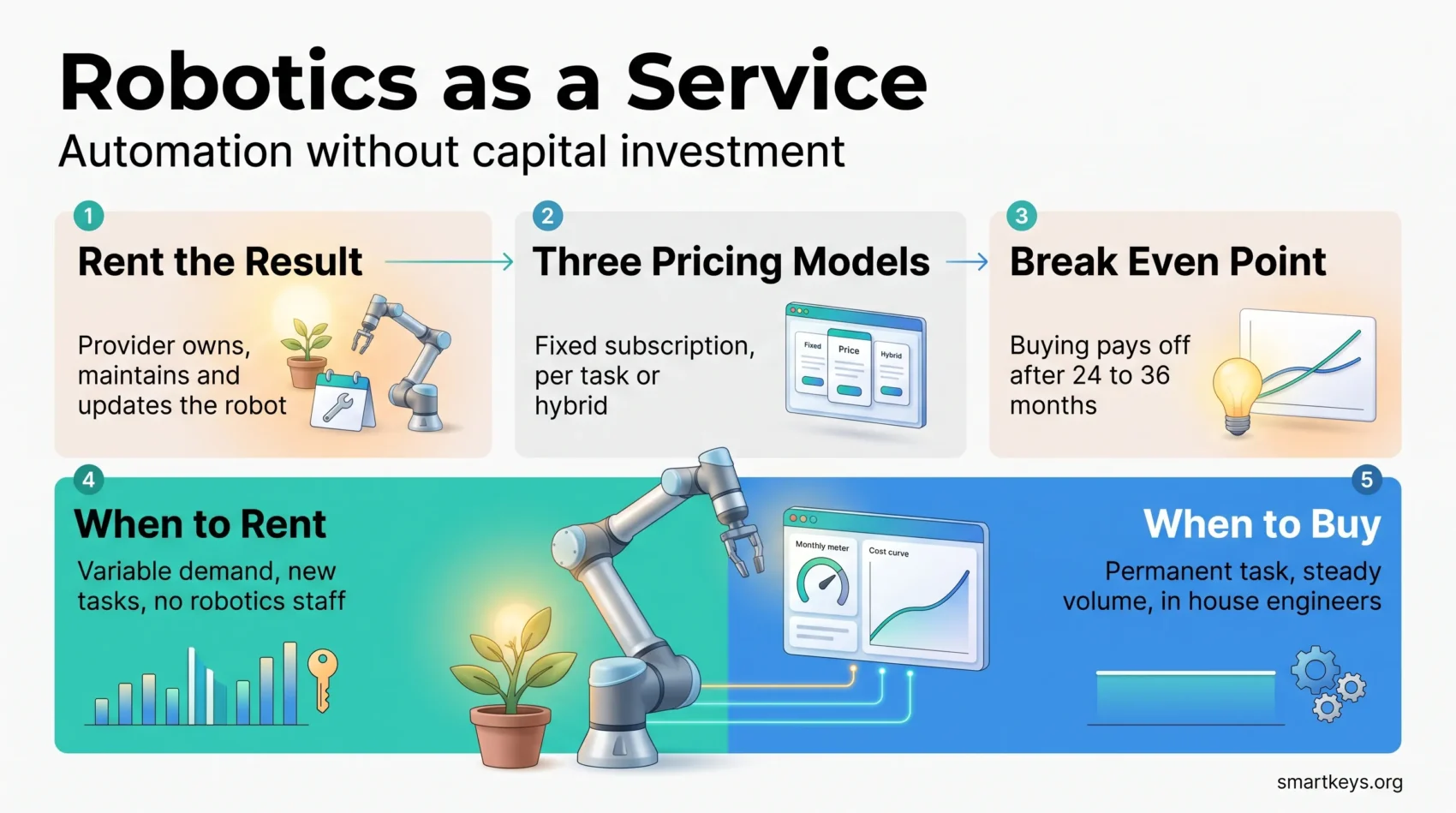
Automation used to demand a large purchase order before it produced a single unit of work. The robot cell had to be bought, installed and maintained, and the bill arrived long before the payback did. Robotics as a service reverses that. You rent the result instead of buying the machine.
Robotics as a service, usually shortened to RaaS, is a rental model for robots. The provider owns the hardware, keeps it running, ships software updates and charges a recurring fee. That fee can be monthly, hourly, or tied to each completed task such as a delivery, a weld or a pallet moved.
This article covers what the model costs in 2026, where it works, and when buying outright is still the better answer.
Key Takeaways
- RaaS replaces a capital purchase with a recurring operating cost.
- The market is real but small: roughly $2.5 billion to $3.3 billion in 2026.
- Break even against buying usually falls between 24 and 36 months.
- Steady, heavy use favours ownership. Variable demand favours renting.
What Robotics as a Service Actually Means
Think of RaaS the way you think about software you subscribe to. You do not own the product. You pay for access, and the vendor keeps it working.
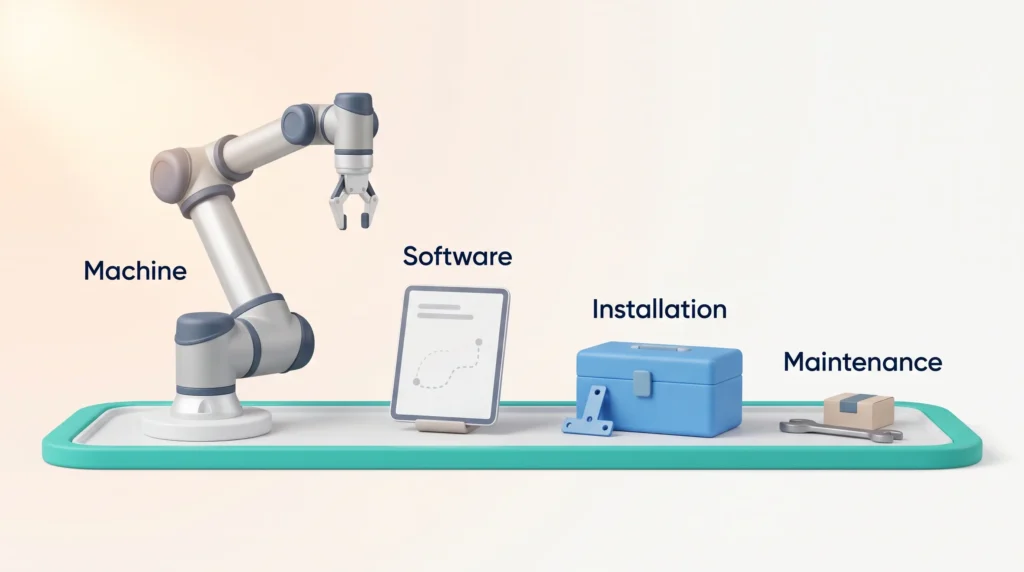
The difference is that a robot is physical, so the contract bundles four things that used to be bought separately: the machine, the software that plans its work, the installation, and the maintenance. A purchase leaves you owning an asset you have to staff, service and eventually resell. A rental leaves the provider holding those problems.
The model sits inside a wider shift toward automation delivered as a service rather than a one time build, the same logic as hyperautomation.
How Big the RaaS Market Really Is in 2026
The honest numbers matter here, because this market has a history of being oversold. In 2018, ABI Research forecast that RaaS would generate $34 billion in revenue by 2026. That year has arrived, and the actual market is roughly a tenth of that.
Three independent 2026 estimates land close together. Global Market Insights puts RaaS at $2.57 billion in 2026, growing about 21% a year. Precedence Research puts it at $2.48 billion. Fortune Business Insights is highest at $3.31 billion, with 22.3% annual growth through 2034.
The direction was right and the scale was wrong. RaaS is growing fast from a small base, not replacing robot sales. For comparison, the International Federation of Robotics counted 542,076 industrial robots installed worldwide in 2024, with roughly 4.6 million operating in factories. Most were bought, not rented. Our guide to industrial robotics automation in 2026 covers that purchase side.
What RaaS Costs: The Three Pricing Models
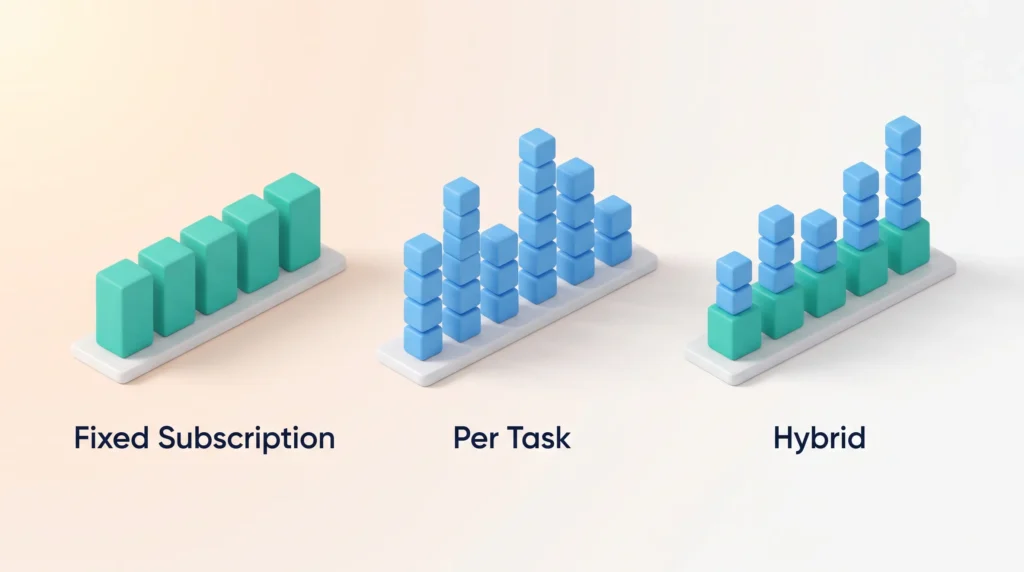
Providers use three basic structures. Knowing which one you are being offered tells you who carries the risk.
Fixed subscription
You pay a set amount each month for a defined term. Budgeting is simple, and the provider carries no utilization risk. If your volumes drop, you still pay.
Published leasing benchmarks give the range. A collaborative robot arm, meaning one built to work safely beside people, typically leases for $1,200 to $3,000 per month against a $30,000 to $50,000 purchase price. A full industrial cell runs $3,500 to $8,000 per month.
Per completed task
You pay for output: each delivery made, each pallet scanned, each weld finished. When demand falls, so does the bill.
That shifts utilization risk onto the provider, which is why most attach a minimum monthly commitment. Read the floor carefully. A per task contract with a high minimum behaves like a subscription with extra paperwork.
Hybrid
A base fee covers hardware and support, and a variable rate covers volume above a threshold. This suits seasonal operations, where peak weeks run several times above the annual average.
The costs outside the headline rate
Three line items are easy to miss. Commissioning typically runs $2,000 to $15,000, operator training $1,000 to $5,000 per session, and insurance 2% to 5% of hardware value each year. Get all three in writing before comparing offers.
Why Companies Choose the Rental Route
Capital stays free. Published guidance for warehouse automation puts entry level point solutions at $10,000 to $50,000 and full facility integration at $500,000 to $25 million or more, with large sites commonly landing at $5 million to $15 million. Annual maintenance adds another 15% to 20% of equipment cost. A monthly fee turns all of that into an operating line.
You can test before committing. Automation projects fail for unglamorous reasons: the floor layout fights the robot, the product varies more than expected, the integration stalls. A twelve month contract makes that a manageable loss.
Capacity can follow demand. Renting for a quarter beats owning equipment that idles for nine months.
It answers a real labour gap. Deloitte and the Manufacturing Institute projected in 2024 that US manufacturing could need as many as 3.8 million new workers by 2033, and that roughly 1.9 million roles could go unfilled if the skills gap persists. Robots do not close that gap alone, but they absorb the repetitive lifting, sorting and packing that is hardest to staff. See our analysis of automation in blue collar jobs and how companies are redeploying workers rather than replacing them.
Where RaaS Works Today
The clearest evidence comes from sectors where the work repeats, the environment is predictable, and labour is hard to hire.
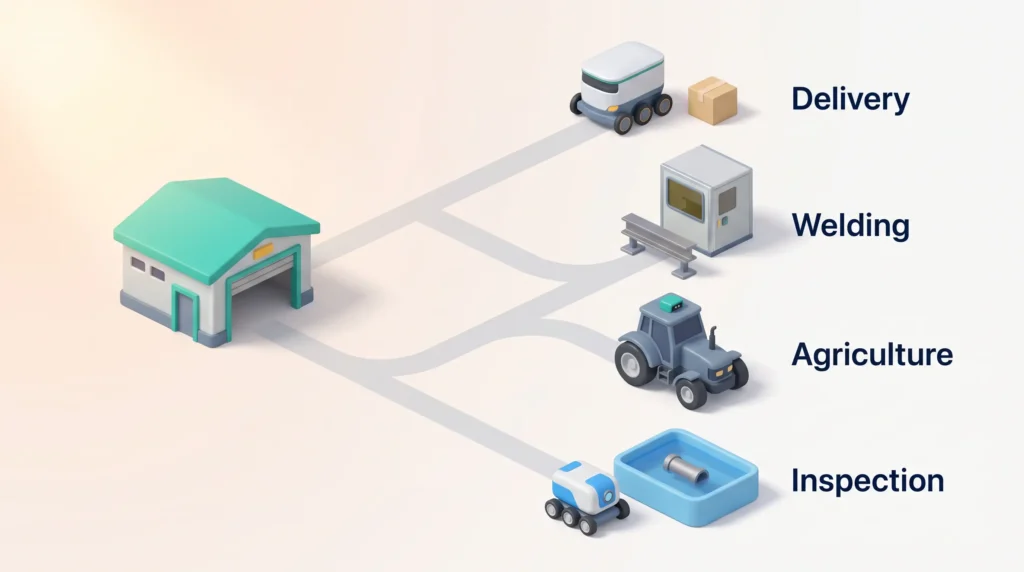
Last mile delivery. Serve Robotics is the most transparent example, because it is publicly listed and reports numbers. As of March 2026 it operated roughly 2,000 delivery robots across 20 cities, working with Uber Eats, DoorDash and more than 4,500 restaurant and retail partners. Full year 2025 revenue was $2.7 million. That last figure is worth sitting with: a working service at real scale that is still commercially small. Our overviews of autonomous delivery in e-commerce and autonomous retail add context.
Welding. Path Robotics builds welding cells that use computer vision to plan and execute welds without a programmer writing the path by hand. Access is sold on subscription with remote support, aimed at a long standing shortage of skilled welders.
Agriculture. Bluewhite retrofits existing tractors with an autonomy kit instead of selling new machines. Notice the pattern: the cheapest robot is often equipment you already own, upgraded. It rhymes with circular economy thinking in manufacturing.
Hazardous inspection. Subsea and confined space work share one trait: sending a person is expensive and risky. Rented robots and commercial drone services both grow here, and the same case supports exoskeletons in roles that stay human.
RaaS Versus Buying Outright
The decision comes down to one number: how many hours the robot will actually work. Leasing benchmarks put the crossover at roughly 24 to 36 months. A $40,000 robot arm on a $1,500 monthly lease reaches break even against purchase at about month 27. After that, ownership is cheaper for as long as the machine keeps running.
So the rule is simple. If the task is permanent, the volume steady and you have engineering staff to maintain the machine, buy it. If the task is new, the volume moves, or you have no robotics staff, rent it. Many companies do both in sequence: rent to validate the use case, then buy once the process is proven. Longer terms also cut the rate, by 15% to 25% for 24 month terms and 25% to 35% for 36 month terms.
Ownership also brings obligations a rental hides: depreciation, spare parts, safety compliance and disposal. Those costs are why robotics in the workplace often stalls at companies with no maintenance function.
The Software Layer Is What You Are Really Renting
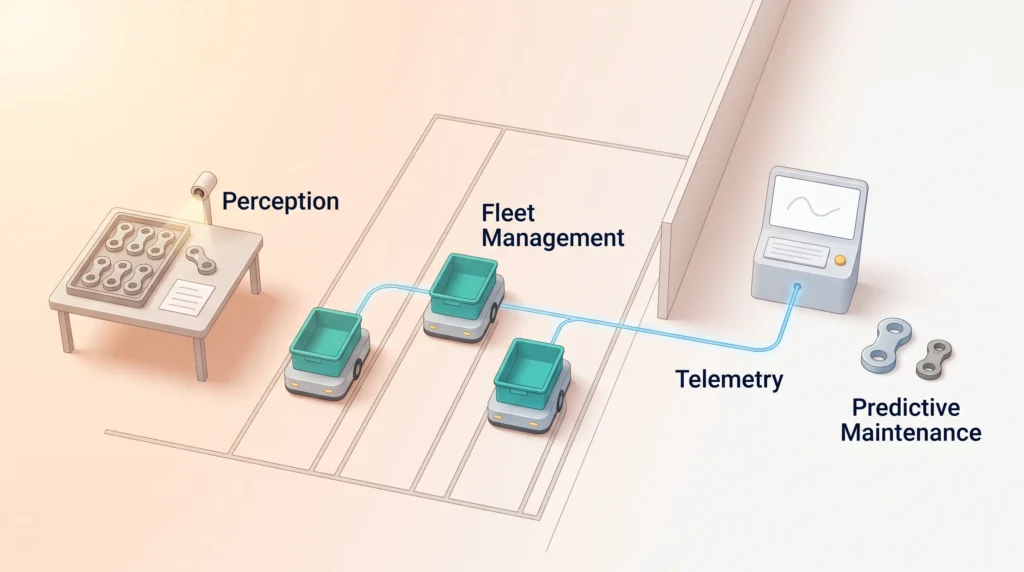
The hardware in a RaaS contract is often unremarkable. The software is what improves month to month. Three capabilities do most of the work. Perception lets the machine adapt to parts that are not in exactly the right place. Fleet management coordinates several robots so they do not queue behind each other. Telemetry streams performance data back to the provider, which enables predictive maintenance, meaning a part is replaced before it fails rather than after.
Providers increasingly pair this with a digital twin, a simulated copy of your line used to test changes before they touch the real floor. Reliable coverage on a factory floor is a genuine constraint, which is why private 5G networks appear in so many of these projects.
Two cautions belong here. Telemetry means operational data leaves your building, so the contract must say who owns it and where it is stored. And when a system makes decisions you cannot inspect, you inherit a governance problem: the principles behind explainable AI apply to a robot that reroutes your workflow.
How to Choose a Provider
Five questions separate a serious offer from a demo.
- What exactly is the robot doing? Define the task, the volume per shift, and how much the parts vary. Vague scopes produce contracts neither side can measure.
- How does it connect to what you already run? Ask which production or warehouse systems the provider has integrated before, and get a named reference.
- What is the total first year cost? Add the recurring fee, commissioning, training and insurance, then compare that number, not the monthly rate.
- What are the exit terms? Check notice periods, early termination fees, and what happens to your data when you leave.
- What is guaranteed in writing? Uptime percentage, response time for a failure, and a throughput target. A provider unwilling to commit to numbers wants you to carry their risk.
If robotics becomes a recurring theme rather than a one off project, centralise the expertise. An automation center of excellence stops every department negotiating its own contract.
When Renting Is the Wrong Answer
Three situations argue against it. The task runs constantly at high volume, so you are paying rent on something you could have owned twice over. The process is unstable, and automation only amplifies whatever it is pointed at. Or the work needs judgement, since robots handle repetition well and exceptions badly, a point our review of the 2026 evidence on AI and automation at work makes repeatedly.
One caution applies to the model itself. Every recurring contract adds to a fixed cost base that is easy to grow and hard to cut, the same trade off found in subscription based business models generally.
The Bottom Line
Robotics as a service does one useful thing well. It removes the capital barrier that keeps mid sized companies out of automation, and moves the maintenance burden to a party whose business is maintenance.
It is not a discount. Over a long enough horizon, renting costs more than owning. What the premium buys is the ability to start small, stop cheaply, and learn whether automation fits your operation before committing. Price the first year in full, insist on written service guarantees, and be honest about how many hours the machine will really run.
Found this useful?
Make SmartKeys a preferred source on Google, and our articles will surface more often in your Top Stories, AI Overviews, and AI Mode.
Add as Preferred SourceFAQ
What is robotics as a service (RaaS)?
RaaS is a rental model for robots. The provider owns the hardware, installs it, maintains it and updates its software, while you pay a recurring fee for access. That fee can be a fixed monthly subscription, an hourly rate, or a charge per completed task such as a delivery or a weld. The practical effect is that automation moves from your capital budget to your operating budget. You never own the machine, and repairs, spare parts and disposal are not your problem.
How much does robotics as a service cost?
It depends on the machine class. Published leasing benchmarks put a collaborative robot arm at roughly $1,200 to $3,000 per month, a full industrial cell at $3,500 to $8,000, and early humanoid platforms at $3,000 to $15,000. Those rates exclude three costs that matter: commissioning at $2,000 to $15,000, training at $1,000 to $5,000 per session, and insurance at 2% to 5% of hardware value a year. Compare total first year cost, because a low monthly rate can hide a large setup fee.
Is RaaS cheaper than buying a robot outright?
Only in the short term. Leasing benchmarks put the break even point at roughly 24 to 36 months. A $40,000 robot arm on a $1,500 monthly lease reaches parity with buying at about month 27, and after that ownership is cheaper for as long as the machine runs. Renting wins when demand is seasonal, the use case unproven, or you have no in house engineering. Buying wins when the task is permanent and the machine runs near full utilization for years.
What happens if the robot fails or the provider shuts down?
Failure is the provider’s problem, which is the main appeal of the model, but only if the contract says so in measurable terms. Ask for a guaranteed uptime percentage, a maximum response time for a breakdown, and a throughput target with a remedy if it is missed. Provider insolvency is a separate risk most contracts handle poorly. Ask what happens to the hardware and your data if the company is acquired or closes, and never let a single rented system be the only way a critical process can run.
Is robotics as a service suitable for small businesses?
It can be, because the entry cost is low enough to test without a capital approval process. The real constraints are staffing and stability. Even a fully managed robot needs one person on site who understands it, and the process has to be consistent enough for a machine to repeat. A small business with steady, repetitive volume and one technically confident employee is a good candidate. One that changes its workflow every few months will spend more on reconfiguration than it saves.