Automation in blue-collar jobs is no longer a forecast. It is a measurable part of daily work on factory floors, in warehouses, on construction sites and in fields. The International Federation of Robotics counted 542,000 industrial robots installed worldwide in 2024, more than double the annual figure a decade earlier, bringing the global operational stock to roughly 4.66 million units.
That scale changes the question. It is no longer whether machines will show up in manual trades, but which tasks they take, which ones they leave behind, and what the people doing that work should do next. This guide sets out what the evidence actually supports in 2026, without the doomsday arithmetic that usually surrounds the topic. It focuses on factories, warehouses, construction and logistics; for the wider view across all sectors, see our guide to job automation and how workers adapt to it.
Key Takeaways
- Global industrial robot installations reached 542,000 units in 2024 and the operational stock grew 9% to about 4.66 million (IFR, World Robotics 2025).
- Robot density in manufacturing now averages 132 robots per 10,000 employees worldwide, roughly double the level of seven years earlier.
- Peer-reviewed US evidence links each additional robot per 1,000 workers to about a 0.42% wage decline and a 0.2 percentage point drop in the employment-to-population ratio.
- The World Economic Forum expects 170 million new roles and 92 million displaced roles by 2030, a net gain of 78 million, with farmwork, delivery and construction among the largest absolute growth areas.
- Generative AI exposure is concentrated in clerical work, not manual trades: the ILO puts global exposure at about 25% of employment, with clerical roles at the top.
How Far Automation Has Actually Reached
The picture in 2026 is one of steady, uneven adoption rather than a single dramatic shift. Robot installations have topped 500,000 units a year for four consecutive years, and the IFR expects roughly 575,000 in 2025 and more than 700,000 annually by 2028.
Adoption is heavily concentrated. Asia accounted for 74% of new deployments in 2024, Europe 16% and the Americas 9%. China alone installed 295,000 units, about 54% of the global total. If you work in manufacturing in Germany, Japan, Korea or the United States, you are already surrounded by more robots than a comparable worker was five years ago. If you work in a smaller economy or a smaller firm, you may still see very few.
Density figures show the same gradient. The global average sits at 132 robots per 10,000 manufacturing employees. Korea reports 1,220, Germany 449, Japan 446 and the United States 307, while China has climbed to 166. The point is not the ranking. It is that the same job title can mean very different things depending on where the work happens, which is why blanket predictions about blue-collar work rarely survive contact with a real shop floor.
What has changed most recently is not the robot arm itself but what surrounds it: cheaper sensors, vision systems that tolerate messy environments, and robotics platforms that no longer need a caged safety zone. That combination is what pushes automation out of high-volume assembly and into smaller batches, older buildings and less predictable tasks.
What the Evidence Says About Jobs and Wages
Most of the alarming numbers circulating about automation come from consultancy forecasts. The most reliable evidence comes from a narrower body of academic work, and it is worth being precise about what it found.
The best known study, by Daron Acemoglu and Pascual Restrepo in the Journal of Political Economy, examined US local labour markets between 1990 and 2007. It found that one additional robot per 1,000 workers reduced the national employment-to-population ratio by about 0.2 percentage points and average wages by about 0.42%. In a given commuting zone, one robot was associated with roughly six fewer jobs locally, though the national figure is smaller because some of that effect is displacement between regions rather than pure loss.
Two things follow. First, the effects are real and concentrated: they fall hardest on routine manual roles such as machine operators and assemblers, and on workers without a college degree. Second, they are gradual. The same research attributes a few hundred thousand US job losses to robots over nearly two decades, which is significant but far from the collapse often described.
The wage gap that opens between high-skilled and lower-skilled workers is arguably the more durable problem. Automation tends to raise output per worker while shifting the remaining human tasks toward supervision, maintenance and exception handling. Where employers invest in that transition, wages hold up. Where they do not, the productivity gain leaves through the balance sheet rather than the payroll.
Where Robots Are Landing First
Automation does not arrive evenly across blue-collar work. It follows tasks that are repetitive, high volume, physically demanding or hazardous.
Warehousing and fulfilment. This is the clearest case. Amazon passed one million deployed warehouse robots in 2025, against an operations workforce of roughly 1.2 million people. The company says more than 700,000 employees have been trained for technical and maintenance roles since 2019, which is a useful illustration of how the work shifts rather than simply disappears.
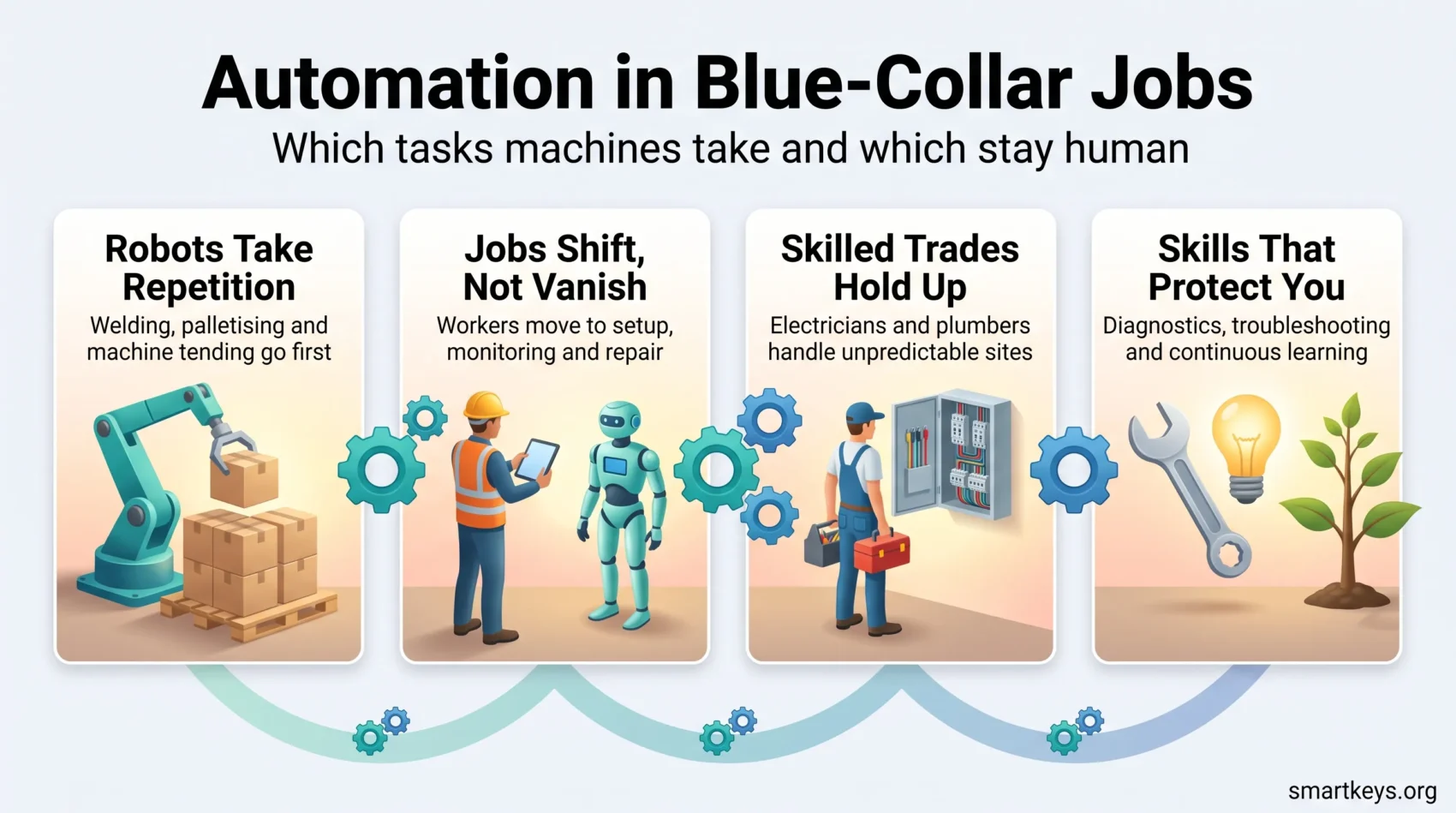
Manufacturing. Automotive plants remain the densest users, followed by electronics and metal fabrication. Welding, painting, palletising and machine tending are the tasks most often handed over first.
Retail and food service. Checkout-free and semi-automated formats have expanded, though not always as originally promised. Our review of where checkout-free retail technology actually worked covers what stuck and what quietly closed.
Logistics and delivery. Sorting, routing and last-mile handling are being reshaped by both software and hardware, and autonomous delivery systems are in limited commercial use rather than widespread deployment.
Construction and agriculture. These lag, mostly because sites are unstructured and weather dependent. Where automation has landed, it tends to assist rather than replace: layout robots, survey drones, machine guidance on excavators and wearable exoskeletons that reduce strain injuries.
The Effect of Automation on Manual Labor
The lived experience of automation in manual trades is usually less about redundancy and more about a changing job description. Tasks are unbundled. The physically hardest and most repetitive parts go to a machine, and what remains asks for a different mix of skills.

On a modern production line, an operator may spend less time lifting and more time monitoring output quality, clearing faults, and interpreting machine data. In logistics, pickers work alongside mobile robots that bring shelves to them. In agriculture, an operator supervises guided machinery across a field rather than steering it row by row.
That shift has two edges. It reduces injury risk and physical wear, which matters enormously in trades where the body is the limiting factor. It also raises the technical floor of the job. Workers who cannot or will not move up that floor are the ones most exposed, which is why planned redeployment inside the company tends to produce far better outcomes than waiting for attrition to solve the problem.
Transport is the exception people ask about most. Fully autonomous long-haul trucking remains limited to specific corridors and controlled conditions in 2026. The nearer-term change in driving jobs is assisted operation and tighter algorithmic scheduling, not the removal of the driver.
The Future of Blue-Collar Work in an Automated Workplace
The most useful forward-looking dataset available is the World Economic Forum’s Future of Jobs Report 2025, which surveys employers directly rather than modelling task exposure in the abstract. It projects 170 million new roles and 92 million displaced roles by 2030, a net gain of 78 million.
What makes it relevant here is which roles grow. In absolute numbers, the largest expected gains are in farmwork, delivery driving, building construction, food processing, sales and care work. These are manual and frontline occupations, and they are growing not despite automation but alongside it, driven by demographics, energy transition, infrastructure spending and food systems.

The same report puts the current split of work at roughly 47% of tasks performed mainly by humans, 22% mainly by technology and 30% by a combination, and expects those three shares to converge by 2030. Read carefully, that is a description of blended work, not replacement.
History supports the cautious reading. Automated teller machines did not eliminate bank tellers; branch staffing per branch fell while the number of branches rose and the role turned toward advice and sales. Similar patterns are visible in how workers have adapted to earlier automation waves. The risk is not that work vanishes. It is that the transition is badly managed for the people in the middle of it.
AI and Machine Learning on the Shop Floor
The newer layer of change is software rather than steel. Machine learning shows up in blue-collar settings in three practical ways.
Predictive maintenance. Sensor data and pattern recognition flag failing equipment before it stops the line. This is the most commercially proven application, and our overview of how predictive maintenance programmes are being deployed covers the operational detail.
Quality inspection. Vision systems catch defects that are difficult to see consistently at speed, which changes the inspector’s role toward handling ambiguous cases and adjusting the process upstream.
Simulation and planning. Digital twins of production lines let teams test layout and scheduling changes before touching the physical floor, and private 5G networks in factories supply the connectivity those systems need.
Generative AI has had less direct impact on manual tasks than on office work, and the data supports that. The ILO’s 2025 global index of occupational exposure, produced with NASK, estimates that about 25% of global employment sits in occupations with some exposure to generative AI, rising to 34% in high-income countries, with clerical roles at the very top of the list. Manual and craft occupations sit far lower. Where generative AI reaches blue-collar work, it usually arrives as a documentation, scheduling or training tool rather than as a substitute for the task itself.
Training is where this becomes concrete. VR-based training programmes and augmented reality guidance on the machine itself shorten the time it takes to qualify someone on new equipment, and short modular learning formats fit shift patterns better than classroom courses.
Which Blue-Collar Roles Are Most Exposed
Exposure follows task structure, not job titles. The roles under most pressure share a few features:
- The work is highly repetitive and follows a fixed sequence.
- It happens in a structured, predictable environment such as a factory or a fulfilment centre.
- Physical precision matters more than judgement or improvisation.
- Volume is high enough to justify capital spending on equipment.
- The task can be defined clearly enough for a machine to be measured against it.
Assembly line work, machine tending, palletising, basic sorting and routine material handling all score high on those criteria. Roles that mix physical work with unpredictable conditions, customer contact or on-the-spot diagnosis score much lower.
A practical way to think about your own position is to break the job into tasks and ask which of them meet all five conditions. If most do, the sensible response is not panic but positioning: move toward the parts of the workflow that involve setup, maintenance, exception handling or supervision. An honest automation risk assessment at team level is more useful than any national statistic.
Blue-Collar Jobs at Lower Risk of Automation
Plenty of manual work is genuinely difficult to automate, and the reasons are structural rather than sentimental.
Skilled trades that work in unpredictable environments come first. Electricians, plumbers, HVAC technicians, industrial maintenance staff and lift engineers spend their days in buildings that are never quite the same twice, diagnosing faults that were not in any manual. The US Bureau of Labor Statistics projects employment of electricians to grow 9% between 2024 and 2034, much faster than the average for all occupations, with about 81,000 openings each year and median pay of $62,350 as of May 2024.
Roles that combine physical work with human judgement follow. Emergency services, care work, site supervision and customer-facing repair all involve reading a situation and negotiating with people. Machines are still poor at both.
There is also a supply-side factor that gets overlooked. Many skilled trades face an ageing workforce and a thin apprenticeship pipeline, which means demand is being driven as much by people leaving as by new work appearing. Employer partnerships with training providers have become a common response, and micro-credentials are starting to appear as a faster entry route.
The Opportunities Automation Creates
The jobs automation creates in blue-collar settings are usually adjacent to the machines rather than distant from them.
Robot technicians, maintenance engineers, controls specialists, quality analysts and automation trainers are all roles that did not exist at scale in most plants ten years ago. They pay better than the tasks they replaced, and they are frequently filled internally, because someone who already understands the process has a real advantage over an outside hire who understands only the technology.
Three moves make that transition more likely:
- Learn the machine you already work next to. Operators who can clear faults, run diagnostics and read maintenance data become hard to replace.
- Build the judgement skills machines lack. Troubleshooting, safety leadership, supervision and clear communication are all portable across employers. Structured cross-training is the fastest route for most teams.
- Keep learning in short cycles. Mid-career retraining works far better when it happens continuously than when it is triggered by a redundancy notice. Current upskilling practice has moved decisively in that direction.
Employers carry the larger share of this. Companies that treat automation as a workforce programme rather than a procurement decision get better results, which is one reason centralised automation teams and joined-up automation strategies have become common. Policy matters too: the debate over taxing automation and over income floors is ultimately about who absorbs the cost of the transition.
Conclusion
Automation in blue-collar jobs is real, measurable and uneven. The industrial robot stock keeps growing, the credible research shows genuine wage and employment pressure in routine manual roles, and the trades that require judgement in messy environments look durable. All three of those things are true at once.
The practical response is neither denial nor fatalism. Break your work into tasks, identify which of them a machine could plausibly do in a structured setting, and move deliberately toward the parts that involve setup, diagnosis, supervision and human contact. Employers that plan redeployment ahead of installation, and workers who keep learning in small continuous steps, consistently end up in a better position than those who wait to see what happens.
For a wider view of how these shifts fit together, see our overview of the trends shaping work, our look at how businesses are approaching automation, and our analysis of robots that extend human presence rather than replace it.
Found this useful?
Make SmartKeys a preferred source on Google, and our articles will surface more often in your Top Stories, AI Overviews, and AI Mode.
Add as Preferred Source