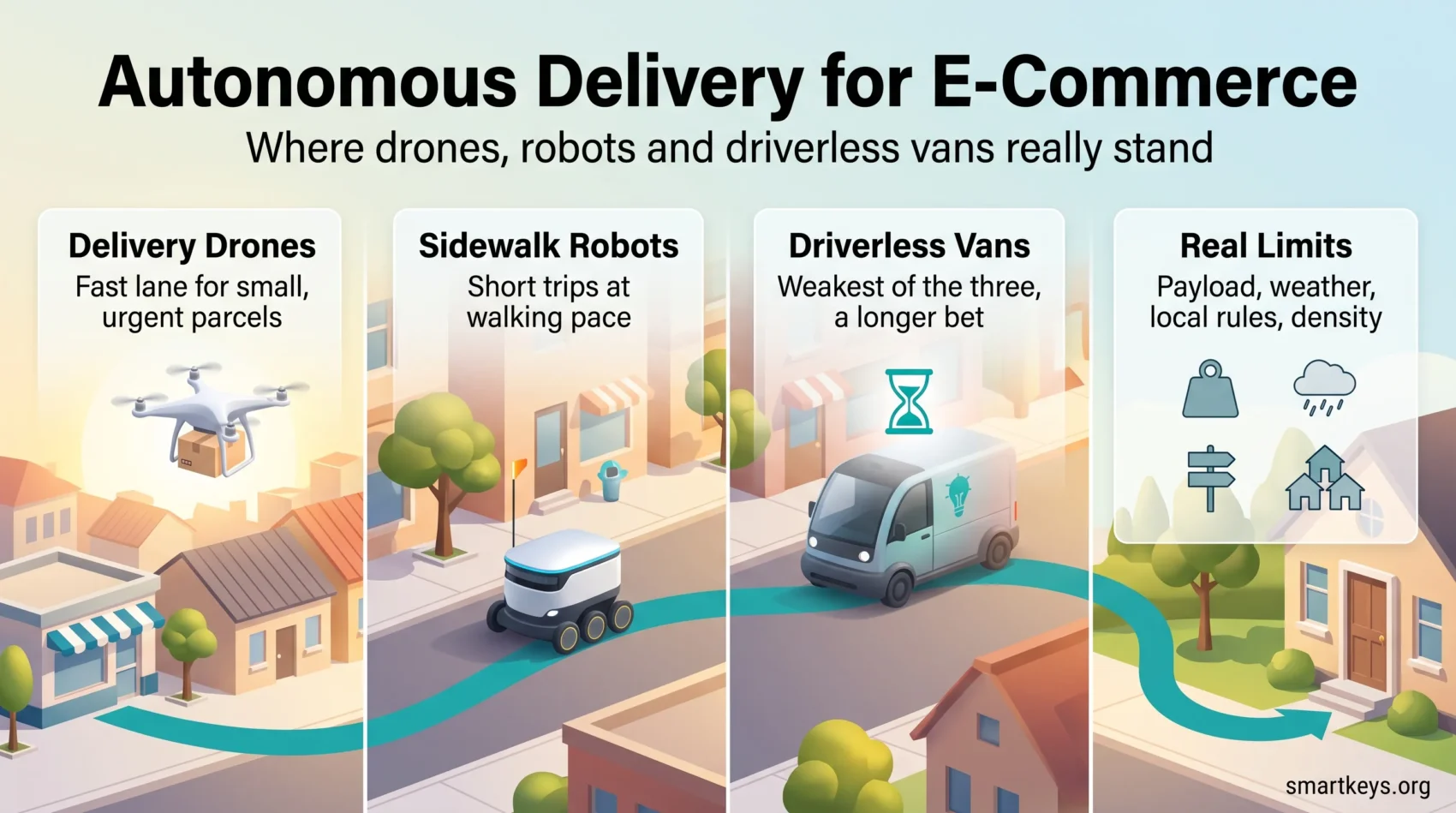
Autonomous delivery means getting a parcel to a customer’s door with no human driver in the loop. In practice that covers three very different machines: drones that fly, small robots that roll along sidewalks, and self-driving road vehicles. Each solves a different piece of the same expensive problem, and in 2026 only two of the three are actually working at scale.
The pressure behind all of it is simple. Online shopping keeps growing: US e-commerce sales reached $340.2 billion in the second quarter of 2026, up 12.2% year over year and 17.1% of all retail sales, according to the US Census Bureau. More orders mean more individual trips to individual addresses, and that final leg is the slowest and most expensive part of shipping.
This guide covers what autonomous delivery genuinely does today, what it costs, where it fails, and what a business should take from it. Every figure here is sourced. Where the industry only offers marketing claims, it says so.
Key Takeaways
- Drone delivery scaled fast in 2026: Amazon plans to reach nearly 500 US cities and towns by year end, and Walmart is adding drone service at 150 more stores.
- Sidewalk robots are the quiet success. Starship passed 10 million autonomous deliveries in April 2026.
- Self-driving road delivery is the weakest of the three. Amazon shut down its Scout robot and Nuro moved its focus to robotaxis.
- The real constraint is payload and geography, not ambition: most drone services carry about five pounds within a short radius.
- A new FAA rule, Part 108, replaced the old case-by-case waiver system for flights beyond the operator’s line of sight.
What Autonomous Delivery Actually Means
“Autonomous delivery” gets used loosely, so it helps to split it into the three machines that exist today.
Delivery drones are small aircraft that fly a parcel from a store or depot to a customer’s garden or driveway. They are fast because they ignore traffic, and limited because they can only carry a few pounds a few miles.
Sidewalk robots are insulated coolers on wheels, roughly the size of a large suitcase. They travel at walking pace on pavements, mostly carrying restaurant and convenience orders over short distances in dense neighbourhoods and on university campuses.
Autonomous road vehicles are the cars and vans that drive themselves on public roads. In principle they carry the largest loads. In practice, this is the category that has struggled most.
One term worth defining early: last-mile delivery is the final leg from a local depot or store to the customer’s address. It involves many stops, short distances and one parcel per address, which is why it is disproportionately expensive compared with moving a full lorry between warehouses. Almost everything in autonomous delivery is aimed at this last leg.
Drone Delivery in 2026: From Pilot to Rollout
Drone delivery spent years as a demonstration. In 2026 it turned into a rollout.
Amazon Prime Air currently operates from 11 locations across seven US states and has said it intends to reach nearly 500 US cities and towns by the end of 2026, a sixfold increase. Its MK30 aircraft has double the range and half the noise of the previous model, according to Amazon. Orders arrive in as little as 30 minutes, though most take about an hour. Almost any item under five pounds that fits in a large shoebox qualifies, which Amazon says covers roughly 60% of the products people buy most often. The company reports hundreds of thousands of drone deliveries so far this year.
Walmart is scaling through Alphabet’s Wing rather than building its own fleet. Wing and Walmart announced in January 2026 that drone service would reach 150 more stores within a year and more than 270 by 2027, with cities including Los Angeles, St. Louis, Cincinnati and Miami joining existing operations in Dallas-Fort Worth and Atlanta. The aircraft fly up to 60 mph over a round trip of up to 12 miles, carrying up to five pounds, and the companies said delivery volume tripled in the six months before the announcement, as reported by Supply Chain Dive.
What unlocked this was regulation, not hardware. Flying a drone beyond the operator’s line of sight used to require an individual FAA waiver, negotiated case by case. The FAA’s Part 108 rule, phasing in from July 2026, replaces that patchwork with a tiered certification process based on aircraft capability, population density and operational risk. Operators can now certify against a published standard instead of bargaining for an exemption. That is what turns a pilot programme into a national service.
The honest limits are worth stating plainly. Five pounds and a short radius rules out most furniture, most bulk grocery orders and anything fragile in bad weather. Drone delivery is a fast lane for small, urgent items, not a replacement for the van.
Sidewalk Robots: The Quiet Success Story
While drones got the headlines, the small robots on pavements quietly did the volume.
Starship Technologies passed 10 million autonomous deliveries on 28 April 2026. The company runs more than 3,000 robots across 300 locations in eight countries, including more than 65 US university campuses, and has covered 22 million autonomous kilometres. Its robots make over 125,000 road crossings a day. Starship puts the cost advantage at $3 to $4 per delivery below a human rider, with a long-term target near $1 per delivery, according to Starship.
Serve Robotics announced in December 2025 that it had deployed more than 2,000 sidewalk robots in the US, across Los Angeles, Atlanta, Dallas-Fort Worth, Miami, Chicago, Fort Lauderdale and Alexandria, Virginia. It reported over 100,000 deliveries for enterprise partners at a 99.8% completion rate, working with Uber Eats, DoorDash and 7-Eleven, per The Robot Report.
Coco Robotics has completed more than 500,000 deliveries and operates in Los Angeles, Chicago, Miami and Helsinki, working with Uber, DoorDash and Wolt. Its robots drive autonomously with human oversight, which is the standard arrangement across this category: a remote operator can take over when a robot meets something it cannot handle.
Why do sidewalk robots work where bigger machines stall? They move slowly, in a forgiving environment, over distances short enough that a remote human can step in. The risk of a two-mph cooler bumping a kerb is nothing like the risk of a two-ton vehicle misreading a junction. Lower stakes made faster deployment possible.
Self-Driving Road Delivery: Where the Story Changed
This is the part of the market that did not go as forecast, and it matters for anyone planning around it.
Amazon ended field testing of Scout, its pavement delivery robot, in 2022 after the trials failed to meet customer needs. Nuro, long treated as the flagship autonomous delivery company, shifted its business from operating its own delivery pods to licensing its self-driving system, and in 2026 announced a global robotaxi programme with Lucid and Uber. The technology it built for delivery is now being pointed at moving people.
The lesson is not that road delivery is dead. It is that carrying passengers turned out to be the better business for the same technology, because a robotaxi generates far more revenue per mile than a parcel does. When a business plans around autonomous logistics, it should weight drones and sidewalk robots heavily and treat driverless vans as a longer bet. The broader picture on robotics in commercial operations follows the same pattern: narrow, well-defined tasks get automated first.
What Autonomous Delivery Costs and What It Saves
The economics are clearer for sidewalk robots than for anything else, because Starship has run them at scale for years. Its stated $3 to $4 advantage per delivery over a human rider is the most concrete cost figure in the sector. Multiply that by millions of deliveries and it explains why platforms keep signing up.
Drone economics are less transparent. Amazon charges Prime members nothing on drone orders over $50, $2.99 below that, and $4.99 for non-members, which tells you what customers pay but not what the flight costs. Vendors publish savings percentages, but most of these come from vendor marketing rather than audited operations. Treat them sceptically.
The reliable savings are structural rather than headline-grabbing:
- No driver wage on the individual trip, which is the single largest line item in last-mile cost.
- Longer operating windows, since a robot does not need a shift break.
- Fewer failed deliveries, because the customer receives a precise arrival window and meets the machine at the door.
- Lower per-drop energy cost, since these are small electric vehicles rather than diesel vans.
Against that sit the costs businesses often forget: remote operations staff, maintenance, insurance, permits, and the software integration to connect a robot fleet to an existing order system. Similar integration questions come up whenever a company adds automation across connected business processes.
The Environmental Case, and Its Limits
The sustainability argument for autonomous delivery is genuine but narrower than usually claimed.
The problem is real. The World Economic Forum’s report The Future of the Last-Mile Ecosystem projected that without intervention the top 100 cities would see 36% more delivery vehicles by 2030, last-mile emissions rising by more than 30% to about 25 million tonnes of CO2 a year, and congestion up by more than 21%, equal to adding 11 minutes to every commuter’s daily journey.
Small electric drones and pavement robots help because they replace car and van journeys with something far lighter. Coco describes its deliveries as zero-emission at the point of use, and Starship’s robots run on batteries. For short trips in dense areas, that substitution is straightforward.
The limit is that these machines only handle the small end of the parcel mix. A five-pound cap excludes the heavy, bulky orders that drive most delivery emissions. Autonomous delivery is one intervention among many, alongside consolidation, off-peak deliveries and fleet electrification. Companies working on sustainable logistics and broader sustainability commitments should treat it as a component, not a solution.
What Customers Actually Think
Adoption depends on trust, and trust has lagged the technology.
The most cited US measurement remains a Morning Consult survey from June 2022, in which 57% of adults reported little or no trust in drone delivery, with the most common worry being that the delivery would simply fail. That survey is now several years old and predates the current rollouts, so treat it as a starting point rather than the present state.
What has changed since is exposure. When people can actually order a drone delivery and watch it arrive in half an hour, abstract concerns tend to give way to practical judgements about whether the service is useful. Starship reports a 97% approval rate among the US campus students who use its robots daily, which is the pattern you would expect: familiarity raises acceptance.
For retailers, the practical implication is that the first delivery matters disproportionately. Clear arrival windows, an obvious fallback when a drop fails, and a human to contact all do more for adoption than promoting the technology itself. That is the same lesson visible across customer experience work generally.
Where Autonomous Delivery Still Does Not Work
Being specific about the failure modes is more useful than listing benefits.
Weight and size. Five pounds is the working limit for most drone services. Sidewalk robots carry more but travel only a mile or two.
Weather and terrain. High wind, heavy rain and snow ground drones. Snow, steep hills, broken pavements and missing kerb ramps stop ground robots.
Local rules. Pavement robots are governed city by city, and some jurisdictions restrict or ban them outright. There is no single national permission.
Density economics. These systems pay off where drops are close together. Rural drone delivery is technically attractive and commercially harder, because each flight serves one distant customer.
Security. A connected fleet is a software system with a physical footprint, exposed to interference and theft as well as to conventional attacks. The same security and verification questions that arise elsewhere in connected logistics apply here.
Workforce. Automating drops changes what delivery jobs look like, shifting work towards remote operations, maintenance and exception handling. The wider evidence on how workers adapt to automation and on automation in blue-collar roles is worth reading before assuming either mass displacement or no change at all.
What This Means for Your Business
Most companies will not run their own autonomous fleet. They will connect to someone else’s. That changes what is worth doing now.
Start by checking whether your catalogue fits. If a meaningful share of your orders is under five pounds and goes to dense urban addresses, drone or robot delivery is relevant to you. If you ship furniture, it is not.
Then look at your order data. Autonomous delivery works through platform partnerships, so your systems need to expose accurate stock location, package weight and dimensions at the item level. Companies that already run clean product data can plug in quickly. Those that do not spend months on cleanup first. The same groundwork supports personalised e-commerce experiences and sales across digital marketplaces.
Finally, set expectations honestly with customers. Offer autonomous delivery as one option among several rather than as a default, and keep a conventional fallback. The retailers handling this well treat it as an extra fast lane for small items, which is precisely what the technology is good at. The parallel shift in physical stores, covered in our piece on autonomous retail, has followed the same path: the automation that stuck was the narrow, useful kind.
Wider context helps too. Autonomous delivery sits inside broader changes in how online retail is growing, in mobile shopping behaviour, in immersive product experiences, and in the urban technology that determines whether a city’s streets can support any of it. The supply chain behind the last mile is changing at the same time, through shifting supply chain priorities, local production and better shipment tracking.
Conclusion
Autonomous delivery in 2026 is real, useful and much narrower than the forecasts suggested. Drones are scaling quickly under a new regulatory framework, but only for small parcels over short distances. Sidewalk robots have quietly passed ten million deliveries and have the clearest economics in the sector. Driverless road delivery, once the centrepiece of every projection, lost out to robotaxis for the same underlying technology.
For a retailer, the practical question is not whether autonomous delivery will transform logistics. It is whether a useful share of your orders is small, urgent and going somewhere dense. If the answer is yes, the option exists today and the partner networks are already built. If not, the sensible move is to keep watching, keep your product data clean, and revisit it as payloads and coverage grow.
Found this useful?
Make SmartKeys a preferred source on Google, and our articles will surface more often in your Top Stories, AI Overviews, and AI Mode.
Add as Preferred Source