A micro-credential is a short, assessed course that proves one specific skill, such as writing a SQL query, configuring a firewall rule or building a paid search campaign. It takes weeks instead of years, ends in a test or a project, and leaves a badge an employer can verify online.
That is a narrow promise, and the narrowness is the point. A degree tells you someone completed a broad course of study. A micro-credential tells you they can do one named task. For a manager filling a role where the tools change every year, the second signal is often more useful. This guide covers what these credentials really prove and how to build them into screening and onboarding without lowering your bar.
Key Takeaways
- A micro-credential is evidence about one task, not a qualification for a profession.
- The World Economic Forum expects 39% of today’s skill sets to be transformed or outdated by 2030, which is why short, repeatable training keeps appearing in workforce plans.
- Employer surveys are very positive. Research on actual hiring records is far more cautious. Read both before you rebuild your process.
- Pair every credential with a work sample. The credential tells you where to look, the work sample tells you whether the skill is really there.
- Track time to productivity, training cost and internal mobility, or you will never know whether the programme paid for itself.
Why Micro-Credentials Matter Now
The work is changing faster than the paperwork that describes it. In its Future of Jobs Report 2025, the World Economic Forum estimated that 39% of workers’ existing skill sets will be transformed or become outdated between 2025 and 2030, and that 59 in every 100 workers worldwide will need training in that period.
That does not make degrees worthless. It says something narrower: a qualification earned years ago cannot tell you whether someone can use this year’s tools. That gap is what short credentials fill.
Where they fit between a course and a degree
Think of three levels. A free tutorial teaches you something but proves nothing. A degree proves years of study but rarely names a tool. A micro-credential sits in between: assessed, dated, tied to a named skill and verifiable by link. They are most useful where tools turn over quickly: data analysis, cloud administration, cybersecurity, digital marketing, project management. They matter less where licensing already governs entry, as in accounting or nursing. Two groups earn most of them: students adding something concrete to a degree, and mid-career workers moving sideways into a new specialism without leaving work. That is the logic behind mid-career retraining and internal cross-training strategies.
What the Evidence Actually Shows
Two bodies of research point in different directions, and you need both to make a sensible decision.
The employer surveys are strongly positive
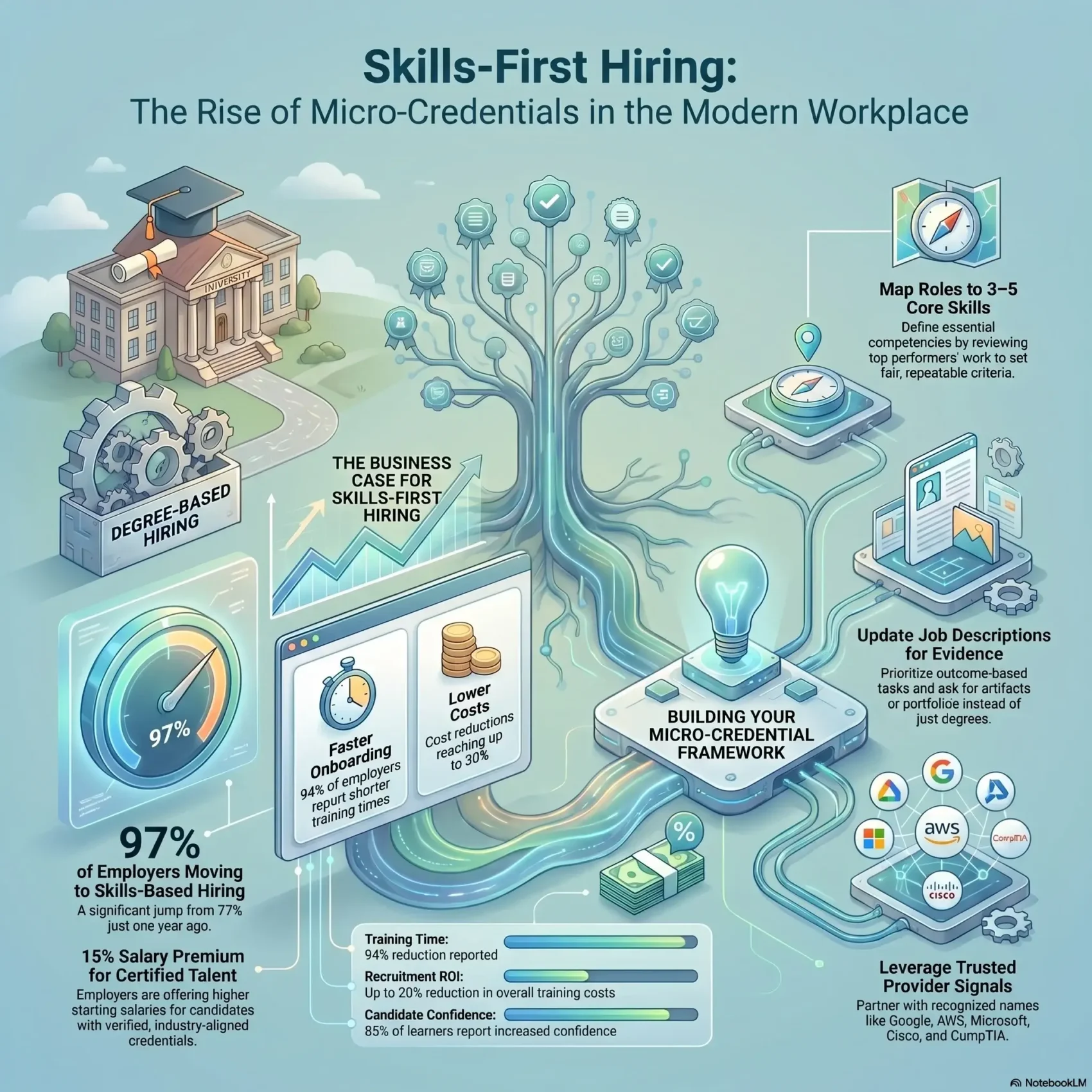
Coursera’s Micro-Credentials Impact Report 2026, based on more than 3,500 learners, employers and education leaders, found that 94% of employers surveyed would offer a higher starting salary to graduates holding an industry micro-credential. In the same survey, 92% said entry-level hires with one performed better in their first year, and 87% of graduates reported finding a role in their field within twelve months.
Read those figures for what they are: impressions, self-reported by people who chose to answer a survey about credentials. They are a good signal of employer attitude and a weak signal of employer behaviour.
The behavioural data is far more cautious
In February 2025, Harvard Business School and the Burning Glass Institute published an analysis of more than 11,000 US job postings from 2014 to 2023, led by Professor Joseph Fuller. It looked at companies that publicly removed degree requirements, then checked who they hired.
The result: fewer than one in 700 new hires benefited. Non-degree hiring rose 3.5 percentage points overall, and under one percentage point once the researchers isolated the roles where requirements were genuinely removed.
A minority of firms did much better. Apple, Walmart, Target, ExxonMobil and several state governments hired on average 18% more workers without degrees, and those hires stayed longer than degree-holding colleagues, with retention rates 10 percentage points higher.
The lesson is practical. Announcing that you accept credentials changes nothing. Changing the screen, the interview and the manager’s shortlist changes everything. The same pattern shows up with AI hiring tools: the tool helps only if the process around it is rebuilt.
How to Build Skills-First Hiring Around Micro-Credentials
Step 1: Map each role to three to five skills
Start with the job, not the credential. For each job family, write down the three to five skills that separate a strong performer from a weak one. Ask two or three of your best people in the role what they actually produce in a normal week.
Keep the list short. Twelve competencies is a wish list, and wish lists get ignored at shortlist time. A digital skills gap analysis shows fastest where your team is thin.
Step 2: Decide which credentials you will accept
Publish a short, named list rather than accepting anything with a badge. Programmes from AWS, Google, Microsoft, Cisco and CompTIA are the usual starting point, because managers recognise them and the assessments are standardised.
For anything outside that list, ask three questions. Is it assessed by a supervised exam or a graded project, or by a quiz you can retake forever? Does the issuer publish outcomes for people who complete it? Can you verify the badge without contacting the candidate? The Burning Glass Institute’s Credential Value Index, which scores over 20,000 commonly earned US credentials against the real outcomes of their holders, helps when you cannot.
The same test applies to training you build internally, as our guides to AI-powered learning platforms and to a microlearning strategy explain.
Step 3: Rewrite the posting and the screen
This is the step most companies skip, and the Harvard data says it matters most. Lead the posting with outcomes and tools, then name the credentials you accept as evidence. Remove degree language from roles where you cannot explain what the degree adds. Replace the CV sift with a short work sample that mirrors a real task: a 45-minute data cleaning exercise, a mock incident triage, a one-page campaign brief. Then check for the failure modes covered in our guide to AI hiring bias, especially if software does the first pass.
Step 4: Stack learning into onboarding
A new hire with a credential in one area usually has a visible gap in another. Map that gap on day one and assign the next course instead of repeating what they know. Done well this shortens onboarding, and it fits with structured onboarding programmes and remote onboarding practices.
Make the next step explicit. If a credential unlocks a pay band or a project type, say so in writing. A career lattice and an internal talent marketplace give people somewhere to use the skill.
Running a Pilot Without Betting the Whole Process
Pick one role, one credential and one hiring cycle. Choose a role you fill repeatedly, so you have a baseline. Name one or two accepted credentials, add a work sample to the screen, then compare the new hires against the last cohort on ramp-up time and first-year performance.
Two partnership models are worth testing alongside it. Employer-shaped short programmes, where you help a provider or community college design the curriculum, produce candidates who need less unlearning. Talent pipeline partnerships extend that over several years, and the contract-to-hire route pairs well with credential-based screening.
One warning. Short programmes that cost the learner money and deliver no measurable wage gain are common. Before pointing candidates at a course, check where its graduates end up.
Measure What Matters
Four numbers tell you whether this is working.
- Time to productivity: days from start date until the person hits the agreed output for the role.
- Training cost per hire: what you spend closing gaps in the first 90 days. If credentials work, this line falls.
- Retention at twelve months: the Harvard data suggests skills-first hires can stay longer, but only your own records confirm it.
- Internal mobility: how many credential holders move into a stretch role within a year. This shows whether the skill was real.
Set the baseline before you change anything, or you will compare this year’s impression against last year’s memory. Our guides to measuring upskilling ROI and workforce analytics tools show how to collect these figures cheaply.
Guardrails that keep it fair
Skills-first hiring widens your pool only if the credential is reachable. Cover exam fees for internal candidates, allow study time inside working hours, and accept demonstrated work from people who learned the skill on the job.
Review the accepted list twice a year. Retire credentials that stop predicting performance and add the ones your teams use. Shifts in HR management and in upskilling and reskilling keep moving that list. For the leadership side of these decisions, see our guide on future leadership skills.
Conclusion
Micro-credentials are a useful signal and a poor substitute for judgement. They tell you someone sat an assessment on a named skill at a known date. They do not tell you whether that person can apply it in your systems, with your customers.
The companies getting value from them treat the credential as the start of the evidence chain, not the end. They name what they accept, test it with a work sample, and measure what happened. Start with one role and one cycle. If ramp-up time falls and the hire is still there a year later, widen it.
Found this useful?
Make SmartKeys a preferred source on Google, and our articles will surface more often in your Top Stories, AI Overviews, and AI Mode.
Add as Preferred Source