Leading a team in 2026 means making decisions while the ground keeps moving. Tariffs change overnight, AI tools arrive faster than anyone can evaluate them, and half of your people may work from somewhere else. Setting a plan and enforcing it no longer works.
The numbers show the strain. Gallup’s State of the Global Workplace 2026 report puts global employee engagement at 20% for 2025, the lowest reading since 2020. Manager engagement fell to 22%, down nine points since 2022. In DDI’s Global Leadership Forecast 2025, 71% of leaders reported more stress, and only 29% of employees said they trust their immediate manager.
Adaptability and a learning orientation are now the working conditions of the job. This guide covers seven future leadership skills that hold up under that pressure, explains each in plain terms and shows how to practice it this week.
For a broader view of where management is heading, see our overview of leadership trends.
Key Takeaways
- Engagement and trust are at multi-year lows, so skills that rebuild both matter more than new tools.
- Self-awareness is the base skill. Leaders who know their own defaults coach, decide and delegate better.
- Adaptability works best as a routine: short experiments, quick feedback, visible adjustments.
- AI fluency means knowing what a tool can and cannot do, not writing code.
- Psychological safety is the strongest predictor of team effectiveness in Google’s research.
- Small, repeated habits (a decision log, a weekly one-on-one, a short pilot) beat one-off transformation programs.
Why the 2026 Workplace Demands a New Leadership Playbook
Most problems a leader faces today have no single correct answer. Supply chain shocks, new AI rules, shifting return-to-office expectations and tighter budgets rarely arrive one at a time.
Technical problems versus adaptive challenges
A technical problem has a known fix that an expert can apply: a server is down, a contract needs a clause. An adaptive challenge has no ready answer and requires people to change how they work. A sales team learning to sell alongside an AI assistant is an adaptive challenge. So is merging two departments onto one process.
Adaptive challenges resist top-down fixes. They need broad participation and repeated testing. That is why the skills below focus on how you involve people, not only on how you decide.
Start with self-awareness
Every skill below rests on something you cannot outsource: knowing how you actually come across. Self-awareness means two things here. You understand your own strengths, blind spots and triggers, and you know how your behavior lands with the people around you.
Most leaders overrate themselves on this. Organizational psychologist Tasha Eurich studied around 5,000 people and found that only 10% to 15% met the criteria for self-awareness, though far more believed they qualified. The business case is not soft either: a Korn Ferry Institute analysis linked higher rates of self-aware employees to stronger financial performance at company level.
Three habits close the gap, and none of them takes long. Ask two colleagues each quarter what you should start, stop and keep doing, then repeat their answer back before you defend anything. Keep a short weekly note on decisions that went badly and what you misread. Write your strengths and limits down twice a year and check that list against the feedback you got. Our guide to soft skills for the future of work covers the wider set.
The Seven Future Leadership Skills You Need Now
Focus on a compact set of behaviors you can practice daily. The seven skills reinforce each other, so progress on one usually lifts the others.
1. Adaptability and learning agility
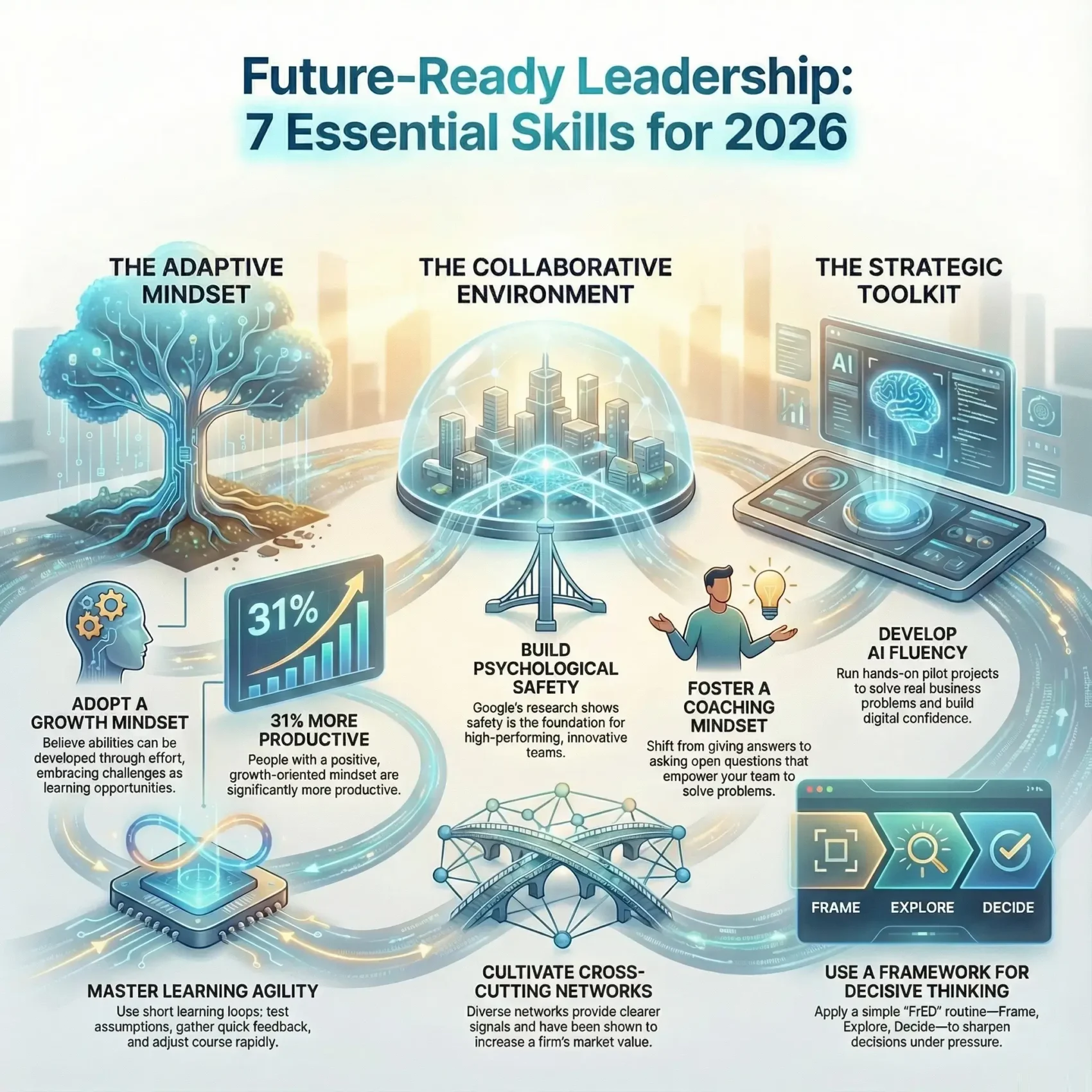
Learning agility means picking up new skills quickly and dropping habits that no longer work. Turn it into a routine with short learning cycles: pick one assumption, test it for two weeks, review the result with your team, adjust.
Example: a marketing lead unsure whether AI-drafted emails perform worse than human-written ones runs both for a fortnight and lets the open rates decide. If your own role is changing, our guide to mid-career retraining shows how to structure the learning.
2. AI fluency and digital confidence
AI fluency means understanding what an AI tool does well, where it fails and what it costs. You need enough knowledge to make a sound business decision, not to build models.
The gap between adoption and results is wide. McKinsey’s State of AI survey, published in August 2026, found that nearly nine in ten organizations use AI in at least one business function. Yet only 37% report any impact on earnings, and about 6% qualify as high performers. Leaders who understand the tools close that gap. See the evidence on AI and automation at work and how managers can use AI in decision making without outsourcing their judgment.
3. Collaborative leadership and psychological safety
Psychological safety is the shared belief that people can speak up, ask questions or admit mistakes without being punished or embarrassed. Google’s Project Aristotle, a multi-year study of its own teams, found it to be the most important factor behind effective teams, ahead of dependability, clarity, meaning and impact.
The payoff is concrete. When an engineer flags a risky shortcut in week one instead of week six, the fix costs hours rather than weeks. Our guide to hybrid meeting etiquette covers giving remote and onsite voices equal weight.
4. A coaching mindset: from “know it all” to “learn it all”
A coaching mindset means asking questions that help people find their own answers. Ask “What have you tried?” and “What would you do if I were unavailable?” before offering a solution.
This moves work from you to the people who own it. It also matters for retention: DDI found that high-potential employees are 3.7 times more likely to leave when their manager offers no growth opportunities. A weekly check-in is the cheapest coaching tool you have. See our one-on-one meeting template and the guide to handing off low-value work.
Empathy is what makes those questions land. It means reading what someone is dealing with before you decide what they need. The Center for Creative Leadership studied 6,731 managers across 38 countries and found that managers whose direct reports rated them as empathetic were also rated as stronger performers by their own bosses. In practice that is small: ask how a deadline sits with someone’s workload before you set it, and act visibly on at least one thing you hear.
5. Culture shaping
Culture is whatever gets rewarded, tolerated and repeated. Satya Nadella’s reset at Microsoft is the best-known example. He framed the company around a growth mindset and treated smart failures as investments. At team scale, publicly credit the person who killed a weak idea early. Learn how to develop a growth mindset in daily work.
6. Trust-based relationships
With trust in immediate managers at 29% (DDI, 2025), rebuilding it is a skill in its own right. Trust grows from small, consistent acts. Keep the one-on-one instead of cancelling it. Say what you do not know. Explain the reasoning behind a decision even when people disagree. Our article on transparency culture shows what open information flow looks like in practice.
7. Decisive critical thinking under pressure
When time is short, use a simple routine such as FrED (Frame, Explore, Decide), developed at IMD business school. State the problem in one sentence, list at least three real options, then choose and record why. A decision log lets the team see how choices were made. For more options, see our overview of decision-making models.
For a fuller checklist, Harvard Business Review published a framework by Schoemaker, Krupp and Howland in 2013, built on assessments of more than 20,000 executives. It names six habits of strategic leaders: anticipate, challenge, interpret, decide, align and learn. Almost nobody is strong in all six, so the useful question is which one you quietly skip when time is short.
Build Adaptability Into Your Organization’s DNA
Treat adaptability as a muscle you develop through routine experiments and broad collaboration.
Cross-cutting networks: broaden your view, spark better ideas
Leaders who widen their networks get clearer signals and spot opportunities earlier. A study of 1,212 CEOs of S&P 1500 companies between 2000 and 2010, summarized in Harvard Business Review in 2018, backs this up. CEOs with connections across different backgrounds and skill sets created higher firm value, mainly through better innovation and more successful acquisitions. At team level the same logic applies: the manager who has lunch with finance and support hears about a problem before it reaches the dashboard.
Make innovation a team sport
Innovation does not have to live in a lab. Let each team prototype, share results and run short demos. London Business School professor Herminia Ibarra recommends cutting across units and including different backgrounds in decisions. The discomfort that creates is the point: it produces better decisions. Our change management strategy guide applies the same approach to larger programs.
Lead Hybrid and Remote Teams With Clarity, Flexibility and Trust
Distributed teams need aligned expectations, shared tools and deliberate human connection.
Design for psychological safety and dependable execution
Create explicit norms that define how to speak up, how to escalate issues and how to share half-formed ideas. Add routines that build trust without micromanagement: one-on-ones and transparent progress tracking. Our guides to remote leadership skills and remote employee engagement go deeper.
Flexible work that works
The gap between what companies require and what people want is still wide. Korn Ferry’s Workforce 2025 survey of 15,000 professionals across 15 markets found that 64% of employees must work on site full time. At the same time, 69% want to work remotely at least part of the time, and only 32% have access to hybrid arrangements. Use those signals to match roles to outcomes rather than to hours at a desk.
Expectations also differ by career stage. Someone in a first job often wants office time for learning and contact, while a parent with a long commute values predictable home days. Ask each person what they need the office for instead of assuming one arrangement suits everyone. If you are formalizing the rules, start from our hybrid work policy template.
Then make the daily mechanics explicit. Keep decision logs and publish written summaries; our guide on choosing email, chat or a meeting helps. Use clean handoffs and asynchronous communication tools so people get focused time. State who decides and how input is gathered.
Become a Tech-Savvy, AI-Enabled Leader
Practical AI adoption starts with a small test that answers one real business question. Judge each pilot on one measurable outcome agreed in advance, such as cycle time or error rate.
Close the gap between strategy and staff
Korn Ferry’s 2025 research shows how far apart leaders and employees are: 70% of leaders believe their organization has an AI strategy, while only 39% of employees agree. Closing that gap is a communication task as much as a technical one. Short workshops, sandbox pilots and peer demos spread good ideas faster than a slide deck. See our guide to upskilling and reskilling in 2026, which also covers how to measure the return.
Responsible AI: ethics, transparency and the law
Set clear decision criteria before a pilot starts: problem fit, data readiness, privacy, compliance and expected return.
Regulation now sets a floor. Under the EU AI Act, transparency duties apply from 2 August 2026: people must be told when they interact with an AI system, and AI-generated content must be labeled. The stricter rules for high-risk systems, which include AI used in recruitment and employee management, were postponed to 2 December 2027 in the Digital Omnibus agreement of May 2026. If your company operates in Europe, see our guides to EU AI Act compliance and AI ethics in the workplace.
Conclusion
The evidence points the same way. Psychological safety anchors high-performing teams, diverse networks raise innovation and firm value, and trust and engagement are the metrics most in need of repair.
Start small. Pick one change: add a decision log, run a short AI pilot or hold a coaching retrospective. Measure the outcome and share what works. Repeated week after week, that small practice is what turns a new habit into how your team operates.
Found this useful?
Make SmartKeys a preferred source on Google, and our articles will surface more often in your Top Stories, AI Overviews, and AI Mode.
Add as Preferred Source