AI is now part of ordinary work, and the ethical questions have moved from conference panels to HR inboxes. Gallup’s Q2 2026 panel found that three in ten US employees use AI frequently on the job while four in ten never use it at all, and only 25% strongly agree their organization has communicated a clear plan for integrating it. That gap between what employers deploy and what they explain is where most workplace AI ethics problems begin.
This guide looks at the question from the side of the people the systems are applied to: staff who are screened by a model, scheduled by an algorithm, measured by a monitoring tool, or handed a chatbot with no rules attached. It covers what employees can reasonably expect, what employers actually have to do in 2026, and how to write a policy that survives contact with a real workplace. For the organisation-wide side of the same question, meaning who sets the rules and how they are enforced, see our guide to AI governance for businesses.
Key Takeaways
- Most workplace AI complaints are communication failures before they are technology failures.
- Public trust in employers to use AI responsibly fell again in 2026, which makes transparency a retention issue.
- Hiring and promotion tools now sit under real notice, testing and record-keeping duties in several US states.
- Emotion recognition at work is banned outright in the EU, and automated decisions still need genuine human review.
- A short policy with a named owner beats a long framework nobody applies.
Where AI Ethics at Work Stands in 2026
Adoption keeps climbing while confidence does not follow it. A Gallup poll published in July 2026 found 39% of Americans think AI does more harm than good, up from 31% in the previous two years, against just 9% who think it does more good. Only 27% expressed at least some trust in businesses to use AI responsibly, down from 31% a year earlier, and close to 80% expect AI to cut jobs over the coming decade.
Those numbers matter to employers for a practical reason. The people being asked to adopt these tools are the same people who distrust the companies deploying them. Ethics work at this point is not an abstract commitment. It is the mechanism by which a workforce agrees to cooperate with a technology it did not choose.

AI has also created work of its own. Governance leads, model reviewers, prompt and workflow specialists and AI trainers are now real job titles rather than predictions, and they sit alongside the operational roles that keep systems running. Our overview of AI and automation at work covers what the wider evidence shows about output and adoption.
What Employees Actually Worry About
Surveys about AI anxiety tend to blur several distinct fears together. Separating them makes each one easier to answer honestly.
Job security and a narrowing entry point
The best current evidence points to a specific effect rather than a general collapse. Stanford’s Digital Economy Lab, using ADP payroll records through June 2026 in its Canaries in the Coal Mine analysis, reports a 19% employment shortfall among workers aged 22 to 25 in the most AI exposed occupations compared with similar peers in less exposed roles, widened from 15% in July 2025. The authors are explicit that they see no widespread, economy wide displacement, and that the adjustment runs through reduced hiring of young workers rather than increased separations.
That is a narrower and more actionable finding than “AI takes jobs”. It suggests the ethical obligation falls on entry level pipelines and early career development, not on blanket reassurance. Our guides to how workers are adapting to job automation and to upskilling and reskilling go into the practical side.
Being judged by a system nobody explains
The second worry is quieter and more common: a decision about shifts, scores, promotion or performance arrives with no visible reasoning behind it. This is the core problem of algorithmic management, and it corrodes trust faster than the decision itself does. Employees who can see how a judgement was reached will argue with it. Employees who cannot simply stop believing the process is fair. Techniques from explainable AI exist precisely to close that gap.
Bias in Hiring, Promotion and Pay Decisions
Recruitment is where workplace AI does the most consequential filtering, and where the legal exposure has grown fastest.
Where workplace bias enters the model
- Training data drawn from past hiring decisions, which encodes whatever preferences those decisions carried.
- Proxy variables that stand in for protected characteristics without naming them, postal codes and school names among them.
- Feedback loops, where a model trained on the people who were hired keeps recommending people like them.
- Thin evaluation, where accuracy is measured overall but never broken out by group.
The consequences run in both directions. Candidates lose opportunities they were qualified for, and the employer quietly narrows its own talent pool while believing it has widened it. Our review of AI hiring tools looks at which categories of tool actually perform and which do not.
What the law now requires
The rules tightened considerably over the past two years, and they are not uniform.
- New York City Local Law 144 requires an annual independent bias audit of automated employment decision tools, published results and advance notice to candidates.
- Illinois amended its Human Rights Act through HB 3773, effective 1 January 2026. Employers must notify applicants and employees when AI is used for employment decisions, and using zip codes as a proxy for a protected class is prohibited.
- California brought FEHA regulations on automated decision systems into force on 1 October 2025. Evidence of bias testing becomes relevant to discrimination claims and defenses, and record retention for automated decision data extends from two years to four.
- Colorado postponed its AI Act, which now applies from 30 June 2026.
- The EU deferred the high risk obligations covering recruitment, selection, promotion, termination, task allocation and performance monitoring. Under the Digital Omnibus agreement those duties move from August 2026 to 2 December 2027.
Deferral is not exemption, and it does not touch the rules already in force. For the wider picture, see our summaries of AI regulation in 2026 and EU AI Act compliance.
Privacy and Monitoring at Work
Monitoring technology became cheap at roughly the same moment it became capable, which is how many organizations ended up collecting more than they can justify.
The trust cost of watching everything
Surveillance changes behaviour before it changes performance. Staff who believe they are continuously measured optimise for the measurement, which is rarely the same as optimising for the work. The ethical test is not whether monitoring is technically lawful but whether the employer can state, in one sentence, what specific problem each collected signal solves. Our detailed look at AI in employee monitoring covers what the tools do and what the independent evidence shows.
Protecting employee data
Employee records are among the most sensitive data an organization holds, and they are now among the most regulated. Practical protections are unglamorous: collect only what has a stated purpose, set retention limits and enforce them, restrict access by role, document what feeds any automated decision, and tell people plainly what is being gathered. One hard line is worth knowing. Emotion recognition in the workplace has been a prohibited practice in the EU since 2 February 2025 under Article 5 of the AI Act, regardless of consent. Our guide to data privacy at work sets out the current obligations in more detail.

Transparency and the Right to a Human Decision
Two duties sit at the centre of ethical automated decision making, and both became sharper in 2026.
The first is disclosure. The EU AI Act’s Article 50 transparency rules began applying on 2 August 2026, with systems already on the market before that date given until 2 December 2026 to comply. In workplace terms the principle is simple: people should know when they are interacting with a machine and when content they are shown was generated by one.
The second is meaningful human review. Article 22 of the GDPR continues to apply to automated decisions with legal or similarly significant effects, and the Court of Justice’s SCHUFA ruling (C-634/21) made clear that human involvement has to carry real discretionary power. A manager who rubber stamps a model’s output has not reviewed anything. Building a genuine appeal route, with a named person who can overturn a result and a record of when that happens, is the single most useful control most employers can add.
Who Owns What Your Team Creates With AI
Intellectual property is where workplace AI policy is thinnest. Two questions come up repeatedly and deserve a written answer before they arise.
The first is ownership of output. Copyright protection generally depends on human authorship, so material generated with minimal human input may not be protectable in the way a team assumes. The practical response is to document the human contribution to anything the business intends to rely on commercially.
The second is exposure through input. Staff who paste contracts, client data or unreleased material into a consumer AI tool create a disclosure problem that has nothing to do with copyright. Clear generative AI usage guidelines, naming which tools are approved and which categories of information must never leave the building, close most of that risk cheaply.
Building a Workplace AI Policy That Holds Up
Most published AI ethics statements fail for the same reason: they list values without saying who does what.
Write down the decisions, not the adjectives
A policy people can follow answers concrete questions. Which tools are approved for which tasks. What data may never be entered. Which decisions require a human in the loop. How an employee challenges an automated outcome and who hears the challenge. What gets logged, and for how long. Fairness and accountability are the goals, but the policy has to describe actions.
Standards worth building on
There is no need to invent structure from scratch. ISO/IEC 42001:2023 defines a management system for AI, ISO/IEC 23894:2023 covers AI risk guidance, and the NIST AI Risk Management Framework offers a mapping of govern, map, measure and manage functions that translates well to internal audits. Our AI ethics framework guide compares the main principle sets, and the broader AI governance model shows how policies, roles and tooling fit together.
Give it an owner
Policies without an owner decay. Some organizations appoint an AI ethics officer; others convene an automation ethics board with representation from legal, IT, HR and the teams actually using the systems. Either works. What does not work is assigning ethics to everyone in general and nobody in particular.
What to Expect Next
Three things are worth watching. The EU’s deferred high risk deadlines give employers more preparation time but also more uncertainty, and the obligations already in force, including the AI literacy duty that has applied since February 2025, are unaffected. US state law will keep diverging, which means multi state employers should build to the strictest rule rather than the nearest one. And employee expectations are rising faster than regulation: staff increasingly assume they will be told when AI touches a decision about them, whether or not a statute says so.
Companies that treat ethical AI as a compliance chore will keep meeting deadlines late. The ones that treat it as part of how they manage people tend to find the compliance work follows almost by itself. Our reporting on HR trends and on how technology affects job satisfaction tracks how that plays out, and our future work trends outlook sets the longer horizon.
Conclusion
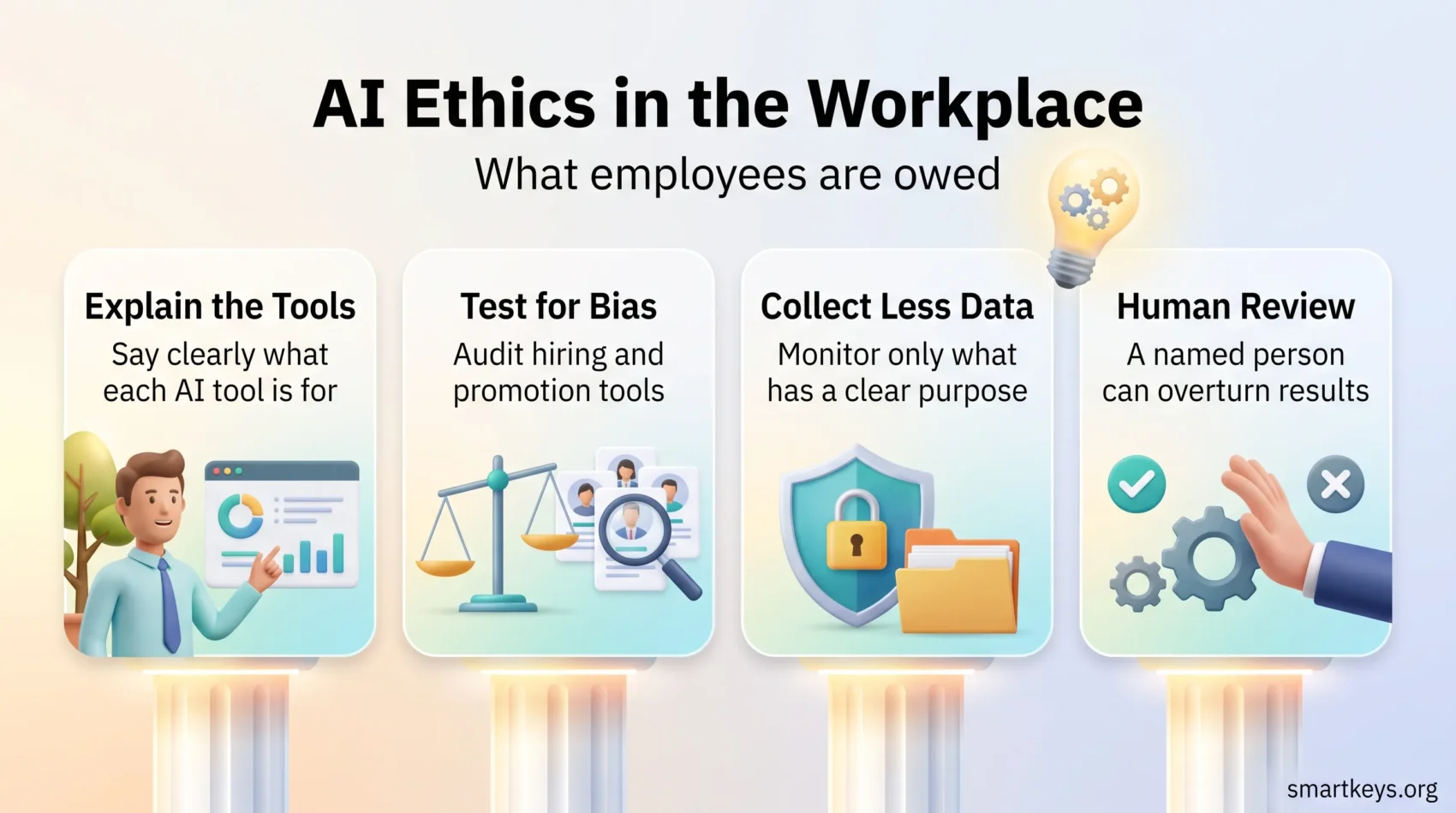
AI ethics at work comes down to a small number of commitments an employer can actually keep: say what the tools are for, test the ones that make decisions about people, collect less than the technology allows, and give every automated outcome a human someone can appeal to. None of that is exotic, and all of it is cheaper than rebuilding trust after it breaks.
Regulation will keep moving, and 2026 has already shown that deadlines shift in both directions. The organizations least disturbed by that are the ones whose practice already sits ahead of the rules. Building an ethical workplace culture around AI, and being deliberate about how AI is used to manage employees, is what turns a policy document into something staff recognise in their working day.
Found this useful?
Make SmartKeys a preferred source on Google, and our articles will surface more often in your Top Stories, AI Overviews, and AI Mode.
Add as Preferred SourceFAQ
What does AI ethics mean in the workplace?
Workplace AI ethics is the set of rules governing how an employer uses AI on and around its own staff, as distinct from how it uses AI on customers or products. In practice it covers four areas: hiring and promotion decisions made or scored by software, monitoring and performance measurement, the handling of employee data, and the rules staff must follow when they use AI tools themselves. It is narrower than corporate AI governance and closer to employment practice. The test of whether a company has it is not whether a values statement exists, but whether an employee can find out how a decision about them was made and who can overturn it.
What must employers tell candidates when AI is used in hiring?
It depends on where you hire. New York City requires advance notice to candidates plus an annual independent bias audit of automated employment decision tools, with results published. Illinois, from 1 January 2026, requires notice to applicants and employees whenever AI is used for employment decisions and bans the use of zip codes as a proxy for a protected class. California’s FEHA regulations on automated decision systems, in force since 1 October 2025, make bias testing evidence relevant in discrimination cases and extend record retention to four years. In the EU, the high risk obligations covering recruitment were deferred to 2 December 2027, but existing data protection duties still apply.
Is it legal for an employer to monitor employees with AI?
Generally yes, within limits that vary sharply by jurisdiction, and with one clear prohibition worth knowing. Since 2 February 2025 the EU AI Act has banned emotion recognition systems in the workplace as a prohibited practice, and employee consent does not make it lawful. Beyond that, most rules turn on data protection principles rather than a specific monitoring statute: the employer needs a stated purpose, must collect only what that purpose requires, has to tell staff what is being gathered, and cannot keep it indefinitely. The ethical bar sits higher than the legal one. If you cannot explain in a sentence what problem a monitoring signal solves, it is difficult to justify collecting it.
Does a human have to review decisions an AI system makes about staff?
For decisions with legal or similarly significant effects on someone in the EU, Article 22 of the GDPR restricts purely automated decision making and gives the person a right to human intervention. The Court of Justice’s SCHUFA ruling (C-634/21) established that this human involvement must carry real discretionary power, so a manager who simply confirms whatever the system output is has not provided a review. Outside the EU the requirement is less uniform, but the design principle travels well. Name a person who can overturn an automated result, give them the information needed to do it, and keep a record of when outcomes are actually changed.
Is AI actually taking jobs?
Not in the broad way the phrase suggests, at least not yet in the payroll data. Stanford’s Digital Economy Lab, analysing ADP records through June 2026, found a 19% employment shortfall among 22 to 25 year olds in the most AI exposed occupations relative to similar peers in less exposed ones, up from 15% in July 2025. The researchers state directly that they see no widespread, economy wide displacement, and that the effect runs through reduced hiring rather than more dismissals. The ethical implication is specific: the pressure sits on entry level roles and early career pipelines, which is where employers should concentrate retraining and hiring commitments.
Who owns work that employees create with AI tools?
Copyright protection generally depends on human authorship, so output produced with very little human contribution may not be protectable in the way a business assumes, and the position continues to develop across jurisdictions. The practical response is to document what the human actually contributed to anything the company intends to rely on commercially. The related and more urgent risk runs the other way: staff pasting contracts, client records or unreleased material into consumer AI tools creates a disclosure problem regardless of who owns the output. A short usage policy naming approved tools and prohibited data categories addresses most of that exposure.
What standards can we build a workplace AI policy on?
Three are widely used and freely referenced. ISO/IEC 42001:2023 specifies a management system for AI, which suits organizations that already run certified management systems and want AI folded into the same structure. ISO/IEC 23894:2023 provides guidance specifically on AI risk management. The NIST AI Risk Management Framework organises the work into govern, map, measure and manage functions and translates cleanly into internal audit checklists. None of them tells you what your company should permit, so treat them as scaffolding for your own decisions about approved tools, prohibited data, human review and appeal routes rather than as a substitute for making those decisions.