An automation ethics board is a standing group that reviews AI and robotics projects before they reach real people, and decides whether they may proceed. It is not a values statement and not a workshop. It is a named set of people with the authority to approve a project, send it back, or stop it.
Most companies already review security and contracts. Very few have anyone whose job is to ask whether a model was trained on data the company had permission to use, whether it treats applicants from different groups the same way, and what happens when it is wrong. That gap is what a board closes.
AI now sits inside hiring, scheduling, pricing, customer service and warehouse robotics, and regulators in the EU and several US states have started demanding evidence that a human checked the system. This guide covers what the board decides, how to structure it so it can say no, and how to run it without becoming the department that blocks everything.
Key Takeaways
- An automation ethics board is a decision body with review gates, not an advisory discussion group.
- Its authority comes from a written charter: what it reviews, what it can block, and who overrules it.
- 2026 rules in the EU, Colorado, Illinois and New York City now expect documented human review of automated decisions.
- Boards fail when they have no budget, no access to data, and no power to stop a launch.
- Keep the scope narrow: review the projects that touch people’s money, jobs, health or safety.
What an automation ethics board actually does
The board reviews specific projects at specific moments. A product team brings a proposal, the board asks a fixed set of questions, and the answer is recorded.
Three questions do most of the work:
- Where did the data come from? Was it collected with consent, bought under a licence that permits this use, or scraped without permission?
- Who could this harm, and how badly? A misrouted support ticket is an annoyance. A rejected job application or a denied loan is not.
- What happens when it is wrong? Can a person catch the error, overrule it, and fix the outcome for the affected customer or employee?
That last question is the one most teams have not answered. A model that is usually right still produces plenty of wrong outcomes at scale, and someone has to own them.
The board is one part of a wider AI governance model. The governance model sets the rules; the board applies them to individual cases. If your company has written an AI ethics framework that nobody consults before a launch, a board is the missing piece.
Why the case for a board changed in 2026
Two things shifted. Regulators moved from principles to filing requirements, and enough public failures accumulated that boards can point to concrete precedent rather than hypotheticals.
What the law now expects
The EU AI Act is the biggest single driver, though its timetable moved. Under the Digital Omnibus agreement reached on 6 May 2026, obligations for standalone high-risk systems listed in Annex III were deferred from August 2026 to 2 December 2027, and for AI embedded in regulated products to 2 August 2028 (Gibson Dunn). What did not move: the Article 5 bans in force since February 2025, the general-purpose AI model rules in force since August 2025, and the Article 50 transparency duties for AI-generated content, which apply from 2 August 2026. A board that treats the deferral as a reprieve will find the transparency and literacy duties already binding. Our guide to EU AI Act compliance walks through the obligations by role.
In the US, the direction is toward disclosure rather than pre-market conformity. Colorado repealed its 2024 AI Act before it took effect and replaced it on 14 May 2026 with Senate Bill 189, the Automated Decision-Making Technology Act. Deployers must tell people when automated technology is used for a consequential decision, disclose within 30 days after an adverse outcome how the technology influenced it, keep records for three years, and name a trained individual who can review and override the decision. It takes effect on 1 January 2027 if the attorney general finishes rulemaking (Skadden).
Illinois HB 3773 amended the state Human Rights Act and took effect on 1 January 2026, requiring notice when AI is used in employment decisions. New York City has required annual independent bias audits of automated employment decision tools since Local Law 144 took effect in July 2023. Our overview of AI regulation tracks how these fit together, and AI hiring bias covers the employment side in detail.
All four ask for the same three things: a named human, a written record, and an explanation. A board produces them as a by-product of doing its job.
What goes wrong without review
Amazon built an experimental recruiting tool that learned from a decade of mostly male technical resumes and began penalising resumes that mentioned women’s activities. The company abandoned it in 2018 rather than fix it. Nobody set out to build a discriminatory tool: the training data carried the pattern, and no review stage was designed to catch it.
Catching that at the design stage costs a few weeks. Catching it after launch costs a rebuild, a public story and, in several jurisdictions now, a regulatory file. Review is cheaper than remediation.
Internal, external or hybrid: pick a structure that can say no
The structure decides two things: how fast the board can move, and whether anyone outside the company believes its conclusions.
An internal board is made up of your own employees. It sees the real roadmap, reads the real code, and can meet within days. Its weakness is obvious: members report to executives whose projects they are reviewing. That is a real constraint on independence, not a theoretical one.
An external board is made up of outside experts on contract. It carries credibility with regulators, customers and journalists. It is also slower, needs briefing on context your staff take for granted, and can only see what you show it.
A hybrid board is the common answer: an internal core that meets often, plus two or three external members with voting rights who join the substantive reviews. Add a liaison in each product team so the board’s conditions actually get built, rather than filed.
Two cautionary examples
Google announced an external AI ethics council in March 2019 and dissolved it roughly a week later, after employee protest over its membership. The lesson is procedural: appoint people through a process you are willing to explain publicly, or the appointment itself becomes the controversy.
Axon, which makes Tasers and police body cameras, had a genuinely independent external ethics board. In June 2022, nine of its members resigned after the company announced Taser-equipped drones for schools against the board’s advice. Axon then paused the project. Both halves matter. The board’s advice was overridden, and its resignation still changed the outcome. An external board’s real power is the ability to leave loudly.
If you would rather concentrate accountability in one role than a committee, compare the tradeoffs with an AI ethics officer.
Write a charter that gives the board real authority
The charter is the document that separates a board from a discussion group. Keep it to two pages and make it specific.
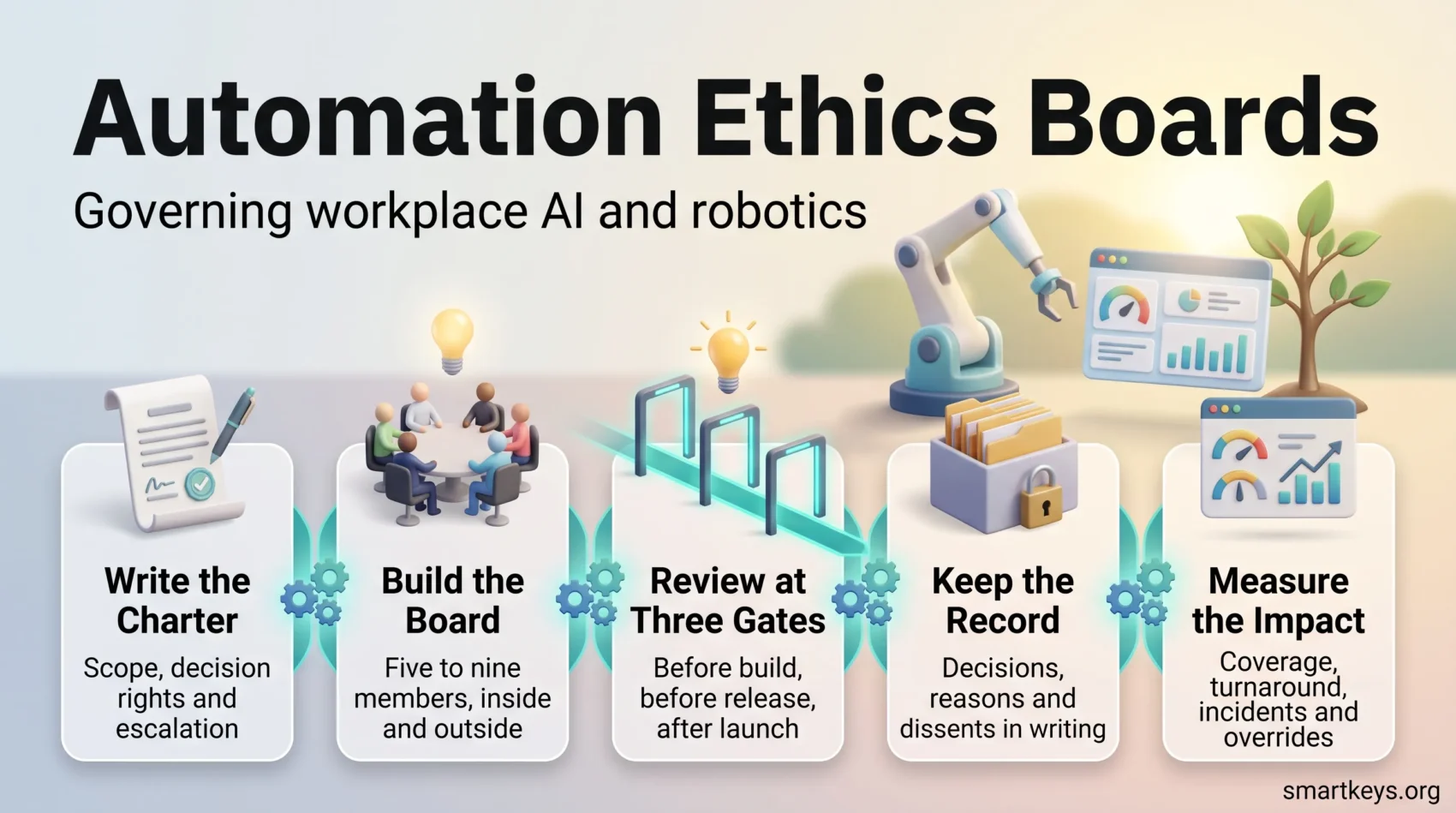
Cover five things:
- Scope. Which projects need review. Define it by impact, not technology: anything that affects hiring, pay, promotion, credit, health, safety or access to a service, plus anything using biometric or location data about employees.
- Decision rights. What the board can do. Approve, approve with conditions, defer pending evidence, or reject. Say plainly whether a rejection stops the launch.
- Escalation. Who can overrule the board, and how that override is recorded. An override that leaves no trace is how governance quietly dies.
- Timelines. How long the board has to respond. Two weeks for standard reviews and 72 hours for urgent ones is a workable default. Slow review is the fastest way to teach teams to route around you.
- Risk tiers. Which projects get a full review, which get a short form, and which need an outside audit.
Risk tiering is what keeps the board sustainable. A chatbot that answers questions about office hours does not need the same scrutiny as a system that ranks job applicants. Write the tiers down so teams can self-assess before they book time.
If you are starting from nothing, a comprehensive AI governance policy gives you the policy layer the charter can reference, and a risk management framework supplies the scoring method.
Who sits on the board
You need enough range to spot problems, and few enough people to reach a decision. Five to nine members works for most companies.
Cover these perspectives:
- Technical. Someone who can read a model card and challenge an evaluation metric.
- Legal or privacy. Someone who knows which rules apply where you operate.
- Domain. Someone who does the work the system will change. If it schedules warehouse shifts, put an operations lead in the room.
- Affected-group perspective. Someone from HR, a works council, a union representative or a customer advocate, depending on who bears the risk.
- External. One or two outside specialists who owe nothing to the roadmap.
Three housekeeping rules keep the board credible. Publish the role description and selection criteria. Run conflict-of-interest checks and record the results. Set term limits, typically two years with one renewal, so the board does not calcify around one view.
Range of background matters for a practical reason: a panel that has never been on the receiving end of an automated decision underestimates how it feels to be rejected without an explanation.
Meeting cadence and decision rules
Match the rhythm to your release cycle. A monthly standing meeting covers the pipeline. Add a fast-notice route, defined in the charter, for anything urgent.
Set voting rules before you need them:
- Quorum. A majority of members, including at least one external member for high-tier reviews.
- Threshold. Simple majority for routine approvals, two-thirds for high-risk decisions.
- Abstentions and proxies. Members with a conflict abstain and the abstention is recorded. Written proxies count toward quorum but not toward a two-thirds threshold.
Send pre-reads 48 hours ahead and cap them. If the board reads the material in the meeting, the meeting becomes a briefing and the decision becomes a rubber stamp.
Documentation and audit trails
The record is the deliverable. When a regulator, a customer or a journalist asks why you deployed something, the answer has to be a document, not a recollection.
Every review should produce four things: who attended, what was decided, why, and who owns the follow-up. Record dissenting opinions by name. A dissent that turns out to be right is the most valuable artefact your governance process will ever produce, and burying it teaches members to stay quiet.
Store the records the way you store other regulated material: access limited to those who need it, versioning switched on, retention aligned with the longest applicable legal requirement. Colorado’s new law sets three years for covered decisions, which is a reasonable floor. Your data governance strategy and privacy compliance framework should already cover the mechanics.
Keep a model card and a datasheet for every approved system: intended use, training data, known limits, evaluation results, and the date of the last revalidation. When the board reviews a change six months later, that file is what it reads first. Where the system makes decisions about people, explainable AI methods belong in the same file.
Budget, access and outside expertise
A board with no budget and no data access is decoration. Two resources are non-negotiable.
Unfiltered access. The board can request any model documentation, evaluation result, incident log or vendor assessment without asking permission from the team being reviewed. Write that into the charter.
A real budget. Enough to commission an independent audit when a high-tier system comes up, pay external members, and buy specialist review the company does not have in house. A bias audit of a hiring tool is the typical first spend, because in New York City it is already mandatory.
Vendors deserve particular attention, because most companies deploy far more AI they bought than AI they built. Marketing claims are not evidence. Ask for the evaluation methodology, the population the system was tested on, and error rates by subgroup. A supplier who will not provide them has told you something. Our guide to automation risk assessment covers the scoring in depth.
Embed checkpoints across the AI and robotics lifecycle
Review has to happen at moments when changing course is still cheap. Three gates cover most cases.
Before the build
Check the purpose, the data and the alternative. What decision is this system making, what is it trained on, who granted permission for that data, and would a simpler rule-based approach do the job? Many projects fail this gate for a mundane reason: nobody can name the licence covering the training data.
Before release
Run the evaluation, the adversarial testing and a scoped pilot. Adversarial testing, often called red teaming, means deliberately trying to make the system fail: feeding it edge cases, manipulative prompts and degraded data to see what breaks. Release to a limited group first so the blast radius of a mistake is small.
After deployment
Watch for drift, which is the slow decline in accuracy as the real world stops resembling the training data. Set thresholds that trigger an alert and a named rollback owner. Schedule revalidation at a fixed interval rather than waiting for a complaint.
Robotics adds a physical dimension: safety zones, emergency stops, maintenance intervals and the human factors of working alongside a machine. Where automation changes what people do rather than replacing them, the redeployment plan belongs in the review too. See automation and jobs for the workforce side, and AI in the workplace for the wider picture.
Risk, security and incident response
Score each use case on two axes: how badly a failure would hurt someone, and how many people it would reach. That score sets the review tier and the testing depth. Keep the template to one page so teams actually complete it.
Security controls belong in the same review: least-privilege access to training data, key management, logging of who touched which model artefact, and integrity checks that prove a model was not tampered with.
Write the incident playbook before the incident. Name the person who can switch the system off, the containment steps, the notification thresholds, and who talks to customers and regulators. Run one tabletop exercise a year. Teams that have never rehearsed a shutdown decide slowly, and speed is the whole point.
Where systems watch employees rather than serve customers, the review bar is higher and so is the legal exposure. Our guides to AI employee monitoring and algorithmic management cover what is permitted and where the limits sit.
How to set up an automation ethics board step by step
- Write the scope first. List the systems in use today that touch people’s money, jobs, health or safety. That list is your initial caseload and it justifies the board’s existence better than any policy document.
- Draft the charter. Two pages: scope, decision rights, escalation, timelines, risk tiers. Get the general counsel and one executive sponsor to sign it.
- Pick the structure. Internal core plus external members is the safe default. Decide who overrules the board and write it down.
- Recruit and onboard. Five to nine members, conflict checks recorded, term limits set. Spend the first session on the existing system inventory, not on principles.
- Build the intake. One form, one risk self-assessment, one calendar. If submitting a project takes more than 20 minutes, teams will skip it.
- Run three reviews, then revise. The first cases will expose whatever your charter got wrong. Fix the charter rather than improvising around it.
- Report upward quarterly. Cases reviewed, decisions, open conditions, incidents. Short and numeric.
Pair the launch with basic training so teams know what will be asked of them. A data literacy program and clear generative AI usage guidelines cut the number of projects that arrive at the board unprepared.
Measuring whether the board is working
Track a small number of things, and be honest about what they mean.
- Coverage. What share of AI systems in production have been through review? Low coverage is the clearest sign teams are routing around you.
- Turnaround. Median days from submission to decision. If this climbs, coverage will fall.
- Conditions closed. How many approval conditions were actually implemented, and how many quietly expired.
- Incidents. Count and severity of AI-related incidents, and whether the review had flagged the risk beforehand.
- Overrides. How often the board was overruled, and by whom. A board that is never overruled may simply be approving everything.
Review the charter once a year against those numbers. Governance that never changes is usually governance nobody is using.
Conclusion
An automation ethics board turns intentions into a decision you can point to. It works when three conditions hold: a written charter that says what it can stop, unfiltered access to the data and documentation it needs, and records that survive staff turnover.
The regulatory direction in 2026 is consistent across the EU and the US states that have moved. Name a human, keep a record, explain the decision. A board that reviews the systems touching people’s jobs, money, health and safety produces that evidence as a matter of routine.
Start with the systems already in production rather than with a policy document. The inventory tells you how much review you actually need. For the wider commercial argument, see ethical AI in business and our business ethics framework.
Found this useful?
Make SmartKeys a preferred source on Google, and our articles will surface more often in your Top Stories, AI Overviews, and AI Mode.
Add as Preferred Source