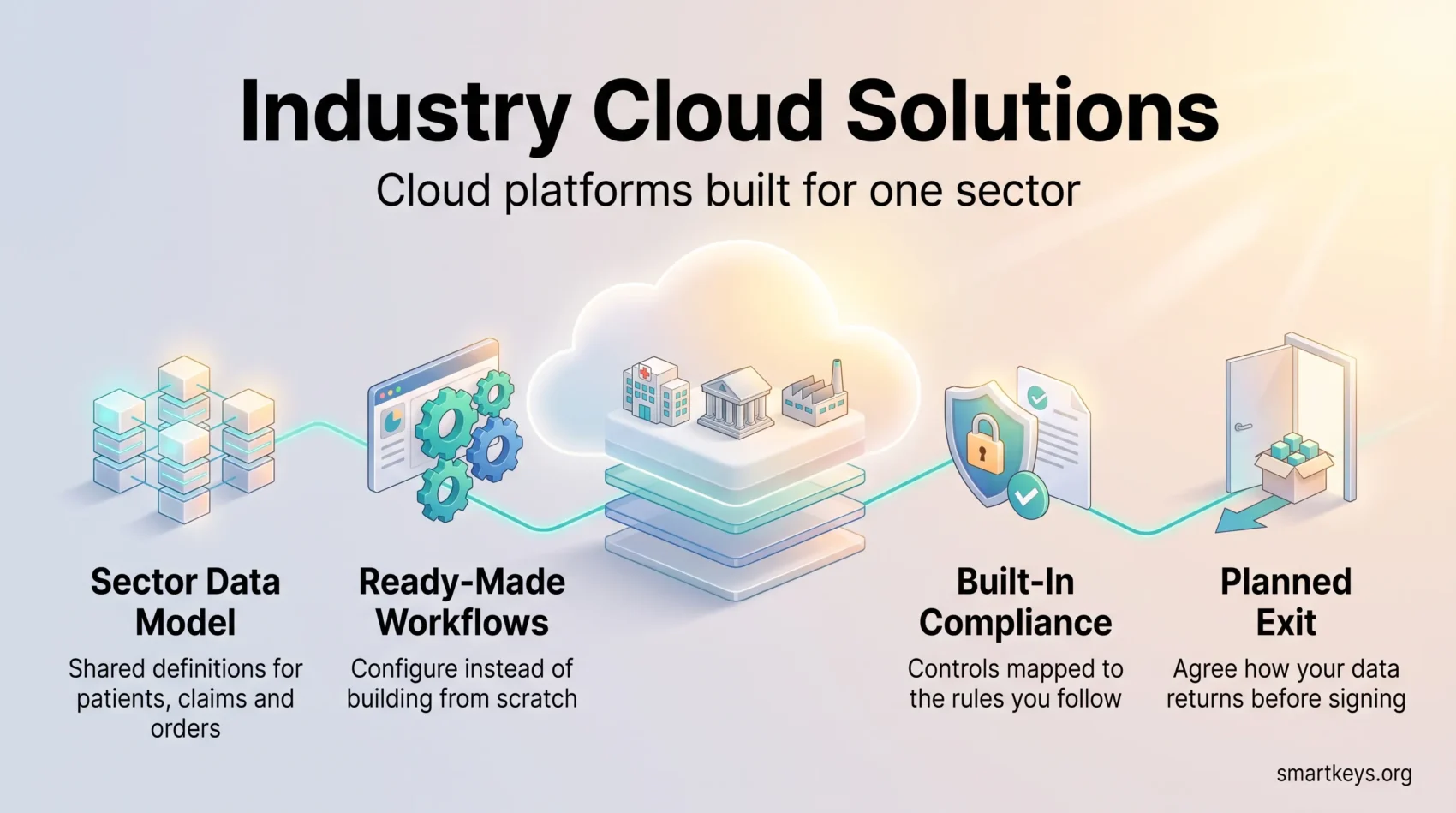
An industry cloud platform is a cloud service that arrives already shaped for one sector. Instead of raw computing power and an empty database, you get the data model, the workflows and the compliance controls that a hospital, a bank or a factory would otherwise build for itself.
The promise is easy to state: less custom software, a working system sooner, and an audit trail that already matches the rules you operate under. The catch is just as simple. You are buying someone else’s idea of how your industry works, and leaving later is harder than leaving a general-purpose platform.
This guide covers what these platforms contain, how far adoption has got, where the model earns its price, and what to ask before you sign.
Key Takeaways
- An industry cloud platform bundles sector data models, ready-made workflows and built-in compliance controls into one service.
- Gartner expects more than half of organizations to use one by 2029, and a quarter to be dissatisfied with cloud adoption by 2028.
- The clearest case is in regulated sectors, where prebuilt controls remove audit work you would otherwise repeat yearly.
- Lock-in is the real cost. The EU Data Act gives customers a route out, and switching fees disappear in January 2027.
- Judge vendors on evidence: certifications, reference customers in your sector, and a written exit path.
What an industry cloud platform actually is
A general-purpose cloud gives you building blocks: servers, storage, a database, an identity system. What you do with them is your problem, and in a regulated industry that problem is large. You model your own data, write your own workflows, and prove to an auditor that it is all controlled.
An industry cloud sells those blocks with the sector layer already built on top. A healthcare version ships with patient and encounter records, connectors to electronic health record systems, and access logging built for health privacy rules. A banking version ships with account and transaction models, fraud scoring and regulatory reporting.
The vendor builds each of those once and spreads the cost across every customer in the sector, so you configure rather than construct. It is the logic behind vertical SaaS, applied one level lower in the stack.
The three layers, in plain language
Vendors describe these platforms as bundling SaaS, PaaS and IaaS, and those terms decide how much work stays with you. IaaS (infrastructure as a service) is rented hardware: compute, storage, networking. PaaS (platform as a service) adds the runtime and database, so developers build applications without managing servers. SaaS (software as a service) is the finished application you log into.
An industry cloud gives you SaaS for the common cases, PaaS for the parts unique to your company, and infrastructure with residency and encryption preconfigured. Work out early which requirements land on the PaaS layer, because anything you build there is custom work the platform did not save you.
The domain layer you are really paying for
Two further pieces separate an industry cloud from ordinary hosting.
The first is a standardized data model: agreed definitions for the objects your sector deals in, such as a claim, a patient encounter or a work order. Because the vendor and its partners use the same definitions, connectors and reports built by one tend to work for the others.
The second is embedded controls: encryption, role-based access, retention rules and audit logging, switched on by default and mapped to named regulations. Writing a control takes a week. Proving every year that it still works as documented is a permanent cost, and that is where a good platform pays for itself.
How far adoption has really got
Treat vendor adoption numbers carefully. The credible figure comes from Gartner, which said in May 2025 that more than 50% of organizations will use industry cloud platforms to accelerate business initiatives by 2029. That is a forecast of partial use: most companies adopt a module for one process, not a new system of record.
Gartner paired it with a less flattering forecast. By 2028, 25% of organizations will have experienced significant dissatisfaction with their cloud adoption, driven by unrealistic expectations, poor implementation and uncontrolled costs. The difference usually comes down to how honestly the requirements were written before signing.
What an industry cloud actually buys you
Strip away the marketing and three benefits survive.
Less custom work, and a shorter first release
The software is not cheaper: subscriptions for vertical platforms usually cost more than generic ones. The saving is in work you never commission, such as the integration nobody writes, the compliance report nobody builds, the data model nobody argues about for months.
An example: a mid-sized insurer launching a product line on a general platform needs a data model, a rating engine, a document generator and a regulator-ready report. On an insurance platform, three of those usually exist already and the job shrinks to configuring rating rules. The project becomes a setup rather than a build.
Compliance evidence you assemble once
In regulated sectors, most of the cost of a control is proving it. Reusable control libraries map one technical measure to the matching requirement in several frameworks, so auditors ask for one artifact instead of three. That is the core of any privacy compliance framework, and an industry cloud arrives with much of the mapping done.
Analytics and AI that work in a regulated setting
Because the data model is standardized, reporting and machine learning become practical without a long preparation project, and vertical AI solutions sit on this kind of structured base. Treat AI features as a reason to check governance rather than a reason to buy: ask whether the vendor can show model documentation, logging and human review paths, the ground covered by any serious AI governance model.
Where the savings do not show up
Three costs move rather than disappear. Migrating data out of your old systems is still yours. So is change management, meaning training and process rewrites, which is routinely underbudgeted. And the closer the platform sits to your system of record, the more expensive any future move becomes.
Sector by sector: where the model fits
The pattern holds where an industry has heavy regulation and a shared vocabulary, and fails where every company works differently.
Financial services
Banks and insurers get preconfigured fraud scoring, know-your-customer checks and regulatory reporting. Regulation drives the design. In the EU, the Digital Operational Resilience Act (DORA) has applied to financial entities since January 2025, and in November 2025 the European Supervisory Authorities designated 19 firms as critical ICT third-party providers, including Amazon Web Services, Microsoft Azure and Google Cloud. EU financial entities now need exit plans and testing evidence in their cloud contracts, not just a service level agreement. See our overview of fintech trends.
Healthcare
Healthcare platforms connect record systems, scheduling and patient communication with access controls built for health privacy law. In the United States, a proposed overhaul of the HIPAA Security Rule published on 6 January 2025 would make encryption, multi-factor authentication, an asset inventory and annual risk analysis mandatory rather than optional. It has not been finalized and the timetable has slipped to 2027, so plan for it as a likely direction rather than a current duty. Our guides to healthcare digital transformation and healthtech trends go deeper.
Life sciences supplies the clearest lesson about lock-in. Veeva, the dominant vendor in pharmaceutical customer management, moved its CRM off the Salesforce platform onto its own. Customer migrations run mainly from 2026 to 2029 and must finish by 2030, while Salesforce made its competing Life Sciences Cloud generally available in September 2025. Thousands of companies face a multi-year migration they did not choose.
Manufacturing
Factory platforms ingest machine signals for quality monitoring and maintenance planning. The value depends on sensor coverage and data quality, which is a plant problem before it is a cloud problem. See predictive maintenance for the results, and digital twins in manufacturing for the simulation layer above it.
Retail, energy and agriculture
Retail platforms bundle inventory, personalization and order orchestration across channels. The differentiator is rarely the recommendation engine; it is whether stock levels are accurate in real time. Energy providers use grid and asset modules to balance variable renewable supply, and agriculture uses field-level data to time inputs. All three lean on connected sensors, so read them alongside IoT in business.
Security, compliance and governance
The selling point is that compliance is designed in rather than bolted on. That is usually true and never the whole story: the platform holds up its share, and you remain accountable for the rest.
Mapping regulation to platform controls
Write down which rules actually apply, then ask the vendor which platform control satisfies each one and which you must cover yourself. Two anchors are already in force. For card payments, the 51 future-dated requirements in PCI DSS v4.x became mandatory on 31 March 2025, including an annual confirmation of which systems are in scope. Elsewhere, the NIST Cybersecurity Framework remains the vocabulary auditors recognize. Ask for current certifications and the date of the last independent audit; one that expired eighteen months ago tells you about the company, not the document.
Data residency and the sovereignty question
Where data physically sits is now a procurement question. Gartner forecast worldwide sovereign cloud infrastructure spending of about $80 billion in 2026, up 35.6% from $59.3 billion in 2025, with European growth of 83% for the year.
Two things follow. Residency options are now standard rather than exotic, so asking for them is normal. And the details differ: storing data in a region is not the same as guaranteeing that support staff outside it cannot reach it. Ask about operational access, not only storage location. Our guide to data localization laws covers the rules behind the trend.
AI features and the EU AI Act
If the platform includes generative AI, the position changed in August 2026. The transparency obligations in Article 50 of the EU AI Act took effect on 2 August 2026: people must be told when they are interacting with an AI system, synthetic media showing real people must be disclosed, and AI-generated text published to inform the public must be labeled.
Heavier obligations for high-risk uses such as recruitment screening and biometric identification were postponed to December 2027. The sensible posture is to get disclosure right now and build the high-risk documentation during the extra time. Detail sits in our EU AI Act compliance guide and AI ethics framework.
Integration, multicloud and the exit you have not planned
An industry cloud rarely replaces everything. It sits next to an ERP system, a data warehouse and older applications, so integration absorbs most of the effort.
Connecting to the systems you already run
Most platforms ship adapters for the major ERP suites. Those remove the plumbing but not the decisions: somebody must define which system owns each field and what happens when the two disagree. Insist on shared identity and end-to-end logging early, because tracing a transaction across four systems afterwards is painful. Where the connector set is thin, iPaaS tools fill the gap and low-code tools often cover smaller internal workflows.
Multicloud, honestly
Running across several providers is common and harder than it sounds. Gartner expects more than half of organizations to miss the results they anticipated from multicloud by 2029, largely because of interoperability gaps. The lesson is not to avoid multicloud but to choose it for a reason you can name, such as a residency requirement. Costs rise with each environment, which is why a FinOps practice tends to arrive shortly after the second provider.
Lock-in, and what the EU Data Act changed
A platform that encodes your sector’s workflows is, by design, hard to leave. European law now pushes back. The EU Data Act became applicable on 12 September 2025 and requires providers to remove contractual, technical and organizational barriers to switching. A customer may give up to two months’ notice, the provider has 30 days to complete the transfer, and from 12 January 2027 providers generally may not charge for switching at all.
Even outside the EU, the Data Act asks the right questions. In what format is my data returned, which parts of it, and who pays? Get the answers into the contract while you still have leverage.
A selection roadmap that fits on one page
Assess before you look at vendors
List the five to ten workflows that actually differentiate you, the regulations you must evidence, and your residency and retention constraints. Attach a business metric to each: case handling time, error rate, days to close the books. Requirements without metrics turn into feature comparisons, won by the longest list rather than the best fit.
Evaluate on evidence, not on the demo
Ask for three named reference customers of your size in your sector, and how long implementation really took against the plan. Ask which parts of the demo are configuration and which were built for it. Ask in writing what happens to your data if you leave. Ask for total cost including integration and the consumption charges that appear as volume grows, a subject covered in our notes on AI in SaaS.
Migrate in waves, and prove value early
Pick one workflow with a measurable outcome and a contained blast radius. Run it end to end, including reporting and an audit rehearsal, before extending. Keep the old system available until the new one survives a full reporting cycle.
Then set up governance that outlives the project: a named owner for architecture decisions, a quarterly cost review, and a check that controls still match regulations, which change more often than the platform does. Sequencing advice sits in our digital transformation guide, and the reporting angle in ESG in SaaS and ESG and SaaS business strategies.
Conclusion
Industry cloud platforms answer a real problem: regulated companies were rebuilding the same data models, connectors and control evidence one company at a time, at enormous cost. Buying that layer instead of building it is often the right call.
Treat it as a procurement decision rather than a transformation story. The forecast that more than half of organizations will use one by 2029 says the category is established; the forecast that a quarter will be disappointed by cloud adoption by 2028 says the outcome is not automatic.
So write the requirements before the demos, make the vendor show which control satisfies which rule, and settle the exit terms early. Then start with one workflow, measure it, and expand once the numbers hold.
Found this useful?
Make SmartKeys a preferred source on Google, and our articles will surface more often in your Top Stories, AI Overviews, and AI Mode.
Add as Preferred Source