Digital transformation stopped being a special project some time ago. In 2026 it is simply how companies buy technology, organise work and decide what to automate. The money involved is no longer marginal either: Gartner forecasts worldwide IT spending of $6.37 trillion this year, a 14.2% increase on 2025, with data centre systems alone growing 62.5% as organisations build capacity for AI workloads.
What has changed is the standard of proof. Boards are no longer asking whether to transform but which parts of the transformation are returning something measurable. This guide covers the trends that matter in 2026, what the current evidence actually supports, and where organisations still get it wrong.
Key Insights
- Worldwide IT spending is forecast to reach $6.37 trillion in 2026, up 14.2%, driven mainly by AI infrastructure (Gartner, July 2026).
- Worldwide AI spending is forecast at roughly $2.52 trillion in 2026, a 44% year-on-year increase (Gartner, January 2026).
- 88% of organisations report using AI in at least one business function, yet only 39% attribute any EBIT impact to it (McKinsey, November 2025).
- 62% are at least experimenting with AI agents, and 23% have scaled an agentic system somewhere in the enterprise (McKinsey, November 2025).
- Gartner expects more than 40% of agentic AI projects to be cancelled by the end of 2027.
- EU AI Act obligations for Annex III high-risk systems have been deferred to 2 December 2027.
Why Digital Transformation Matters in 2026
The competitive gap in 2026 is not between companies that have adopted technology and companies that have not. Adoption is close to universal. The gap is between organisations that changed how work is done and organisations that layered new tools on top of unchanged processes.
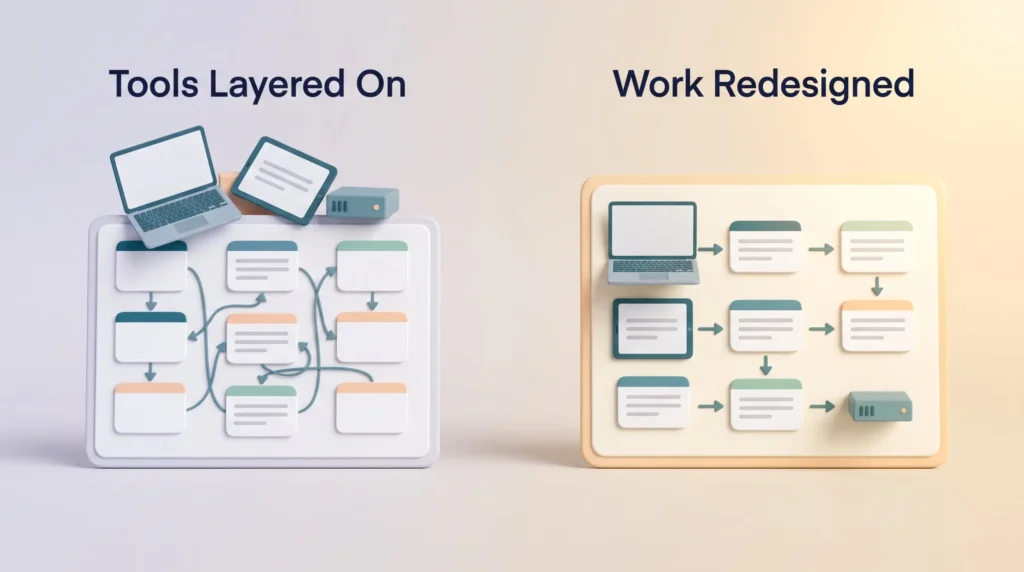
McKinsey’s 2025 survey of nearly 2,000 executives across 105 countries found that 88% of organisations use AI in at least one function, but only 39% could point to any earnings impact at all – and for most of those, the effect was under 5% of EBIT. The organisations seeing real value were roughly three times as likely to say they had fundamentally redesigned individual workflows rather than automating the existing ones.
That is the practical message of the current data. A digital strategy that buys capability without changing process produces cost, not advantage. Successful transformation still delivers what it always promised – better customer experience, stronger security posture, more efficient operations – but only where the operating model moved with the technology.
Understanding Digital Transformation
Digital transformation is the continuous use of technology to change how a business creates value – how it reaches customers, how it makes decisions, and how work moves through the organisation. It is distinct from digitisation, which simply converts existing processes to digital form without altering them.
The familiar examples still hold. Nike built a direct-to-consumer channel around its own apps and membership data rather than treating digital as an extra sales surface. Starbucks rebuilt ordering and payment around a mobile app that changed store operations, not just the checkout. In both cases the technology was the visible part; the process redesign behind it was the work.
Sustained transformation needs governance to match. Data architecture, clear ownership of systems and a realistic view of technical debt matter more than the choice of any individual platform. Every unit of spend on new capability should be matched by spend on process change and training, otherwise the capability sits unused.
Leadership structure matters too. Accountability that sits with a named executive – whether a CIO, a chief digital officer or one of the newer C-suite roles that have emerged around data and AI – tends to outperform transformation run as a committee. Focusing on whole business domains rather than isolated use cases is what turns pilots into operating change.
Key Drivers of Digital Transformation Trends
Several forces are pushing the current wave, and they are worth separating because they call for different responses.
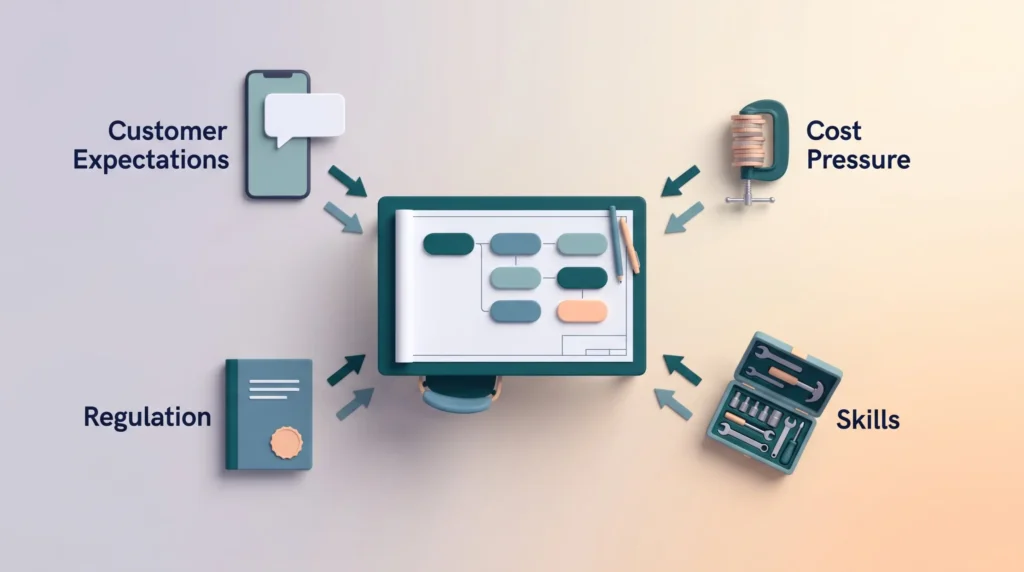
Customer expectations continue to set the pace. Response times, personalisation and self-service standards are now set by the best digital experience a customer has anywhere, not by direct competitors. That is why CRM platforms and customer data platforms keep absorbing budget.
Cost pressure is the second driver, and it cuts both ways. Automation promises efficiency, but AI infrastructure is expensive and consumption pricing makes bills harder to predict. Disciplined cloud cost management has become a transformation skill in its own right rather than a finance afterthought.
Skills remain the constraint that most reliably stalls programmes. Tools arrive faster than the ability to use them well, and broad digital literacy across the workforce now matters more than a small pool of specialists.
Regulation has become a genuine design input rather than a compliance step at the end. The EU AI Act, data localisation rules and sector-specific requirements shape which systems can be deployed where, and that is a decision made at architecture time.
Technology Adoption in Digital Transformation
Impact of Advanced Technologies
The technology stack behind transformation has consolidated around a few capabilities that now appear in almost every programme:
- Cloud platforms as the delivery model, increasingly through cloud-native architecture and hybrid cloud strategies that keep sensitive workloads under direct control
- Data and analytics, where augmented analytics and data democratisation push interpretation closer to the people making decisions
- Connected operations through IoT deployments and edge AI, which move processing to where the data is generated
- Simulation, with digital twins in manufacturing now used for planning rather than demonstration
Adoption is uneven by sector. Technology, financial services and professional services remain furthest ahead; parts of healthcare, agriculture and public administration are still moving from pilots to production. That lag is a genuine opportunity for organisations in those sectors, because the tooling has matured and the early-adopter risk has largely been absorbed elsewhere.
Investment and Spending Trends
The spending picture in 2026 is lopsided in an instructive way. Gartner’s July 2026 forecast puts total IT spending at $6.37 trillion, but the growth is concentrated: data centre systems are up 62.5% to $822 billion and infrastructure as a service is up 29.3%, while IT services grow only 5.3%. Software sits in between at 15.5% growth.
AI spending specifically is forecast at about $2.52 trillion for the year, up 44%, of which roughly $1.37 trillion is infrastructure. Gartner’s John-David Lovelock has described the current phase bluntly, noting that AI is passing through the “Trough of Disillusionment” and that improved predictability of ROI has to come before enterprises can genuinely scale it.
The practical reading for a mid-sized company: the headline numbers are dominated by hyperscaler infrastructure build-out, not by what a typical business needs to spend. Budget for the capability you will actually operate, and treat the industry totals as context rather than a benchmark.
No-Code and Automation-Driven Efficiency
No-code and low-code development changed who gets to build things. Teams that understand a process can now assemble the workflow that supports it without waiting in a development queue, which shortens the distance between spotting a problem and fixing it.
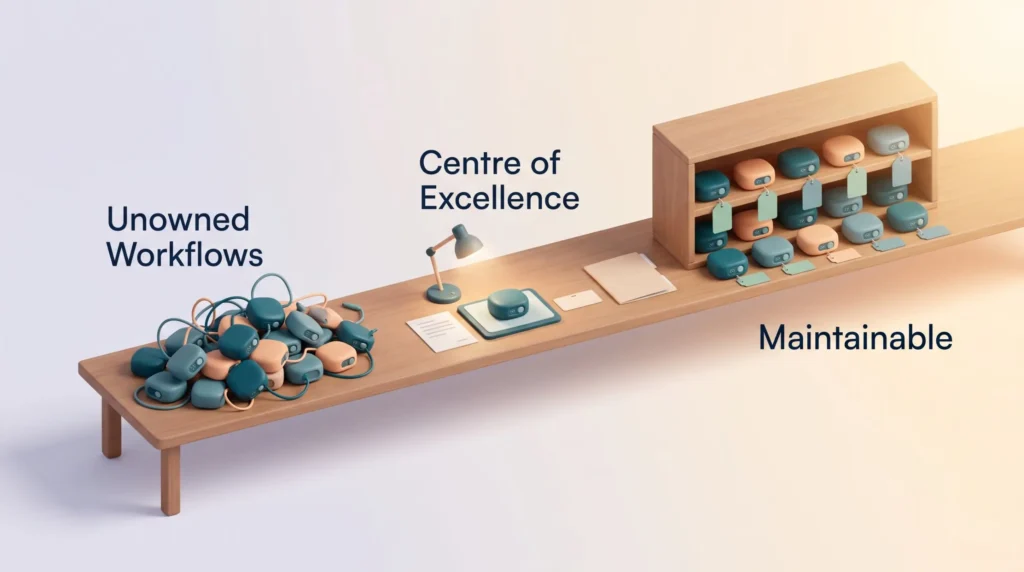
The benefits are real: faster iteration, lower cost for straightforward internal tools, and a wider pool of people able to contribute. Finance automation and digital procurement are two areas where this has produced durable results, because the processes are well defined and the rules are stable.
The risk is equally real and less often discussed. Citizen-built automations accumulate. Without ownership, documentation and a review process, an organisation ends up with hundreds of workflows nobody can safely switch off, built by people who have since changed roles. This is why an automation centre of excellence has become standard practice at scale: not to slow building down, but to keep what gets built maintainable.
Hybrid Work and Employee Experience
Hybrid working has settled into something ordinary. The argument about whether it works has largely been replaced by a more useful one about how to run it well, and the answer is mostly unglamorous: clear expectations about which work happens together, tooling that does not punish the people who are remote, and managers who assess output rather than presence.
The digital workplace is where transformation becomes visible to employees. People judge their employer’s technology by whether it lets them do their job without friction, and a stack that requires constant context-switching between tools erodes goodwill quickly. Consolidation – fewer applications, better connected – often does more for experience than adding another platform.
AI has entered this conversation directly. Assistants embedded in everyday tools are now common, and AI collaboration tools are being evaluated on whether they reduce coordination overhead rather than on demo quality. Where they help, they help by removing routine work; where they disappoint, it is usually because the underlying process was unclear to begin with.
Digital Solutions: AI, Agents and Machine Learning
AI has moved from a discrete initiative to a component of most systems. Prediction, classification, language processing and generation are now features of software organisations already own, which is why the practical question has shifted from what AI can do to which decisions you are willing to let it influence.

Agentic AI is the live frontier. McKinsey found 62% of organisations at least experimenting with agents and 23% scaling one somewhere in the enterprise. Gartner’s counterweight is worth taking seriously: it expects more than 40% of agentic AI projects to be cancelled by the end of 2027, citing unclear value, escalating cost and inadequate risk controls. Both things are true at once – genuine capability, high failure rate.
What separates the projects that survive is unromantic. They start from a defined process with a measurable outcome, they have clean data behind them, and they are operated rather than launched. That operational discipline is what LLMOps practice exists to provide: versioning, evaluation, monitoring and a way to catch degradation before users do.
Design matters as much as technology. Mapping AI agent workflows end to end – including what happens when the agent is wrong, and who is accountable when it is – is the difference between a system you can put in front of customers and one that stays a prototype. In regulated or specialised domains, vertical AI solutions built for the specific workflow often outperform general-purpose tools, because the hard part was never the model.
Customer Data Platforms: Unifying Customer Insights
Customer data platforms address a problem most organisations recognise immediately: customer information scattered across systems that were never designed to talk to each other. A CDP collects, resolves and unifies that data into a single profile, then makes it available to the tools that act on it.
The value is not the platform itself but what becomes possible once identity is resolved. Segmentation stops being approximate. Personalisation can use behaviour rather than assumptions. Service teams see the same customer history as sales. None of that requires AI, though it is the precondition for AI-driven marketing producing anything sensible.
The caveat is that a CDP inherits whatever data quality it is given. Implementations fail when they are treated as a purchase rather than a data governance programme, and the symptom is familiar: a unified profile that nobody trusts enough to act on. Decide first what decisions the unified data is supposed to improve, then buy accordingly.
Organisational Change and Cultural Shift
Technology programmes fail for organisational reasons far more often than technical ones. That is not a platitude; it is the pattern behind the gap between 88% adoption and 39% reporting any earnings impact.
Building a Digital-First Culture
A digital-first culture is one where changing a process is normal rather than exceptional. That requires leaders who visibly use the systems they ask others to adopt, training treated as part of the rollout rather than an afterthought, and enough tolerance for failed experiments that people are willing to try. Maersk, which began its transformation in 2016, is a frequently cited example precisely because integrating a new operating model with a long-established industrial culture took years rather than quarters.
Communication does more work here than most leaders expect. People resist change they do not understand far more than change they disagree with, and explaining why a process is changing is cheaper than managing the resistance that follows when you do not.
Strategies for Effective Change Management
The approaches that hold up are consistent: sponsor the change at a level with real authority, sequence it so early wins are visible, involve the people who do the work in designing the new version of it, and measure adoption rather than deployment. Treating transformation as a series of iterations with checkpoints beats a single large programme with a distant completion date, because it lets you stop the parts that are not working. Standing risk management practice should cover technology change too, including the risk that a project continues past the point where it should have been cancelled.
Privacy, Trust and AI Regulation
Data protection has become a condition of doing business rather than a differentiator. Customers assume competence and notice only failure, which makes the security and privacy investment a floor rather than a selling point.
The regulatory picture shifted meaningfully in 2026. Under the EU’s Digital Omnibus agreement, reached in May 2026, obligations for Annex III high-risk AI systems were deferred from 2 August 2026 to 2 December 2027, and those for AI embedded in regulated products under Annex I moved to 2 August 2028. Several requirements already apply and were not postponed: prohibited practices and AI literacy obligations have been in force since 2 February 2025, general-purpose AI obligations since 2 August 2025, and the Article 50 transparency requirements proceed from 2 August 2026.
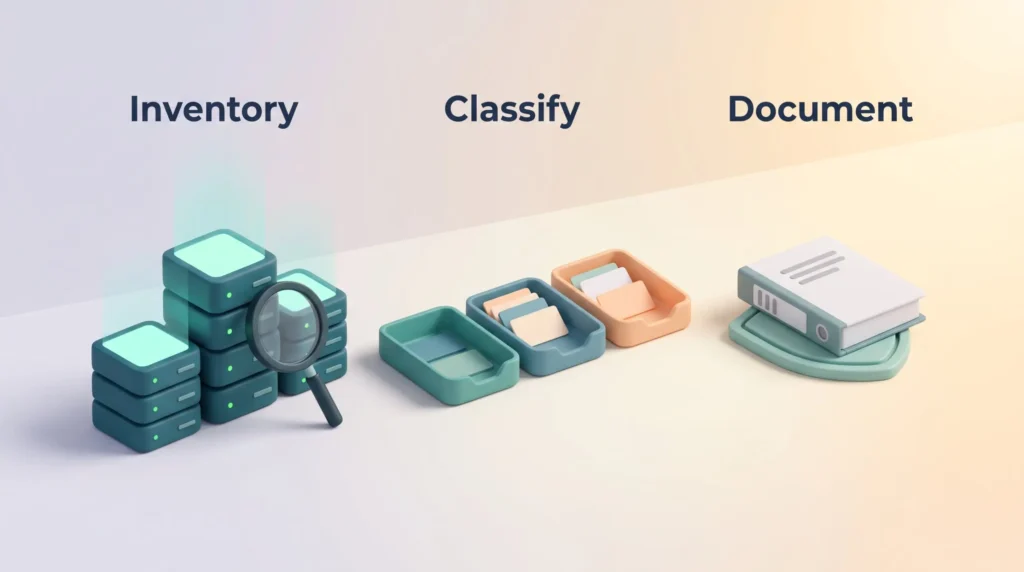
The deferral buys preparation time; it does not remove the requirement. Organisations that use the extra period to inventory their AI systems, classify them and build documentation will be in a very different position in late 2027 than those that treat the delay as a reprieve.
Practical groundwork remains the same regardless of jurisdiction:
- Know what data you hold, where it lives and who can reach it
- Encrypt in transit and at rest, and test that the controls actually work
- Assess risk on a schedule rather than after an incident
- Train staff on the failure modes that actually cause breaches
- Have an incident response plan that someone has rehearsed
Involving security leadership early in transformation decisions is considerably cheaper than retrofitting controls onto a system already in production.
Preparing for the Next Wave
The near-term direction is reasonably clear. AI capability keeps improving and keeps getting embedded into software organisations already run, which means the decisions ahead are less about procurement and more about governance: which processes to hand over, what oversight to keep, and how to tell whether it is working.
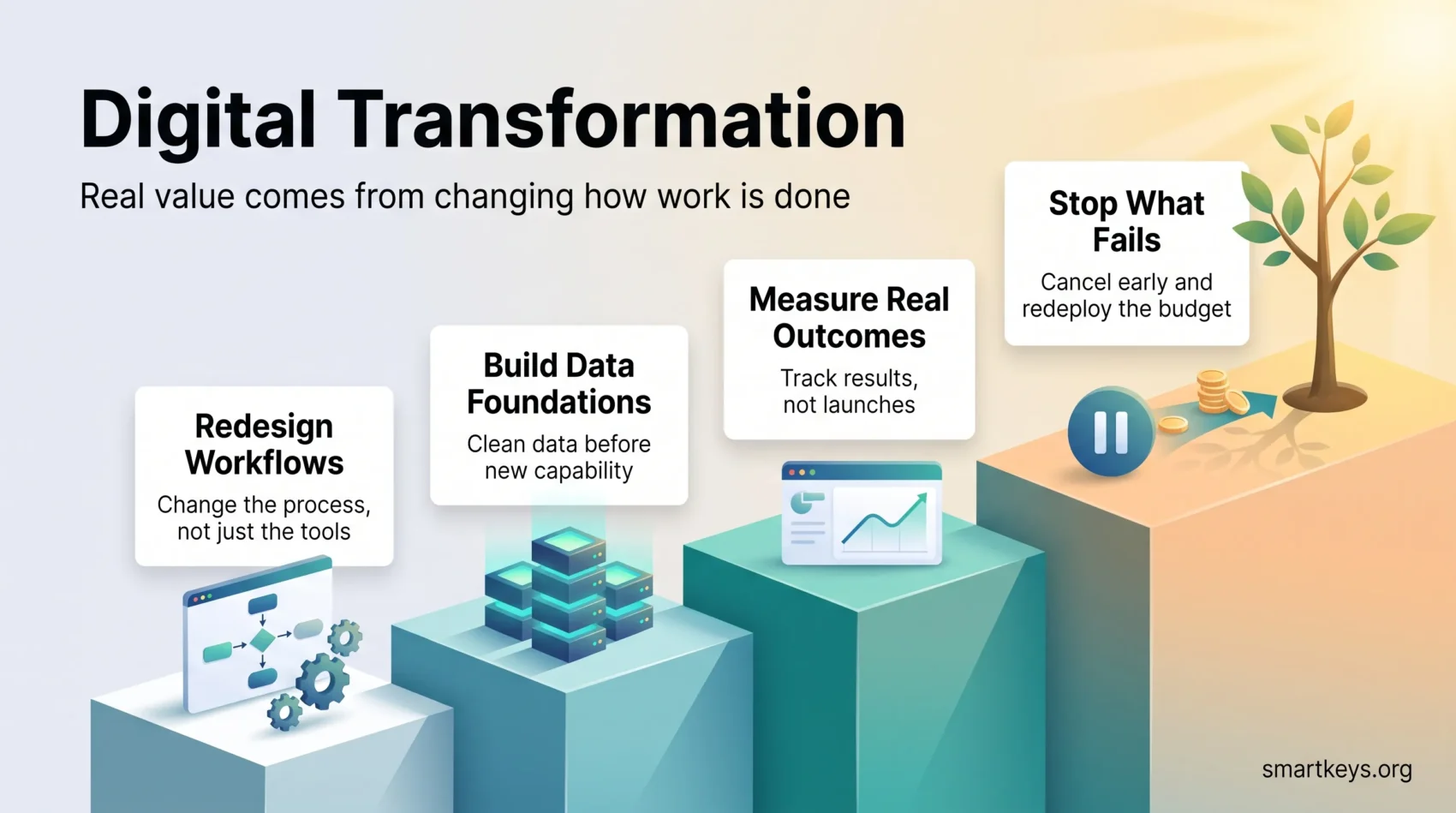
Three things are worth building now. First, data foundations, because every subsequent capability depends on them and no model compensates for poor inputs. Second, evaluation habits – the ability to measure whether a deployed system still performs as it did at launch. Third, the organisational muscle to stop projects, which is the capability most conspicuously absent from the 40% of agentic initiatives Gartner expects to be cancelled.
The environmental and ethical dimensions are no longer peripheral either. AI infrastructure has a real energy footprint, and algorithmic decisions affecting people carry consequences that show up as legal and reputational risk. Both belong in the design conversation rather than in a later review.
Conclusion
Digital transformation in 2026 is less about deciding to adopt technology and more about being honest regarding what the adoption has produced. Near-universal AI use alongside a minority reporting earnings impact is the defining tension of the year, and it points at process rather than technology as the binding constraint.
The organisations getting value are doing recognisable things: redesigning workflows rather than automating existing ones, investing in data foundations before capability, keeping governance close to deployment, and cancelling what is not working early enough to redeploy the budget. None of that depends on picking the right vendor.
Spending will keep rising, and much of the headline growth reflects infrastructure build-out that has little to do with a typical company’s decisions. The useful benchmark is not what the industry spends but whether your own last three transformation initiatives changed how work is done – and whether you can tell.
Found this useful?
Make SmartKeys a preferred source on Google, and our articles will surface more often in your Top Stories, AI Overviews, and AI Mode.
Add as Preferred Source