Most companies do not have an automation problem. They have a scaling problem. One team builds a bot that clears invoices. Another wires up an AI assistant for tickets. Both work. Neither spreads.
An automation center of excellence (CoE) fixes exactly that: a small, permanent team that sets the standards, owns the governance, and keeps a library of reusable parts so the next project starts at 60% instead of zero.
This guide covers what a CoE is, why programmes stall, who belongs on it, and what the EU now requires.
Key Takeaways
- Central standards and governance are what let automation spread past the first team.
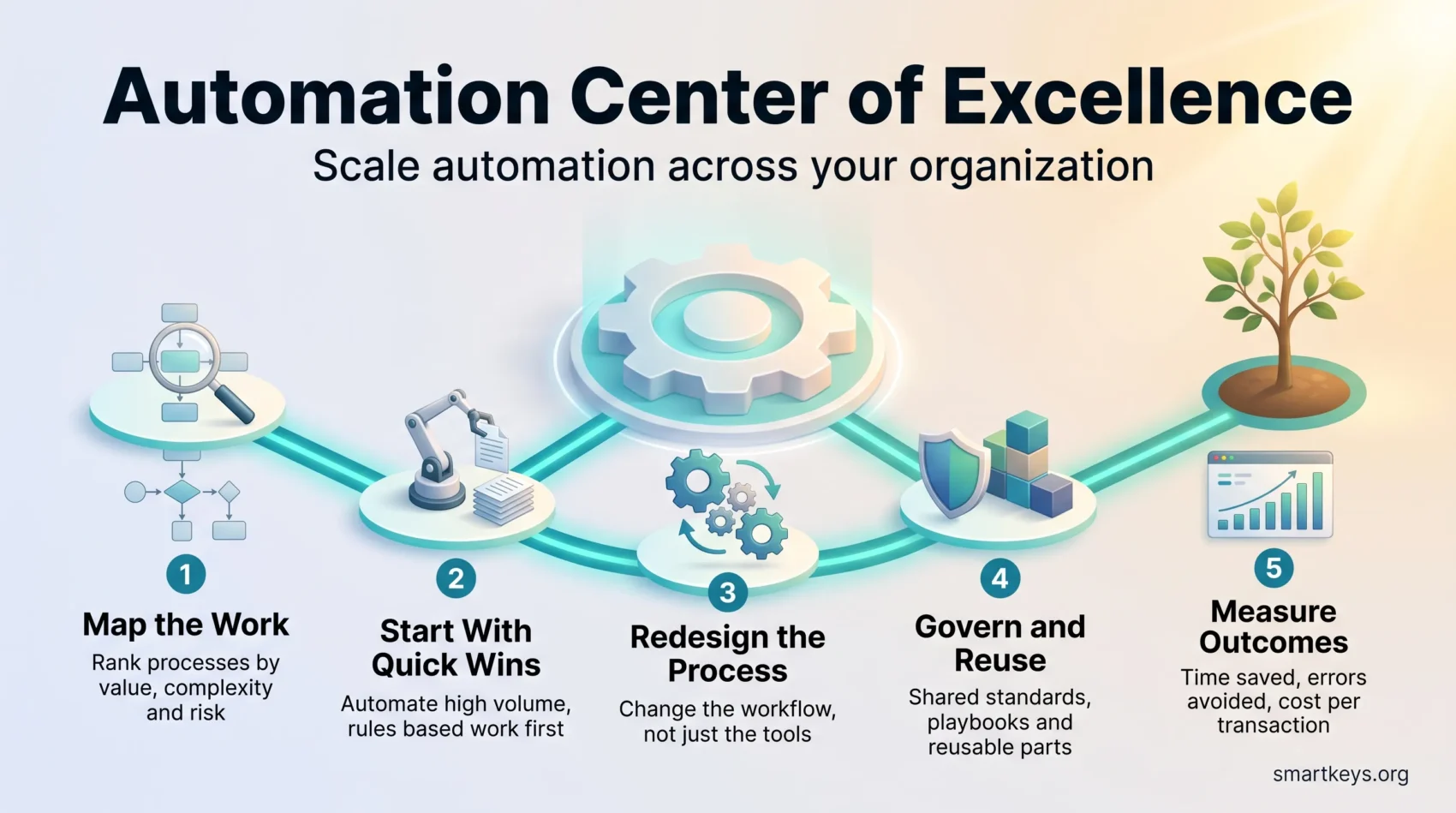
- Start with high-volume, rules-based work so you can prove value in one quarter.
- Redesigning the process beats bolting technology onto the old one.
- Staff a small team and grow it only as real demand appears.
- Tie every project to a measured outcome: time saved, errors avoided, cost per transaction.
What an automation center of excellence actually is
Think of the CoE as an internal operations studio. It does not own every automation in the company. It owns the rules everyone follows, the parts everyone reuses, and the record of what worked.
Three terms come up constantly, so it is worth pinning them down.
RPA stands for robotic process automation: software that clicks through an application the way a person would, following fixed rules. It moves data between systems with no proper connection.
Intelligent automation adds a judgement layer. Instead of failing on an unusual invoice, the system reads it, classifies it, and either handles it or routes it to a person.
AI agents go further. They plan a sequence of steps toward a goal rather than following a script. That flexibility is useful, and it is also why they need tighter supervision. Our guide to AI agent workflows covers how they differ from RPA in practice.
A CoE spans all three. It curates playbooks and reusable components so nobody rebuilds the same approval step five times, and partners with IT on security and change control without becoming a bottleneck.
Why most automation programmes stall
The problem is now well measured. McKinsey’s global State of AI survey, fielded from 4 May to 8 June 2026 with 1,719 respondents across 97 countries, found close to nine in ten organisations using AI in at least one business function. Only 44% said AI was scaling across their enterprise, and 37% could attribute any EBIT impact to it, unchanged from the year before. Just 6% qualified as high performers, crediting AI with at least 5% of earnings.
The same survey shows what separates that 6%. Roughly three-quarters of high performers had fundamentally redesigned workflows because of AI, against 25% of everyone else. That is the most useful finding for anyone building a CoE: the value comes from changing the process, not from wrapping a bot around the process you already had.
Governance is the second gap. Deloitte’s State of AI in the Enterprise report, published in January 2026 from a survey of 3,235 IT and business leaders across 24 countries, found only 21% had a mature governance model for AI agents. Four in five were scaling capability faster than the controls around it.
Neither problem is solved by better software. Both are solved by an owner.
What a CoE delivers that scattered projects do not
Quick, visible wins turn sceptical leaders into supporters. Automate high-volume work first, prove the number, then use that credibility to fund the harder work.
The savings that survive scrutiny are boring ones: fewer touches per transaction, less rework, fewer corrections downstream. Our guide to repetitive tasks automation has a checklist for spotting these candidates, and the task automation playbook walks through one process end to end.
Auditable workflows, consistent logging, and controlled change cut error rates on their own, and they mean you can answer a regulator without a three-week archaeology project. Shared design standards also reduce technical debt, the accumulated shortcuts that make every future change slower and riskier.
Proven patterns then let you move quickly without gambling. Map benefits to metrics finance already trusts, and feed results back into the next rollout the way any continuous improvement cycle works.
Inside the team: roles, structure, and sponsorship
Successful CoEs pair real executive backing with a small squad that ships. Sponsorship usually sits with the CIO, CTO, or CFO, because that is where budget and accountability for returns meet.
Start compact. A handful of people can prove value and keep priorities clear; growing before demand justifies it just adds overhead.
Core roles
- Executive sponsor: sets direction, funds the work, clears roadblocks.
- CoE lead: owns the intake queue, the standards, and the reporting.
- Business analysts: map candidate processes and write usable requirements.
- Architects and developers: design and build against the shared patterns.
- Operations: monitor running automations and handle exceptions.
- Change manager: runs the training and adoption work that decides whether anyone uses what you built.
Hire for mindset as much as tooling: platforms change, curiosity does not. Pair junior and senior staff so no single person becomes a bottleneck, and run a blameless culture, because a team that hides broken automations hands you an outage instead of a warning. Our operations team efficiency playbook covers how to structure a shared service like this.
Governance: the operating model that makes it repeatable
Governance sounds like paperwork. In practice it is what stops a good pilot becoming an unmaintainable mess.
Define a simple path from idea to production: how requests arrive, how they are triaged, what design standards apply, how testing works, and who signs off a release. Write it once, apply it every time.
Track a small set of numbers rather than a dashboard nobody reads:
- Throughput: transactions handled per automation per month.
- Quality: exception and error rates before and after.
- Effort: hours returned to the business, measured rather than estimated.
- Cost: cost per transaction, including licences and support.
Keep a pattern library, a shared repository, and written playbooks so the second project is genuinely cheaper than the first. A standard operating procedure for the build process is worth more than a slide deck about excellence, and the numbers belong in the business intelligence tools your leadership already opens.
Most automation failures are adoption failures. People do not trust a system they did not help design, and they will quietly keep the old spreadsheet running beside it. Run training, publish wins, appoint champions inside the teams you are changing, and make clear who decides and who signs off. Our guide to change management strategy goes deeper on the communication side.
Review the portfolio on a schedule. An automation nobody has looked at in eighteen months is a liability, not an asset.
Your build roadmap: from first candidate to scale
Start with needs, not wants. Map the current workflows, pull the operational data, and build a ranked pipeline. That turns opinions into evidence.
Talk to the people doing the work and look at what has already been deployed. Half-finished tools and workaround spreadsheets tell you more than any wish list, and workforce analytics tools can point at the volume hotspots.
Then score each process on value, complexity, and risk. Ask how often it runs, how many decision points it contains, how often it goes wrong today, and what a failure would cost. A high-volume, rules-based, low-blast-radius process is your first project. A quarterly regulatory filing is not.
Run a short, focused build on that one candidate. Measure before and after using the same definition, or the result will not survive a finance review. Use what you learn to shape the architecture rather than committing to a platform on day one. Publish an honest roadmap, build in modular components, and give the team clear decision rights.
Tools and platforms that power a CoE
Choose tools that let your team ship repeatable work while keeping visibility and control. The category matters more than the brand.
An RPA and orchestration suite gives you deployment pipelines, role-based access, scheduling, and monitoring in one place. Platforms such as UiPath, Automation Anywhere, and Microsoft Power Automate sit here, and most have added AI agent features to what began as rule-based tooling.
An integration layer connects the applications your processes touch. If you are stitching together many cloud and on-premises systems, read our overview of iPaaS and business integration before building point-to-point connections you will regret.
Low-code tooling lets business teams build simple things themselves under your standards. That is a real lever, and it needs guardrails: see low-code business process automation.
Generative AI is useful inside the CoE itself, drafting documentation, generating test data, and summarising process recordings. Keep a human review step on anything reaching production. Where a model influences a decision affecting people, you also need to explain it, which is the practical case for explainable AI.
Whatever you pick, instrument it. Metrics and alerts on every automation are what turn hyperautomation from a slogan into something you can operate, and the same goes for the digital workflows underneath.
What the EU AI Act requires of your CoE
If you operate in or sell into the EU, several parts of the AI Act already bind you.
The prohibitions on unacceptable-risk AI have applied since 2 February 2025. The transparency obligations in Article 50 apply from 2 August 2026: people generally have to be told when they are interacting with an AI system, and certain AI-generated content must be marked. The AI literacy duty in Article 4 is also in force, so the staff who operate your automations need appropriate training.
The Digital Omnibus package pushed the high-risk deadlines back. Obligations for standalone high-risk systems in Annex III, which include recruitment, credit scoring, and worker management tools, moved from August 2026 to 2 December 2027. AI embedded in regulated products under Annex I moved to 2 August 2028.
The practical reading is simple: deferred is not cancelled. Build the inventory, the logging, and the human oversight now, while the pressure is off. Our guides to EU AI Act compliance and the wider AI regulation landscape cover the detail.
Conclusion
Scattered wins become durable value when someone owns the standards. The 2026 evidence is consistent: most organisations use AI, far fewer have scaled it, and the ones showing real financial impact redesigned how the work happens rather than automating its old shape.
Staff a small CoE, pick a high-volume process you can measure, and publish the result. Track time saved, errors avoided, and cost per transaction, then feed those numbers back into the roadmap. Do that for four quarters and you will have something rarer than a working bot: a repeatable way to make the next one cheaper.
For the wider picture, see our overviews of AI in business operations, AI augmentation, and how workers are adapting to job automation.
Found this useful?
Make SmartKeys a preferred source on Google, and our articles will surface more often in your Top Stories, AI Overviews, and AI Mode.
Add as Preferred Source