Most companies have already shipped AI into production. Far fewer trust what it does. One 2026 enterprise survey found that while 86% of organizations had moved past pilots, only 34% said they trusted the actions their AI systems took. That gap is the real blocker now — not model quality.
Explainable AI (XAI) closes it. It turns a score into a reason: which inputs mattered, how much, and whether the logic holds up when a regulator, an auditor, or a rejected customer asks.
This guide covers what changed in 2026: the EU AI Act timeline after the Digital Omnibus, Colorado’s repeal-and-replace, the methods that work, the ones that quietly mislead, and a 90-day plan to get from zero to audit-ready.
Key Takeaways
- Trust, not accuracy, is now the main barrier — roughly 46% of planned AI investment is stalled over it.
- EU high-risk duties moved to December 2027, but transparency duties have applied since 2 August 2026.
- Colorado repealed its AI Act and replaced it with a disclosure-first law effective 1 January 2027.
- Feature attributions and example-based explanations cover most practical needs.
- Explanations can mislead — validate them before you act on them.
- Start with one high-exposure model, not a platform-wide rollout.
What Explainable AI Actually Means
An explanation answers a specific question: why this output, for this input, right now. That is different from a dashboard showing overall accuracy, and it is what your reviewers, auditors, and customers actually need.
From black box to traceable decision
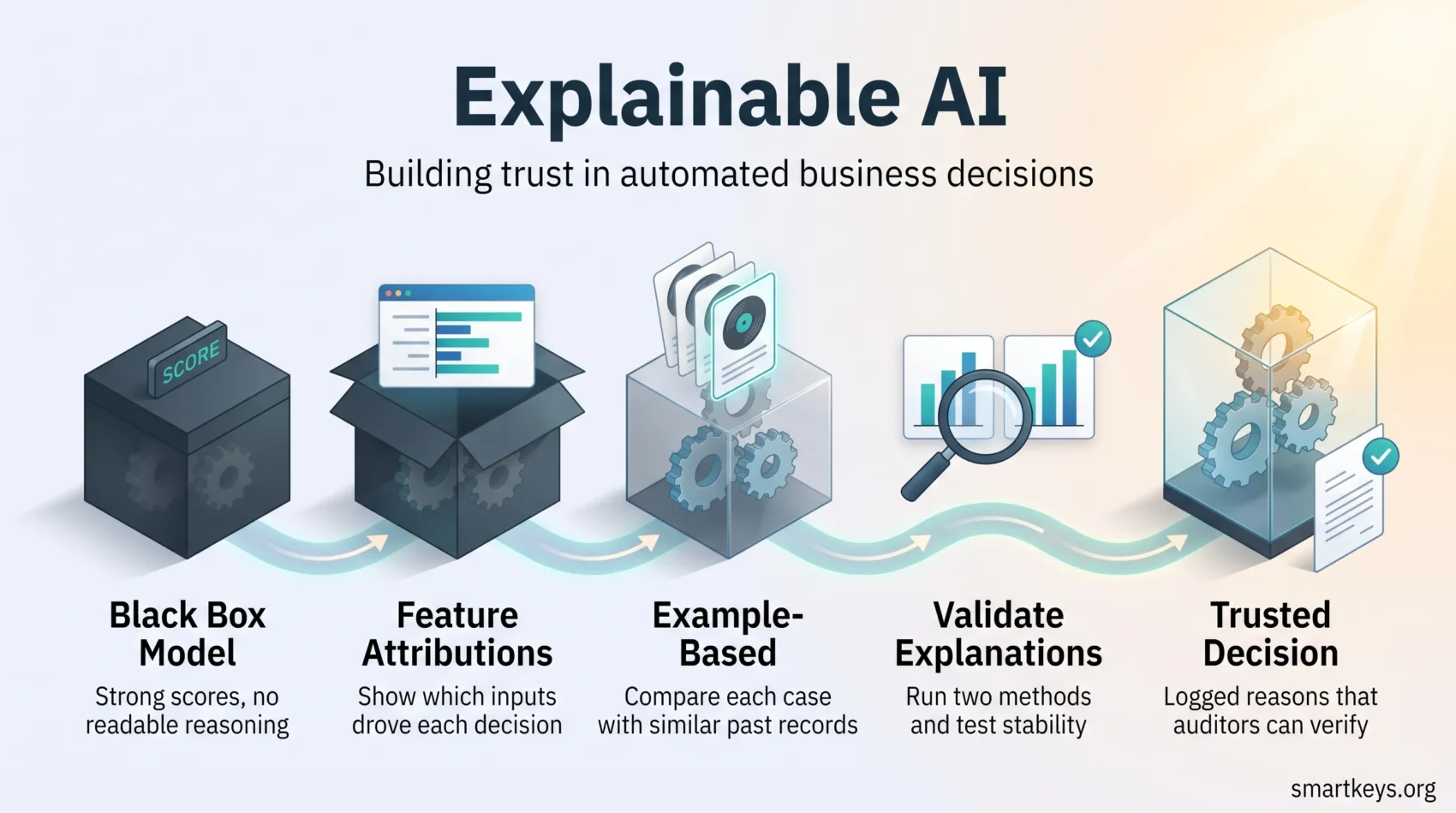
Many production models — gradient-boosted trees, deep networks, ensembles — produce strong results while giving you no readable path from input to output. Even the team that built the model often cannot retrace a single prediction.
XAI adds that path back. It records which features moved the result, which training examples resemble the case, and what the model would have done under slightly different inputs. Applied across build, test, and deployment, that traceability is what makes the whole pipeline auditable rather than just the final score. It is one of the more practical ways AI changes day-to-day business operations.
Interpretability vs. explainability
Interpretability is a property of the model: can a person inspect it and predict how it behaves? A ten-node decision tree is interpretable. A 70-billion-parameter model is not.
Explainability is a capability you add: can you produce a defensible reason for a specific decision, even from an opaque model? You need both. Interpretability guides design. Explainability lets you communicate results to people who will never read your code.
Explainable AI vs. responsible AI
These get used interchangeably and shouldn’t be. Responsible AI sets the rules before predictions exist — policies, thresholds, approval gates, who signs off. Explainability supplies the evidence afterwards that those rules were followed.
A governance policy without explanations is a document nobody can verify. Explanations without a policy are technical output nobody acts on. Pair them: a working AI governance model defines the requirement, and XAI proves compliance case by case.
Why Trust Became the Bottleneck in 2026
When people on the floor can’t follow how a model reached a result, they route around it — regardless of how good the score looks.
The adoption math
April 2026 research put concrete numbers on this. Data and security concerns were the top factor eroding trust in AI at 34%, followed by lack of explainability at 30% and model transparency at 28%. The consequence: nearly half of planned AI investment — about 46% — sat stalled because buyers couldn’t get comfortable.
The ROI picture reinforces it. PwC’s January 2026 CEO survey found 56% of chief executives reported no measurable financial return from AI in the preceding year, and only 12% saw both revenue growth and cost reduction. McKinsey’s 2026 work on AI trust maturity found roughly 30% of organizations reaching higher maturity in strategy, governance, and controls.
A model nobody uses returns nothing. Explanations are what convert technical accuracy into actual usage, which is why explainability increasingly sits alongside security and uptime as a component of digital trust in modern business models.
What it buys you operationally
- Faster root cause analysis: when a decision surprises someone, you can see which feature drove it instead of guessing.
- Earlier bias detection: aggregated attributions surface proxy variables before they become a legal problem.
- Cheaper audits: logged explanations answer most reviewer questions without a new investigation.
- Better data: attributions routinely expose leakage, mislabeled records, and features that shouldn’t be in the model at all.
The Rules That Apply Right Now
The regulatory picture shifted substantially in 2026, and a lot of published guidance is now wrong. Here is the current state.
EU AI Act after the Digital Omnibus
The Digital Omnibus on AI — Regulation (EU) 2026/1744 — was published in the Official Journal on 24 July 2026 and entered into force on 27 July 2026, days before the AI Act’s original high-risk deadline. It is enacted law, not a proposal.
What that changed:
- 2 August 2026: Article 50 transparency obligations apply. Not deferred. Telling users they’re interacting with AI, labelling synthetic content.
- 2 December 2026: Article 50(2) marking and detection duties extend to generative systems already on the market, plus new Article 5 prohibitions.
- 2 December 2027: high-risk obligations for standalone Annex III systems — hiring tools, credit scoring, biometric identification — a 16-month deferral.
- 2 August 2028: high-risk obligations for AI embedded in regulated products under Annex I.
Two things get missed. First, the deferral is tied to a registration and readiness mechanism, so the clock is structured rather than simply pushed back. Second, systems placed on the market before those dates are grandfathered — until you substantially modify them, at which point the exemption resets.
The interpretive record and human-oversight duties that make explainability necessary sit inside the high-risk regime, so December 2027 is your real deadline for documentation. Our EU AI Act compliance guide for SaaS businesses breaks down the risk tiers in detail.
GDPR and CCPA still apply today
Nothing about the Omnibus touched data protection law. GDPR still requires meaningful information about the logic involved in automated decision-making that significantly affects people. CCPA still gives consumers rights over inferences drawn about them and the data behind those inferences.
These apply now, with no 2027 grace period. If you deploy automated decisioning affecting EU or California residents, you already need to explain it.
The U.S. patchwork just got messier
Colorado was supposed to be the template. It didn’t hold. SB 24-205, the first comprehensive state AI accountability statute, was repealed and replaced by SB 26-189, signed 14 May 2026 and effective 1 January 2027 — before the original law ever took effect.
The replacement drops the duty of care around algorithmic discrimination, mandatory impact assessments, and risk-management program requirements. In their place: disclosure obligations, three-year record-keeping, consumer rights to request and correct inaccurate personal data used by automated decision-making technology, and a 60-day pre-enforcement cure period through the Attorney General.
Context matters here. A December 2025 federal executive order directed the creation of an AI Litigation Task Force targeting state AI laws, and litigation against Colorado’s original statute preceded the rewrite. Expect more states to follow the disclosure-first model rather than the duty-of-care model. Our overview of AI regulation in 2026 tracks the broader picture.
What this means for your roadmap
Deferral is not permission to stop. Every version of these regimes — EU, Colorado, sector rules in lending and employment — requires the same underlying artifacts: documented logic, retained records, and the ability to explain a specific decision to a specific person. Build those once and they satisfy all of it.
XAI Methods and Techniques That Work
A small set of methods covers the overwhelming majority of real business needs.
Feature attributions
Feature attributions quantify how much each input contributed to a single output. Shapley-value approaches assign proportional credit with strong theoretical grounding; sampled Shapley approximates them fast enough for non-differentiable models and ensembles.
The practical trick is aggregation. One attribution explains one decision. Thousands of attributions, aggregated, reveal what the model has actually learned — and that is where leakage and proxy discrimination show up.
Example-based explanations
Nearest-neighbor retrieval pulls the training records most similar to the case at hand. For a human reviewer this is often more convincing than a bar chart: here are twelve past cases that look like this one, and here is what happened.
Example-based methods are also your best tool for finding mislabeled data, spotting outliers, and prioritizing what to label next.
Model-agnostic vs. model-specific
LIME builds a simple local surrogate around one prediction. It works on anything, runs fast on tabular and text data, and is the right default when you’re explaining a vendor model you can’t see inside.
DeepLIFT traces neuron activations against a reference input. It needs access to model internals but gives higher-fidelity attributions on deep networks.
The trade-off is fidelity against flexibility. Model-agnostic methods approximate; model-specific methods measure. Pick based on whether you own the model and how much precision the decision warrants.
Integrated gradients and XRAI
Integrated gradients accumulate the gradient along a path from a baseline to the actual input, which suits differentiable models and large feature spaces. XRAI builds on it for images, segmenting the picture and ranking regions rather than individual pixels — usually far more readable than raw saliency on natural images.
Where explanations mislead you
This is the section most XAI content skips, and it is the one that matters in production.
- Local is not global. An attribution explains one prediction. Generalizing from a handful of cases to “how the model works” is a common and expensive error.
- Oversimplification. Surrogate models are approximations. A clean local explanation of a genuinely complex boundary can be confidently wrong.
- Adversarial fragility. Attribution methods can be manipulated. A model can be constructed to produce reassuring explanations while behaving badly.
- False reassurance. A plausible-looking explanation makes reviewers stop asking questions. That is the opposite of oversight.
- Instability. If small input changes produce wildly different attributions, the explanation is noise. Test for this before you trust it.
The defense is corroboration: run at least two methods, check them against domain knowledge, and treat disagreement as a signal to investigate rather than an inconvenience.
Matching method to model
- Differentiable networks → integrated gradients or DeepLIFT.
- Non-differentiable ensembles and tree models → sampled Shapley.
- Vendor or black-box APIs → LIME or permutation-based methods.
- Images → XRAI over pixel-level saliency.
- Novel or anomalous inputs → example-based retrieval.
Building Explainability Into the ML Lifecycle
Explanations bolted on after deployment are expensive and usually incomplete. There are three points where they belong.
Pre-modeling: understand the data first
Profile distributions, document provenance, and check for proxy variables before you train anything. Most “model bias” is data bias that nobody looked for. This work also feeds directly into your data governance strategy — the lineage records auditors ask for are the same ones your team needs to debug.
Explainable modeling: design for it
Where the accuracy cost is small, prefer the more interpretable architecture. Constrain feature sets. Use monotonic constraints where the business logic demands them. A model that is 0.5% less accurate but defensible often outperforms in production, because people actually act on it.
Post-hoc explanations: serve them with the prediction
Generate the explanation at inference time and log it alongside the output. Retroactive explanation of a decision made six months ago against a model version since retrained is unreliable at best.
Monitoring drift, bias, and model risk
Stand up pipelines that watch input distributions, feature importance, and outcome disparities across groups continuously. Alert on shifts between training and production data, and surface explanations automatically for predictions that fall outside expected ranges.
This is standard MLOps discipline — the same instrumentation covered in our LLM Ops strategy guide applies to classical models. Tie the thresholds and escalation paths into your existing risk management framework rather than building a parallel one.
Audit trails that hold up
Version models, log decisions, store explanations, and record who reviewed what and when. Three-year retention is now an explicit statutory requirement in at least one U.S. state; assume it becomes the norm.
Where Explainability Pays Off Most
Across hospitals, lenders, and courts, seeing why a model acted changes what people do next.
Healthcare
When a model highlights which image regions or lab values drove a flag, clinicians can validate it against their own judgment instead of accepting or ignoring it wholesale. Saliency over an X-ray turns an opaque score into a second opinion a radiologist can argue with.
The secondary benefit is patient communication: a clinician who understands the reasoning can explain it in the room.
Financial services
Adverse action requirements have demanded specific reasons for credit denials for decades. Explainability makes that possible with modern models rather than forcing lenders back to logistic regression.
In fraud, explanations let investigators triage. A flagged transaction with three named drivers gets worked; a bare risk score gets queued and ages out.
Hiring and employment
This is the highest-exposure category. Hiring tools sit squarely in Annex III of the EU AI Act, and employment decisions are covered by every U.S. state framework in play. Aggregated attributions across applicant cohorts are the practical way to detect proxy discrimination before a complaint does — see our detailed treatment of AI hiring bias and algorithmic recruitment.
Criminal justice
Risk assessment tools carry the heaviest oversight burden. Explanations let domain experts see which inputs drove a score and override it when the reasoning doesn’t survive scrutiny. Build the override path explicitly, log every use of it, and review the pattern quarterly — the overrides tell you where the model is weakest. The principles in our AI ethics framework apply directly here.
Tools and Platforms
Pick tools that attach a reason to every prediction, not tools that produce reports nobody reads.
Managed platforms
Vertex Explainable AI offers sampled Shapley, integrated gradients, and XRAI across AutoML and custom models, covering tabular, text, and image inputs. Example-based explanations use nearest-neighbor search over embeddings, which means the model has to output embeddings — check that before you plan around it.
AWS SageMaker Clarify and Azure Machine Learning’s responsible AI dashboard offer comparable coverage if you’re already in those ecosystems.
Open-source options
SHAP remains the reference implementation for Shapley-based attribution. LIME covers model-agnostic local explanation. Captum handles PyTorch attribution. Alibi bundles several methods including counterfactuals, which are often the most intuitive explanation format for end users: what would have needed to be different for a different outcome.
Governance platforms
These bundle fairness monitoring, drift alerts, and lifecycle reporting into audit-ready output across hybrid environments. They earn their cost when you’re running dozens of models under regulatory scrutiny, not when you’re running three.
Your First 90 Days
Do not roll this out platform-wide. Pick one model and prove the loop.
- Days 1–15: select your highest-exposure model — the one touching credit, hiring, health, or anything a regulator names. Define baselines and document what a good explanation would look like for it.
- Days 16–30: enable feature attributions. Log them with every prediction. Review the top drivers against domain expertise and expect to find at least one feature that shouldn’t be there.
- Days 31–45: add example-based retrieval for outliers and low-confidence predictions. Validate that embeddings behave sensibly on your data.
- Days 46–60: test explanation stability. Perturb inputs slightly and check whether attributions hold. Unstable explanations get fixed or dropped.
- Days 61–75: wire alerts for drift, outliers, and outcome disparity. Route them to a named owner, not a shared inbox.
- Days 76–90: put explanations in front of the humans who make the decisions. Measure whether review time drops and override rates change. That is your evidence for scaling.
Conclusion
Treat model reasoning as a first-class output, not a debugging tool. Ship it with the prediction, log it, and review it on a schedule.
The regulatory deadlines gave you time, not a pass. December 2027 sounds distant until you count the models you’d need to document, and the transparency duties that landed in August 2026 are live now. Meanwhile the commercial case stands on its own: nearly half of planned AI spend is stuck behind a trust problem that explanations are the direct answer to.
Pick one model. Turn on attributions. Check them against what your experts already know. Fix what you find, then scale the pattern — that is how AI-based decision making stops being a leap of faith and starts being something you can defend.
Found this useful?
Make SmartKeys a preferred source on Google, and our articles will surface more often in your Top Stories, AI Overviews, and AI Mode.
Add as Preferred Source