Most managers no longer decide whether to use AI. They decide how much of a decision to hand over. In McKinsey’s State of AI global survey, fielded in May and June 2026, nearly nine in ten respondents reported regular AI use in at least one business function and 80% said it improved their own productivity. Only 50% said it helped them make better decisions.
That gap is what this guide is about. Not whether the managerial role survives AI, which we cover in whether AI is making traditional managers obsolete, but how a decision actually changes when AI sits inside it.
Key Takeaways
- Adoption is near universal, yet only 37% of organizations can attribute any EBIT impact to AI.
- AI improves decisions in three ways: automating routine calls, forecasting, reading unstructured input.
- Data quality, not model quality, is the most common blocker.
- Keep a named human accountable for every consequential decision.
- EU transparency duties apply from August 2026; US state rules land in 2027.
Where AI Decision Making Stands in 2026
Adoption figures have stopped being useful on their own. Almost everyone uses AI somewhere. The questions now are how deeply it is embedded and whether anyone can show what it returned.
What the 2026 Adoption Data Shows
McKinsey’s 2026 survey found 44% of respondents reporting AI scaled across the enterprise, up from 38% a year earlier. Only 37% attribute at least some EBIT impact to AI, essentially unchanged from 2025, and just 6% qualify as high performers, meaning an EBIT effect of 5% or more they assess as significant.
Agents are where the movement is. Among organizations above $1 billion in revenue, 40% report scaling AI agents, up from 27%; smaller organizations sit at 22% and did not move. Chatbots remain the most widely scaled application at 47%, and roughly 20% said AI operating costs had constrained their use.
Capability is widespread; measurable return sits with a minority. For the analytics side of that story, see our guide to predictive analytics in business decisions.
What Managers Actually Report
Gartner surveyed 1,973 managers in July 2025 and published the results in March 2026. Forty-five percent said AI had improved their teams’ work as much as they expected, and 46% were experimenting with AI to improve their own work, against 26% of employees. Only 14% reported no challenges in driving effective AI use across their teams, and only 7% of organizations had guidelines on what employees should do with the time AI frees up.
Deloitte’s 2026 Global Human Capital Trends study, run with Oxford Economics across more than 9,000 leaders in 89 countries, found 60% of executives regularly using AI to support decisions. Gartner projects that by 2027, half of business decisions will be augmented or automated by AI agents.
Managers are therefore ahead of their teams on adoption, and almost nobody has decided what the freed time is for. That gap is a management problem, not a technology one.
What AI Actually Adds to a Decision
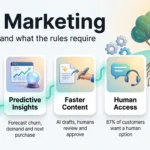
AI changes decisions in three ways, and each carries a different risk.
Automating the Routine Calls
The clearest wins are high-volume, low-variance decisions with a clear rule set: approving a standard expense, routing a support ticket, reordering stock at a threshold, flagging an invoice mismatch. These do not need judgment, they need consistency, and a system applies a rule more reliably than a tired person on a Friday afternoon. The value is throughput, not intelligence, which is why our overview of AI in the workplace puts this layer first.
Prediction and Forecasting
The second mechanism estimates what happens next: demand, churn, cash position, staffing need. A forecast does not make the decision. It narrows the range you choose within.
Here real-time data matters more than model sophistication. A good model on stale inputs produces a confident wrong answer. Teams that get value invested in the pipeline first and the model second.
Reading Unstructured Input
The third mechanism turns text and voice into something a decision can use: support transcripts, survey comments, contract clauses, review threads. Natural language processing surfaces themes a person would need weeks to find.
Treat the output as a lead, not a finding. Sentiment scoring is frequently wrong on sarcasm, jargon and mixed messages, so read the underlying examples first. The same caution applies to AI chatbots in customer service, where a model’s confidence and its accuracy are only loosely related.
How Managers Use AI in Practice
Vendor case studies describe the version that worked. The useful lesson usually sits in what happened afterwards.
Where the Decision Actually Changes
AI rarely replaces a decision. It changes the shape of the meeting where the decision is made: the analyst arrives with a forecast instead of a spreadsheet, discussion starts from a shortlist, and the argument moves from “what do we know” to “do we believe this”.
That gain has a failure mode. When model output arrives first, it anchors the room. The countermeasure is cheap: state the decision criteria before the output is shown.
What the Well-Known Examples Prove
McDonald’s ran a voice-ordering AI pilot with IBM across more than a hundred drive-thru locations and ended it in 2024 after widely shared order errors, later testing a Google-backed system instead. Recommendation engines at Netflix and Amazon have run at scale for over a decade.
The difference is not the technology. It is the cost of a wrong answer. A bad recommendation costs a click; a bad drive-thru order costs a customer and a refund, in public. Before automating a decision, ask what a wrong one costs and who finds out. Our piece on automation risk assessment works through that calculation.
Where AI Decision Making Goes Wrong
The failure patterns are consistent enough to plan around.
Data Quality and the Trust Gap
Deloitte’s 2026 study found 72% of leaders saying data volume and a lack of trust in that data had prevented them from making decisions, and 57% of organizations operating at low decision-making maturity. Sixty-four percent called AI decision-making very important to their success, while only 5% considered themselves leading the way.
That is a governance problem before it is a modelling problem. A working data governance strategy does more for decision quality than a better model.
Cancelled Projects and Overreach
Gartner predicts more than 40% of agentic AI projects will be cancelled by the end of 2027, citing unclear business value, escalating costs and inadequate risk controls. That is not an argument against agents, but for scoping them to decisions you can evaluate.
Algorithmic Bias and Accountability
A model trained on past decisions reproduces the pattern in those decisions, including the parts you would not defend. This matters most in hiring, promotion, pay and performance, where the affected person rarely sees the reasoning. Our guides to bias in AI hiring and explainable AI cover the mitigations.
Three practices carry most of the weight: test outputs against outcomes rather than assuming fairness from inputs, keep an audit trail of what was recommended and what was decided, and name a person who owns the decision. Algorithmic management without a named owner is how accountability disappears.
What the Rules Require in 2026
The EU AI Act’s transparency obligations became enforceable on 2 August 2026. They require disclosure when people interact with an AI system, machine-readable marking of AI-generated content, and notice where emotion recognition or biometric categorisation is used. Market surveillance authorities became operational the same day. Under the Digital AI Omnibus, the Annex III high-risk obligations covering employment and worker management moved to 2 December 2027, with product-embedded systems following on 2 August 2028.
In the US, Colorado repealed its AI Act and replaced it with the Automated Decision-Making Technology Act, effective 1 January 2027. The duty of care on algorithmic discrimination was dropped, but employers using the technology in hiring or promotion must give notice beforehand, explain an adverse outcome in plain language within 30 days, offer meaningful human review, and keep records for three years. Our guides to EU AI Act compliance and employee data privacy track the detail.

New Roles Around AI Decisions
As decisions move partly into systems, someone has to own the systems. That is producing genuinely new job descriptions.
New Managerial Specializations
The AI ethics officer role, data curators, model risk owners and AI product managers exist because a model in production needs the same oversight as any other operational asset. They sit between the technical team and the business owner, and are judged on whether outputs hold up, not on whether the system shipped. Our overview of AI governance models shows how the responsibilities are usually split.
From Administrative to Strategic Work
Where AI absorbs reporting, scheduling and status-chasing, the manager’s remaining work is the part that was always harder: setting the criteria, deciding what evidence would change the answer, and carrying the consequences.
That shift is real but not automatic. Only 7% of organizations have guidance on what to do with freed time, and without a deliberate decision the time refills with meetings. Our look at current leadership trends covers how teams handle it.

Building AI Competence in the Team
The skill that matters is not prompting. It is judging output.
Skills That Make AI Output Usable
People need enough statistical literacy to ask what a model was trained on, what it optimizes for and how confident it is, plus the judgment to spot a plausible answer that is unsupported.
Closing the Skills Gap
Analytics show which teams are weakest on which capability, which makes targeted training possible. Pair it with clear generative AI usage guidelines and our guide to upskilling and reskilling.
A Practical Framework for Leaders
A structured approach beats enthusiasm. These steps recur in organizations that can show a return.
Before You Deploy
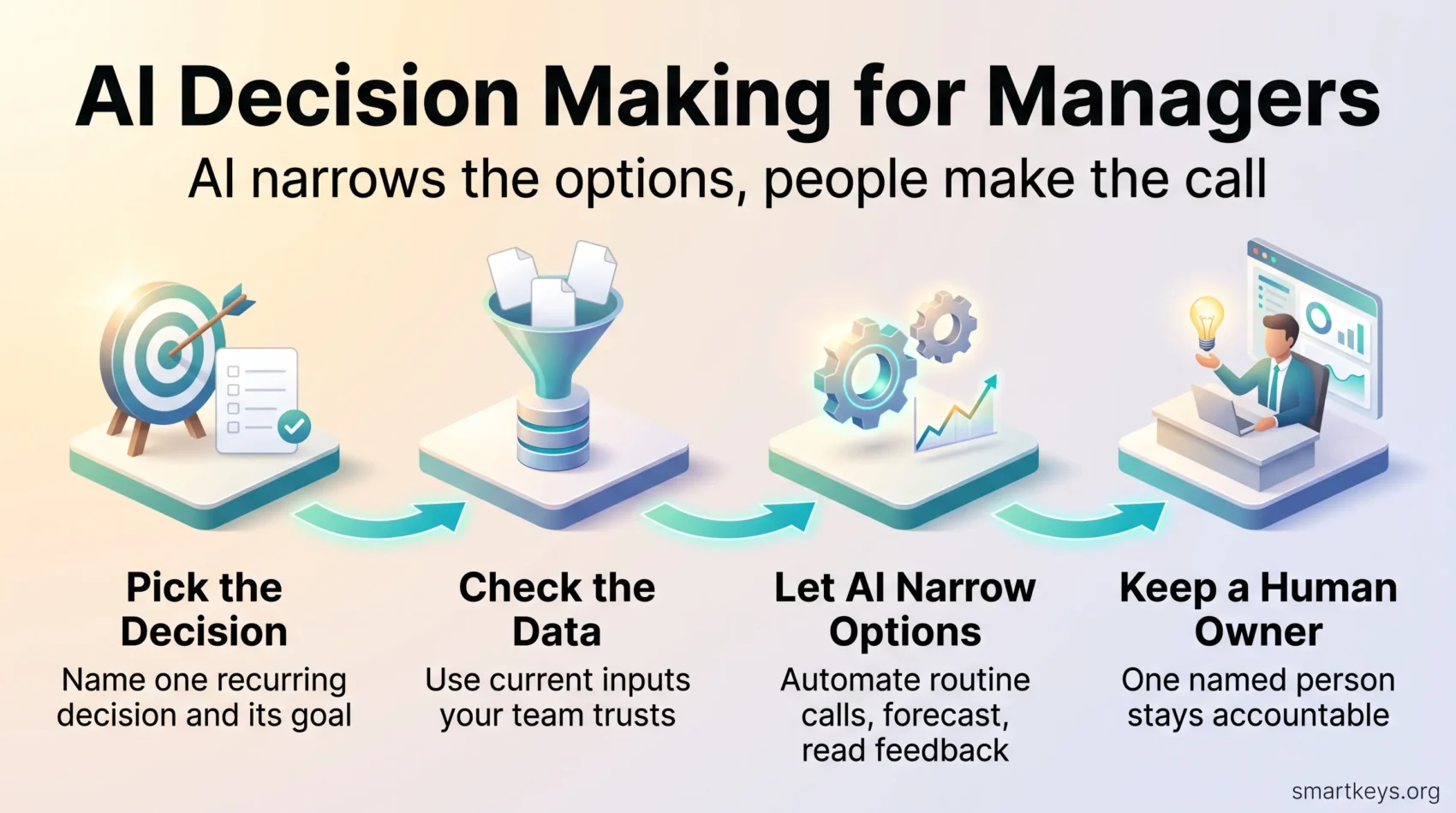
- Pick the decision first: name a recurring decision, its frequency, and how you will know it improved.
- Check the data: confirm the inputs exist, are current, and are trusted by the people using the output.
- Budget honestly: include ongoing inference and integration costs, not just the pilot.
- Assign an owner: one named person accountable for the decision, not the model.
Screening applications is the classic starting point: high volume, repetitive process. It is also the highest-regulation use case, so read our guide to AI hiring tools before you buy one.
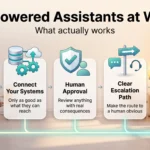
Keeping a Human in the Loop
Oversight only works if it is real. A reviewer approving 200 recommendations an hour is not reviewing anything. Set a sampling rate you can sustain, give reviewers authority to overrule, and track how often they do. An override rate of zero means the model is perfect or the review is theatre.
What Changes for Employees
The people affected by AI-assisted decisions are also the people making them.
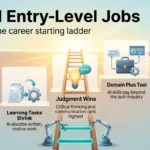
Entry-Level Work
Junior roles were historically where people learned judgment by doing repetitive work slowly. When AI absorbs that work, the learning has to be designed in deliberately, or you get people making senior decisions without ever having built the pattern recognition. Our analysis of how workers are adapting to job automation covers the evidence so far.
Human-AI Collaboration
Deloitte found that workers who trust the AI agents they work with are far more likely to see those agents as critical to creating value. Trust is earned by accuracy and by honesty about limits, not by rollout campaigns. Tell people what the system does badly; it is the fastest way to get them to use it well. Structured onboarding and training is where that message lands.
Conclusion
AI decision making in 2026 is not a question of capability. Nearly every organization has the tools and only a minority can show what they returned. The gap sits in data quality, in unclear ownership, and in the absence of a plan for the freed capacity.
The managers getting value do something unglamorous. They pick one recurring decision, define what better looks like before they start, fix the inputs, keep a named person accountable, and measure whether the answer improved. Then they repeat it with the next decision.
AI is very good at narrowing the range you choose within. Deciding remains yours.
Found this useful?
Make SmartKeys a preferred source on Google, and our articles will surface more often in your Top Stories, AI Overviews, and AI Mode.
Add as Preferred Source