Almost everyone using AI at work says it helps them personally. Very few companies can point to the money. That gap is the problem with proving the value of artificial intelligence.
Gartner forecasts worldwide AI spending of $2.59 trillion in 2026, up 47 percent on the year. In the same May 2026 forecast, Gartner analyst John-David Lovelock notes that technology leaders struggle to prove the value of those investments.
The survey data agrees. McKinsey’s State of AI report from August 2026, based on 1,719 respondents, found 80 percent of people using AI in their role reported better personal productivity. Only 37 percent saw any effect on company EBIT, which is earnings before interest and taxes, the standard measure of operating profit. Just 6 percent could attribute at least 5 percent of EBIT to AI. An MIT NANDA report from August 2025 found roughly 95 percent of enterprise generative AI pilots produced no measurable return.
This article covers how to measure AI return on investment, usually shortened to ROI. You get a definition, a four step framework, the inputs to model, a worked example, and the reporting mistakes that make good projects look worthless.
Key Takeaways
- Personal productivity gains and company profit are different things. Only the second counts as ROI.
- Estimate returns before you buy, so you can compare use cases instead of defending one.
- Every metric needs a baseline, a target, an owner and a reporting period.
- Adoption numbers such as active users are not returns.
- Compare use cases across the portfolio and move money toward what works.
Start Measuring Before You Commit the Budget
The best moment to build an ROI case is before anything is bought. At that stage you are comparing options, not defending a decision. A rough estimate across five candidate use cases tells you which to fund first. That choice matters more than the precision of any single number.
Early estimates rest on assumptions, so write them down. If you assume support agents save twelve minutes per ticket, record the figure, its source and the date. When real usage data arrives you can test the assumption instead of arguing about what anyone once believed.
Your first calculation will be wrong in places. It still beats approving spend because a demo impressed someone. The same discipline applies to AI agent workflows and plain task automation.
What AI ROI Measurement Actually Means
ROI is a simple ratio. Take the value produced, subtract what it cost, divide by the cost. A project returning $200,000 on $100,000 of spend has an ROI of 100 percent. The arithmetic is easy. Agreeing what belongs in each half is the hard part.
Companies count returns in one of four ways:
- Traditional ROI. Everything in currency. Licences, staff time and infrastructure on one side; lower cost to serve and higher revenue on the other. This is what a finance director expects.
- Non-traditional ROI. Benefits that resist a dollar figure, such as reputation or competitive position. Real, but not bankable.
- Hybrid ROI. Money plus a scored qualitative measure, on one scale for every use case.
- Uncalculated ROI. No consistent method. Each team argues its own case with its own numbers, and nobody can rank them.
Pick one approach and apply it everywhere. Short and long horizons still need different evidence. A three month efficiency pilot can be judged on hours and error rates. A two year platform investment needs assumptions about growth, adoption and the infrastructure it will run on.
Choosing Metrics That Survive a Finance Review
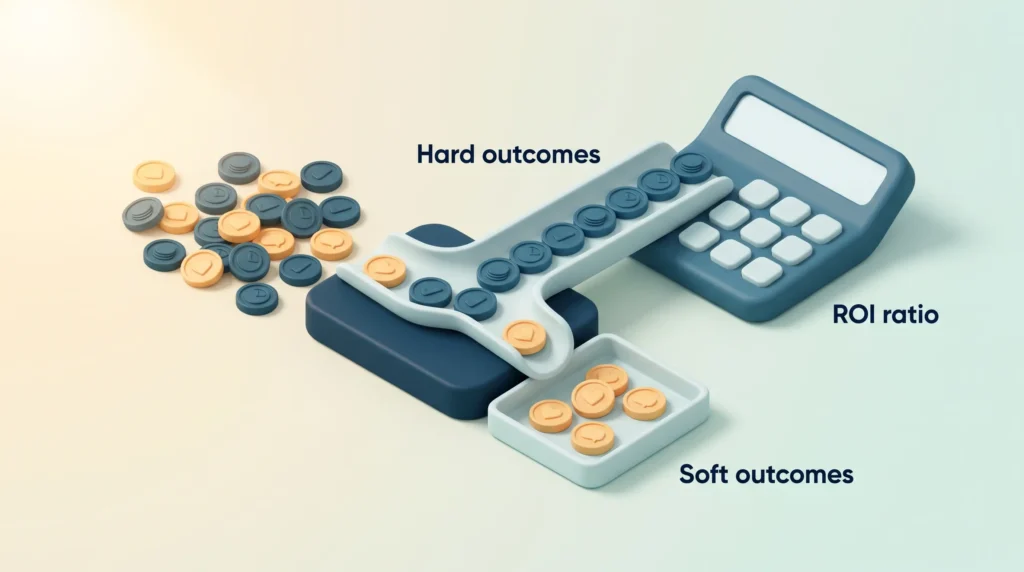
Split your measures into hard and soft outcomes. Hard outcomes include labour cost per case, revenue per representative, error rates and cycle time. Soft outcomes cover sentiment, decision confidence and customer perception. Only the first group belongs in the ROI ratio.
The confidence gap is wide. IBM reported in its Q4 2025 Think Circle research that 79 percent of executives see productivity gains from AI. Only 29 percent feel able to measure the return with confidence. Most organisations are not short of enthusiasm. They are short of baselines.
- Quantitative: hours saved per person per week, cost per resolved ticket, conversion rate, defect rate.
- Qualitative: employee feedback scores, decision confidence, perceived quality of output.
- Each measure needs four things: a baseline taken before launch, a target, a named owner, a fixed reporting period.
The baseline is the part teams skip, and skipping it is fatal. If you never recorded how long the task took before, you cannot prove anything after. Measure the process for two weeks first, as you would when tracking personal productivity metrics.
A Four Step Measurement Framework
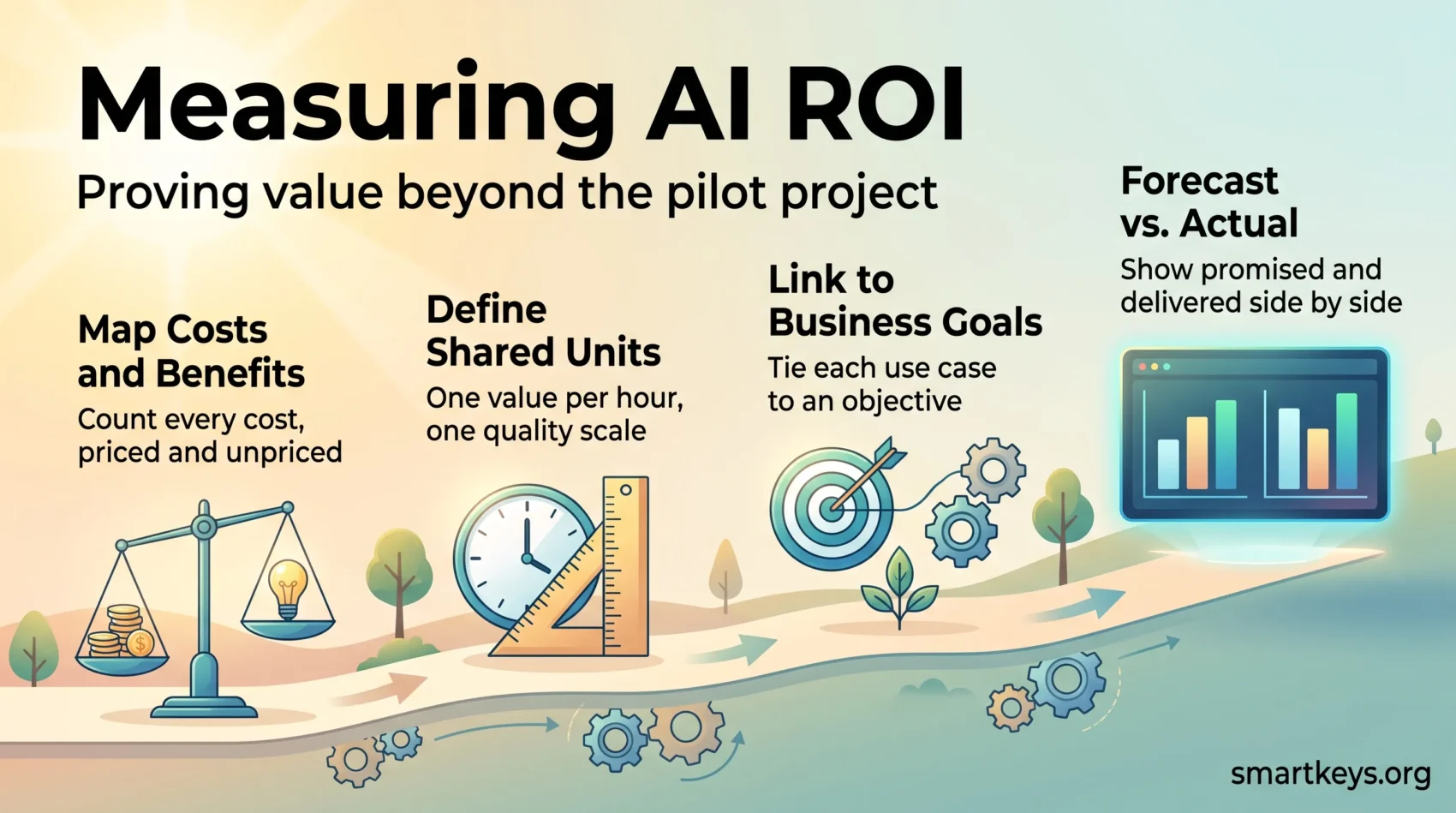
One: map costs and benefits. List every cost, including the ones nobody invoices you for, such as internal hours for integration and change management. List benefits the same way, separating what you can price from what you cannot.
Two: define a unit for every input. Decide what an hour of analyst time is worth and score quality on one scale. Without shared units you cannot compare a marketing case against a logistics one.
Three: connect each use case to a business objective. If the goal is lower cost to serve, a tool that improves internal search counts only once you show it moved that number. A clear revenue operations model helps, because objectives and owners are already defined.
Four: show forecast and actual side by side. A dashboard with actuals only hides the useful signal, which is the gap between what you promised and what arrived. Teams already using augmented analytics and self-service analytics can build this view quickly.
A credible ROI calculation needs context: comparisons across use cases, across time periods, and across investment stages.
The Inputs to Put in Your Model
A model that ignores half the cost side flatters now and surprises later. Work through four categories.
Costs. Licences and usage fees, compute, integration, data preparation, security review, training and support. Usage based pricing deserves care, because costs rise with adoption. An LLMOps strategy that keeps spend visible is the difference between a budget and a bill.
Revenue. New customers, higher order value, shorter sales cycles, better retention. Attribution is contested, so state your method up front. Teams running AI in marketing usually have a model you can borrow.
Quality. Fewer errors, fewer escalations, less rework. Quality turns into money indirectly, through avoided refunds or shorter handling, so trace that path rather than asserting it.
Process and risk. Faster delivery, fewer handoffs, less dependence on one expert. Set this against new exposure. A structured risk management framework and an honest automation risk assessment keep the downside in the same document as the upside.
Turning Hours Saved Into a Number Finance Accepts
Time saved is the most claimed benefit and the most challenged. The objection is fair. An hour freed is not an hour banked unless something valuable fills it.
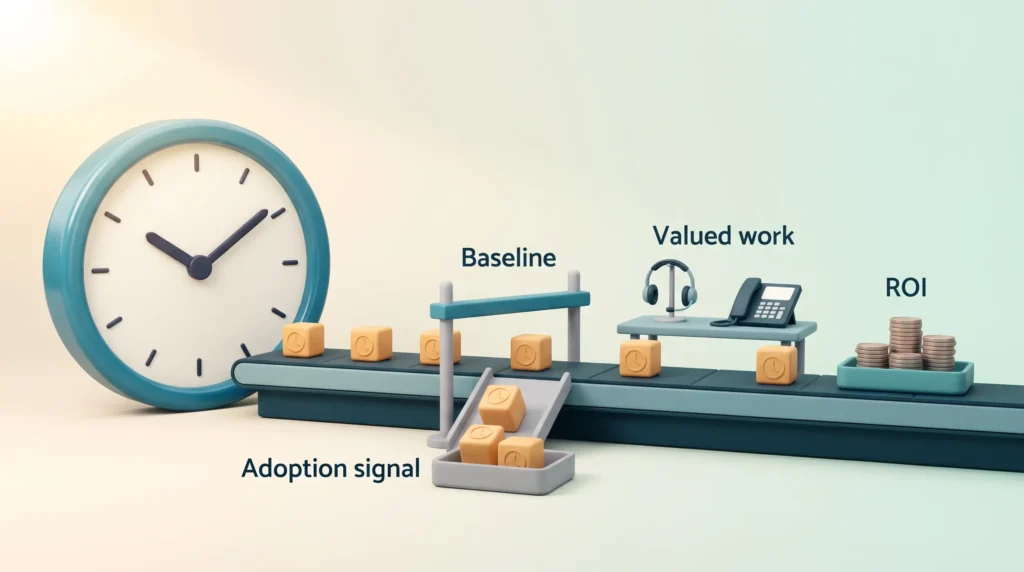
Here is an illustration with invented inputs, so take the shape rather than the figures. A sales team of 50 people each save three hours a week. At a fully loaded $75 an hour, that is $11,250 a week, or $585,000 a year. Subtract $150,000 of annual cost for licences, rollout and training and the net gain is $435,000, an ROI of 290 percent.
That holds only if two conditions are met. The three hours must be verified against a baseline rather than self-reported. The freed time must go into work the business values, such as more customer calls. If either fails, report the hours as an adoption signal and keep them out of the ROI line. The same test applies to outsourcing low value tasks and AI collaboration tools.
Present results in a few views, not one crowded report:
- An executive summary: forecast against actual.
- A scorecard per department, so owners see their numbers.
- A use case comparison ranking initiatives on one basis.
- A trend view, because one quarter settles nothing.
- An action list with names against each gap.
Where AI ROI Reporting Goes Wrong
Most disputed AI business cases fail on reporting, not on the technology. Five come up repeatedly.
- Vendor defined metrics. One supplier counts an active user as anyone who opened the app, another as someone who finished a task. Comparing them tells you nothing.
- No internal definitions. Write down what your company means by active user, time saved and resolved case. Publish it.
- Inconsistent practice. Marketing, sales and IT measuring differently makes consolidation impossible.
- Irregular reporting. Fix a cadence and keep it. Problems appear as trend breaks, which sporadic snapshots hide.
- No independent check. Have someone outside the project validate figures before they reach the board.
The cost of getting this wrong is documented. S&P Global Market Intelligence surveyed more than 1,000 organisations in North America and Europe. In March 2025 it reported that 42 percent had abandoned most of their AI initiatives, up from 17 percent a year earlier. Companies dropped an average of 46 percent of proofs of concept before production. Better measurement will not rescue a bad idea, but poor measurement regularly kills a good one.
What the Companies With Returns Do Differently
IBM’s Institute for Business Value found that product development teams following its top four practices reported a median generative AI ROI of 55 percent. The practices are unglamorous:
- Act on feedback from the people doing the work.
- Work in short iterations, so small releases fail cheaply.
- Learn from usage data, moving the tool toward high value workflows.
- Build mixed teams of domain experts, engineers and finance, close to collaborative intelligence.
The same research reports that paying down technical debt, meaning the shortcuts in existing systems that make every change slower, can improve AI ROI by up to 29 percent. Returns often come from removing friction rather than from buying better models.
Comparing use cases across a portfolio surfaces patterns invisible one project at a time. A saving that repeats in three departments beats a larger one that works in a single place. Anyone who has scaled robotics automation or measured AI augmentation knows the pattern.
Measuring in the Accountability Era
Boards have stopped accepting enthusiasm as evidence. IBM surveyed 2,000 chief executives across 33 countries for its 2025 CEO Study. Only about 25 percent of AI initiatives had delivered the expected return, and just 16 percent had scaled across the enterprise.
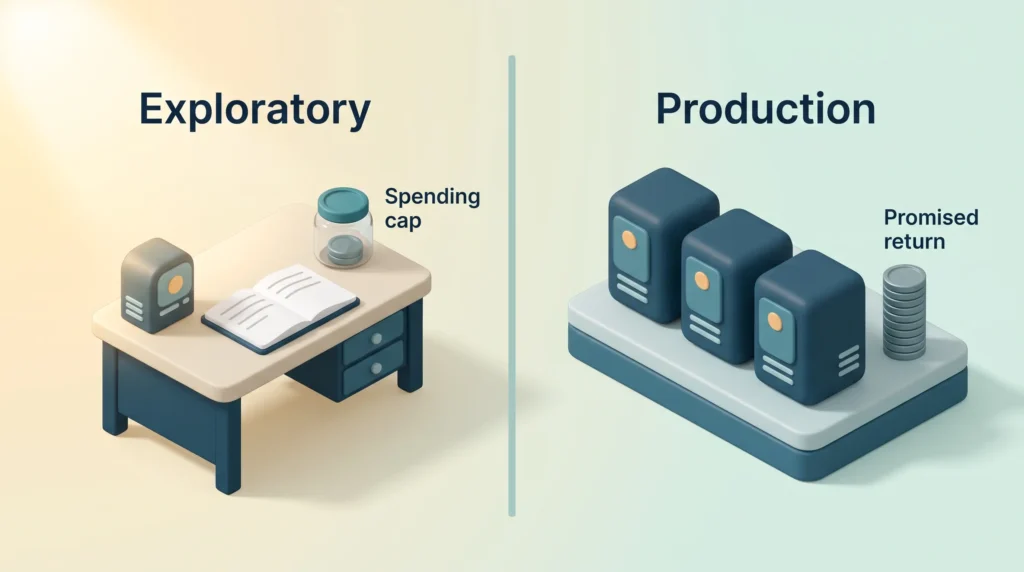
The practical answer is two categories with different rules. Exploratory work is judged on what it teaches: a written hypothesis, a learning milestone, a spending cap, a decision date. Production work is judged on the numbers it promised. Board level ROI demands kill a two week experiment. Experimental tolerance applied to a scaled rollout wastes money.
Buy-in has to be maintained, not won once. Finance validates the model, operations owns the baselines, and the people using the tool report what changed. Involving employees in that loop improves data quality and adoption, and supports talent retention.
Finally, remember what caps returns. Culture, workflow design and data quality limit a model long before the model does. If your customer records sit in five systems that disagree, a customer data platform is a prerequisite, and your analytics maturity is the honest starting point.
Conclusion
Start measuring at the idea stage, or as soon as an initiative turns out to have no clear evidence of cost and benefit. The first estimate will be rough. Its job is to let you compare options, not to be right to the dollar.
Keep financial and qualitative measures in the same report but in separate columns. Set baselines before launch, use the same units everywhere, and let someone outside the project check the figures.
Do that consistently and the picture changes. Instead of pilots that each feel successful, you get a portfolio you can rank, defend and reallocate.
Found this useful?
Make SmartKeys a preferred source on Google, and our articles will surface more often in your Top Stories, AI Overviews, and AI Mode.
Add as Preferred SourceFAQ
Why does measuring AI ROI matter more than tracking adoption?
Adoption tells you people opened the tool. ROI tells you the company is better off. McKinsey’s 2026 State of AI survey found 80 percent of AI users reported better personal productivity, while only 37 percent could attribute any operating profit impact to AI. Reporting logins and prompts to a board means reporting activity and calling it value. Measured ROI connects a specific change, such as shorter handling time, to a cost or revenue line finance already tracks. It also lets you rank use cases and fund the better one.
How do I calculate AI ROI accurately?
Take the value produced, subtract the total cost, divide by that cost. Accuracy comes from the inputs, not the formula. Record a baseline before launch, because a saving with nothing to compare it to is an opinion. Count every cost, including internal hours for integration, data preparation and training, not just the licence fee. Fix your units, so an hour of staff time is worth the same in every case. Then have someone outside the project check the model.
Does time saved count as real ROI?
Only if two things are true. First, the saving is measured against a baseline rather than self-reported, because people overestimate how much time a tool gives back. Second, the freed time goes into work the business values. Ninety minutes a week returned to a team that then handles more customer calls has a price. The same ninety minutes absorbed into a longer inbox session does not. When that is unclear, report the hours as an adoption signal only.
How long should it take before an AI project shows a return?
It depends on the type of project, and you should agree the answer before you start. A narrow efficiency case, such as drafting standard replies, can show a measurable change within one or two quarters, because the task repeats and the baseline is easy to capture. Platform work touching several systems takes longer and should be judged on interim milestones. Set the timeline and checkpoint dates in advance. Without them, a project that is simply early looks identical to one that is failing.
What should I do if an AI initiative is not delivering the expected return?
Work through four questions before deciding. Was there a proper baseline, or is the comparison guesswork? Is the tool used for the workflow it was bought for, or has it drifted? Is the bottleneck the model, or the data and process around it, which is the more common answer? And was the original assumption realistic? Many apparent failures are measurement or scope failures. If the case still does not hold, stop it and move the budget.
How often should AI ROI be reviewed?
Set a fixed rhythm and keep it, because trends carry the information and irregular snapshots hide them. A workable pattern is a monthly operational review of usage and quality, a quarterly financial review of costs against benefits, and an annual portfolio review. Match the depth to the stage. An exploratory project needs frequent light checks against its milestones. A scaled deployment needs rarer but stricter financial validation.