An AI ethics officer is the person a company holds responsible for how its artificial intelligence gets built, bought and used. The role exists because these systems now decide things about real people: who gets shortlisted for a job, whose expense claim is flagged, which customer sees which price. Someone has to set what the company will and will not do with them, and check that teams follow it.
Job titles vary. Responsible AI lead, AI governance manager and head of AI risk describe much the same work: set policy, review systems before launch, train colleagues, and investigate when something goes wrong. As AI moves deeper into everyday work, auditors and regulators ask about that mandate by name. For a sense of how sensitive these tools get, see our look at emotion-aware tools at work.
Key Takeaways
- The role turns company values into decisions that can be recorded and defended later.
- Core areas: policy, pre-launch review, monitoring, training and incident handling.
- Most organisations work on AI governance, but few have given it an owner.
- The rules changed again in 2026, in the EU and in several US states.
- Pay depends on scope and sector far more than on the job title.
What an AI ethics officer actually does
Picture a recruiting team that wants to buy a CV screening tool. The ethics officer asks what data the vendor trained it on, what its bias audit shows, whether a human reviews every rejection, and whether candidates are told a machine is involved. If those answers are missing, the purchase waits. That is the job in miniature.
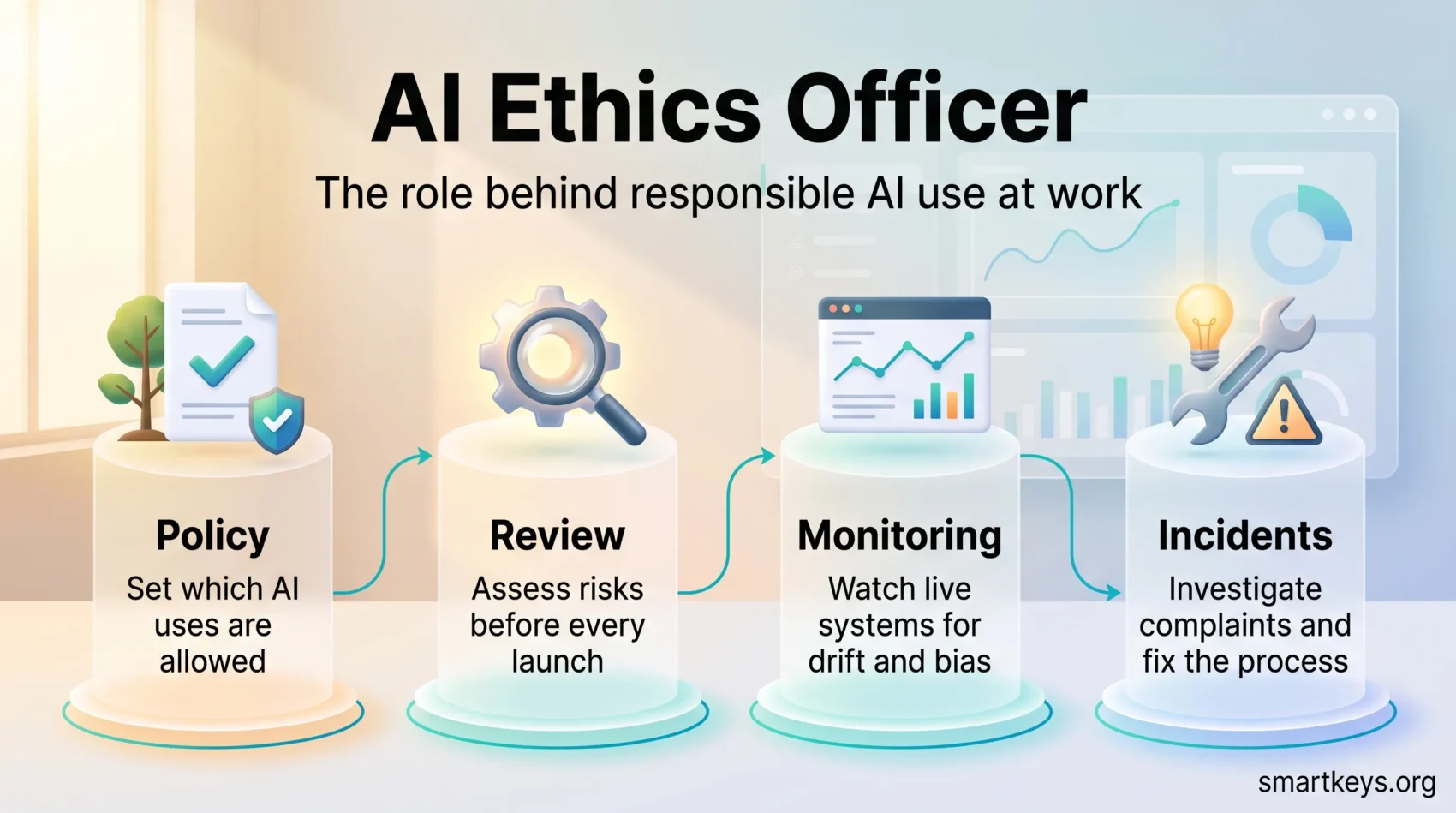
The work falls into four streams.
- Policy. Rules on which uses are allowed, which need approval, and which are off limits.
- Review. Risk assessments at intake and before deployment, with releases gated on the result.
- Monitoring. Watching live systems for drift, meaning accuracy that quietly decays as the world changes, and for outcomes that skew against one group.
- Incidents. Investigating complaints and fixing the process that allowed them.
The role only works when it is wired into how products already get built, which is why it sits close to legal, security, product and HR rather than above them. Our guide to building an AI governance model covers the structure.
Why companies created the role
Two pressures converged. Once dozens of teams use AI tools, no single department sees the whole picture. And the rules now name specific duties rather than general principles.
The International Association of Privacy Professionals (IAPP) surveyed organisations for its 2025 AI Governance Profession Report and found 77% were working on AI governance, rising to roughly 90% among those already using AI. Responsibility was scattered: privacy owned it in 22% of cases, legal and compliance in another 22%, IT in 17%. Of 671 respondents, only 1.5% expected to need no extra staff that year.
That gap between “we are working on it” and “someone owns it” is what the role closes. Our AI ethics framework sets out the principles most policies are built from.
The rules the role has to keep up with
This part of the job changes fastest. A policy written in 2024 is already out of date in several places.
European Union
The EU AI Act phases in over several years. Its AI literacy duty, which requires providers and deployers to give staff working with AI adequate training, has applied since February 2025. The Article 50 transparency duties, covering disclosure that people are dealing with an AI system and labelling of synthetic content, apply from 2 August 2026.
The heavier high-risk obligations moved. Under the Digital Omnibus package agreed in 2026, standalone high-risk systems listed in Annex III now have until 2 December 2027, and high-risk AI embedded in regulated products such as medical devices until 2 August 2028. The GDPR separately limits decisions made solely by automated means where they have legal or similarly significant effects. Our EU AI Act compliance guide breaks the phases down.
United States
There is no federal AI law. The Algorithmic Accountability Act has been introduced in Congress several times and never enacted, so citing it as a live requirement is a mistake. What binds employers is state and city law.
- Illinois. HB 3773 amended the state Human Rights Act and took effect on 1 January 2026. It bars discriminatory use of AI in employment decisions and requires notice to candidates.
- New York City. Local Law 144 requires an annual independent bias audit of automated employment decision tools, with a summary published.
- Colorado. The original AI Act (SB 24-205) never took effect as written. A federal court stayed enforcement in April 2026, and lawmakers replaced it with SB 26-189, which regulates automated decision-making technology from 1 January 2027.
State rules keep moving, so most ethics officers track them as a standing item. Our overviews of AI regulation and workplace legislation ahead help, and hiring teams should read up on bias in AI hiring and what current AI hiring tools can document.
Standards worth knowing
Two voluntary frameworks do the heavy lifting. The NIST AI Risk Management Framework gives US organisations a common vocabulary for identifying and reducing AI risk. ISO/IEC 42001 goes further: it is certifiable, so an organisation can be audited against it as it can for information security. Both are optional, and both show that your process was deliberate.
Skills that make the difference
The role sits between two groups that rarely share a vocabulary, so the defining skill is translation.
- Enough data science to ask hard questions. You need not train models, but you should read a model card, spot a training set that does not match the people the tool will judge, and tell a real evaluation from a marketing chart.
- Working legal fluency. Data protection, employment and sector rules, at the level where you know when to call counsel.
- Documentation discipline. A decision made in March still has to be explainable in November.
- Comfort saying no. The role has little value if it never blocks anything.
Timnit Gebru’s research on bias in large models helped make audits and documentation standard practice rather than an afterthought. Our explainer on explainable AI covers the techniques that make an output reviewable, and data governance strategy covers the inputs.
Education, certifications and career path
People arrive from three directions: privacy and compliance, data science, and social science or law. All three work. What matters is closing the gap on the side you did not start from.
Common credentials include the IAPP’s AIGP (Artificial Intelligence Governance Professional), CIPP for privacy law, ISO/IEC 42001 lead auditor training, and CISSP if your remit includes security. None is a hiring requirement on its own; they prove you can speak the language of an audit.
A typical progression runs from analyst, to responsible AI lead owning a product area, to head of AI governance with a team and a budget. The strongest evidence at each step is a portfolio: assessments you ran, a policy teams actually use, an incident you handled. Look also at the skills employers are hiring for and at upskilling routes.
What the job pays
Be careful with the salary figures that circulate online. Most come from job-board aggregators that infer pay from advertisement text, mixing junior analysts with heads of governance under one average. A range spanning $25,000 to $200,000 tells you the sample is noisy, not what the role is worth.
Scope drives pay more than the title does. Three questions predict it better than any published average: does the role own policy only, or also block releases? Is it in a regulated sector such as finance or health care? And does it sit in legal, privacy or engineering, since each has its own band?
Conclusion
The value of this role is not that it produces principles. Almost every company has those. It is that someone turns them into a decision that can be recorded, checked and defended months later, when a regulator, a customer or a rejected candidate asks how a system reached its conclusion. Start small: an inventory, a short policy, a review gate, a named owner. That beats a long charter nobody uses. Give monitoring tools particular care, because AI employee monitoring is where trust erodes fastest and employee data carries its own obligations. Our pieces on ethical oversight at work and AI in decision making pick up where this guide ends, and our AI job descriptions give you a draft posting.
Found this useful?
Make SmartKeys a preferred source on Google, and our articles will surface more often in your Top Stories, AI Overviews, and AI Mode.
Add as Preferred SourceFAQ
What does an AI ethics officer do in a company?
They decide and document how the company may use artificial intelligence, then check that it happens. The work splits four ways: writing the policy on which uses are allowed and which need approval, reviewing systems before they go live, monitoring them for drift and skewed outcomes, and investigating complaints. The role also trains colleagues, since product and HR teams make most AI decisions. It works only when it can pause a launch, not just comment on one.
Which regulations does the role need to track in 2026?
In the EU, the AI Act’s literacy duty has applied since February 2025 and its Article 50 transparency duties from 2 August 2026. The Digital Omnibus package agreed in 2026 pushed high-risk obligations back to 2 December 2027 for standalone Annex III systems and 2 August 2028 for AI embedded in regulated products. The GDPR still restricts decisions made solely by automated means. The United States has no federal AI law, so state and city rules bind: Illinois HB 3773, New York City Local Law 144, and Colorado’s SB 26-189 from 2027.
Is the Algorithmic Accountability Act in force?
No. It has been introduced in the US Congress several times and never enacted, so it creates no obligations today. Watch it as a signal of what federal rules might eventually require, particularly impact assessments for automated decision systems, but do not build a programme on it. What binds US employers now is state and municipal law, plus existing anti-discrimination and sector rules that apply whether a human or a model made the decision.
How do you run a bias or impact assessment?
Start with the use case, not the model. Write down what decision the system influences, who is affected, and what a wrong output costs that person. Then check the inputs: where the training data came from, whether it reflects the people the tool will judge, and how labels were produced. Test outputs across groups, not just in aggregate, because an overall accuracy figure can hide a far worse result for a smaller group. Record the risks you accepted and who watches them.
Which standards or frameworks should a company adopt?
Two are worth knowing. The NIST AI Risk Management Framework gives you a shared vocabulary and a structure for identifying and reducing AI risk, free to use. ISO/IEC 42001 defines a management system for AI that an external auditor can certify, much as ISO 27001 works for information security. Neither is legally required. Adopting one shows your process was deliberate rather than improvised, which shortens conversations with regulators, enterprise customers and insurers.
What skills and background does the role need?
Enough technical depth to challenge a claim, and enough plain language to explain the answer to a non-technical audience. You do not need to build models, but you should be able to read a model card, notice when a training set does not match the group the tool will be used on, and tell a genuine evaluation from a marketing chart. Add working knowledge of data protection and employment law, documentation habits, and a willingness to block a launch.
What can a company do first if nobody owns AI governance yet?
Begin with an inventory of every AI tool in use, including the ones individual teams bought on a company card, since those are usually the ones nobody has reviewed. Rank them by who is affected and how badly a wrong output would hurt. Write one short policy for the top tier. Require and record a human review step for any decision about a person. Then name an owner, even part-time, with authority to pause a launch.