Two things are true about AI in the workplace in 2026, and they sit uncomfortably together. Almost every large organisation now uses AI somewhere, and almost none of them can show what it earned. That gap is the real story of this year, and it is a more useful starting point than any forecast about how many jobs will disappear.
The evidence has also improved. We are no longer working from projections alone: payroll records, federal business surveys and large employee panels now show how companies actually use AI at work today. This article walks through what those sources say about adoption, use cases, obstacles and rules. If your question is narrower, namely which tasks should move to AI and which should stay with people, our guide to AI job augmentation versus replacement covers that role split in depth.
Key Insights
- 88% of organisations use AI in at least one function, but only 7% have scaled it (McKinsey, 2025).
- About half of US employees now use AI at work; 13% use it daily (Gallup, February 2026).
- There is no economy-wide displacement, but young workers in AI-exposed jobs are being hired less (Stanford Digital Economy Lab, August 2026).
- The WEF expects 170 million new roles and 92 million displaced by 2030, a net gain of 78 million.
- EU transparency rules for AI systems became enforceable on 2 August 2026.
How Far AI Adoption in the Workplace Has Actually Gone
Adoption depends entirely on who you ask, and the three best sources disagree in a way that is informative rather than confusing.
McKinsey’s global survey, fielded between late June and late July 2025, found that 88% of respondents said their organisation used AI in at least one business function. That is ten points higher than the year before. But only 7% said AI was fully scaled across the organisation. Most companies are running pilots, not operations.
The US Census Bureau’s Business Trends and Outlook Survey asks a narrower question of a much broader sample: does the firm use AI to produce goods or services? In its May 2026 reading, 19.8% said yes. Size explains most of the difference. 37% of firms with 250 or more employees use AI, against under 20% of firms with fewer than 20, and small-firm use barely moved between December 2025 and May 2026.
Gallup’s February 2026 survey of 23,717 employed US adults found that roughly half now use AI at work at least occasionally, with 13% using it daily. Use is heavily skewed by seniority: among organisations that provide AI tools, 67% of leaders used AI daily or several times a week, against 46% of individual contributors.
Put together: executives adopt, large firms deploy, small firms mostly do not, and the person doing the work uses it far less than the person announcing it. If you want a sober read on how AI is changing business operations, the scaling gap matters more than the adoption headline.
How Companies Use AI at Work Today
Strip out the pilots and the pattern is consistent. AI earns its keep where the work is high-volume, rule-bound and already digital, and where a wrong answer is cheap to catch.
- Customer support: deflecting routine questions and drafting replies. See current customer service trends for where self-service helps and where it annoys.
- Document and data work: summarising, extracting and reconciling. This is the work that fills the gap between two systems that do not talk to each other.
- Scheduling and planning: shift patterns, routing and capacity. Intelligent shift scheduling is one of the few areas with a clean, measurable payback.
- Pricing and forecasting: demand signals and AI-driven pricing optimisation, where small percentage gains compound.
- Physical operations: inspection, maintenance and material handling, covered in more depth under robotics automation and automation in blue-collar jobs.
- HR and people processes: screening, scheduling interviews and analysing survey data. AI and machine learning in HR can speed these up, but hiring and performance decisions are exactly where an unreviewed model does the most damage.
The newer layer is agentic: systems that chain steps together and act, rather than answering one question at a time. That shift raises the ceiling and the risk together. It is why AI agent workflows need explicit scope, logging and a human checkpoint before anything irreversible. If you are starting smaller, a simple task automation playbook usually beats a platform purchase.
What AI Is Doing to Jobs So Far
The most careful recent work on this comes from the Stanford Digital Economy Lab, which analyses ADP payroll records covering millions of US workers. Its August 2026 update reached two conclusions that are worth holding at the same time.
First, there is no widespread, economy-wide job displacement associated with AI. The aggregate labour market has not cracked.
Second, one group is clearly affected. Workers aged 22 to 25 in highly AI-exposed occupations are now employed about 19% below where they would be if their employment had tracked similarly aged workers in less-exposed jobs. The adjustment runs through reduced hiring rather than increased layoffs. Employment is flat or rising in occupations where AI complements the work, and experienced workers are largely unaffected.
That points to the entry-level rung of the ladder as the place where pressure lands. Organisations that quietly stop hiring juniors will find their mid-level bench empty in five years. This is one reason an internal talent marketplace and structured internal learning paths have become more than HR nice-to-haves.
Looking further out, the World Economic Forum’s Future of Jobs Report 2025 estimates 170 million new roles created and 92 million displaced by 2030, a net gain of 78 million, with around 39% of workers’ core skills changing over the same period. Forecasts are not evidence, but the direction matches the payroll data: churn in what jobs contain, not collapse in how many exist.
Designing the Split Between People and AI
Deployments that last tend to give the system the mechanical portion of a task while the person keeps judgement, context and accountability. That does not happen by itself; it means redrawing the task, not bolting a tool onto it. Which tasks to hand over and which to keep is a question of its own, and the augmentation versus replacement playbook works through it task by task.
Two workplace consequences are already visible. Job descriptions are being rewritten around review and verification rather than production, and new hybrid jobs that combine human and AI skills are appearing. For the operating model behind it (roles, decision rights and team routines), see our guide to human-AI collaboration in teams.
What Still Gets in the Way
The obstacles have shifted since 2023. Model quality is rarely the binding constraint now.
Scaling, not starting. The distance between a working pilot and a production system is integration, monitoring, error handling and ownership. That is engineering and operations work, and it is where most initiatives quietly stall. A deliberate LLMOps strategy (LLMOps being the practice of running language models in production: evaluation, cost control, observability) is what separates the 7% from the 88%.
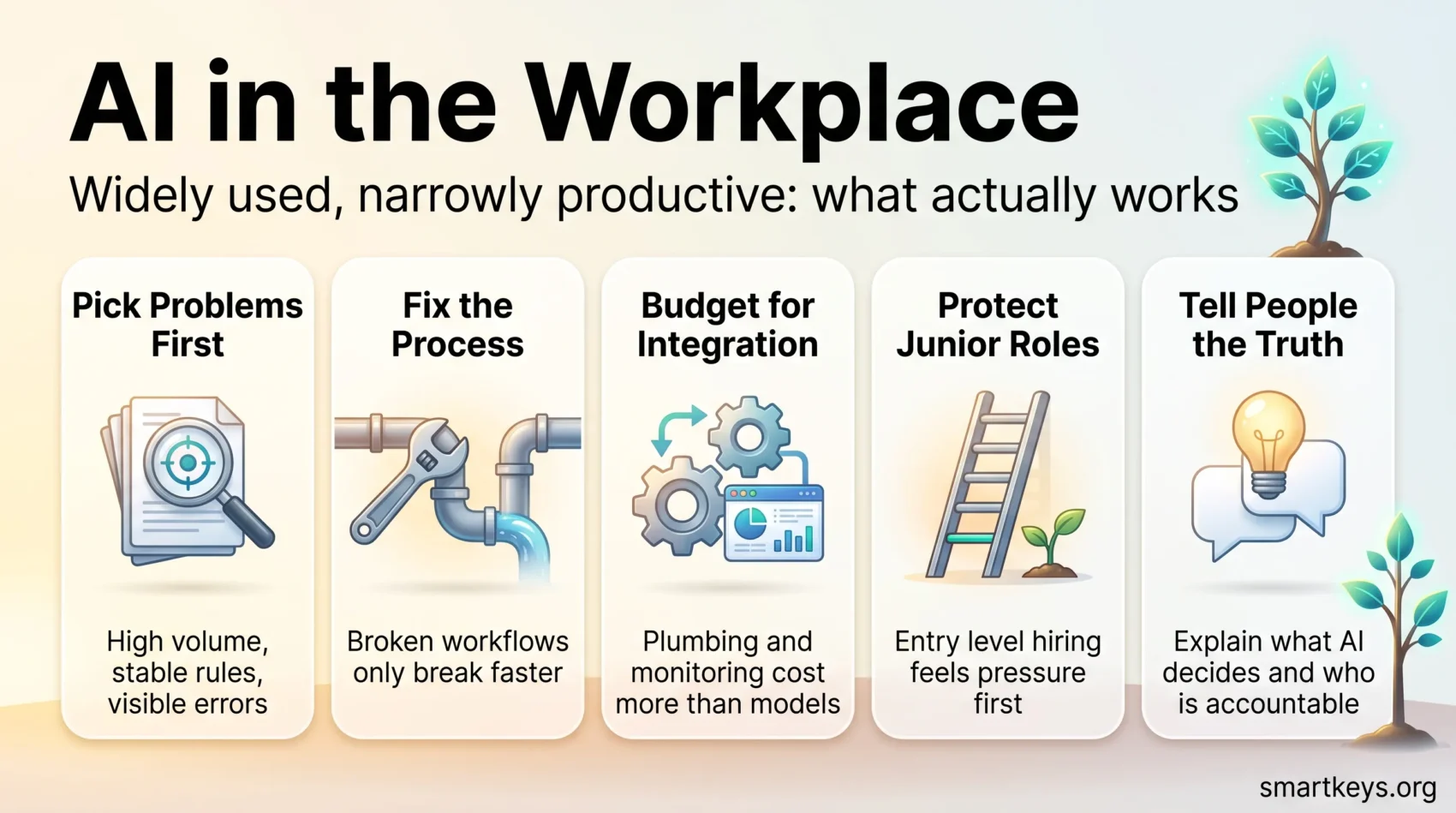
Data and process debt. AI applied to a broken process produces faster broken output. Firms that got value usually fixed the workflow first.
Trust and communication. When staff learn about an AI rollout from the tool itself, adoption stalls and shadow use spreads. Say what the system does, what it does not decide, and what happens to the time it saves.
Concentration risk. Depending on one vendor’s model, pricing and roadmap is a real exposure. Building resilient workplaces around automation means being able to switch, degrade gracefully, or run without it.
Ethics that bite. Bias, monitoring and opaque decisions are not abstract. They surface in hiring, scheduling and performance data. The ethical questions AI raises at work are now compliance questions too.
The Rules You Now Have to Work With
Regulation stopped being hypothetical this year. Under the EU AI Act, the transparency obligations in Article 50 became applicable and enforceable across the EU on 2 August 2026. They apply regardless of risk tier: people must be told when they are interacting with an AI system, AI-generated audio, image, video and text must be machine-readably marked, and deployers must disclose emotion recognition or biometric categorisation. Non-compliance can reach €15 million or 3% of worldwide annual turnover.
The high-risk obligations moved in the other direction. The AI Omnibus adopted on 27 July 2026 pushed standalone high-risk systems under Annex III to 2 December 2027, and AI embedded in regulated products to 2 August 2028. Prohibited practices remain in force on the original schedule.
The practical reading: disclosure and labelling are due now; heavier conformity work has more runway. Our guides to EU AI Act compliance and the wider spread of future-of-work legislation go through what that means for a product roadmap and for employment practices respectively.
What to Do With This
Four moves follow from the evidence rather than from vendor decks.
Pick problems, not tools. Start where volume is high, rules are stable and errors are visible. If you cannot name the metric that should move, you are not ready.
Budget for the boring 80%. Integration, evaluation and monitoring cost more than the model. Plan for them at the start, or join the pilots that never ship.
Protect the entry rung. The payroll data says junior hiring is where AI pressure lands first. Redesign junior roles around review and verification instead of quietly deleting them. Support the people whose jobs shift, which is what adapting to job automation requires in practice.
Tell people the truth. What the system does, what it does not decide, who is accountable when it is wrong, and what happens to the hours it frees. Silence is what turns a reasonable rollout into a retention problem.
Conclusion
AI in the workplace is now widely used and narrowly productive. The adoption numbers are real, the scaling numbers are sobering, and the labour-market effects so far are concentrated rather than general. Nothing in the 2026 evidence supports either the collapse story or the effortless-transformation story.
What it does support is unglamorous: fix the process, invest in the plumbing, keep judgement with people, protect the entry-level pipeline, and comply with disclosure rules that are already in force. The companies that get value from AI over the next two years will mostly be the ones that did those five things while everyone else was running pilots.
Found this useful?
Make SmartKeys a preferred source on Google, and our articles will surface more often in your Top Stories, AI Overviews, and AI Mode.
Add as Preferred Source