A “hybrid job” is a role where part of the work is done by software and the rest is done by a person. A recruiter whose shortlist is drafted by an AI tool and then checked, corrected and defended by a human is doing a hybrid job. So is a support agent whose replies are suggested by a model and approved before sending. The term causes confusion because it sounds like hybrid working, which is about splitting your week between home and the office. This article is about the other kind: the split between human judgment and machine output inside a single role.
That split is no longer theoretical. Half of employed Americans now use AI at work in some form, and the interesting question has moved on from whether AI arrives in your job to which parts of it the tools take over, and what you are still accountable for afterwards.
Key Takeaways
- A hybrid job splits tasks between a person and software, not between home and office.
- Gallup found 50% of employed Americans using AI at work in early 2026, but only about one in ten strongly agree it has transformed how work gets done.
- The World Economic Forum estimates 22% of work tasks are done mainly by technology today, against 47% mainly by humans.
- Measured job losses are narrow rather than economy wide, and concentrated among the youngest workers in the most exposed roles.
- From 2 August 2026 the EU AI Act applies generally, including AI literacy duties for employers.
How Much Work Machines Actually Do
The most useful number here comes from the World Economic Forum’s Future of Jobs Report, published in January 2025. Employers reported that 47% of work tasks were performed mainly by humans, 22% mainly by technology, and 30% by a combination of the two. By 2030, those employers expect the three categories to be roughly equal in size.
Read that carefully: it is a statement about tasks, not jobs. A task is a step, such as pulling a report, drafting a first version or calling a customer. Very few jobs are one task. Most are a bundle of twenty or thirty, and automation rarely takes the whole bundle. It takes some steps and leaves you the rest, plus the new work of supervising what the tool produced.
That is exactly what a hybrid job is. The role does not disappear. Its centre of gravity moves from producing output to directing and checking it. Deciding which steps go to the tool and which stay with a person is the wider question of whether AI augments or replaces jobs; this article looks at what that split means inside a single role.
What the 2026 Evidence Shows About AI at Work
Gallup surveyed 23,717 employed US adults in February 2026. The findings are worth reading in full, because they cut against both the hype and the panic.
Half of employed Americans said they use AI at work at least a few times a year, up from 46% the previous quarter. Frequent use, meaning a few times a week or more, reached 28%. Daily use reached 13%. So adoption is broad but shallow: most people who use AI at work are not using it every day.
Forty-one percent said their organization had integrated AI tools to improve how it works. Among employees at those organizations, 65% reported improved productivity. But only about one in ten strongly agreed that AI had actually transformed how work gets done. Enthusiasm and transformation are not the same thing.
The gap has a well-documented commercial version. MIT’s 2025 study of enterprise generative AI found that around 95% of pilots produced no measurable return on the profit and loss account. Most stalled between demo and daily use. The pattern matches what we found looking at AI and automation in the workplace: near-universal adoption, rare measurable returns.
The practical lesson for anyone designing a hybrid role: the tool is the easy part. Deciding who checks its output, and what happens when it is wrong, is the part that determines whether the role works.
Which Jobs Are Actually Changing
Forecasts about job losses are cheap. Measurements are better, and by 2026 there are some.
Stanford’s Digital Economy Lab tracks US payroll data from ADP covering November 2022 to June 2026. Its conclusion in August 2026 was blunt: there is no widespread, economy-wide job displacement associated with AI. The effects that do show up are narrow and concentrated.
Workers aged 22 to 25 in the most AI-exposed occupations now trail their peers in less exposed fields by roughly 19% on employment, up from a 15% gap in July 2025. The declines cluster in roles built on codified knowledge, meaning information that is written down, standardized and easy for a model to reproduce. Roles that lean on tacit knowledge, the kind you pick up by doing the job, held steady or grew for experienced staff.
This is the clearest signal in the current data, and it has a specific implication. If your work consists of applying documented rules to standard inputs, the tools are closest to your task list. If your work depends on reading a situation, weighing competing priorities or carrying responsibility for a decision, you are further from the line. That distinction matters more than your job title. We looked at how people are responding in our piece on adapting to job automation.
Looking further out, the World Economic Forum expects 170 million jobs to be created and 92 million displaced by 2030, a net gain of 78 million. Net figures hide a lot of individual disruption, but they do not describe a shrinking labour market.
What People Still Do That Software Does Not
It is easy to write that humans bring creativity and empathy, and just as easy to mean nothing by it. Here is the concrete version.
Software does not carry accountability. When an AI tool declines a loan application or flags a shift pattern, someone still has to be able to explain the decision to the customer, the regulator or the union. That explanation is a job, and it requires a person who understood the input well enough to defend the output.
Software struggles with tacit knowledge. A senior claims handler knows which unusual case is a genuine edge case and which is a badly filled form. That judgment was never written down, so a model trained on written records does not have it.
Software cannot negotiate a relationship. A support agent who spots that a frustrated customer is really asking for reassurance rather than a refund is doing something no ticket classifier will do for them.
Software does not set the goal. It optimizes toward whatever it was pointed at. Choosing what is worth optimizing, and noticing when the metric has stopped tracking the thing you care about, remains a human task. Our guide to AI-supported decision making goes into how teams keep that judgment in the loop.
Designing a Hybrid Role That Works
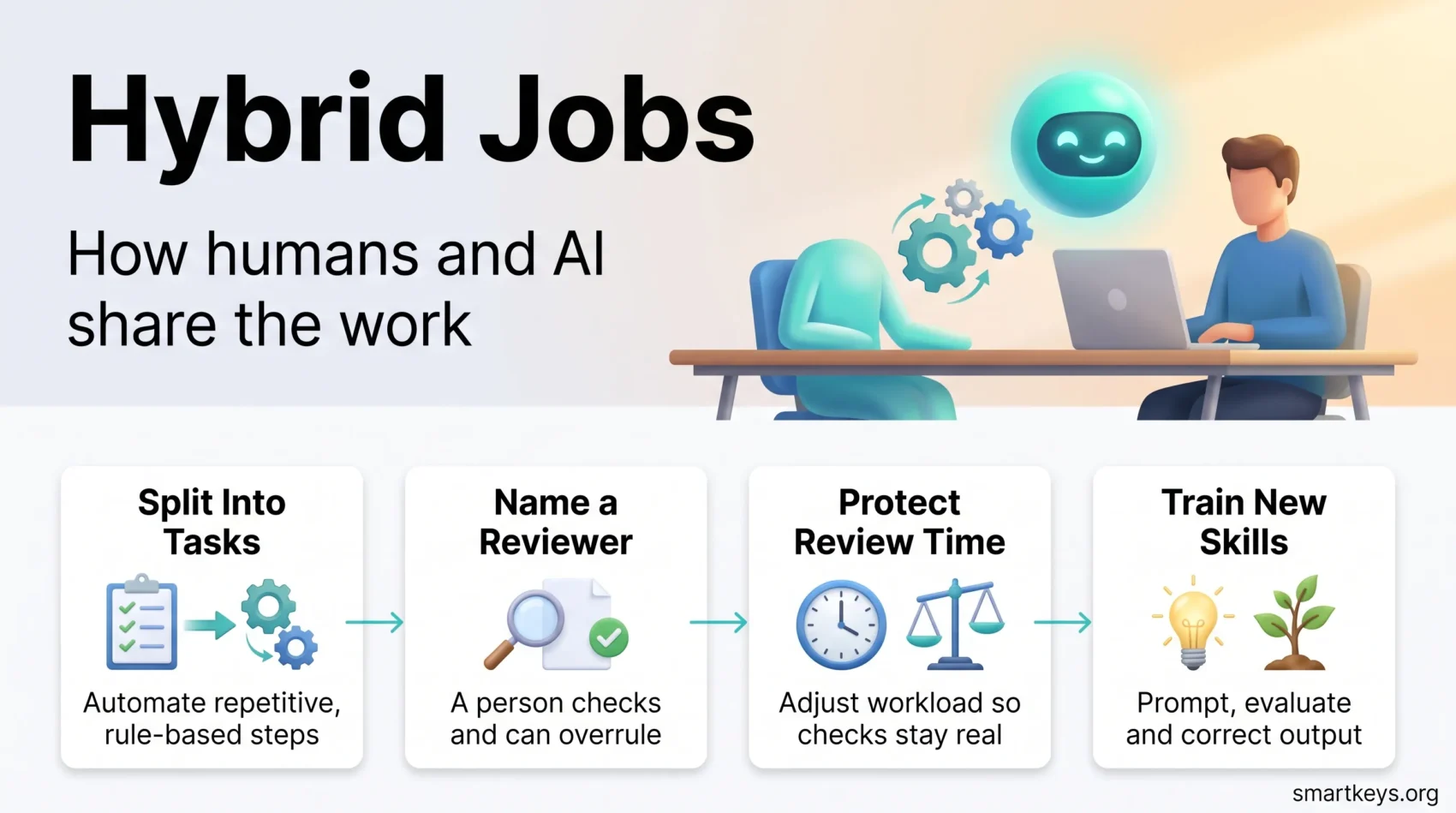
Most hybrid roles fail for organizational reasons, not technical ones. The team-level side (decision rights, pilots and KPIs) is covered in our guide on how to implement human-AI collaboration in teams. At the level of a single role, four things separate the ones that hold up.
Split the role into tasks first. List what the job actually involves, step by step, then mark which steps are repetitive and rule-based and which need judgment. Automate the first group. This sounds obvious and is skipped constantly, which is why tools get bought before anyone knows what they are for. An automation risk assessment is a useful way to structure that review.
Name who checks the output. Every automated step needs a person who reviews it, has the authority to overrule it, and knows enough to spot when it is wrong. A reviewer who cannot say no is decoration.
Give people the time the check requires. If a tool halves the drafting time but nobody adjusts the workload, the review becomes a rubber stamp within a month. This is where most quality problems actually start.
Train for the new task, not the old one. The skill in a hybrid role is prompting, evaluating and correcting, which is different from producing. Short, practical microlearning tends to work better here than a one-off workshop, because the tools keep changing.
Software choice matters less than vendors suggest, though our overview of AI collaboration tools and AI-powered assistants covers what the main categories do.
The Rules That Now Apply
If you employ people in the EU, hybrid roles come with legal obligations that took effect in 2026.
The EU AI Act became generally applicable on 2 August 2026. That date brought in the prohibitions on certain AI practices, the governance and penalty framework, rules for general-purpose AI models, and the AI literacy duty in Article 4, which requires employers to make sure staff working with AI systems have an adequate level of understanding of them.
The heavier obligations for high-risk systems listed in Annex III, which includes AI used in recruitment, task allocation and performance evaluation, were pushed back. Under the AI Omnibus agreed in late 2025, those requirements now apply from 2 December 2027 rather than August 2026.
One provision is worth knowing early. Article 26(7) requires an employer deploying a high-risk AI system at work to inform the affected workers and their representatives before putting it into use. Consultation is not an optional extra bolted on afterwards. If you are introducing AI hiring tools or any form of AI-assisted employee monitoring, plan the notification into the rollout. A written set of usage guidelines and a broader view of EU AI Act compliance will save considerable time later. The ethical questions that sit alongside the legal ones are covered in our piece on AI ethics at work.
Rules outside the EU vary widely, so check your own jurisdiction rather than assuming the EU timeline applies.
Skills Worth Building
The World Economic Forum estimates that 39% of the skills workers hold today will be disrupted or outdated within five years. That figure gets quoted as a warning. It is more useful as a filter.
Three things are worth your time. First, working knowledge of the AI tools in your own field, which means knowing what they get wrong as well as what they do well. Second, the tacit, situational judgment that the Stanford data suggests is holding its value, which you build by doing difficult work with feedback rather than by taking a course. Third, the ability to explain a decision clearly to someone who was not in the room, since that is what accountability looks like in practice.
Certificates in general AI awareness are the easiest to collect and the least valuable. Our guides to future job skills and upskilling and reskilling go deeper on how to prioritize.
Three Things People Get Wrong
“Automation means mass unemployment.” The measured data does not show it. Stanford found no economy-wide displacement through mid-2026, and the WEF’s forecast is a net gain of jobs by 2030. That is not the same as saying nobody is affected. Entry-level workers in exposed roles clearly are, and that deserves a serious policy answer rather than reassurance.
“AI will replace whole jobs.” Automation works at the level of tasks. Most roles lose some steps and gain supervision work. The exceptions are jobs that were almost entirely one repeated task, which were also the jobs most exposed to earlier waves of automation.
“Adopting the tool is the hard part.” Adoption is broad already. Gallup found 41% of employees at organizations that have integrated AI, yet only about one in ten strongly agree it changed how work gets done. The hard part is redesigning the work around it, and that has always been an organizational problem rather than a technical one. Our look at future work culture and at AI in management covers what that redesign involves.
Found this useful?
Make SmartKeys a preferred source on Google, and our articles will surface more often in your Top Stories, AI Overviews, and AI Mode.
Add as Preferred Source