5G is the fifth generation of mobile network technology. For retailers, the interesting part is not the speed test on a phone. It is three practical things: more devices connected in the same space, a shorter delay between an action and a response, and a usable connection in places where pulling a fixed line is slow or expensive.
That matters because most shopping still happens inside a building. E-commerce accounted for 17.1% of total US retail sales in the second quarter of 2026, according to the US Census Bureau, and it grew 12.2% year over year. Online is growing faster, but roughly five in six retail dollars are still spent in physical stores that need tills, scanners, cameras, tablets and stock systems to work without drama.
This guide covers what 5G in retail actually delivers in 2026, where it is worth paying for, and which promises from the early 5G years have quietly failed to arrive.
Key Takeaways
- 5G reached 3.1 billion subscriptions worldwide in the first quarter of 2026 (Ericsson Mobility Report, June 2026), so coverage is no longer the blocker in most urban retail locations.
- The features retailers are sold, such as network slicing and guaranteed latency, need 5G Standalone, which just over 90 of roughly 390 commercial operators had deployed by mid-2026.
- Fixed wireless access is the most common practical win: it connects pop-ups, new sites and backup links in days rather than weeks.
- Private 5G is real but concentrated in manufacturing, research campuses and mining. Retail use sits mainly in distribution centres, not shop floors.
- 5G fixes connectivity problems. It does not fix bad stock data, thin staffing or a weak product range.
What 5G Actually Changes in a Store
Every mobile generation is sold with the same word: faster. The useful way to think about 5G is to separate the three capabilities it was designed around, because a retailer will care about one of them far more than the other two.
The Three Capabilities That Matter
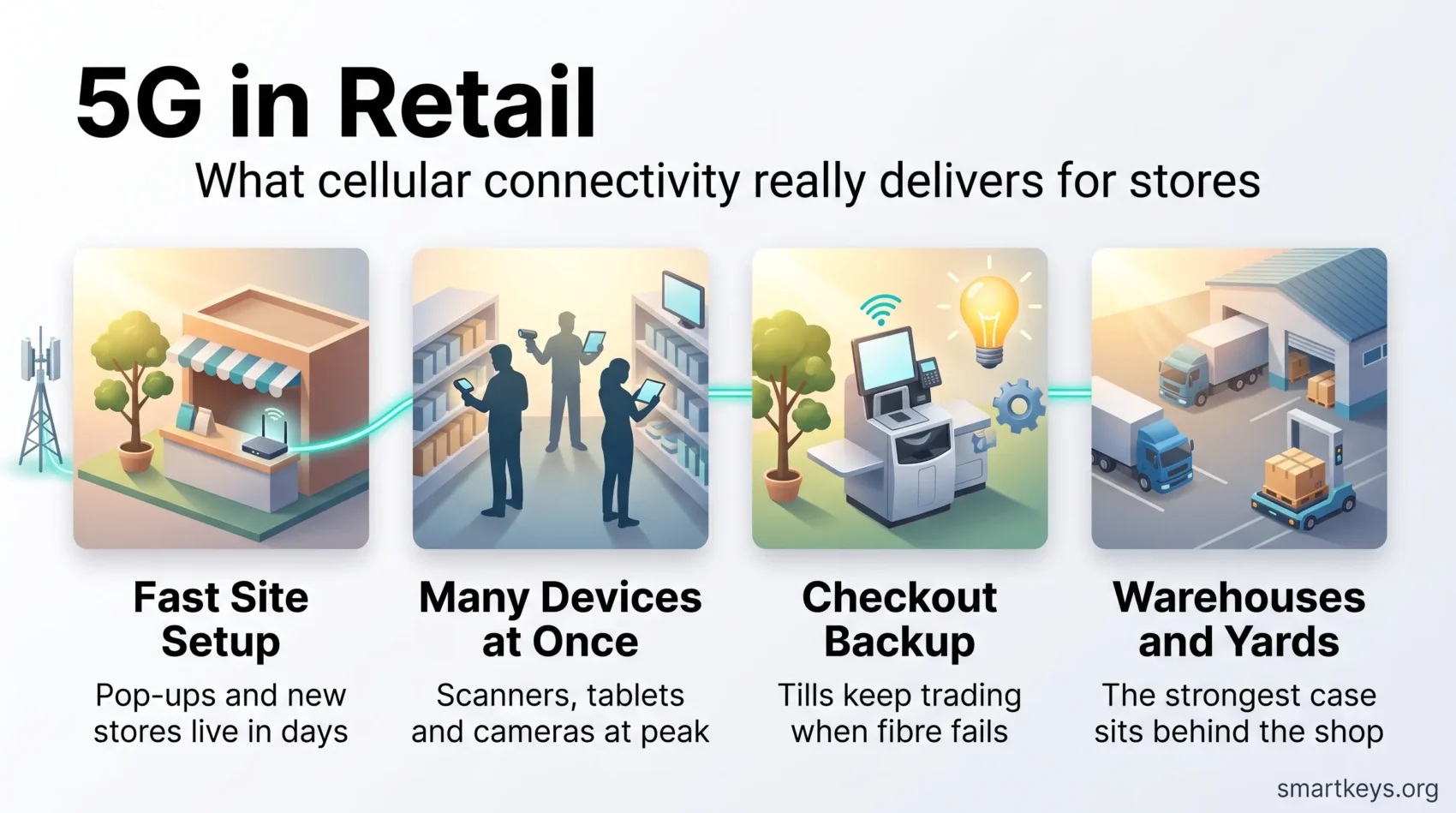
- High device density (the specification calls this massive machine-type communication): many connected devices in a small area without the network buckling. In practice this is the difference between 30 handheld scanners working on a busy Saturday and staff walking to the stockroom to check a number.
- Low latency (ultra-reliable low-latency communication): the gap between an action and a response drops to a few milliseconds. This matters for a robot moving pallets or a camera system that has to flag something while the customer is still at the counter. It does not matter for a card payment, which was never limited by network delay.
- Higher capacity and stronger uplink: more data moving in both directions, and notably more data moving out of the site. Cameras, sensors and photo-based stock audits all push data upwards, which older networks handled badly.
That third point is not theory. Ericsson found that 43 of 55 measured operators saw uplink traffic growing faster than downlink in the first quarter of 2026. Retail sites full of cameras and scanners are part of that shift, and it is a good argument for treating upload capacity as a real requirement when you compare contracts.
Why the 5G on Your Phone Is Not the 5G in the Brochure
Most 5G in the world still runs on a 4G core, an arrangement called non-standalone. It gives you more speed and nothing else. The capabilities that vendors pitch to enterprises, including network slicing (reserving a guaranteed slice of the network for one use, such as payments), require 5G Standalone.
The gap is closing but it is still a gap. Ericsson counted around 390 service providers offering commercial 5G in mid-2026, with just over 90 of them running standalone networks. Commercial offerings built on slicing rose from 65 in November 2025 to 84 by mid-2026. If a supplier promises you guaranteed performance, the first question is whether your operator has standalone coverage at your sites. The same question applies across every industry, as our overview of the business impact of 5G across industries explains in more detail.
Where 5G Is Already Earning Its Place in Retail
The honest picture in 2026 is less dramatic than the 2019 pitch decks, and more useful.
Connecting Sites That Are New, Temporary or Hard to Wire
This is the clearest win. Fixed wireless access, which delivers broadband to a fixed location over a mobile network, lets a store go live without waiting for a fibre installation date. It suits pop-up shops, seasonal locations, market stalls, construction-phase stores and remote sites where a fixed line is expensive.
Adoption backs this up: 71% of fixed wireless providers now serve customers over 5G, up from 57% a year earlier, the largest annual jump in four years according to Ericsson. Many chains also keep a cellular link as automatic failover, so a cut fibre line does not stop the tills.
Keeping Stock Counts Honest
Inventory accuracy is the retail problem most often attached to 5G, and the connection is genuine but indirect. What actually improves counts is scanning more often: RFID readers, handheld terminals, shelf cameras and cycle-count apps. Those tools need a network that stays up when dozens of devices are used at once and that can push images and scan batches upward quickly.
A reliable connection removes the excuse for not counting. It does not, on its own, tell you what is on the shelf. If your master data is wrong, faster syncing simply spreads the error more quickly, a point worth remembering before signing anything. Retailers looking at the wider stock picture usually get more value from work on supply chain resilience than from a network upgrade alone.
Payments, Checkout and Self-Service
Card payments are not slow because of the network. What cellular connectivity does add is resilience: a self-checkout or mobile point-of-sale terminal on a cellular link keeps trading through a local outage, and staff can take payment anywhere in the store instead of queuing customers at a fixed lane. That flexibility is what makes queue-busting and curbside handover practical.
Newer payment methods, including biometric and passkey-based payment systems and digital wallets, depend on the same thing: a link that is boringly reliable rather than record-breakingly fast.
Warehouses, Yards and Delivery Fleets
The strongest operational case sits behind the shop. Distribution centres cover large areas, mix indoor and outdoor space, and increasingly run automated equipment that cannot tolerate dropped connections. Yard management, trailer tracking and autonomous delivery vehicles all live outdoors, where Wi-Fi struggles and cellular does not. Manufacturers reached the same conclusion first, which is why private 5G in manufacturing is further ahead than anything on a shop floor.
Private 5G in Retail: What the Numbers Show
A private 5G network is a cellular network you run yourself, using licensed or shared spectrum, covering your own site. It gives you control over capacity, SIM-based device authentication and coverage that does not depend on a public operator.
The adoption data is worth reading carefully. The Global mobile Suppliers Association identified 2,003 organisations worldwide running private mobile networks with a contract value above 100,000 euros as of the first quarter of 2026, spread across 88 countries, growing at a compound annual rate of 37% since 2019. Manufacturing leads, followed by education and research campuses, then mining. Retail is not among the leading verticals.
That is the useful correction to a lot of 5G marketing. Private cellular is proven in large, complex, partly outdoor sites. A 900 square metre high-street store is not that. If you run large distribution centres or automated fulfilment sites, private 5G deserves a business case. If you run small-format stores, public 5G plus good Wi-Fi is almost certainly the right answer.
5G or Wi-Fi? A Practical Way to Decide
This is not a competition, and most retailers end up with both. A workable rule of thumb:
- Wi-Fi fits fixed indoor coverage, guest access, tills and back-office kit, and any situation where device cost matters. Wi-Fi radios are cheap and built into everything.
- Cellular fits movement across large or outdoor areas, sites where cabling is impractical, backup links, and devices that must authenticate through a SIM rather than a shared password.
- Both together is the normal outcome: Wi-Fi indoors, cellular for failover, mobile staff devices and outdoor operations.
The deciding factors are usually mundane: does the equipment you already own support cellular, what does the data plan cost per device per year, and who fixes it at 6am when a site goes down.
What 5G Does Not Fix
Several claims from the early 5G years circulated widely and did not survive contact with real deployments. It is worth naming them.
Faster connectivity does not by itself lift conversion or basket size. Speed only helps when slowness was the obstacle, which in most stores it was not. Immersive shopping is a similar story: augmented reality try-on is genuinely useful in a few categories such as eyewear, cosmetics and furniture, and has stayed a niche elsewhere, as our look at AR in e-commerce sets out. The limit was never bandwidth. It was the effort of building accurate 3D assets for every product.
5G also does not improve security by itself. Cellular networks authenticate devices through SIM credentials, which is stronger than a shared Wi-Fi password, but connecting more devices enlarges the attack surface. That is an argument for a zero trust approach and clear rules on what each device may reach. More sensors also means more personal data in scope, so the privacy rules that apply to customer data matter as much as the network design.
Finally, connectivity is not a strategy. Checkout-free stores were the flagship 5G-era retail concept, and the results have been mixed, as our review of autonomous retail covers. The technology worked. The economics often did not.
How to Plan a Rollout Without Wasting Money
Start From a Problem, Not the Technology
Write down the failure you want to remove: scanners dropping out at peak, a new store waiting six weeks for a line, cameras that cannot upload footage, tills that stop when fibre is cut. If you cannot name the failure, you are buying a network upgrade in search of a purpose.
Check Devices and Coverage Before Contracts
Two things sink projects. First, existing handhelds, printers and terminals often have no cellular radio, so the real cost is device replacement rather than data. Second, standalone coverage varies enormously by location, so test at your actual sites rather than trusting a coverage map. Ask your operator for measured uplink figures, not headline download speeds.
Plan the Data Layer at the Same Time
More connected devices produce more data, and most of it is only useful if something acts on it quickly. That usually means processing close to the site rather than shipping everything to a central cloud, which is where edge computing fits, and it means agreeing in advance who owns and acts on the resulting real-time data. The same discipline applies to IoT deployments generally: sensors are cheap, acting on them is not.
Train the People Who Will Use It
A store team that does not trust the handheld will go back to paper. Budget time for training and for a support route that works during trading hours, not just a ticket queue.
What to Watch Through 2027
Three developments are worth tracking.
RedCap, a stripped-down 5G device standard, brings cheaper and lower-power hardware within reach, which is what makes wide sensor deployment affordable rather than merely possible. Network slicing is moving from pilot to product, with commercial offerings up from 65 to 84 in roughly seven months, which is the mechanism behind any promise of guaranteed performance for payments or video. And uplink capacity is becoming the number that matters, because retail sites send more data out than they pull in.
Beyond the network itself, the retail context keeps shifting: mobile commerce continues to take share, stores are being redesigned around blended online and offline journeys covered in our guide to phygital retail, and personalisation is doing more of the work that hardware was once expected to do. Subscription and loyalty models face their own limits, as our piece on subscription fatigue describes. Connectivity underpins all of it without determining any of it. The broader shifts are set out in our overview of e-commerce trends.
Conclusion
5G in retail turned out to be infrastructure rather than transformation, and that is not a criticism. Infrastructure is what lets a new store open in a week, keeps tills running through an outage, and makes it realistic for staff to count stock properly instead of guessing.
The retailers getting value from it in 2026 started with a specific operational failure and asked whether cellular connectivity removed it. The ones who are disappointed started with the technology and looked for a use. If you are evaluating it now, the useful questions are narrow: which sites, which devices, what uplink, and what happens when it breaks. Wider context on how the same technology plays out elsewhere is covered in our articles on 5G and SaaS-enabled operations, IoT in distributed work and predictive maintenance.
Found this useful?
Make SmartKeys a preferred source on Google, and our articles will surface more often in your Top Stories, AI Overviews, and AI Mode.
Add as Preferred Source