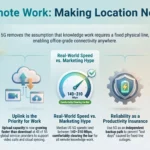
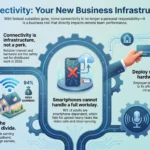
5G promised to change everything about how companies run software. Several years into commercial deployment, the picture is clearer and a lot more specific. 5G has not replaced fixed broadband, and it has not made latency disappear. What it has done is remove the assumption that a mobile connection is not good enough to run real work on.
For teams whose operations live inside SaaS applications, the useful question about the 5G impact on SaaS in 2026 is narrower than “is 5G fast?”. It is whether a cellular link can now carry the same cloud workload as an office network, how it changes application performance and cloud latency, which SaaS use cases benefit, and where the marketing still outruns the measurements.
Key Takeaways
- Real-world 5G speeds land in the hundreds of megabits per second, not the multi-gigabit figures used in launch material.
- 392 operators had launched commercial 5G by March 2026, but only 95 had launched a standalone network.
- 5G standalone is the version that enables network slicing, consistent latency and a stronger uplink.
- Uplink, not download speed, is the real constraint for SaaS workloads that push data outward.
- Private 5G carries the clearest business cases today: factories, logistics hubs and large campuses.
5G Speeds and Latency in Practice for SaaS
Start with measured numbers rather than specifications. In Ookla’s US testing across the second half of 2025, median 5G download speeds ran from roughly 173 Mbps on AT&T to 214 Mbps on Verizon and 309 Mbps on T-Mobile. That is a genuine step up from typical 4G, and it is far below the 10 to 20 Gbps peak rates that appear in vendor material. Peak figures describe a lab; medians describe your Tuesday afternoon.
Upload is the number most businesses should watch. The same testing put median 5G upload speeds between roughly 9 and 14 Mbps. Download bandwidth decides how fast a file arrives; upload decides how a video call looks to everyone else, how long a backup takes, and whether field staff can push photos and forms without waiting.

Latency has improved, but the “one millisecond” figure belongs to the radio interface under ideal conditions, not to the round trip between your laptop and a cloud region hundreds of miles away. In practice 5G shaves tens of milliseconds off a 4G connection and, more importantly, makes latency less erratic. For interactive SaaS applications, that consistency matters more than the headline number.
The other real gain is capacity. A 5G cell handles far more simultaneous devices than its 4G equivalent, which is what makes dense sensor deployments and crowded sites workable. If you want the broader view across industries rather than the SaaS angle, our guide to the wider 5G impact on business covers adoption, private networks and costs.
How 5G and Cloud Computing Reinforce Each Other
Cloud computing removed the need to own hardware; 5G removes the need to be somewhere specific to reach it. Together they turn IT from a fixed cost into a variable one, which is the underlying reason SaaS keeps taking share from installed software.
The spending data shows where the weight sits. Gartner’s July 2026 forecast put worldwide software spending at $1.468 trillion for 2026, growing 15.5%, with infrastructure-as-a-service (rented servers and storage in the cloud) at $287 billion and growing 29.3%. That is the fastest-moving segment in the forecast, driven mainly by AI infrastructure. Connectivity is not what is driving that growth, but poor connectivity is what stops organisations from realising it.
5G narrows the gap between “in the office” and “anywhere else” for cloud-hosted tools. A branch office can run on fixed wireless access (broadband delivered over the mobile network) instead of waiting months for a leased line. A pop-up site can be online in an afternoon. Neither is glamorous, and both remove real delay from digital transformation programmes.

The caution worth keeping: a faster link does not fix a slow application. If a report takes eight seconds to render because of an inefficient query, it will take eight seconds on 5G too. Connectivity improvements expose application bottlenecks rather than hiding them.
What 5G Changes in Everyday SaaS Work
Most SaaS work is not bandwidth-hungry. A CRM update, a ticket or a chat message is a small, frequent exchange where responsiveness beats throughput. The value of 5G for day-to-day SaaS operations comes from removing variability, not from raw speed.
Where Speed and Reliability Actually Help
Three patterns benefit measurably. Large file movement (design assets, video, survey data) finishes without babysitting. Video meetings hold up when someone joins from a car park or a train, which matters if your team runs on Zoom or Microsoft Teams. And synchronisation-heavy tools stay current instead of queueing changes until someone finds Wi-Fi.
Where Latency Actually Matters
Latency is decisive in a narrower set of cases than vendors suggest: live collaborative editing, remote control of equipment, real-time monitoring dashboards, and voice or video where a delay is immediately obvious. For asynchronous work, which covers most of what happens in Slack or a project tool, a hundred milliseconds either way is invisible.
Be honest about which category your workload sits in before you build a business case around it.
The Integration of IoT with 5G and SaaS
The combination that changes operations is not 5G plus laptops. It is 5G plus a large number of small connected devices feeding a SaaS platform that does something useful with the data.
How IoT Devices Benefit from 5G
5G’s advantage for IoT in business operations is density and power efficiency as much as speed. RedCap (Reduced Capability) devices, a simpler 5G class designed for mid-tier sensors, extend battery life and cut module cost, which is what makes deployments at scale affordable.
- Sites can connect hundreds of sensors and vehicles without running cable through hostile environments.
- Asset tracking works across a whole yard or campus rather than only near access points.
- Condition monitoring feeds maintenance schedules instead of waiting for a failure.
Real-time Data Processing for Businesses
Once the data arrives continuously, the bottleneck moves to what you do with it. That is where AI in business operations earns its place: filtering signal from noise, flagging anomalies, and forecasting demand from patterns nobody would spot manually.
- Continuous monitoring supports preventive maintenance and reduces unplanned downtime.
- Live inventory and location data shorten the gap between an event and a decision.
- Timely insight improves planning, but only where someone acts on it.
Edge Computing Opportunities with 5G
Edge computing moves processing close to where data is produced instead of sending everything to a distant region. 5G supplies the fast local link between devices and that nearby compute, which is why the two are usually discussed together.

Private 5G networks deliver high-speed connectivity in places where Wi-Fi struggles and cabling is expensive, such as production floors, ports, warehouses and mine sites. Traffic stays on infrastructure you control, and equipment can be monitored continuously rather than on inspection rounds.
- Quality inspection with machine vision needs decisions in milliseconds, which rules out a round trip to the cloud.
- Safety systems and interlocks cannot depend on an internet link staying up.
- Bandwidth-heavy sources such as camera feeds are cheaper to process locally than to ship wholesale.
The honest counterpoint is that edge architecture adds operational complexity: more places to patch, more hardware to fail, more to secure. Our pieces on how edge computing transforms workflows and what it changes about data processing go into that trade-off. Treat edge and 5G as a targeted architecture for latency-bound workloads, not a default upgrade.
Improved User Experiences in SaaS Applications
For the people using the software, the change is felt as the absence of friction rather than the presence of speed. Pages load, calls hold, uploads finish.

That matters most for distributed teams, where connection quality is the difference between a tool people trust and one they route around. The same dynamic shapes 5G’s effect on remote work, and it is part of why remote work settled rather than disappeared.
- Consistent connections reduce the small failures that erode confidence in a platform.
- Mobile-first workflows become viable for field, retail and logistics staff.
- Fewer connectivity excuses means adoption problems show up as what they are.
There is a limit worth naming. Better connectivity raises expectations. Once people stop blaming the network, every remaining delay is attributed to the software.
Scalability and Flexibility of SaaS Solutions with 5G
SaaS handles variable demand well: capacity scales without procurement, and upgrades arrive without a project. 5G extends that flexibility to the access layer, so adding a location or a shift no longer waits on physical infrastructure.
Handling Increased Demand for Remote Work Solutions
The practical benefits are unglamorous and real:
- Stand up connectivity at a new site in days rather than months.
- Keep a cellular link as automatic failover for a fixed line.
- Support seasonal or project-based headcount without permanent capacity.
- Give field teams the same tools as head office instead of a stripped-down version.
This flexibility has a commercial mirror image. Usage-based connectivity and usage-based software are converging on the same billing logic, which is worth understanding if you sell as well as buy. We cover that shift in our look at subscription business models. Tools such as Salesforce increasingly price by consumption rather than seats, and mobile access patterns feed directly into that.
Advanced Security Features with 5G
5G is meaningfully more secure by default than earlier generations. Subscriber identifiers are encrypted rather than sent in the clear, and standalone deployments support network slicing: logically separate networks over shared infrastructure, each with its own performance and security policy.
Slicing is the feature most often oversold. It requires a standalone core (a network built on a native 5G core rather than on 4G infrastructure), and standalone remains the exception. The GSA counted 392 operators with commercial 5G at the end of March 2026 but only 95 with standalone launched, alongside 11 that had gone live with 5G-Advanced, the next upgrade of the standard. Before you design around slicing, confirm your operator supports it where you actually need it.
It is also worth being precise about what slicing protects. It secures transport. It does nothing for weak identity controls, unmanaged devices, or a SaaS vendor with a poor security posture. A private 5G network adds a further consideration: the core becomes infrastructure your team now has to run and defend. Our overview of cybersecurity trends for businesses covers the wider picture; the short version is that 5G belongs inside a zero-trust approach (checking every user and device on every request), not as a substitute for one.

Real-time Data Processing and AI Analytics
Continuous connectivity and continuous analysis are complementary. Data that arrives in a batch overnight supports reporting; data that arrives continuously supports intervention. 5G makes the second pattern practical outside the data centre.
The gap most organisations hit is not technical. Live data multiplies alerts, and alerts without an owner become noise. Deciding in advance who acts on what, and automating the routine cases, is what turns a stream into a result. That is the same discipline that separates useful from ornamental deployments of AI and automation at work.
Predictive maintenance is the clearest example. Vibration and temperature data from equipment, pushed continuously over a private network and scored by a model, can flag a failing bearing before it stops a line. The value comes from the maintenance process behind it, not from the connection.
Where 5G Adoption Meets SaaS
5G is rarely the headline of a transformation programme. It is more often the thing that makes an existing plan feasible. Manufacturing and logistics lead, because large sites, expensive cabling and moving equipment favour private networks. Retail is more mixed, with in-store analytics and mobile point of sale as common entry points, as our piece on how 5G is changing retail shows. For the sector-by-sector comparison, see our overview of how 5G affects business.
For SaaS teams the pattern is what counts: the strongest cases are private networks on controlled sites feeding cloud platforms, not public 5G for office workers.
Innovation and Competitive Advantage Through 5G
Connectivity alone is not a differentiator. Everyone can buy it. Advantage comes from what a reliable link makes possible that was not possible before, and that is usually a process change rather than a technology one.

- Moving inspection from sampling to continuous coverage.
- Replacing scheduled maintenance with condition-based intervention.
- Giving field staff full system access instead of paper and later data entry.
Each of those changes how work is organised. The network is a precondition, not the payoff. The same logic will apply to the next wave of infrastructure, including quantum computing’s eventual effect on workflows, which is further out than most coverage implies.
What This Means for SaaS Teams
If you build SaaS, assume better and more consistent mobile connections, but do not assume unlimited uplink or guaranteed latency. Applications that degrade gracefully still win, because coverage is uneven and will stay uneven.
If you buy SaaS, the practical checklist is short. Confirm whether your workloads are latency-bound or bandwidth-bound. Check uplink, not just download, against what you actually push. Ask whether standalone 5G is available where you need slicing or guaranteed performance. And treat private 5G as a site-level decision with a measurable payback, not a company-wide strategy.
Conclusion
5G in 2026 is a mature technology with an uneven rollout. Commercial coverage is broad, standalone deployment is not, and 5G-Advanced has barely started. Real-world speeds are good rather than spectacular, and uplink remains the limiting factor for many business workloads.
That is not a disappointing conclusion. It is a usable one. The organisations getting value from 5G are not the ones that bought the vision. They are the ones that identified a specific constraint, checked whether 5G removed it, and changed a process to match. For SaaS-enabled operations, that is where the return sits.
Found this useful?
Make SmartKeys a preferred source on Google, and our articles will surface more often in your Top Stories, AI Overviews, and AI Mode.
Add as Preferred Source