5G stopped being a launch story some time ago. By the first quarter of 2026 there were roughly 3.1 billion 5G subscriptions worldwide and around 390 operators running commercial 5G networks, according to the June 2026 Ericsson Mobility Report. The question for a business is no longer whether the network exists. It is which parts of it are mature enough to build on, and which are further out than the marketing suggests.
This guide to the 5G impact on business separates the two: what 5G delivers now, where private networks earn their keep, what it costs, and where to read more about each industry and use case.
Key Insights
- 5G subscriptions reached about 3.1 billion in Q1 2026 and are forecast to hit 6.4 billion by the end of 2031 (Ericsson Mobility Report, June 2026).
- The capability gap is standalone 5G: only around 90 of roughly 390 commercial 5G operators had launched standalone networks by mid-2026, and slicing and RedCap both depend on it.
- Private 5G is where enterprise value has concentrated. The GSA counted 2,003 private mobile network deployments across 88 countries by Q1 2026, with manufacturing the largest sector.
- Network slicing is real in enterprise and private deployments, not in consumer plans. Commercial differentiated-connectivity offerings grew from 65 to 84 between November 2025 and mid-2026.
- Headline specification figures (10 Gbps, one-millisecond latency, a million devices per square kilometre) are design targets, not what a typical commercial network delivers.
Understanding 5G Technology and Its Capabilities
5G was designed around three service classes rather than one headline speed. Enhanced mobile broadband means more capacity for phones and laptops. Ultra-reliable low-latency communication means connections that respond fast and almost never drop, which matters for machines. Massive machine-type communication means connecting huge numbers of small sensors. Most confusion about the 5G technology impact on industries comes from treating those three as one package that arrives at once. They do not.
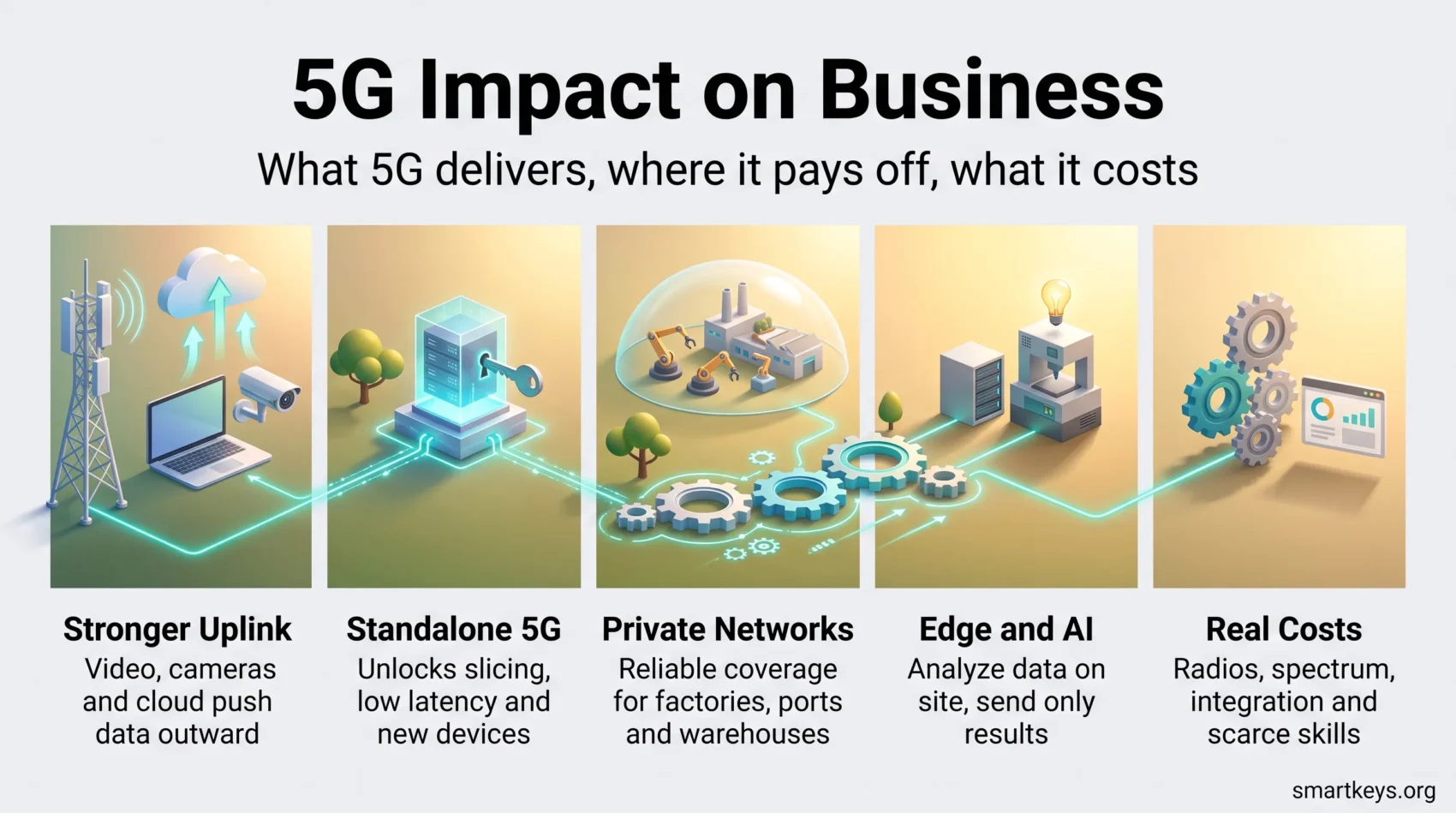
Enhanced broadband came first and is now widely available: 5G carried 48% of all mobile data traffic at the end of 2025 and is projected to reach 85% by 2031. The other two classes are the ones that matter for factory automation, remote control and dense sensor estates. They depend on standalone architecture, meaning a network that runs on a new 5G core instead of the 4G core many early 5G networks still use underneath. That upgrade is the real gate, and most operators have not passed it yet.
The specification targets are worth stating plainly, because they get quoted as guarantees. IMT-2020, the international standard 5G is built to, sets a peak downlink target of 20 Gbps, a one-millisecond latency target for ultra-reliable services, and a density target of one million devices per square kilometre. Those are ceilings measured under ideal conditions. On a live public network, a well-covered mid-band connection typically delivers a few hundred megabits per second and latency in the tens of milliseconds.
For most digital transformation programmes, that distinction decides the business case. Applications that need guaranteed single-digit latency need a standalone network, probably a private one. Everything else is already served by public 5G.

Key Advantages of 5G for Businesses
Stripped of the hype, 5G offers three concrete advantages over 4G. Each maps to a different business problem, and each is at a different level of real-world maturity.
Faster Connection Speeds and Stronger Uplink
Download speed is the least interesting of the three, because most businesses were not short of bandwidth on 4G. The change that matters is uplink, the data you send rather than receive. In the first quarter of 2026, 43 of 55 service providers tracked by Ericsson recorded faster growth in uplink than downlink traffic. Video conferencing, cloud backup, camera estates and machine vision all push data outward rather than pulling it in.
That shift is what makes 5G useful for connected cameras, mobile broadcast and field engineering. It also explains why cloud-first companies care: SaaS workflows are far more upload-heavy than the traffic 4G networks were built for. Our guide to how 5G affects SaaS performance and cloud latency looks at edge computing, network slicing and what software teams should change.
Lower Latency and What It Actually Enables
Latency is the delay between sending a signal and getting a response. Public 5G cuts it meaningfully compared with 4G, which helps interactive and cloud-hosted tools. Guaranteed latency under 10 milliseconds, the kind needed for motion control or safety-critical automation, requires standalone 5G. It usually also needs a local core or an edge computing node close to the site. If a vendor promises one-millisecond latency over a public network, treat it as a specification quotation, not a service level.
Greater Device Capacity and the Arrival of RedCap
Device density is where 5G changed the economics of sensing. The relevant development is RedCap (Reduced Capability), introduced in 3GPP Release 17, the industry standards update that defined it. RedCap strips out antennas, bandwidth and modem complexity to produce cheaper, lower-power 5G devices for smart meters, point-of-sale terminals, fleet telemetry and industrial sensors.
RedCap makes large sensor estates affordable on a 5G core, which is the foundation of how IoT is changing business operations. The catch is familiar: it needs standalone 5G, so rollout tracks standalone deployment rather than coverage maps.

5G Technology Impact on Industries
Sector impact has been uneven, and the pattern is consistent. 5G delivers most where a private network replaced cabling or unreliable Wi-Fi in a demanding environment. It delivers least where it merely made a consumer experience faster.
Manufacturing: The Clearest Case
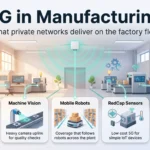
Manufacturing is the largest sector in the GSA’s private mobile network catalogue, with 387 deployments by Q1 2026. The reason is structural. Factory floors are hostile to Wi-Fi because of metal, interference and moving machinery, and cabling every asset is expensive and inflexible. Private cellular gives predictable coverage, controlled latency and the freedom to move production lines without rewiring.
That foundation supports connected asset monitoring, autonomous guided vehicles, machine-vision inspection and digital twins in manufacturing. Our deeper look at private 5G use cases in smart factories covers campus networks, predictive maintenance and where Wi-Fi still wins. The same connectivity layer underpins current robotics automation projects.
Healthcare: Monitoring Rather Than Remote Surgery
The remote-surgery demonstrations that dominated early 5G coverage remain demonstrations. What has scaled is less dramatic and more useful: connected diagnostic equipment, ambulance-to-hospital data links, imaging transfer, and continuous monitoring of patients at home. These need reliable uplink and broad coverage rather than exotic latency guarantees, which is why they work on today’s networks. We cover the trend in IoT in healthcare.
Retail: Augmented Reality With Caveats
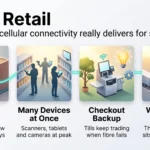
Retail applications such as virtual try-on, smart mirrors, real-time inventory visibility and digital signage are technically viable and commercially mixed. Adoption is strongest where the application solves a measurable problem, such as high return rates. It is weakest where it was built as a novelty. For the store-level detail, see our guide to 5G in retail stores, from AR shopping to live inventory tracking, plus AR in e-commerce and AR for on-the-job training.

Remote and Mobile Work: Coverage Over Capability
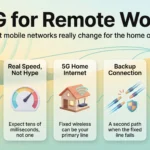
For distributed teams, the gain is coverage and a credible backup line, not exotic features. 5G home internet now works as a primary connection in many areas, and a phone hotspot rescues a video call when fixed broadband fails. Our article on 5G connectivity for remote workers and video calls covers real speeds, coverage gaps and which claims do not hold up.
5G Business Impact on Customer Engagement
The customer-facing case for 5G is more modest than early forecasts suggested, and the reason is simple: most customer experience bottlenecks are not network bottlenecks. A slow checkout, a badly designed app or an understaffed support queue does not improve when the radio gets faster.
Where 5G helps is at the edges of that experience. Richer media loads without the wait, which matters for product video and configurators. More uplink capacity makes customer-generated content practical from a phone in the field, for example photo insurance claims, video support sessions and live streams. Better coverage inside venues and dense urban areas removes a category of failure that was invisible in analytics but obvious to customers. That is worth having, but it is an improvement at the margin.

Location-based marketing deserves a caution rather than a promise. 5G improves positioning accuracy in some deployments, but the limit on geo-targeted marketing in 2026 is regulatory, not technical. Consent requirements and platform-level tracking restrictions set the ceiling long before the network does.
5G Integration for Business Growth
Getting value from 5G is mostly an integration exercise. The network is a means; the return comes from what you connect and what you do with the data.
Using IoT for Better Resource Allocation
Cheap, dense sensing is the practical payoff. Once assets, vehicles and meters report continuously, maintenance can shift from a fixed calendar to the actual condition of the machine. A pump gets serviced when its vibration data says it needs it, not every six months. That is where most documented savings in industrial deployments come from: fewer unplanned stoppages and less spare capacity kept “just in case”, rather than the connectivity itself.
Pairing 5G With Edge and AI
Latency-sensitive analytics only work if the computation sits near the data. That is the case for edge AI: the model that checks camera images for defects or spots unusual machine behaviour runs on site, and only the results travel onward. This also cuts bandwidth cost and keeps sensitive data on the premises, which often matters more to a compliance team than milliseconds do. Architecturally, it pushes 5G projects toward hybrid designs rather than pure cloud, as our overviews of cloud computing trends and business automation trends describe.
5G Impact on Global Supply Chain Management
In logistics, 5G’s contribution is coverage and capacity rather than magic. Warehouses run autonomous vehicles, scanners, wearables and camera systems that all compete for the same airwaves. Private cellular handles that contention far more predictably than shared Wi-Fi.
Outdoors the picture is more nuanced. Container yards, ports and large distribution sites are strong candidates. Long-haul tracking is usually better served by LPWAN or LTE-M, low-power networks built for small, infrequent messages, because coverage and battery life matter more than throughput. Choosing 5G for a use case that does not need it is the most common and most expensive mistake in this area.
Adjacent technologies do more of the work than the network gets credit for: provenance through blockchain in logistics, last-mile economics through autonomous delivery. 5G is the layer beneath both, not a substitute.

Challenges and Risks Associated with 5G Deployments
The obstacles to 5G are less about technology than about cost, spectrum and in-house skills.
Infrastructure and Spectrum Costs
Spectrum, the radio frequencies an operator is licensed to use, is expensive, and the numbers are public. The FCC’s C-band auction closed with roughly $80.9 billion in gross bids, the costliest mid-band 5G auction held anywhere. The pipeline is still open: under the One Big Beautiful Bill Act signed in July 2025, the FCC must auction at least 100 MHz of Upper C-band spectrum by 4 July 2027, and as of mid-2026 it was still working through interference and relocation questions.
For an enterprise the relevant costs are different but still material: radios, a local core, spectrum access or an operator agreement, systems integration, and people who understand cellular networking. That last skill set is one most IT teams lack in house. Business cases built on a specific, quantified operational problem survive. Deployments justified by general modernisation stall after the pilot.
Security and Compliance Considerations
More connected devices means a larger attack surface, and industrial endpoints are often long-lived, rarely patched and physically accessible. Private cellular does bring real advantages: SIM-based authentication, traffic that never touches the public internet, and isolated traffic classes. Those advantages only hold if the network is designed and monitored properly.
Regulation adds a second layer. Supply-chain rules restrict permitted equipment vendors in many markets, and data residency rules shape where traffic and analytics can live. Both belong in the design phase. Our coverage of cybersecurity trends and the cybersecurity mesh architecture is a useful starting point for extending controls to cellular endpoints.
5G Market Opportunities for Emerging Industries
The economic case for 5G is best made with the industry’s own numbers rather than speculative multipliers.
Economic Contribution and Skills Demand
The GSMA’s Mobile Economy 2026 report puts the mobile industry’s contribution to global GDP at $7.6 trillion in 2025, equal to 6.4% of the total, and forecasts $11.3 trillion, or 8.4%, by 2030. Operators are expected to spend around $1.2 trillion in capital expenditure between 2025 and 2030, and 5G is projected to account for 57% of mobile connections by the end of that period.
Those figures describe the mobile sector as a whole, not 5G-specific job creation, so it is worth resisting the urge to slice them further than the data supports. What is observable is demand: private network design, radio engineering, cellular security and industrial integration are all in short supply relative to the projects being commissioned.
New Business Models and Services
The most durable new models are unglamorous. Network-as-a-service lets a manufacturer or logistics operator rent managed private connectivity instead of building and running it. Differentiated connectivity, the commercial form of network slicing, gives a customer a reserved, guaranteed share of a public network. It is emerging for broadcast, emergency services and event venues, with offerings rising from 65 in November 2025 to 84 by mid-2026. Fixed wireless access (broadband delivered over the mobile network instead of a cable) has become a mainstream business product, with 71% of FWA providers now offering it over 5G.
Municipal applications continue to develop, as covered in urban tech in smart cities.

How to Approach 5G in 2026
5G has become useful infrastructure without becoming a transformation in itself. Public 5G is broadly available and delivers real gains in capacity and uplink. Private 5G solves a specific class of industrial connectivity problem better than the alternatives, and the deployment numbers show enterprises acting on that. The advanced capabilities are arriving through standalone networks, unevenly and later than promised.
A sensible approach starts from the operational problem, not the technology. Establish what your current network cannot do, check whether the fix requires standalone 5G or merely better coverage, and price integration and skills alongside hardware. Projects framed that way survive the pilot stage; projects framed as “adopting 5G” do not.
Found this useful?
Make SmartKeys a preferred source on Google, and our articles will surface more often in your Top Stories, AI Overviews, and AI Mode.
Add as Preferred Source