The Internet of Things (IoT) means putting sensors and network connections into physical objects so they can report what they are doing. A pump tells you its bearing is running hot. A pallet tells you it is in the wrong warehouse. A meter tells you which shift burns the most electricity. Once machines, vehicles and buildings send that signal on their own, work that used to need someone with a clipboard becomes a dashboard entry and an alert.
This guide covers what IoT actually does inside a business in 2026: which uses pay for themselves, what the device numbers really say, and which security rules take effect this month.
Key Takeaways
- IoT means sensors and network links inside physical objects, reporting their condition automatically.
- The clearest wins are predictive maintenance, asset tracking and energy monitoring, not vague “efficiency”.
- IoT Analytics counted roughly 21.1 billion connected IoT devices at the end of 2025, growing about 14% a year.
- Skills, not budget, are the main barrier: in a 2026 Fluke survey, roughly 78% of reported obstacles were skills-related.
- EU incident reporting duties for connected products take effect on 11 September 2026.
Understanding IoT and Its Significance in Business
Strip away the jargon and IoT is simple: a physical thing gets a sensor, a small processor and a way to send data. The sensor measures temperature, vibration, location, humidity or power draw, and the reading lands in software that can act on it.
The business value comes from timing. Most operational problems surface late, once a machine has stopped or a shipment has gone missing. A sensor moves that discovery earlier, which is usually where the money is.
An example: a bakery chain fits temperature loggers in its refrigerated display cases. Before, a failing compressor was noticed when a manager found spoiled stock in the morning. Now the system flags a case drifting warm at 2 a.m., a technician arrives before opening, and nothing is thrown away. Nothing changed except when the information arrived.
The pattern repeats across sectors. In healthcare, connected monitors send vital signs continuously instead of at ward rounds, which is why IoT in healthcare grew around remote monitoring. In retail, shelf sensors show what shoppers do rather than what they say. In distributed teams, connected building systems are part of how IoT supports hybrid work.
Transforming Business Operations with IoT Solutions
IoT is one strand of a wider digital transformation effort, and it rarely works on its own. Sensor data is only useful once it reaches a system that can store it, compare it against history and trigger something.
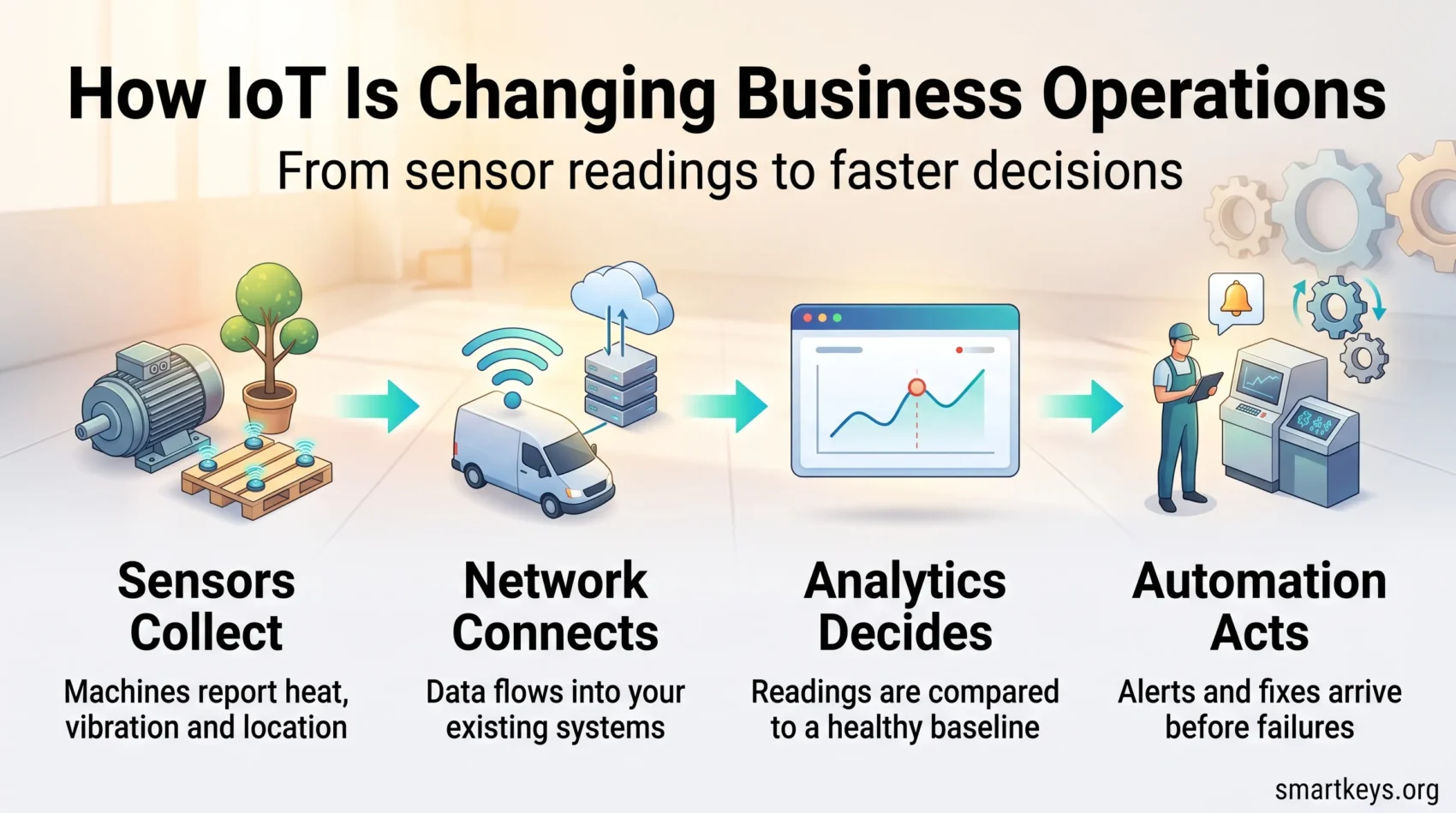
Three layers have to exist together. Devices collect. A network moves the data, often through an integration platform that links the sensor feed to your existing ERP or maintenance software. Analytics then turns the stream into a decision. Skip that third layer and you get an expensive data lake nobody reads.
Where the data is processed matters too. Sending every reading to the cloud is slow and costly when a machine needs an answer in milliseconds, so more processing happens on or near the device. That approach, edge computing, cuts latency and bandwidth costs, and increasingly runs models locally through edge AI.
The honest caveats: devices from different vendors often do not talk to each other, retrofitting old machinery is fiddly, and the governance question (who owns the readings, how long you keep them) belongs before deployment, not after.
How IoT Improves Operational Efficiency
“Improves efficiency” means nothing on its own. Below are the uses where the mechanism is clear and the payback is easiest to measure.
Streamlined Processes and Workflows
Connected devices remove manual checking from routine work:
- Energy and building management. Occupancy, temperature and humidity sensors let heating and lighting follow actual use instead of a fixed timetable, which matters most in buildings that are half empty on hybrid days.
- Safety. Door sensors, lone-worker alarms and gas detectors raise an alert immediately rather than at the next inspection.
- Asset tracking. Tagged tools, trolleys and containers stop disappearing, and stocktakes stop being a weekend job.
None of these are dramatic. They are small recurring costs that quietly disappear, which is why they survive budget review.
Real-Time Data Monitoring and Analytics
Predictive maintenance is the most cited IoT use case, and it is finally moving from pilots into production. A survey of more than 600 senior decision-makers and maintenance professionals in the US, UK and Germany, run by Censuswide for Fluke and published in May 2026, found adoption had doubled year on year, from 9% to 18%. Purely reactive maintenance stayed flat at 36%.
Two things follow. First, 18% is still a minority, so anyone calling predictive maintenance standard practice is ahead of the evidence. Second, roughly 78% of the obstacles respondents reported were skills-related rather than financial. Sensors are affordable; people who can interpret them are not easy to hire.
This is where IoT and analytics meet. Raw vibration data is useless until something compares it against a healthy baseline, which is why IoT projects sit alongside work on real-time data analytics and business intelligence tooling.
IoT Applications Across Industries
The technology is the same everywhere. What differs is which problem is expensive enough to justify wiring it up.
Retail: Understanding What Shoppers Actually Do
Retailers use connected shelves, cameras and smart carts to see stock levels and shopper movement without staff counting anything. That feeds replenishment, layout and pricing decisions. Checkout-free formats are the most visible version, though the record there is mixed, as the story of autonomous retail shows. The steadier wins are duller: fewer out-of-stocks, less shrinkage, better fridge uptime.
Manufacturing: Fewer Surprises on the Line
Factories were the first serious IoT buyers and remain the biggest. Sensors on motors, presses and conveyors feed condition monitoring, quality checks and predictive maintenance. Many plants pair this with a digital twin, a live software model of the equipment used to test changes before touching the real line. Where a large floor needs reliable wireless, some operators run private 5G networks instead of extending Wi-Fi.
Logistics and Field Operations
Trackers on trailers, containers and pallets show where goods are and what conditions they travelled in. That matters for cold chains, high-value freight and anything with a chain-of-custody requirement, which is why sensor data feeds into blockchain-based logistics records and supply chain resilience planning.
Boosting Automation and Productivity through Smart Technology
Sensors on their own only report. The productivity gain comes when the reading triggers an action without a person in the loop.
Automated Inventory Management
Weight-sensing shelves and tagged stock keep a live count, so reordering triggers on an actual threshold rather than a weekly guess. The benefit is symmetrical: fewer stockouts, and less cash tied up in unsold inventory. It also removes a common error source, since nobody retypes counts into a spreadsheet.
Remote Monitoring and Management
Remote monitoring lets one team oversee equipment across many sites from a single screen. A facilities manager sees every building’s plant room without driving between them, and a small operations team covers more assets than headcount would normally allow. With rule-based automation, routine responses (restart, throttle, raise a ticket) happen before anyone reads the alert, the same logic behind hyperautomation in back-office processes.

The Role of Connected Devices in Business Optimization
Beyond individual use cases, connected devices change what management can see. Decisions that rested on monthly reports can rest on this morning’s readings.
Location Tracking for Logistics Improvement
Live vehicle and shipment tracking lets dispatchers reroute around delays rather than explain them afterwards, and gives customers an arrival window that holds. Matching stock to real demand per location also shrinks the buffer inventory warehouses carry “just in case”.
Data Exchange Between Devices for Enhanced Decision-Making
When devices share data with each other and with core systems, patterns appear that no single sensor would reveal: a defect that only occurs above a certain humidity, or an energy spike that tracks one shift pattern. That is the difference between monitoring and insight. It also raises governance questions early, because pooled operational data quickly becomes sensitive, a point covered under data privacy trends.
Security and Compliance in the IoT Era
Every connected device is another way into your network, and cheap devices are often the weakest link. Default passwords, unpatched firmware and exposed APIs remain the standard failure modes, and compromised devices are routinely recruited into botnets.
Protecting Sensitive Data
The practical baseline has not changed much: unique credentials per device, encryption in transit and at rest, a firmware update path that actually works, network segmentation so a compromised sensor cannot reach finance systems, and monitoring that notices when a device starts behaving oddly. Treating IoT devices as untrusted by default is the core of a zero trust approach, and it belongs in the same programme as your wider cybersecurity planning.
What the Rules Now Require
Compliance stops being optional this month. The EU Cyber Resilience Act, in force since 10 December 2024, covers products with digital elements, meaning essentially any connectable hardware or software sold in the EU. Its incident and vulnerability reporting duties apply from 11 September 2026: manufacturers must send an early warning within 24 hours of becoming aware of an actively exploited vulnerability, a full notification within 72 hours, and a final report within 14 days of a fix being available. The act’s main design and lifecycle security requirements follow on 11 December 2027.
The United States took the voluntary route. The FCC’s Cyber Trust Mark labels consumer IoT products that pass testing at approved labs. The programme wobbled when UL Solutions withdrew as lead administrator in December 2025; the FCC named the ioXt Alliance as its replacement in April 2026.
If you buy connected equipment rather than build it, the practical effect is the same: ask vendors how long they will ship security updates, and get the answer in the contract.
Where IoT Is Heading
Growth Forecast
IoT Analytics estimated that connected IoT devices grew about 14% in 2025 to roughly 21.1 billion by year end, and projected around 39 billion by 2030. The same analysis trimmed its earlier estimate slightly, citing deferred capital spending and softer demand in China, a useful reminder that these forecasts move.
IDC’s widely cited spending guide projected worldwide IoT investment would pass $1 trillion in 2026. Treat that as a forecast made several years ago rather than a measured result.
What This Means for Smaller Companies
IoT no longer requires a capital project. Sensors are cheap, connectivity is sold per device, and most platforms are subscriptions, so a five-van plumbing firm can fit trackers without an IT department. The constraint has moved from hardware cost to knowing which question the data should answer.
So start with one expensive, recurring, badly understood problem and instrument that. If the sensors do not change a decision you actually make, they are a subscription, not an investment.
Conclusion
IoT has stopped being a futuristic label and become ordinary infrastructure. Roughly 21.1 billion devices were connected at the end of 2025, predictive maintenance adoption doubled in a year, and from 11 September 2026 the EU requires manufacturers to report exploited vulnerabilities within 24 hours.
What has not changed is the failure mode. Companies that buy sensors because IoT sounds strategic end up with dashboards nobody opens. Companies that start with one specific recurring cost, instrument it and connect the readings to a decision see a return quickly, then expand. The hard part is no longer the devices. It is knowing which question is worth measuring, and having someone who can read the answer.
Found this useful?
Make SmartKeys a preferred source on Google, and our articles will surface more often in your Top Stories, AI Overviews, and AI Mode.
Add as Preferred Source