Remote work is no longer an experiment. About 25% of US paid working days were worked from home in May 2026, according to the Survey of Working Arrangements and Attitudes (SWAA). Among employees whose jobs can be done remotely, Gallup puts 52% in a hybrid pattern and 28% fully remote.
So the question is not whether distributed teams can operate. It is narrower: does creative work survive the distance? Part of it does not, at least not by default. Here is what the research shows, and what to change about how your team meets and talks.
Key Takeaways
- Video calls produce measurably fewer ideas than meeting in the same room.
- Psychological safety, meaning people can float a rough idea without being punished for it, is what everything else rests on.
- Let people write ideas down silently before anyone discusses them.
- Autonomy over hours and methods improves wellbeing and job satisfaction.
- Spend any in-person time on the early stage of projects.
What Remote Work Actually Does to Team Creativity
Most advice treats distance as harmless or fatal. Neither is right. Remote work changes specific things about how ideas get made, and knowing which lets you fix them.
The evidence on generating ideas
The clearest study was published in Nature in 2022 by Melanie Brucks and Jonathan Levav. They ran a laboratory experiment with pairs working face to face or over video, then repeated it with almost 1,500 engineers at a multinational company across five countries. In-person pairs generated roughly 15% to 20% more ideas.
The reason was physical rather than social. A video call puts your attention on a rectangle, and that narrow visual focus produced narrower thinking, so people stayed closer to obvious answers. There is a flip side: when the same groups had to pick the best idea, the virtual groups did just as well. Generating ideas suffers at a distance. Judging them does not.
The slower problem: networks that stop mixing
A second study, published in Nature Human Behaviour in 2022 by a team including Microsoft researchers, tracked 61,182 US Microsoft employees through the first six months of 2020. As the company went fully remote, collaboration networks became more static and more siloed, with fewer connections bridging distant parts of the organisation. That makes it harder for people to pick up and pass on new information.
One caveat: this was a sudden, unplanned shift during a pandemic, not a hybrid model anyone designed. The mechanism still holds. When nobody bumps into anybody, teams talk mostly to the people they already know.
What remote work gives back
The trade runs both ways. Research by Dr Daniel Wheatley at the University of Birmingham, published in Work and Occupations in 2017, analysed around 20,000 employees in the UK Understanding Society survey. Those with more autonomy over their hours, their pace and the content of their tasks reported higher wellbeing and job satisfaction.
There are practical gains too. A quiet morning in a well-set-up home office beats an open-plan floor for sustained thought. And hiring without a commute radius widens the range of backgrounds on a team, whether you recruit locally or support staff working abroad under digital nomad visa schemes. Varied experience is raw material for ideas, as our review of the evidence on hybrid work and wellbeing sets out.
Build Psychological Safety Before You Ask for Ideas
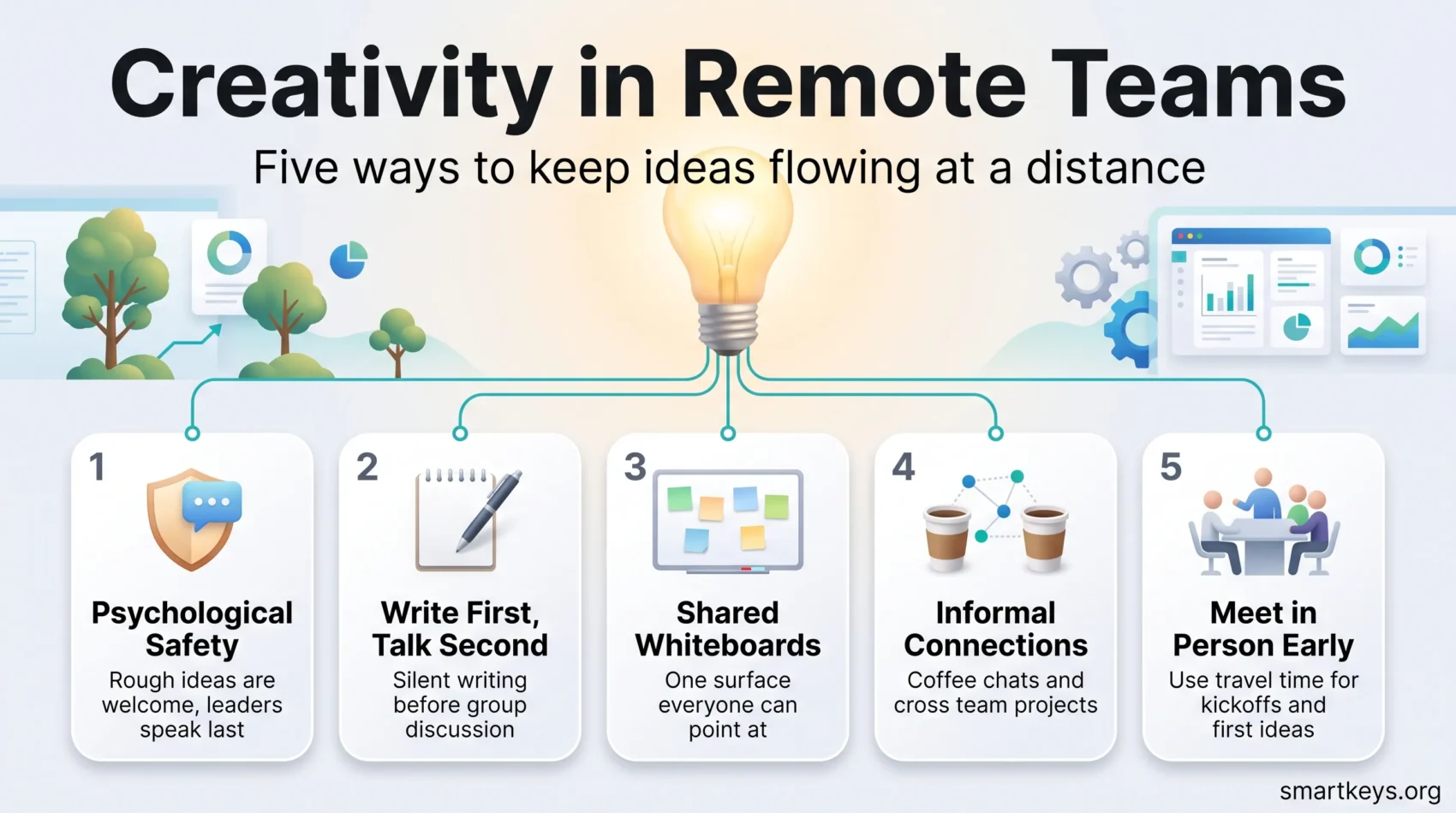
Psychological safety is the shared belief that you can ask a question, admit a mistake or float a half-finished idea without being embarrassed or penalised. The term comes from Harvard professor Amy Edmondson, and Google’s internal study of its own teams, Project Aristotle, found it was the factor that most separated effective teams from ineffective ones. It matters more remotely, because the usual repair signals are missing. In a room you can see a colleague wince and soften what you said. On a call you get silence and a grid of faces.
What safety looks like on a call
Safety comes from small, repeatable behaviours rather than announcements:
- The most senior person speaks last, so early opinions do not anchor everyone else.
- People label rough ideas as rough, which lowers the cost of being wrong.
- When something goes wrong, the first question is about the process, not the person.
- Quiet team members are invited in by name, and may answer in writing.
Keep the feedback loop open
Feedback at a distance has to be scheduled, because it will not happen by accident. Short weekly one-to-ones, a visible record of decisions, and a habit of explaining why an idea was not taken forward all keep people contributing. Otherwise a team quietly stops offering ideas, because none of them ever seemed to land. Our guide to remote leadership skills goes deeper.
Run Idea Sessions That Actually Produce Ideas
The standard virtual brainstorm, where everyone joins a call and talks, is close to the worst possible format. Fixing it is mostly a matter of order.
Write first, talk second
Group brainstorming has a known flaw called production blocking. Only one person can speak at a time, so while you wait your turn you either forget your idea or talk yourself out of it. Michael Diehl and Wolfgang Stroebe showed this in the Journal of Personality and Social Psychology in 1987: people who generated ideas alone and pooled them afterwards produced more than the same number brainstorming together.
The fix is simple. Open a shared document or board, give everyone ten minutes of silence to write their own ideas, and only then start talking. You get the volume of solo work and the cross-pollination of a discussion. The same logic scales up into a silent meeting format.
Practical rules for a virtual session
- Give the session one sharp question. “Let’s think about the new onboarding flow” produces mush; “how do we get a new customer to their first successful export within ten minutes?” produces answers. Put it in the invitation.
- Appoint a facilitator whose only job is to keep one voice at a time and pull in people who have not spoken.
- Capture every suggestion, including impractical ones. They are often the seed of a workable idea.
- Let people turn cameras off during the silent writing phase. Staring at a screen is exactly the constraint the Nature study identified.
- Leave the board open for two days so late ideas have somewhere to go. Late, asynchronous contributions still count.
Choose Tools That Support Creative Work
No tool generates ideas. What tools do is remove friction, so the gap between having a thought and showing it to someone stays short. Most distributed teams end up with a video platform, a chat tool, a project tool and a shared document suite. Our Zoom and Microsoft Teams comparison and our Slack versus Microsoft Teams guide cover the two that matter most for conversation.
Digital whiteboards
A digital whiteboard gives a remote team the one thing a video call takes away: a surface everyone can point at. Sticky notes, sketches and clustering all work again. Our Miro and Lucidspark comparison covers the differences.
AI features are now built into most of these products, from meeting summaries to first drafts. They clear routine work so people have attention left for the interesting part, but they are a weak source of original thinking. Our piece on AI in remote collaboration looks at where that line sits.
Offer Flexibility to Protect Creative Time
Creative work is not spread evenly across the day. Most people have two or three hours when hard thinking is possible and several more when it is not.
Establish flexible working hours
The practical version is a short band of shared hours when everyone is reachable, with the rest of the day left to the individual. That protects the meetings that need to be live while freeing the hours where deep work happens. Our guide to flexible work schedules covers how to write a policy that survives a real calendar.
Encourage real breaks
A break only helps if it is a break. Scrolling a news feed at the same desk is not one. Walking, cooking lunch or stretching lets attention reset, and stuck problems often loosen. See the evidence on short breaks and focus, and our piece on how remote work changed the workplace for the wider shift.
Create Opportunities for Informal Interaction
The Microsoft study above found that remote teams lose the weak connections between groups first. Those loose ties are where unexpected ideas usually come from, because they connect people who do not already share the same assumptions.
Schedule virtual coffee breaks
A short, optional call with no agenda does more than it sounds like it should. People mention what they are stuck on, someone else has solved it before, and a connection forms that later carries a real question. Keep them small and never let them become a status update. Our guides to the virtual watercooler and to remote team building have formats worth stealing.
Make room for non-work conversation
A channel for hobbies, photos or recommendations is not a distraction. It gives people a low-stakes way to be visible to colleagues they do not work with directly, which is the bridge full remote work erodes. It also helps with isolation, as our coverage of remote work and mental health sets out.
Provide Opportunities for Skill Development and Cross-Functional Collaboration
New ideas usually come from combining things you already know in a new way. So the size of someone’s mental library matters, and so does how many libraries a team can reach.
Encourage learning and development
Three things reliably work at a distance: short, regular learning slots rather than an annual training day; a budget for online courses people choose themselves; and mentoring pairs across teams, so knowledge moves sideways. Our overview of upskilling and reskilling covers which skills are growing in demand.
Facilitate cross-departmental collaboration
Cross-functional work means people from different departments, such as engineering, support and marketing, working on the same problem rather than passing it along. It is the most direct antidote to the siloing effect the Microsoft research found. Short mixed-team projects, a shared channel per project, and a visible place for work in progress all help. A well-organised digital headquarters makes that visibility the default.

Encourage Autonomy and Empowerment
Autonomy is the practical expression of trust. It is also the condition under which people try things nobody asked for, which is where improvements start.
Set clear expectations
Autonomy without clarity is just ambiguity. Be precise about the outcome and loose about the method:
- State what the finished thing needs to do, and by when.
- Name the constraints that are genuinely fixed, such as budget or a legal requirement.
- Say who decides, so nobody stalls waiting for permission that was already granted.
Our guide to outcome-based work covers how to define usable results.
The benefits of empowerment for creativity
When people control how they reach a goal, they experiment more, because the experiment is theirs. The Birmingham research cited above links that control to higher wellbeing and job satisfaction.
One failure mode is worth watching for. Managers tend to over-reward whoever they see most, which in a hybrid team means whoever comes into the office. That pattern, known as proximity bias, quietly teaches remote staff that initiative goes unnoticed. Our guide to proximity bias covers how to spot it in your own decisions.

Budget for Occasional Time in the Same Room
If in-person groups generate more ideas, the answer is not to abandon remote work. It is to spend a limited travel budget on the part of the process that benefits: the messy, divergent phase of a project, meaning the kickoff, the problem framing and the first round of options. Let the convergent work happen remotely, where the same research found no penalty. A quarterly two-day session beats a monthly one-day session, because the useful conversations tend to start on the second day. Teams without a central office can get much of this from coworking spaces in a few hub cities.
Conclusion
Distance does not damage creative work uniformly. It damages the generation of ideas, and it erodes the loose connections between teams that carry ideas around a company. Judgement, execution and focused individual work come through largely intact, and autonomy improves.
So aim your effort at those two weak points. Change how idea sessions run, with silent writing before discussion and a facilitator who makes room for quieter voices. Then rebuild the informal connections on purpose, through optional social time, cross-functional projects and occasional gatherings. Neither needs a new platform. Both need someone deciding that creative work is worth designing for.
Found this useful?
Make SmartKeys a preferred source on Google, and our articles will surface more often in your Top Stories, AI Overviews, and AI Mode.
Add as Preferred Source