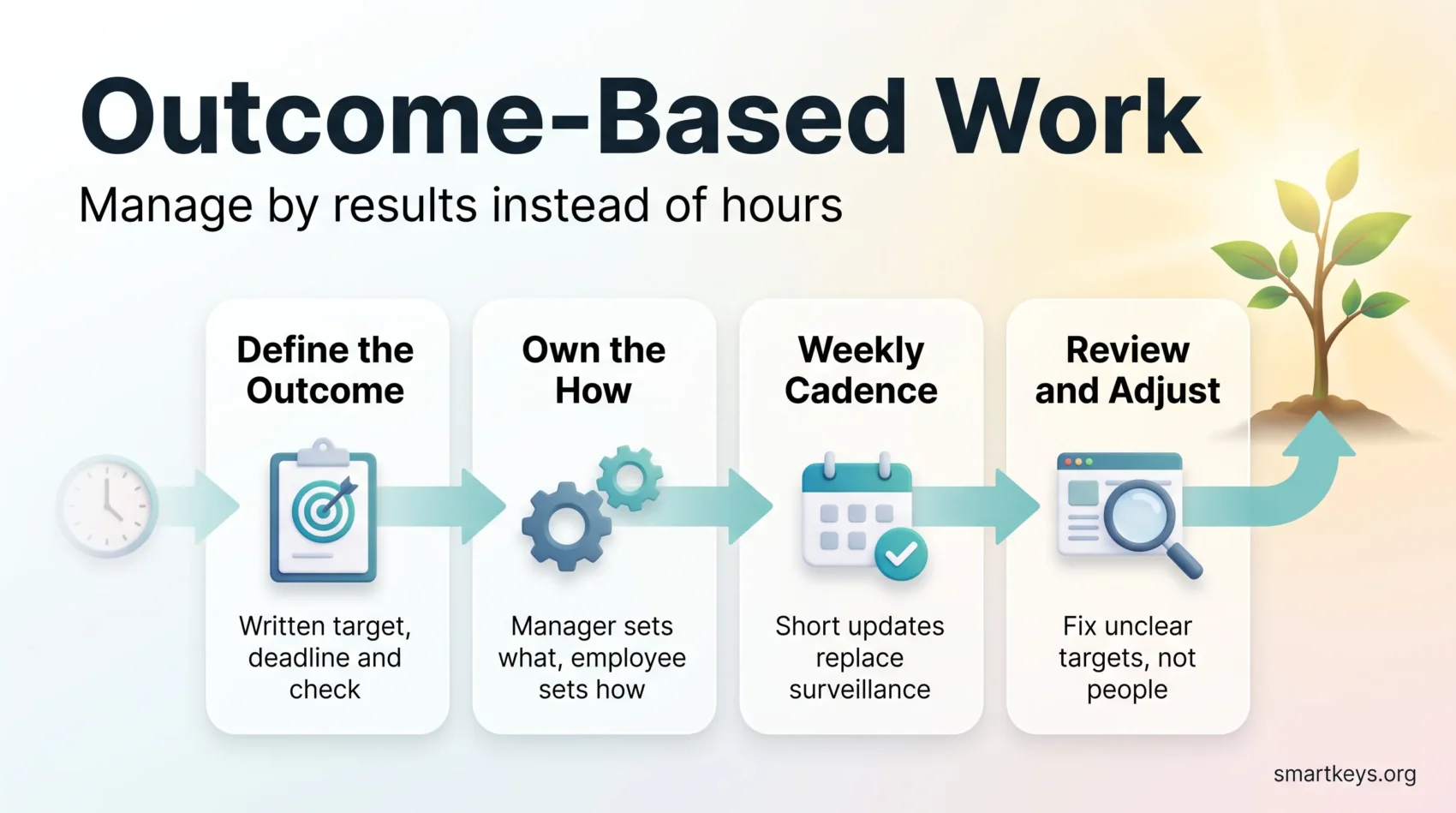
Outcome-based work means judging people on what they deliver, not on how many hours they spend at a desk. A support lead who clears the ticket queue by Thursday has done the job, whether that took 30 hours or 45. It sounds obvious. In practice, most companies still run on time: attendance, availability, hours logged, and the quiet assumption that a visible person is a productive one.
That assumption got harder to defend. About 25% of paid full days in the United States were worked from home in May 2026, according to Stanford’s Survey of Working Arrangements and Attitudes. You cannot manage by walking the floor when a quarter of the work happens somewhere else. So the question becomes what you measure instead.
Key Takeaways
- Outcome-based work replaces hours logged with results that someone else can verify.
- It only works when the outcome is defined in writing before the work starts.
- Gallup found in May 2026 that just 49% of US employees strongly agree they know what is expected of them, which is the weak point in most rollouts.
- The strongest evidence is about retention and autonomy, not about raw output gains.
- Work that is hard to measure needs a different approach, not a forced metric.
What Outcome-Based Work Actually Means
Before the benefits and the pitfalls, it helps to be precise about the term. It gets used loosely, and the loose version is where most implementations fail.
Outputs Versus Outcomes
An output is what you produced. An outcome is the change that output created. Writing twelve blog posts is an output. Cutting the support team’s inbound tickets by a fifth because the help pages finally answer the common questions is an outcome.
Outcome-based work sets the second kind of target, then leaves the method to the person doing the work. The manager owns the what and the why. The employee owns the how and the when. That trade is the whole model in one sentence.
What It Is Not
It is not unlimited freedom. Meetings still happen, deadlines still bind, and colleagues still need answers within a reasonable window. It is not a way to get more work out of the same people; if you set outcomes that quietly require 55 hours, you have rebranded overwork, not changed it. And it is not the same as remote work, though the two often arrive together. An on-site factory team can be managed by outcomes, and a remote team can still be micromanaged by the minute.
Why Companies Are Moving Away From Hours
Time was never a measure of value. It was a proxy, and a convenient one. Understanding why the proxy worked for so long explains why it stopped.
Time Was a Proxy That Used to Fit
In manufacturing, hours and output really did move together. Industrial engineers timed a task, adjusted for how fast the worker was going using rating scales such as the British Standards Rating Scale, then added allowances for rest and interruptions to reach a standard time for the job. If the task was repetitive and physical, the method was reasonable. An hour on the line produced roughly an hour’s worth of parts.
Knowledge Work Broke the Link
Most office work no longer behaves that way. A developer can spend a morning removing code and leave the product better. A salesperson can close more in one well-prepared call than in a week of cold outreach. Hours stopped predicting value, but the timesheet stayed, because nobody replaced it with anything better.
The result is a gap between what gets measured and what matters. Employees feel it as performative availability. Managers feel it as uncertainty about whether anything is getting done.
Distributed Work Made the Gap Impossible to Ignore
Microsoft’s 2022 Work Trend Index put numbers on that uncertainty. 87% of employees said they were productive at work, while 85% of leaders said the shift to hybrid work made it hard to be confident that their teams were. Both groups were looking at the same work and reaching opposite conclusions, because one had evidence and the other had an empty chair. That gap is now common enough to have a name, and we cover it in detail in our guide to productivity paranoia.
Companies respond to that gap in one of two ways. They install monitoring software, or they agree on results. The first path is covered in our look at AI in employee monitoring. The second is outcome-based work.
What the Evidence Actually Shows
The case for outcome-based work is often oversold. Here is what independent research supports, and what it does not.
Autonomy Is Linked to Retention
The best known study looked at a Results-Only Work Environment, a program at Best Buy’s corporate headquarters that let staff decide when and where they worked as long as results were delivered. Researchers Phyllis Moen, Erin Kelly and Rachelle Hill followed 775 employees and published their findings in Social Problems in 2011. Employees in the program had lower odds of leaving over the following eight months, and the effect held across gender, age and family situation.
One caveat matters. Best Buy ended the program in 2013 under new leadership, which is a reminder that a results-based culture survives only as long as the people at the top want it to.
Flexibility Did Not Damage Performance
A randomized trial published in Nature in 2024 by Nicholas Bloom and colleagues followed 1,612 employees at the travel company Trip.com. Hybrid work cut quit rates by 33% and had no measurable effect on performance reviews or promotions over two years. The study does not test outcome-based management directly, but it removes a common objection: giving people control over when and where they work did not cost the company performance.
Clear Expectations Are the Weak Link
Gallup reported in May 2026 that only 49% of US employees strongly agree they know what is expected of them at work. Globally, Gallup put employee engagement at 20% in 2025. Those two numbers are the real constraint. Outcome-based work depends entirely on a shared, written definition of the target. If half your staff cannot state what success looks like, removing the timesheet does not create clarity. It removes the last thing that was giving the week a shape.
What the Evidence Does Not Show
No large study demonstrates that switching to outcome-based management by itself raises output. The honest claim is narrower: it supports retention and makes performance conversations concrete instead of impressionistic. Treat vendor case studies promising double-digit productivity jumps with skepticism.
The Benefits, Stated Plainly
Control Over the Working Day
People who own their schedule can put demanding work where their concentration actually is. Someone who thinks clearly at 7am stops pretending that 3pm is the same thing. Parents can move an hour without filing a request. That control is the benefit employees name first when they judge flexible work schedules.
Fewer Arguments About Effort
When the target is written down, the review stops being a debate about who looked busy. Both sides are pointing at the same document. That is a meaningful improvement over the vague annual conversation, and it fits naturally with continuous performance management rather than a once-a-year verdict.
A Fairer Deal for People Who Are Not in the Room
Managers tend to over-reward the people they see. That tendency, known as proximity bias, quietly penalizes remote and part-time staff. Judging delivered results narrows the gap, because a finished piece of work looks the same whether it was produced in the office or two time zones away.
What Managers Have to Change
The model asks more of managers than it removes. Attendance was easy to check. Outcomes have to be designed.
Define the Outcome Before the Work Starts
A usable outcome states what will be true when the work is done, by when, and how anyone will know. “Improve onboarding” is not an outcome. “New hires complete their first customer call within ten working days, measured from the start date, by the end of Q2” is one. Frameworks such as personal OKRs help, and large objectives need splitting before anyone can act on them, which is the practical value of breaking large goals into smaller steps.
Replace Surveillance With a Cadence
Trust is not the absence of contact. It is contact on a predictable schedule instead of a random one. A short weekly one-on-one meeting and a written status update usually replace the reassurance that walking past a desk used to provide. Teams that go further often adopt asynchronous work habits, so progress is readable without anyone being online at the same moment.
Decide What Happens When a Target Is Missed
This is the step most rollouts skip. If missing an outcome carries no consequence, the model is decoration. If it carries a harsh one, people will negotiate for easy targets. The workable middle is a review of what went wrong and a documented adjustment. Say this out loud before the first quarter, not after it.
What Employees Have to Change
Make Progress Visible Without Being Asked
Under an hours model, being present was the signal. Under an outcomes model, the signal is a short, regular note about what moved and what is stuck. A weekly summary of two or three lines is usually enough. Building a simple weekly review habit covers this and is worth the fifteen minutes. The personal routines behind it, such as planning each day around one result and trimming low-value meetings, are covered in our guide to working smarter, not harder.
Prioritize Without Waiting for Permission
More autonomy means more decisions land on you. A working method for ranking competing requests matters more than it used to, which is why task prioritization frameworks become part of the job rather than optional self-improvement. When the list keeps growing, it often helps to focus on fewer priorities and finish three outcomes instead of starting ten.
Protect the Boundaries the Clock Used to Protect
The clock had one underrated function: it ended the day. Remove it and work expands to fill the evening, especially for people who worry the results are not yet good enough. Deliberate boundary setting and attention to burnout prevention are not soft extras here. They are the safety mechanism. Several countries have written the same idea into law through right to disconnect rules.
Where Outcome-Based Work Breaks Down
Work That Resists Measurement
Some roles produce results that are real but slow or diffuse. A researcher may spend six months ruling things out. A mentor’s contribution shows up in someone else’s promotion. Forcing a monthly metric onto that work produces a bad metric, not accountability. The honest answer is to judge such roles on documented judgment and peer input, and to say openly that the standard is different.
Metrics That Get Gamed
Any measure that carries a reward will be optimized, including in ways you did not intend. A support team scored on tickets closed will close tickets fast rather than well. This is Goodhart’s law: once a measure becomes a target, it stops being a good measure. The usual defense is to pair a volume metric with a quality one, and to review both together. Our guide to workforce analytics tools covers how teams put that pairing into practice.
A Culture That Never Actually Changed
The most common failure is cosmetic. The company announces outcome-based work, keeps the 9am status call, keeps rewarding visible availability, and wonders why nothing shifted. Employees read behavior, not announcements. If the first person who delivers early and logs off at 3pm gets a comment about commitment, the policy is dead and everyone knows it. Getting this right is mostly a question of transparency and consistent remote leadership.
How to Introduce It Without Breaking Things
A staged rollout beats a company-wide announcement. A workable sequence looks like this.
- Pick one team whose work already has visible results, such as sales, support or delivery.
- Write three to five outcomes per person for one quarter, each with a date and a check.
- Agree the response times and meetings that stay fixed, so coordination does not collapse.
- Set the review cadence before the quarter starts, not during it.
- At the end of the quarter, ask which targets were wrong rather than who missed them.
- Fix the target-setting, then extend to a second team.
Expect the first quarter to expose sloppy goals rather than lazy people. That is the point of running it small.
Where Technology Helps and Where It Hurts
Tools cannot create clarity, but they can hold it. A shared project board that shows the current state of every commitment removes most status meetings on its own. Written updates in a searchable place let colleagues in other time zones catch up without waiting, which is the practical argument for a digital headquarters.
The failure mode is buying surveillance and calling it measurement. Keystroke counters and screenshot tools measure activity, which is exactly the proxy the model is meant to retire. They also carry legal weight in the EU, where transparency duties now apply to workplace AI systems. Pick tools that show what was delivered, not who was moving.
Conclusion
Outcome-based work is a narrower idea than the marketing around it suggests. It does not make people faster. It changes what the organization pays attention to, from presence to delivery, and that change only pays off if the delivery is defined clearly enough to be checked.
The failure cases are predictable. Vague targets, unmeasurable roles forced into metrics, and cultures that keep rewarding visibility while claiming to reward results. The successes are quieter: fewer status meetings, performance conversations grounded in something real, and people who can arrange the day around their work rather than the other way round.
If you want to test it, start with one team and one quarter. The first honest review will tell you more than any framework. For the wider context, see our overview of future work culture.
Found this useful?
Make SmartKeys a preferred source on Google, and our articles will surface more often in your Top Stories, AI Overviews, and AI Mode.
Add as Preferred Source