Business education is being pulled in two directions at once. Employers keep raising the bar on skills, so schools and training teams keep adding technology, flexibility and international reach. At the same time, demand for fully online degrees has cooled while short, job-focused online learning keeps growing. This guide sets out what actually changed by 2026 and which claims hold up against published data. It applies whether you are choosing a program or paying for your team’s training.
Two terms are worth separating. Business education means a formal qualification such as an MBA. Training means shorter, job-specific learning inside companies. The two now borrow heavily from each other.
Key Takeaways
- Employers expect 39% of workers’ core skills to change by 2030, according to the World Economic Forum.
- Applications to graduate business programs grew 7% in 2025, but in-person formats gained while online formats lost ground.
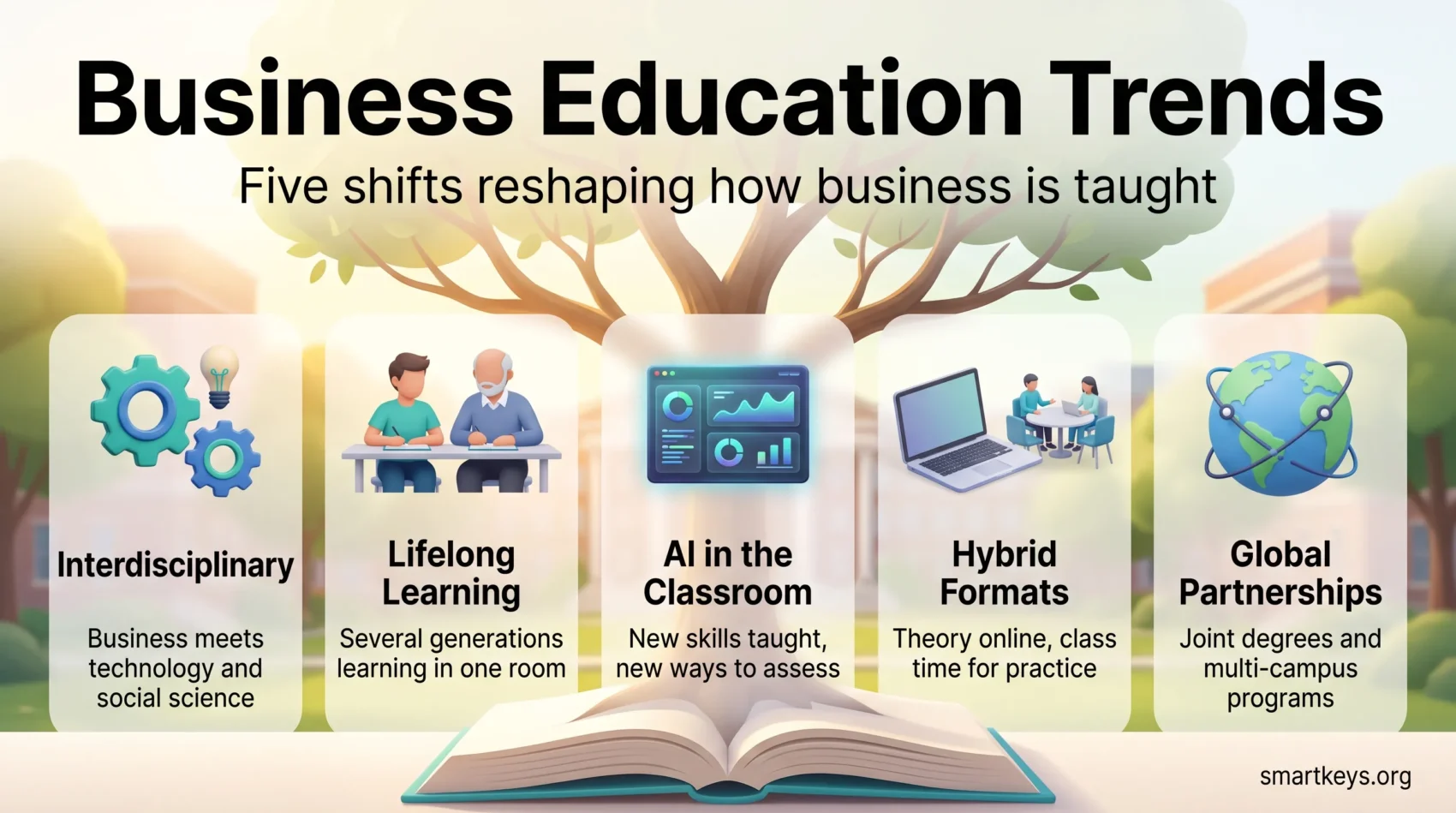
- Interdisciplinary teaching, mixing business with technology and social science, is the clearest curriculum change.
- Lifelong learning is now a design requirement, because one classroom often holds several generations.
- AI changes both how courses are delivered and what they have to teach.
- Internationalization continues, but student flows are moving away from the US, UK and Canada.
Online Learning: Wide Reach, Cooling Demand for Online Degrees
Online study stopped being the exception some time ago. In autumn 2021, the most recent term the US National Center for Education Statistics reports in this detail, 9.4 million undergraduates (61%) took at least one distance education course and 4.4 million (28%) studied entirely online. Among postgraduates, 56% took at least one distance course.
The interesting shift is what happened next. GMAC, the body behind the GMAT admissions test, surveys business schools every year. Its 2025 Application Trends Survey found applications to graduate management programs up 7% overall, after a 12% rise in 2024. Within that total the formats moved apart: full-time in-person programs grew 8%, while online programs fell 7%.
So the picture is not “online replaces campus”. Online widened access enormously and remains the default for short courses and corporate training. But when people commit two years and a large fee, many choose the room, the cohort and the network again.
Flexibility and Access for Students
Distance study removed two practical barriers: location, and the need to stop working. A regional sales manager can take an evening module without moving city, and a parent can study after bedtime. That is a real widening of access, and it is why distance enrollment stayed far above pre-pandemic levels after campuses reopened.
It also has costs that are easy to underplay. Online study demands far more self-management, and drop-out is a persistent problem. The honest question is not which format is better, but which one you will finish.
What MOOCs Really Changed
MOOCs, or massive open online courses, are free or low-cost courses that anyone with an internet connection can join. The tracking site Class Central counted 220 million people signed up to at least one MOOC by the end of 2021, 40 million of them in that year alone, excluding China.
Read that figure carefully. It counts sign-ups, not completions, and completion rates in open courses are very low. What MOOCs genuinely changed is the price of trying something: you can test whether financial modeling or data analysis suits you before committing to a degree. Many business schools now use short online courses as a recruiting funnel for paid programs. Platforms such as LearnWorlds and similar course tools pushed the same model down to small providers. The equivalent shift inside companies is covered in our guide to EdTech for corporate training.
Interdisciplinary Teaching Is the Clearest Curriculum Shift
The clearest summary of where business schools are heading comes from Lily Bi, president of the accreditation body AACSB. She groups the changes under five headings: interdisciplinary, interconnected, intergenerational, internationalized, and integrated with technology. Four of the five describe boundaries being removed, and the interdisciplinary one has the most visible effect on timetables.
Combining Business with Technology and Social Science
The reason is simple: the problems graduates are hired to solve no longer sit inside one department. Pricing a subscription product needs finance, behavioral psychology and a grasp of what the data team can measure. Rolling out an AI tool needs operations, employment law and change management.
In practice this means shared projects with engineering, design and public policy students. It also means technical content inside general management degrees rather than as an optional extra. If you are assessing a team rather than a syllabus, our guide to a digital skills gap analysis covers how to map what is missing.
Turning That into Leaders Who Can Act
The stated goal of most redesigned programs is a graduate who can decide under uncertainty, not one who can recite frameworks. Hence more case work, live client projects and ethics teaching, and less lecture time.
Be skeptical here. Every school claims to build leaders, and leadership is hard to assess in a written exam. The practical test when comparing programs is whether students face real consequences: a client who can reject the work, a budget that can run out, a team that can disagree. Our overview of the skills employers are hiring for is a useful cross-check against any prospectus.
Lifelong Learning Is Now a Design Requirement
Careers have outgrown a single qualification. People change field at 40 and work later than their parents did. Programs built for 24-year-olds do not serve that.
The World Economic Forum’s Future of Jobs Report 2025 puts numbers on the scale of it. Employers expect 39% of workers’ core skills to change by 2030. Of every 100 workers, the report projects that 29 will be upskilled in their current role, 19 will be reskilled and moved to a different one, and 11 will need training but will not get access to it. That last group is the uncomfortable part: the gap is not only about willingness, but about who gets offered training at all.
LinkedIn’s 2025 Workplace Learning Report shows the same tension from inside companies. It found 84% of employees agreeing that learning adds purpose to their work. Yet only 15% said a manager had helped them build a career plan in the previous six months, five points lower than the year before. Appetite is not the bottleneck. Management attention is. Our articles on upskilling and reskilling and on mid-career retraining go further into how organizations close that gap.
Teaching Several Generations in One Room
An executive program today can hold a 26-year-old analyst and a 58-year-old operations director, with different reference points and different reasons for being there. The younger participant may want technical depth and a credential; the older one a structured route into general management.
Good programs handle this by separating a common core from electives, and by using cohort work so participants teach each other. That peer element is the part most often left unused.
Keeping Skills Current Between Qualifications
Most learning now happens between degrees, not during them. The WEF ranks AI and big data, networks and cybersecurity, and technological literacy as the three fastest-growing skills to 2030, with creative thinking, resilience and curiosity close behind. None of those stay learned. They need refreshing.
That is the argument for short, repeated formats rather than one large course, which is the idea behind a microlearning strategy.
Technology Inside the Classroom
Technology now affects business education twice over: it changes the subject matter, and it changes the delivery.
AI and Data Analytics
Since generative AI tools reached the mainstream, schools have had to answer two questions at once. What do we teach about AI, and what do we allow students to do with it?
On teaching, data literacy has moved from a specialist elective into core courses. Managers are expected to read a model’s output, question the data behind it and know when the answer is unreliable. On assessment, essays written at home became weak evidence of learning almost overnight, which is why oral defenses, in-class work and project assessment have grown.
Schools also run analytics on their own students, flagging who has stopped logging in so tutors can step in early. That is useful, and a fair privacy question to ask before you enroll. Our overview of AI-powered learning platforms covers the same tools in corporate upskilling.
Virtual and Augmented Reality
Immersive tools work best where the skill is physical, spatial or dangerous to practice for real: a maintenance procedure, a safety drill, a factory layout. For most business content, a good video and a discussion do the same job far more cheaply.
The realistic verdict is that VR earned a place in specific corporate training cases rather than across the curriculum. We set out the evidence and the costs in VR employee training and the on-the-job variant in AR in on-the-job training.
Hybrid Models and What They Solve
Hybrid learning combines scheduled in-person sessions with online material you work through on your own time. It exists because the two formats fail in opposite ways: pure online loses the cohort, pure in-person loses the people who cannot be in the room every week.
The sensible split is to put explanation online, where it can be paused and repeated, and reserve contact time for what needs other people: debate, negotiation practice, feedback, group problem solving. Sitting in a lecture hall to hear something that could have been a recording is the waste hybrid design removes.
The same logic applies to company training. Our guide to remote learning in corporate training covers the practical failure points, most of which are about scheduling and manager involvement rather than technology.
Internationalization Is Continuing, but Redirecting
Business schools have long argued that a mixed-nationality cohort is part of the product, because you learn to work across cultures by doing it. That has not changed. Where students go has.
GMAC’s 2025 survey shows the redistribution clearly. International applications fell 8% in the United States, 5% in the United Kingdom and 47% in Canada, while they rose 26% in India, 42% across East and Southeast Asia and 10% in Europe outside the UK. Visa policy, post-study work rights and cost are doing most of the work here, not teaching quality.
For students, that makes the destination decision less obvious, and post-study work rights worth checking before ranking. For schools, it puts more weight on partnerships: joint degrees and multi-campus programs such as the CEMS Master in International Management offer an international experience without depending on one country’s visa rules. Our article on globalization and future work trends covers the wider pattern.
Skills Training for a Changing Workforce
Employers keep asking whether a qualification predicts performance. Increasingly they want evidence of a specific skill rather than a general credential.
Which Skills Programs Are Prioritizing
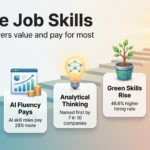
Following the WEF ranking, curricula have leaned toward data and AI fluency, security awareness, and general technological literacy. Alongside those sit the human skills the same report puts near the top: creative thinking, resilience and flexibility, and curiosity with a habit of continued learning.
Those human skills are not a soft extra. They decide whether someone can absorb the next technical change without being retrained from scratch. Our article on soft skills in future work looks at how they are being assessed.
Shorter Credentials and Internal Routes
Two responses have grown alongside degrees. The first is the short credential: a certificate tied to one defined skill, faster and cheaper than a qualification, and increasingly accepted in hiring. How far that acceptance goes is covered in micro-credentials in hiring.
The second is training people sideways inside the company instead of hiring outside. That is the logic behind cross-training strategies and internal talent marketplaces, which match existing employees to open work based on skills rather than job titles.
Competition Between Providers
Business schools now compete with corporate academies, online platforms and employers who train their own staff. That competition shows up in what students choose.
Responding to a Changing Workforce
Programs are being redesigned to match how work is actually organized, including teams that combine human and automated work, covered in hybrid jobs, and the demographic pressures set out in how future work adapts to demographic shifts.
What Students Are Choosing
The 2025 GMAC data is a useful signal. Specialized business master’s degrees grew 9%, led by accounting at 14%, while the generalist MBA grew only 2%. Shorter, clearly targeted qualifications are gaining ground on the broad two-year degree.
Values matter too, though the evidence is softer than the confident numbers often quoted. What is well documented is that expectations around flexibility, purpose and development differ by career stage, as we cover in HR management trends.
What This Means for You
If you are choosing a program, decide what you are actually buying. A network and a career change point towards an in-person cohort. A specific skill gap points towards a short credential or an internal move, both faster and far cheaper.
If you run a team’s training, the WEF and LinkedIn findings point at the same weak spot. The constraint is rarely content, which is cheap and plentiful. It is whether managers make time for it, and whether the people who most need training are the ones actually offered it. Fixing that costs less than any platform license and changes more.
Found this useful?
Make SmartKeys a preferred source on Google, and our articles will surface more often in your Top Stories, AI Overviews, and AI Mode.
Add as Preferred Source