Globalization used to be a story about goods moving in containers. For most office workers it is now a story about tasks moving over a network. A design brief, a support ticket, a payroll run or a line of code can be handed to someone three time zones away at almost no extra cost. That single change is what puts globalization inside your working week, whether or not your employer sells anything abroad.
This article looks at what that actually means in 2026: where the work is going, which jobs are growing and shrinking, which skills hold their value, and what you and your employer can realistically do about it. Where a figure appears, the source is named. Where a popular claim cannot be verified, it has been left out.
Key Takeaways
- Employers expect around 40% of the skills a job requires to change by 2030, and 59 workers in every 100 will need reskilling or upskilling, according to the World Economic Forum’s Future of Jobs Report 2025.
- The same report projects 170 million new roles and 92 million displaced roles worldwide by 2030, a net gain of 78 million.
- US job growth is slowing sharply. The Bureau of Labor Statistics projects 5.9 million new jobs from 2025 to 2035, growth of 3.5%, against 10.9% over the previous decade.
- Remote work made distance cheap and then settled. About a quarter of paid days in the US were worked from home in May 2026 (Stanford’s Survey of Working Arrangements and Attitudes).
- Independent work is now a large parallel labor market: MBO Partners counted 72.9 million independent workers in the US in 2025.
- Skills gaps, not budgets, are the barrier employers name most often. 63% of them cite it, per the WEF.
What Globalization Means for Work Today
Globalization, in the workplace sense, is simply the falling cost of coordinating work across borders. Three things drove that cost down: cheap bandwidth, common software, and a generation of managers who learned during the pandemic that a team does not have to sit together to function.
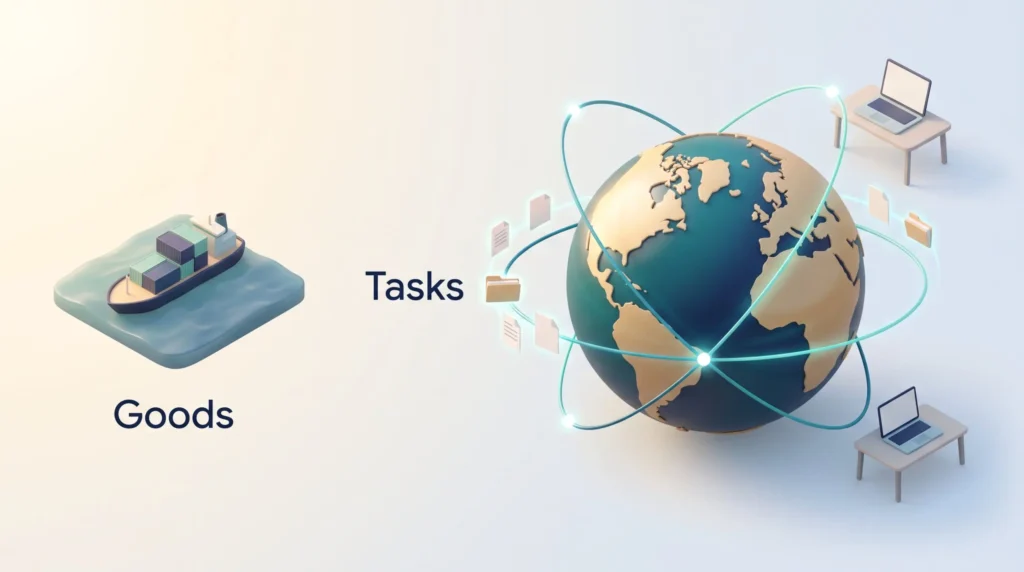
The result is a shift in what actually crosses borders. Trade in goods still matters, and tariffs and trade policy still shape it: that side of the story is covered in our piece on globalization and business trends. But the fastest-moving category is services delivered over a network, which the World Trade Organization tracks separately as digitally delivered services. Accounting, software, marketing, research and customer support now travel as data rather than cargo.
For you, that means the boundary of your labor market has moved. A marketing manager in Manchester is not only competing with other managers in Manchester. She is also competing, for some tasks, with an agency in Warsaw and a contractor in Manila. The same shift works in her favor when she wants a client, a job or a project outside her own city.
The Numbers That Set the Frame
Three figures do most of the work in explaining the current moment.
First, job growth in rich countries is slowing. The US Bureau of Labor Statistics projects the economy to add 5.9 million jobs between 2025 and 2035, a rise of 3.5%. Over the previous ten years, employment grew 10.9%. Slower growth makes each hiring decision more competitive, and it pushes employers to look further afield for the skills they cannot find nearby. The demographics behind that slowdown are covered in more detail in our article on how work adapts to demographic shifts.
Second, churn is high even where net numbers look calm. The World Economic Forum’s Future of Jobs Report 2025 projects 170 million new roles created and 92 million displaced by 2030, for a net gain of 78 million. Roughly 22% of jobs are expected to be disrupted in some way. A net gain of 78 million is good news in aggregate and cold comfort to anyone in the 92 million.
Third, distance stopped being expensive. Stanford’s Survey of Working Arrangements and Attitudes put about 25% of paid full days in the US as worked from home in May 2026. That is far below the pandemic peak and far above the pre-2020 level of under 6%. Remote work did not take over and did not disappear. It settled into a stable pattern, and the evidence on remote work and productivity is what convinced most employers to keep it. That stability is what makes cross-border hiring practical rather than experimental.
Where the Work Actually Crosses Borders
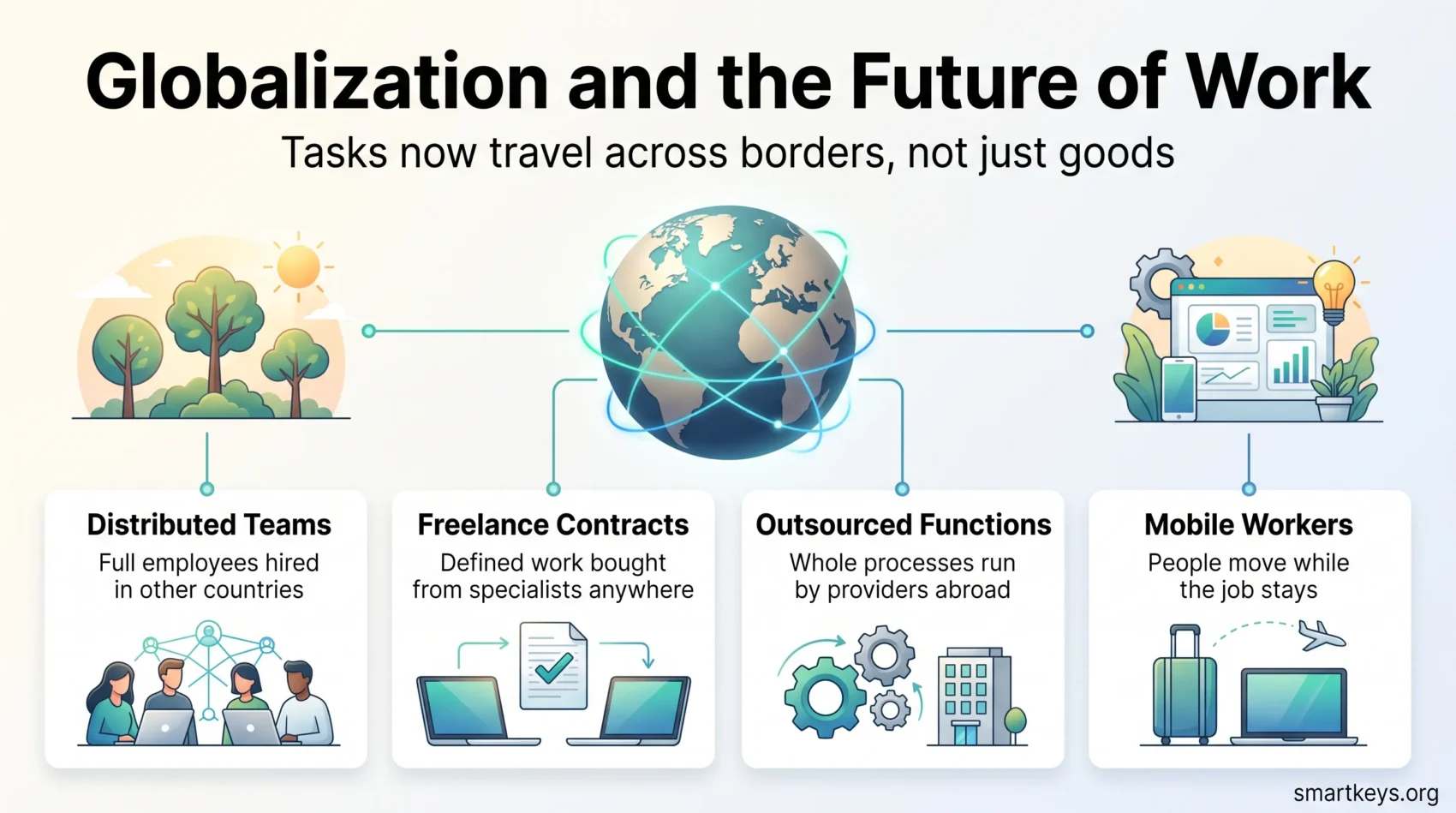
It helps to be specific, because “globalization” is easy to nod at and hard to act on. Work crosses borders in four recognisable ways.
Distributed employment. A company hires someone in another country as a full employee, usually through a local entity or an employer of record, meaning a third-party firm that legally employs the person on the company’s behalf. This is now routine for engineering, design and customer success roles. Running those teams well is its own discipline, covered in our guide to managing cross-border remote teams.
Contracting and freelancing. Instead of a job, the company buys a defined piece of work. Platforms made this searchable and payment infrastructure made it fast. The global gig economy is the visible edge of this, but a large share happens through direct relationships and referrals.
Outsourced functions. Whole processes, such as payroll, first-line support or claims handling, move to a specialist provider abroad. This is the oldest form and it is being reshaped by automation rather than replaced by it, as our overview of business process outsourcing trends explains.
Mobile workers. The person moves rather than the job. Dozens of countries now offer some form of remote work permit, and the requirements, income thresholds and tax consequences vary a lot, as our guide to digital nomads and the mobile workforce sets out.
Most companies use several of these at once, often without a deliberate strategy. That is usually where the problems start.
What This Does to Jobs and Pay
The honest version is mixed, and it depends heavily on which task you do rather than which industry you are in.

When a task is well defined, gets sent as a file and comes back as a file, it can be bought anywhere. Data entry, basic bookkeeping, routine translation and first-line support all fit that description, and all face steady price pressure. The same logic now applies to some tasks that felt safe five years ago, because AI tools handle a share of them before a human is involved at all. Our piece on how workers are adapting to job automation looks at which tasks are actually being absorbed.
When a task depends on being present, on local knowledge, or on judgment that cannot be written down in a brief, distance protects it. A plumber, a nurse, a schools inspector and a regional sales lead are not competing globally in any practical sense. Neither is a manager whose value lies in knowing which of three imperfect options her organisation can actually execute.
Between those two poles sits most knowledge work, and this is where the effect is real but uneven. Some roles gain: a specialist in a small country can now sell to the whole world, and salaries in mid-income countries for globally traded skills have risen well above local norms. Some roles lose bargaining power, because the employer has more options than before. Both things are happening at the same time, which is why the argument about globalization and wages never resolves cleanly.
One practical implication: if your work can be fully described in a written brief, that is a signal worth acting on. Not a reason to panic, but a reason to add something to the role that a brief cannot capture.
Independent Work as a Parallel Labor Market
Global demand did not only change who employers hire. It changed how many people choose not to be employees at all.
MBO Partners counted 72.9 million independent workers in the US in 2025, and reported 5.6 million of them earning more than $100,000 a year, close to double the 2020 figure. That upper tier matters, because it undercuts the assumption that independent work is only precarious work. For skilled specialists, a global client base can be more stable than a single employer.
The trade-offs remain real. Independents carry their own benefits, their own pipeline risk and their own admin, and cross-border invoicing brings tax questions most people underestimate. Regulation is moving too, unevenly, as different countries decide what a platform worker is owed. Our article on the next phase of the gig economy covers where those rules are heading.
For companies, the same market is a hiring channel. Firms increasingly combine a small core of employees with a wider bench of specialists, staffing projects from that bench rather than opening a permanent role each time.
The Skills That Keep Their Value
This is the part with the clearest evidence, and the WEF’s Future of Jobs Report 2025 is the reference point.
Employers expect around 40% of the skills their roles require to change by 2030. Fifty-nine workers in every 100 will need reskilling or upskilling by then, and 63% of employers name skills gaps as the key barrier to transforming their business. Meanwhile 77% plan upskilling programmes and 41% expect to reduce headcount where AI can do the work. Those last two are not contradictions. They describe the same company deciding which roles to invest in and which to shrink.
What holds value in a global market falls into three groups.
Technical fluency that is current. Not a lifelong specialism, but the ability to pick up the tool your field standardised on last year. Data literacy and comfort with AI assistants now function the way spreadsheet skills did in the 1990s: unremarkable when you have them, disqualifying when you do not.
Judgment and context. Deciding what to build, spotting when a model’s output is wrong, knowing which client will actually sign. These resist both offshoring and automation because they depend on information that never made it into any brief.
Working across differences. Writing clearly enough that someone in another time zone can act without a follow-up call, chairing a meeting where half the room is not fluent in your language, giving feedback that lands across cultures. Our overview of soft skills in the future of work goes into what this looks like in practice, and future job skills covers the technical side.
Where those skills come from is changing too. Employer-run training and short credentials now sit alongside formal education rather than after it, and some firms build their pipeline directly through partnerships with schools and colleges. If you are planning your own next step, our guide to upskilling and reskilling is the place to start.
Working Across Time Zones and Cultures
A distributed team is not a co-located team with worse video. It runs on different rules, and the teams that struggle are usually the ones that never changed the rules.
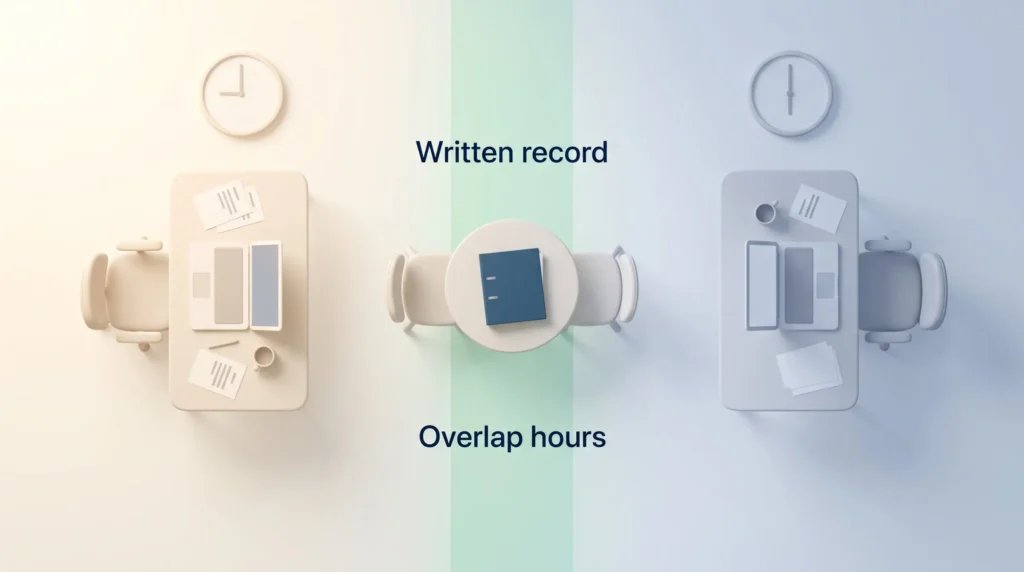
Three habits do most of the work.
Write things down. If a decision only exists in a call, half the team learns it late and secondhand. A short written record of what was decided and why costs ten minutes and saves a week of confusion.
Protect the handover, not the meeting. With four hours of overlap or fewer, synchronous time is the scarce resource. Spend it on decisions and disagreements. Everything else can be asynchronous. Some support and operations teams go further and design deliberately around the clock, an approach covered in our piece on follow-the-sun scheduling.
Be explicit about norms. How direct is feedback here? Does silence mean agreement? Is a deadline a promise or an aspiration? Teams that name these things early argue less later. Our guide to AI-supported remote collaboration covers the tooling side, and crowdsourced innovation looks at what happens when you widen the circle of contributors.
Diversity of background genuinely helps here, but only when the working practices let quieter or non-native-speaking members contribute. Hiring globally and then running every decision through a fast English-language call wastes the advantage you paid for.
What Companies Can Do
Four moves separate organisations that handle this well from those that improvise.
Decide deliberately where work sits. Map which roles need to be local, which can be anywhere, and which are genuinely global. Most companies discover they have made this choice by accident, one hire at a time.
Fix the compliance layer before scaling. Employment law, tax residency, data transfer and IP ownership all differ by country. Getting this wrong is expensive and slow to unwind. Sort it for one country properly before adding five.
Invest in the skills you say you need. If 63% of employers name skills gaps as their main barrier, the ones that close the gap internally will hire from a much less crowded market than the ones that only recruit for it.
Redesign roles rather than only cutting them. Where automation absorbs part of a job, the useful question is what the person does with the freed time. Our article on robotics in the workplace comes back to the same point: the boundary between what you keep and what you send out is a design decision, not a cost calculation alone.
What You Can Do This Quarter
Advice at the level of “be adaptable” is useless. Three concrete steps:
Audit your own tasks. List what you did last week and mark each item: could this be fully specified in a written brief? The items you mark yes are the ones exposed to both offshoring and automation. That tells you where to add value, not where to hide.
Build one skill that is hard to brief. Client judgment, domain depth, running a difficult conversation, technical review. Pick one and put real hours into it this quarter rather than sampling four.
Widen your own market. The same forces that expose you to competition give you access. One remote client, one cross-border collaboration or one work-from-anywhere arrangement changes what your options look like if your current role narrows. Younger workers already treat this as ordinary rather than adventurous.
Conclusion
Globalization has not made work borderless and it has not put everyone in competition with everyone. It has made the boundary of your labor market a variable rather than a fact, and the variable is set by how specifiable your work is.
The measurable trends point the same way. Job growth in rich countries is slowing, skills are turning over faster than careers, and roughly a quarter of US paid days already happen away from an office. None of that resolves into a single instruction, but it does support a simple habit: keep the parts of your work that depend on judgment, presence and relationships, and keep learning fast enough that the specifiable parts are not all you have. For a wider view of where these forces are heading, our overview of future work trends picks up the thread.
Found this useful?
Make SmartKeys a preferred source on Google, and our articles will surface more often in your Top Stories, AI Overviews, and AI Mode.
Add as Preferred Source