Crowdsourced innovation means asking people outside your company to help solve a problem, then rewarding the answers you use. Instead of a closed R&D team working alone, you publish the problem and let outsiders, customers, hobbyists, specialists or freelancers, send in ideas. What changed by 2026 is that generative AI writes submissions too, which forces anyone running a contest to decide what they actually want from the crowd.
This guide covers how it works, which models exist, what the evidence supports, where it fails, and how to run a first challenge without creating legal problems for yourself.
Key Takeaways
- It gathers ideas from outside the organization and pays mainly for what gets used.
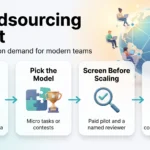
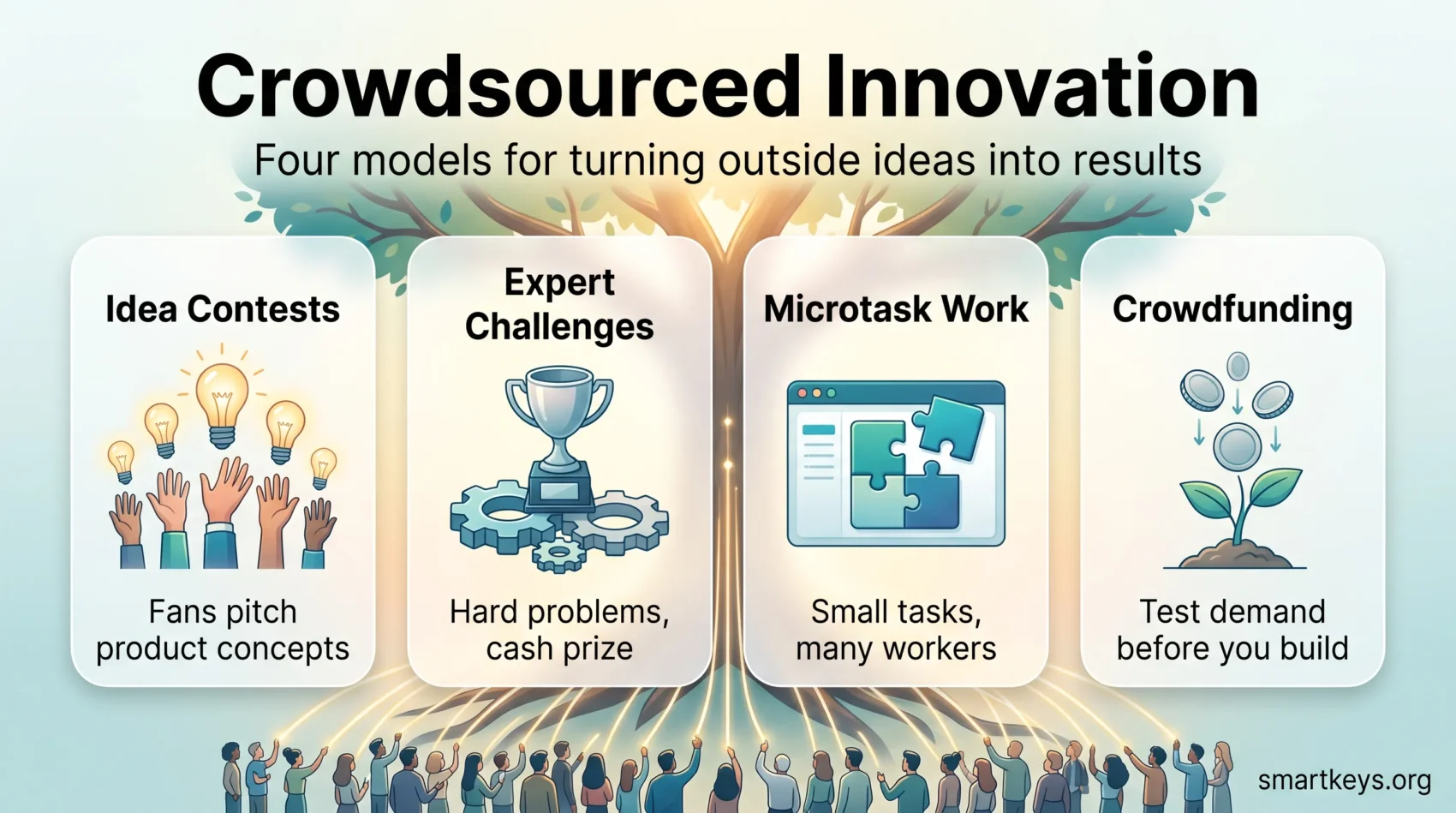
- Four models cover most of it: idea contests, expert challenges, microtask work and crowdfunding.
- LEGO Ideas, Doritos and the former My Starbucks Idea show what a working programme looks like.
- Ownership of submitted ideas must be settled in the rules before the challenge opens.
- Harvard research finds human entries score higher on novelty and AI entries higher on perceived value.
- Challenges usually fail for boring reasons: a vague problem, a token reward, no plan for the winner.
What Crowdsourced Innovation Actually Means
A Working Definition
Crowdsourced innovation opens a defined problem to a large, self-selected group and offers something in return for a usable answer: money, royalties, recognition, or the chance to see your idea made.
Three things separate it from market research. You ask for solutions rather than opinions. Anyone can answer, not just a pre-screened panel. And you pay for results, not for effort.
That last point drives the economics. A consulting engagement bills you for time whether or not it produces anything. A challenge with a fixed prize costs the prize plus the effort of running it, and only if someone solves the problem. In exchange you give up control over who works on it and how long it takes.
Crowdsourcing sits inside the wider practice of open innovation, where a company deliberately pulls ideas in from outside its own walls.
Where the Idea Came From
Journalist Jeff Howe coined the term in a 2006 article for Wired. The practice is older than the word; prize competitions go back centuries. The internet added scale and speed.
In 2006 Netflix offered one million dollars to any team that could improve its recommendation algorithm by 10 percent. The prize was claimed in 2009 by a team assembled from separate competitors who realized their approaches worked better combined. That became the template: publish a measurable target, let strangers compete, pay the winner.
By 2026 the field has split into a professional layer, with contract platforms and legal frameworks, and a consumer-facing layer where brands run public contests largely for the marketing value. Both are called crowdsourcing, and they behave very differently.
The Four Models You Will Encounter
Most programmes take one of four shapes, and picking wrong is the most common early mistake.
Idea contests ask a broad audience for concepts and pick favourites. They suit consumer products and marketing, where part of the value is the attention the contest generates.
Expert challenges publish a hard technical problem with a defined success criterion and a cash award. They suit chemistry, engineering, logistics and data problems, where you can test whether a submission works.
Microtask platforms break work into small pieces spread across many workers. Amazon Mechanical Turk is the classic case. This is labour rather than innovation, though it now underpins much AI training data.
Crowdfunding asks the crowd for money instead of ideas, which doubles as demand testing. If a Kickstarter campaign fails to fund, you learned something before tooling a factory. It is a cheap sanity check on a product diversification bet.
You can combine them: run an idea contest to find the direction, then a crowdfunding campaign to test whether anyone will pay. That works best when it feeds an existing business model innovation process rather than sitting beside it.
Three Programmes Worth Studying
LEGO Ideas: Fans Design, the Community Votes, LEGO Decides
LEGO Ideas is the most transparent crowdsourcing programme in consumer products. Anyone can submit a set design. A design that collects 10,000 community supporters enters a formal review, and LEGO runs three review periods a year; the first 2026 review drew 97 qualifying product ideas.
The terms are published rather than negotiated. A creator whose design becomes a retail set receives 1 percent of net sales, ten copies and credit on the box. A public threshold, a fixed calendar and a stated royalty remove almost all the ambiguity that sinks other programmes.
Doritos: The Contest That Now Bans AI
Doritos ran “Crash the Super Bowl” from 2006 to 2016, inviting fans to make the brand’s Super Bowl advert. Fan entries repeatedly outperformed agency work in USA Today’s Ad Meter. It was retired, then revived in September 2024 for Super Bowl LIX with a one million dollar prize, 25 finalists and a public vote on the final three.
The revival added a rule the original never needed: entries must be original and must not use artificial intelligence to create or assist in creating the script or any creative asset. When anyone can generate a hundred passable concepts in an afternoon, a contest has to define what it is buying. Decide your position on AI-assisted entries before you publish the rules, the same way you would set internal guidelines for generative AI use.
My Starbucks Idea: What a Suggestion Platform Costs
Starbucks launched My Starbucks Idea in 2008 as a public site where customers posted ideas and voted on each other’s. It collected more than 150,000 ideas in its first five years, and Starbucks implemented hundreds of them, including free in-store Wi-Fi.
It closed in June 2018. The lesson is not that it failed but that an always-open suggestion box is expensive. Someone has to read, sort, answer and close out every idea indefinitely, or the community notices the silence and stops posting. That is why most companies now run time-boxed campaigns rather than standing platforms.
What You Gain
A Wider Range of Starting Points
The practical benefit is variety. An internal team shares training, vocabulary and assumptions, so its first twenty ideas tend to cluster. A crowd of strangers produces scattered ideas, most useless and a few from a direction nobody inside would have considered. You are buying the outliers and accepting noise to get them. That is one reason challenges suit sustainability problems where the usual answers have been tried.
Crowdsourcing therefore pairs well with internal methods. A design thinking process refines a promising concept well and generates unfamiliar ones poorly. A challenge is the reverse.
Cost That Scales With Results
Wazoku, which acquired the veteran platform InnoCentive in 2020 and now runs it as Wazoku Crowd, reports an 80 percent challenge success rate across roughly twenty years, more than 40 million dollars paid to solvers, and a cycle of two to six months from problem to award.
Treat vendor figures as vendor figures. The useful part is the shape of the spend: a platform fee plus an award, and the award only lands when a solution passes your own acceptance test. For a problem stuck internally for a year, that is a different risk profile from hiring another engineer. Public bodies use the same logic. NASA runs a standing prizes, challenges and crowdsourcing programme through its Center of Excellence for Collaborative Innovation, and opened new competitions in 2026.
Platforms and Tools
Where to Run a Challenge
The choice of platform follows the model you picked.
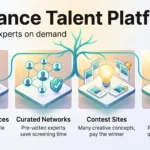
For expert technical challenges, Wazoku Crowd (formerly InnoCentive) and HeroX handle problem framing, solver agreements and awards. For software and data work, Topcoder, owned by Wipro since 2016, runs competitive development and design contests. For microtasks, Amazon Mechanical Turk remains the default, while Upwork and similar freelance talent platforms cover specialist project work.
Research has its own tradition. Zooniverse lets volunteers classify images for academic projects, and Foldit turns protein folding into a game. Open source development on GitHub is arguably the largest crowdsourced innovation system ever built, though it runs on contribution and reputation rather than prizes, which makes it a separate open source strategy question.
What the Software Has to Do
Whatever platform you use, it needs four things: a clear problem statement, a submission form detailed enough to evaluate, a public channel for questions, and a visible decision record. That question channel matters most: many weak submissions come from people who misread the brief and could not check.

Working With the Community You Attract
A challenge does not run itself. Participation drops sharply if questions go unanswered, if the deadline moves without explanation, or if the winner is announced with no reasoning. People are giving you unpaid work for the chance of a reward, and they read every signal about whether you are serious. Organizations that get repeat participation treat the crowd as a standing relationship, the discipline behind community-led growth.
Format matters too. The Netflix Prize was won by a merged team, not a lone genius. Platforms that let participants build on each other’s entries usually produce stronger submissions than sealed-bid formats, at the cost of some free-riding. Getting the results in front of the right internal people is largely a knowledge management problem.
Where Crowdsourcing Goes Wrong
Intellectual Property Is the Real Risk
Intellectual property, meaning legal ownership of an idea, design or piece of code, causes the most trouble. Three problems recur. If your rules do not state who owns an entry and what rights you get, you may not be able to use the winning idea. A submitted idea may itself infringe someone else’s patent, and you inherit that risk. And companies have been sued by participants who later saw something resembling their rejected entry in a product.
The fix is unglamorous. Publish terms before the challenge opens, require participants to warrant the work is their own, define whether you take ownership or a licence, and keep dated records. If the challenge collects personal data, normal data privacy obligations apply too.
Weak Participation and Low-Quality Entries
The second failure mode is quieter. You open a challenge and get thirty entries, twenty-eight of which restate the problem. That is almost always the brief. “How might we improve customer experience” gets vague answers. “Reduce the time to unpack and shelve a pallet of mixed goods from 40 minutes to under 20, using no new hardware” gets specific ones.
Budget for evaluation too. A challenge that attracts 500 entries needs a scoring rubric and named reviewers, or the decision drifts and the community notices. Screening at that volume is where AI genuinely helps, much as it supports AI-assisted decision making elsewhere: it can cluster and shortlist, but judgement stays human.
What Changes in 2026: AI Joins the Crowd
What the Evidence Shows
The most useful study comes from researchers at Harvard Business School and collaborators, who ran a circular economy business challenge and compared 125 human submissions with 730 generated by GPT-4, then had around 300 evaluators rate them.
The result was a split decision. Human entries scored higher on novelty and varied more in expression. AI entries scored higher on perceived value, which the authors attribute to models tending toward the centre of their training data. Neither side won outright.
Read practically: AI produces a broad, competent field, and humans produce the strange idea that turns out to matter. If you only want volume, you no longer need a crowd. If you want the outlier, you still do. That distinction should shape how you deploy AI across business operations, not only in innovation programmes.
Decide Your AI Position Before You Publish
There are three defensible stances, and the mistake is having none. Ban AI-assisted entries, as Doritos did, when human authorship is the point. Allow AI openly when you only care whether the answer works, which is usual for technical challenges. Or require disclosure and judge on results, the middle path most expert platforms have taken.
Whichever you pick, state it in the rules, say how you will handle a suspected breach, and stay realistic about detection. AI-writing detectors are unreliable, so a rule you cannot enforce only damages trust in the result. In the EU, check how the challenge interacts with EU AI Act compliance obligations if AI screens or scores human submissions.
Conclusion: Running Your First Challenge
Keep the first one small and finishable. Pick a problem specific enough to test and that you would genuinely act on. Set a deadline under eight weeks. Publish terms covering ownership, eligibility and AI use. Name the judges and their criteria. Offer a reward proportionate to the effort you are asking for, since a serious technical problem with a 500 dollar prize reads as an insult. Answer questions publicly, announce the result with reasoning, and treat participants as a customer relationship rather than a transaction.
Crowdsourced innovation has settled into something more ordinary than the early hype suggested. It is not free ideas, and it does not replace internal expertise. It is a sourcing option: you trade control over who works on a problem for a much wider range of approaches, and you pay mainly for results. The programmes that last share a clear rule set, a published reward, a predictable calendar and someone whose job it is to close the loop. The ones that disappear had none of those, and AI-generated submissions punish the vague ones fastest.
Found this useful?
Make SmartKeys a preferred source on Google, and our articles will surface more often in your Top Stories, AI Overviews, and AI Mode.
Add as Preferred Source