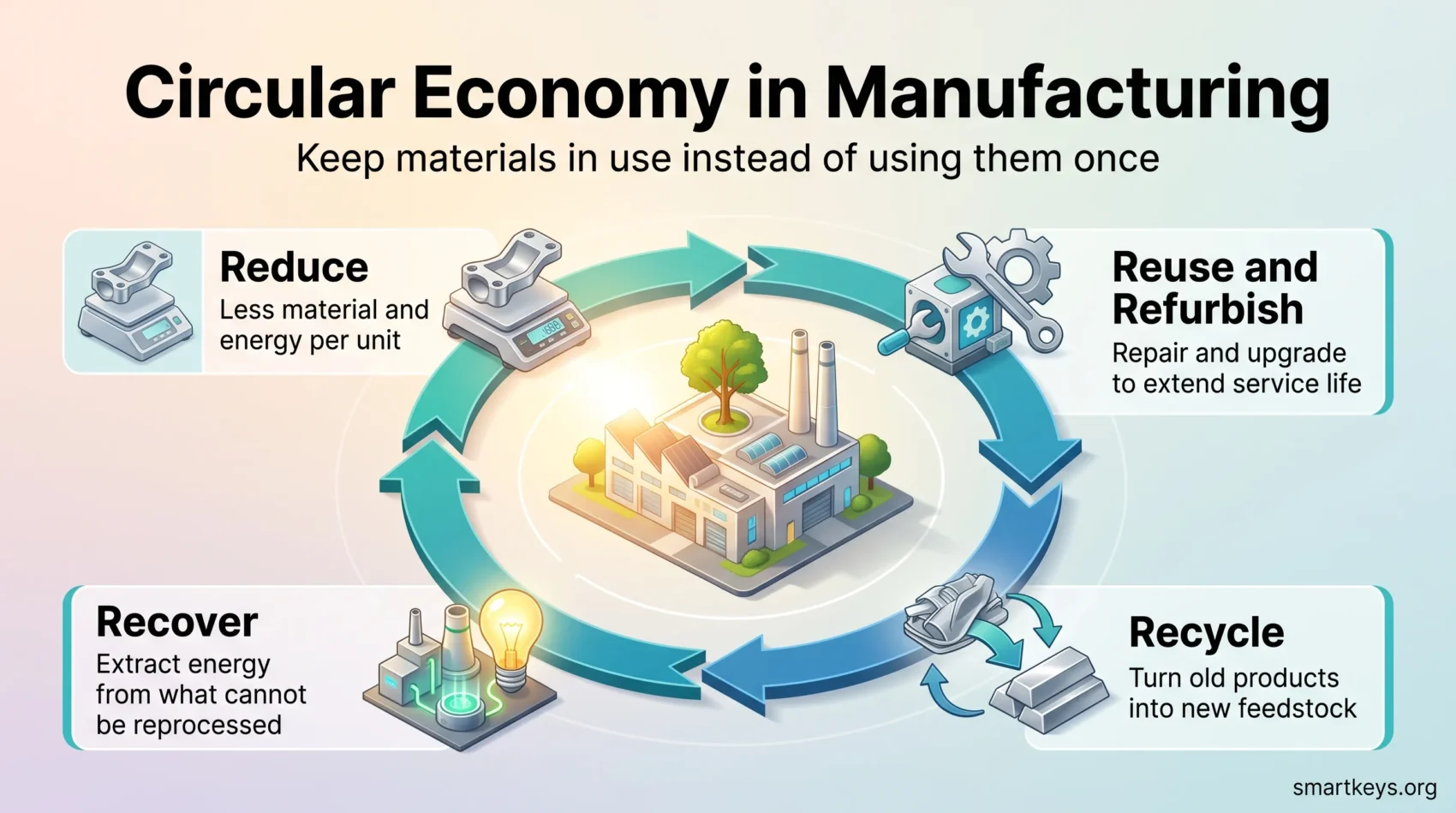
The Circular Economy promises to keep materials in use instead of burning through them once. Manufacturing is where that promise is hardest to keep, and where it matters most. Industry accounts for roughly 21.5% of global greenhouse gas emissions directly, and close to 31% once its electricity use is counted, making it the largest single contributor of any sector (UNIDO, 2023 data).
The headline numbers suggest the transition is stalling. The Circularity Gap Report 2026 puts the global circularity rate at 6.9%, a new low, and values what the linear model throws away at roughly 25.4 trillion euros a year, close to a third of global GDP. The same report reframes that waste as recoverable value, and that is the practical case for Circular Economy Manufacturing: the material you do not have to buy twice is the cheapest material you will ever own.
This guide covers what circular manufacturing involves in 2026, from closed-loop production to what regulation requires, and where the claims outrun the evidence.
Key Takeaways
- Global circularity fell to 6.9% in 2026, so most of the opportunity is still untapped.
- The EU circular material use rate hit a record 12.2% in 2024, and the Commission wants it near 24% by 2030.
- Ecodesign rules, recycled content quotas and the Digital Product Passport turn circularity into a compliance question, not just a strategy question.
- Reduce, Reuse, Recycle and Recover remain the working principles, and design decisions set the ceiling for all four.
- The financial case rests on material and energy costs first, brand positioning second.
What the Circular Economy Means for Manufacturers
The Circular Economy redefines the relationship between a factory and its inputs. Instead of extracting, making and discarding, it keeps materials and components circulating at their highest useful value for as long as possible. This guide stays on the factory floor; for the wider picture across sales, services and supply chains, see our overview of what the circular economy means for businesses.
The scale is easy to underestimate. UNEP’s Global Waste Management Outlook 2024 counted 2.3 billion tonnes of municipal solid waste in 2023 and projects 3.8 billion by 2050. Direct management cost was roughly USD 252 billion in 2020, and about USD 361 billion once pollution, health and climate damage are counted.
Manufacturing is a smaller slice of the waste picture than most people assume, and it has been improving. Eurostat recorded 2,233 million tonnes of total EU waste in 2022, of which manufacturing accounted for 10.4%. Waste from manufacturing fell 30.7% between 2004 and 2022, even as total EU waste rose.
The circular question is therefore less about landfill volume and more about material productivity: output per tonne of virgin input, and how much of that input can be secondary.

On that measure Europe is moving slowly. Eurostat put the EU circular material use rate at 12.2% in 2024, the highest level on record but only one percentage point above 2015. National performance varies enormously: the Netherlands reached 32.7%, Belgium 22.7% and Italy 21.6%, while several member states remain in low single digits. The lesson for manufacturers is that secondary material supply is a local question, not a continental one.
The Shift from Linear to Circular Production
The linear economy is simple to run: extract raw materials, make products, sell them, and let the customer dispose of them. It is also exposed. Every price shock in metals, polymers or energy lands directly on the cost of goods sold, and every new disposal rule adds cost at the end of life you no longer control.
The Circular Economy transition replaces that with loops. Products are designed to be repaired, upgraded, disassembled and eventually reprocessed. Manufacturers that go furthest keep ownership of the physical asset and sell its output instead, which turns end-of-life recovery from a cost into a scheduled return.
Companies adopting a circular economy model tend to start with the loops that are shortest and cheapest. Maintenance and repair keep a product in service. Refurbishment restores it. Remanufacturing rebuilds it to original specification, usually at a fraction of the material and energy cost of a new unit. Recycling is the last resort, because it destroys the form and much of the embedded value.
Principles of Circular Economy Manufacturing
The principles of Circular Economy Manufacturing form the basis for sustainable production practices. Adopting them reduces waste and improves resource efficiency, which protects the environment and hardens the business against input volatility. The four working principles are Reduce, Reuse or Refurbish, Recycle and Recover.
Reduce
Reduce means using less material and energy per unit of output. Lightweighting, tighter tolerances, better nesting and yield optimisation belong here, as does designing out components nobody needs. It is usually the cheapest principle to act on, because it pays back through purchasing rather than new infrastructure.
Reuse and Refurbish
Reuse and refurbishment extend service life: you maintain, repair and upgrade an asset instead of replacing it. This depends heavily on design, since modular architectures, standard fasteners and available spare parts decide whether refurbishment is economic or impossible.
Recycle
Recycling processes end-of-life products back into feedstock. It works well for materials that tolerate reprocessing without heavy quality loss, aluminium and steel being the clearest cases, and poorly for mixed, bonded or contaminated assemblies. Material choice at the design stage limits what any recycler can recover.
Recover
Recovery extracts energy from material that cannot be reprocessed, through routes such as anaerobic digestion or waste-to-energy. It keeps material out of landfill, but it ends the loop rather than closing it, so it belongs at the bottom of the hierarchy.

Impact on Sustainable Production Practices
Circular principles change how a plant is engineered, not just how it reports. Closed-loop systems reduce both the virgin input at the front end and the disposal burden at the back end, and they do it with the same capital equipment doing different work.
Advanced manufacturing technologies help. Additive manufacturing cuts material removal and enables spare parts to be produced on demand rather than stocked, a shift covered in detail in our guide to 3D printing and supply chain management. Sensor networks and connected equipment give the visibility that circular decisions need, which is why IoT in business operations and digital twins in manufacturing now appear in most circular roadmaps.
Industrial symbiosis takes the idea between companies: one plant’s byproduct becomes another’s feedstock. It works best in dense clusters where transport distances stay short, which is also the honest limit on the model.
Examples worth studying:
- Siemens applies eco-design criteria so equipment can be serviced and its materials recovered.
- Patagonia runs its Worn Wear repair and resale programme alongside recycled input materials.
- Toyota designs vehicles for end-of-life recovery and reuses components across generations.

What EU Rules Require in 2026
Circularity moved from voluntary strategy to legal obligation, and 2026 is when the schedule becomes concrete. If you sell into the EU, these are the instruments that matter.
Ecodesign for Sustainable Products Regulation (ESPR). The first working plan, adopted in 2025, covers textiles and apparel, furniture, tyres, mattresses, iron and steel, and aluminium, plus horizontal requirements on repairability scoring and recycled content for electrical and electronic equipment. Indicative dates for the delegated acts are 2026 for iron and steel, 2027 for textiles and tyres, 2028 for furniture and aluminium, and 2029 for mattresses.
Digital Product Passport. The ESPR introduces the DPP as the mechanism carrying durability, repairability, composition and recycled content data along the supply chain. The practical work is upstream: you cannot publish material data you never collected from suppliers, so that groundwork starts well before your deadline.
Critical Raw Materials Act. The 2030 benchmarks set 10% of EU annual needs from domestic extraction, 40% from processing, 25% from recycling, and no more than 65% of any strategic raw material from a single third country. The recycling benchmark is what turns scrap recovery into a supply security question rather than a waste question.
Batteries Regulation. Minimum recycled content applies from August 2031: 16% cobalt, 85% lead, 6% lithium and 6% nickel, rising in 2036 to 26% cobalt, 12% lithium and 15% nickel. These are the first hard recycled content quotas most manufacturers will meet, and they set the template.
Packaging and Packaging Waste Regulation. It generally applies from 12 August 2026, which puts packaging design changes on a shorter clock than product design changes.
A broader Circular Economy Act is expected in the third quarter of 2026, aimed at doubling the EU circular material use rate to around 24% by 2030 from 11.8% in 2023. The underlying data work overlaps almost entirely with what a serious ESG framework and corporate social responsibility reporting already require.
Resource Efficiency in Production
Resource efficiency is where circular thinking meets the plant budget. Energy and materials are the two lines where it shows up first.
Energy Use Reduction
Cutting energy intensity lowers emissions and cost, and does not depend on anyone else’s recycling infrastructure. Process heat recovery, variable speed drives, compressed air leak programmes and load scheduling are unglamorous and reliably profitable. On-site generation and storage extend that further, which is where energy-efficient power technology and the wider climate tech landscape come in. Firms setting formal targets usually anchor them to a carbon neutrality roadmap.
Material Cost Savings
Secondary material is often cheaper than virgin material and always less exposed to commodity swings. The constraint is availability and consistent quality, a procurement problem before an engineering one. That makes supplier qualification and specification work the real bottleneck, and it is where digital procurement earns its place. Any claimed saving should be measured against your own bill of materials rather than a published industry average.

Waste Reduction Techniques in Manufacturing
Waste reduction techniques are the entry point for most plants, because they need process discipline rather than new capital. Lean manufacturing remains the backbone: map the value stream, find where material and time are consumed without adding value, and remove it.
Beyond lean, the levers are familiar. Segregate waste streams at source so recyclable material is not contaminated. Requalify off-spec output rather than scrapping it. Find buyers for byproducts instead of paying for disposal. Track first-pass yield and scrap rate as operational KPIs with named owners.
The EU Waste Framework Directive hierarchy gives a defensible order of priority: prevention first, then preparation for reuse, recycling, recovery and disposal last. Programmes that follow that order tend to survive budget scrutiny, because prevention shows up in purchasing before it shows up in a report.
Collaboration extends the reach. Industry associations and cluster bodies share techniques a single plant would take years to develop, and pooled volumes often make a recycling route viable that no one site could justify. The same dynamics shape green supply chains and supply chain resilience programmes.
Closed-Loop Production
Closed-loop production means material recovered from your own products returns as input to your own process. It is the most demanding circular model and the most valuable, because it removes a purchasing dependency instead of merely reducing it.

Running one requires three things most manufacturers do not have by default: a way to get products back, a way to disassemble them economically, and a reprocessing route that yields material good enough for your own specification. Take-back schemes, leasing and product-as-a-service models exist mainly to solve the first problem.
The enablers are maturing. RFID, serialised identifiers and connected sensors make it possible to know what a returned unit contains and how it was used, precisely the data the Digital Product Passport will formalise. Where robotics and automation handle disassembly, the labour cost that once killed the business case starts to fall.
Metals demonstrate why the model works. Recycling aluminium uses a small fraction of the energy of primary production, and the metal tolerates repeated reprocessing without meaningful quality loss. Polymers, composites and bonded assemblies are far harder, and pretending otherwise is how circular programmes lose credibility internally.
How Circularity Affects Competitiveness
The competitive argument for circular manufacturing has shifted. It used to rest on brand differentiation. It now rests on input security and regulatory access.
The European Commission estimates that up to 80% of a product’s environmental impact is determined at the design stage, which is why ecodesign rules target designers rather than waste managers. That same design phase decides your exposure to recycled content quotas, repairability scores and disclosure duties. Products designed now will be sold into a rulebook that is already published.
Circular practices also extend asset life. Connected equipment enables predictive maintenance, which keeps machines in service longer and avoids the material cost of premature replacement.
New models create revenue rather than just saving cost. Product-as-a-Service turns a one-off sale into a recurring contract and gives the manufacturer both the asset and the usage data. Remanufactured lines serve price-sensitive segments without cannibalising new product margins. Firms that treat this as part of a wider sustainability strategy rather than a bolt-on tend to get further.
What Customers Actually Reward
Consumer surveys consistently show strong stated support for sustainable products, and consistently overstate willingness to pay. Any business case built on survey sentiment alone is fragile.
What holds up better is the business-to-business signal. Corporate buyers with their own reporting duties increasingly ask suppliers for recycled content figures, product carbon footprints and end-of-life documentation, because they need those numbers for their own disclosures. That demand is contractual rather than aspirational. Our analysis of what consumers reward in 2026 covers where the say-do gap sits.
Regulation reinforces it. Eco-labelling rules, substantiation requirements for green claims and the coming Digital Product Passport all push the same way: claims must be backed by data a customer can check. That favours manufacturers who invested in measurement early.
Challenges and Opportunities
The barriers are real and worth naming plainly. Reverse logistics is expensive and often has no existing route. Secondary material supply is inconsistent in both volume and quality. Disassembly is labour intensive. Accounting systems rarely capture the value of a recovered component. Supplier data needed for a product passport frequently does not exist yet.

Against that, the opportunities are concrete rather than speculative. Input costs fall when secondary material substitutes for virgin. Compliance risk falls when recycled content and repairability are designed in rather than retrofitted. Market access is protected in jurisdictions that are tightening rules. And the measurement work regulation demands produces exactly the operational data that supply chain planning already needs.
The sensible approach is narrow and evidenced. Pick one product family, one material stream or one plant. Measure the baseline. Prove the loop closes economically. Then scale what worked instead of announcing a target you cannot yet deliver.
Conclusion
Circular manufacturing is no longer an experiment on the margins of industrial strategy. With global circularity at 6.9% and falling, the gap between the linear model and a working circular one is the largest untapped efficiency opportunity most manufacturers have.
Adopting circular economy practices lets manufacturers cut input cost, reduce exposure to commodity and regulatory shocks, and build supply chains that survive disruption. The technical enablers exist and the regulatory schedule is published. What remains is the unglamorous work: collecting material data, redesigning for disassembly, qualifying secondary suppliers and building take-back routes that pay for themselves.
Start with the loop you can close this year, measure it honestly, and let the results fund the next one. That is also how a workforce learns the new practices. Our guide to circular economy jobs and skills looks at the roles this creates, and the broader shift is covered in sustainable work practices and green jobs.
Found this useful?
Make SmartKeys a preferred source on Google, and our articles will surface more often in your Top Stories, AI Overviews, and AI Mode.
Add as Preferred SourceFAQ
What is the Circular Economy in manufacturing?
Circular Economy manufacturing keeps materials and components in use at their highest value for as long as possible, instead of the traditional take-make-dispose sequence. In practice it means designing products so they can be maintained, repaired, upgraded, disassembled and eventually reprocessed, then building the logistics to make those steps happen. The aim is not simply more recycling. Recycling sits at the bottom of the hierarchy because it destroys the product’s form and much of its embedded value, while reuse, refurbishment and remanufacturing preserve far more.
How does the Circular Economy benefit manufacturers?
The clearest benefit is cost and supply stability. Secondary material is usually cheaper than virgin material and less exposed to commodity swings, and material recovered from your own products removes a purchasing dependency entirely. Longer asset life through repair lowers replacement cost. Circular design also reduces regulatory risk, since recycled content quotas and repairability requirements are already scheduled in the EU and cost far less to design in than to retrofit. Product-as-a-service contracts and remanufactured lines can open segments a new-only catalogue cannot serve profitably.
What are the key principles of Circular Economy Manufacturing?
Four principles do the work: Reduce, Reuse or Refurbish, Recycle and Recover. Reduce means less material and energy per unit of output, through lightweighting, yield optimisation and removing unnecessary components. Reuse and refurbishment extend service life by maintaining and upgrading products rather than replacing them. Recycle returns end-of-life material to feedstock, which works well for aluminium and steel and poorly for bonded or contaminated assemblies. Recover extracts energy from what cannot be reprocessed. Each step down the list destroys more embedded value, so recovery should be the exception.
What is a closed-loop production process?
Closed-loop production means material recovered from your own end-of-life products returns as input to your own process, rather than being sold into a general recycling market. It needs three things at once: a reliable way to get products back, an economic disassembly route, and reprocessing that yields material meeting your own specification. Take-back schemes, leasing and product-as-a-service contracts exist largely to solve the return problem. Aluminium and steel suit the model best, since they tolerate repeated reprocessing without meaningful quality loss. Polymers and composites are considerably harder.
Which EU rules on circular manufacturing apply from 2026?
Several instruments are now on a published schedule. The Ecodesign for Sustainable Products Regulation covers textiles, furniture, tyres, mattresses, iron and steel, and aluminium, with delegated acts expected from 2026 for iron and steel through to 2029 for mattresses, and it introduces the Digital Product Passport. The Packaging and Packaging Waste Regulation generally applies from 12 August 2026. The Critical Raw Materials Act sets a 2030 benchmark of 25% of EU needs from recycling. The Batteries Regulation sets minimum recycled content from August 2031. A wider Circular Economy Act is expected in the third quarter of 2026.
How much of the global economy is actually circular?
Very little, and the share is falling. The Circularity Gap Report 2026 puts the global circularity rate at 6.9%, a record low, meaning under 7% of the material entering the economy comes from secondary sources. The same report values what the linear model wastes at roughly 25.4 trillion euros a year, close to a third of global GDP. Europe does better but not dramatically so: Eurostat measured the EU circular material use rate at 12.2% in 2024, the highest yet recorded and only about one percentage point above 2015.
What challenges do manufacturers face when going circular?
The obstacles are practical rather than philosophical. Reverse logistics is expensive and often has no existing route, so getting products back is frequently the hardest step. Secondary material supply is inconsistent in volume and quality, which makes supplier qualification slow work. Disassembly is labour intensive unless automated. Standard cost accounting rarely captures the value of a recovered component, so circular projects can look worse on paper than they are. The workable response is to prove one loop economically before committing to a company-wide target.
What waste reduction techniques work best in manufacturing?
Lean manufacturing remains the backbone, because it needs process discipline rather than new capital: map the value stream, find where material and time are consumed without adding value, and remove it. Beyond that, segregating waste streams at source prevents contamination that would otherwise make material unrecyclable. Requalifying off-spec output avoids scrapping it. Selling byproducts to other plants turns a disposal cost into revenue. Tracking first-pass yield and scrap rate as operational KPIs with named owners keeps attention on the numbers year-round.