Procurement is simply how a company buys the goods and services it needs, from laptops and cleaning contracts to legal advice. Digital procurement means running that buying on connected software instead of email threads, spreadsheets and paper approvals.
The difference shows up in ordinary work. A marketing manager requests a design tool, the request routes itself to the right approver, the purchase order reaches the supplier automatically, and finance sees the committed spend the same day. Nobody has to chase anybody.
That matters more in 2026 than it did two years ago. The Hackett Group’s 2026 Procurement Key Issues Study, published in March 2026, found procurement workloads rising by about 8% this year while head count and operating budgets fall. Buying teams are being asked to handle more with fewer people, which is exactly the situation automation suits. This guide covers what digital procurement includes, what AI realistically adds, and how to sequence a rollout your team will use rather than work around.
Key Takeaways
- Digital procurement replaces manual approvals and scattered files with connected workflows that record every step.
- Analytics surface savings spreadsheets hide: duplicate invoices, missed discounts, price variance.
- AI is spreading fast but is still early stage. 43% of organizations are actively deploying it, only 12% at large scale.
- Integration with your finance system decides whether the project delivers anything, so make it the first milestone.
- E-invoicing mandates in Europe now force structured, machine-readable invoices on a fixed timetable.
What digital procurement means today
Traditional purchasing runs on requests sent by email, approvals given by reply, and invoices matched by hand at month end. Information sits in personal inboxes, so answering what the company spent on software last quarter takes days.
Digital procurement puts those steps into one system. A requisition (the internal request to buy something) is created on a form, routed by rules, and turned into a purchase order. When the goods arrive and the invoice lands, the system matches order, receipt and invoice automatically. That check is called three-way matching, and it is the main defence against paying twice or paying for something nobody ordered.
How it differs from traditional purchasing
The visible change is speed. The structural one is that purchasing stops being separate from finance. Requisitions, orders, receipts and invoices flow into the ERP system (the central software holding a company’s finance, inventory and operations records, such as SAP, Oracle or NetSuite) without anyone retyping them. That removes the duplicate entry behind most reconciliation errors, and it means procurement and finance report the same spend figures.
Why the pressure has increased
Supply volatility is one reason. IBM reports that around one third of chief supply chain officers have started working with suppliers in new countries, which multiplies onboarding and risk checks. Building resilience into the supply chain is hard when supplier records live in three spreadsheets. Regulation is the other: structured electronic invoicing is becoming mandatory across Europe, and a scanned PDF no longer counts.
The benefits that actually show up
Fewer manual steps. Rule-driven routing replaces individual judgement about who approves what. Approvals stop waiting in inboxes, and audits stop being archaeology.
Costs you can see. Analytics reveal patterns nobody spots by hand: the same part bought at three prices, early-payment discounts left unclaimed, duplicate invoices paid twice, contracts renewing on old terms. Weak contract handling is expensive on its own. World Commerce and Contracting, the industry body for contract professionals, has long estimated that poor contract management costs organizations around 9% of annual revenue.
Visibility for everyone. Dashboards show committed spend, open orders and supplier performance in one place: the shift business intelligence tools brought to sales reporting, applied to buying.
Control that holds up. Spending limits and policy rules are enforced by the system rather than by memory, so exceptions get flagged instead of discovered later.
The core pillars of a modern procurement strategy
Technology alone changes very little. Five pillars separate a working programme from an expensive tool nobody opens.
One connected stack instead of silos
Connect purchasing, finance and ERP so data moves without manual entry. Where systems cannot talk directly, middleware fills the gap. That layer, usually sold as iPaaS or integration platform as a service, is often what makes a mixed software estate behave like one system.
Standard processes people can follow
Standardization means one route for a laptop order and another for a six-figure services contract. Repeatable steps lower risk on large purchases and speed up small ones. This is ordinary digital transformation work: agree the process first, then automate it.
Supplier relationships worth having
Supplier relationship management means treating important suppliers as long-term partners rather than interchangeable quotes: regular reviews, shared forecasts, a named contact on both sides. It improves quality and gives you leverage, and it matters most when supply chains come under strain.
Feedback loops and KPIs
Dashboards should expose service levels, request status and the few metrics that matter. A short weekly review of where requests are stuck fixes more bottlenecks than an annual report ever will.
People who can change the process themselves
No-code tools let a procurement analyst adjust a form or an approval rule without waiting months for IT. The agility is real, and so is the governance risk if nobody owns the rules. The answer is the one most low-code automation programmes settle on: let teams build inside guardrails IT sets.
What AI and analytics actually add
AI in procurement is moving quickly from a low base. Hackett found 43% of organizations actively pursuing AI deployment in 2026, nearly double the previous year, yet only 12% had implemented it at large scale. Most reach AI through features already built into software they own: 69% use capabilities embedded in their existing procurement platforms.
Where it helps today:
- Demand forecasting. Models trained on purchase history predict what you will need and when. Better forecasts mean less capital tied up in stock and fewer emergency orders at bad prices, the same predictive analytics approach used in sales planning.
- Spend analysis. Software classifies thousands of transactions into categories and benchmarks what you paid, so category managers negotiate from a position rather than a hunch.
- Invoice and approval automation. Robotic process automation, meaning software that performs repetitive screen-based steps the way a person would, handles matching and routing.
- Supplier risk scoring. Systems combine your performance data with outside signals such as financial filings and sanctions lists, then flag suppliers worth checking.
IBM reports cutting procurement task time by 10% to 20% with intelligent workflows, onboarding suppliers ten times faster, and pricing analysis dropping from two days to ten minutes in its own procurement organization. Hackett found 76% of organizations scaling AI report improvements of 25% or more in the metrics they track.
Two cautions belong with those numbers. They come from vendors and from companies that succeeded, so they show what is possible rather than what is typical. And AI output is only as good as the records beneath it: if your supplier data lists one company four times under four spellings, no model will fix that. Settling who owns your data is unglamorous and comes first. For the wider picture, see our overview of AI in business operations.
The software landscape
Choosing the right mix matters more than choosing the most advanced tool.
Source-to-pay and e-procurement suites
Source-to-pay suites cover the whole chain: finding suppliers, running tenders, awarding contracts, raising orders, receiving goods and paying invoices. Coupa, SAP Ariba, Ivalua, Jaggaer, GEP and Zip compete here. Gartner evaluated 13 providers in its Magic Quadrant for Source-to-Pay Suites published on 21 January 2026, with Coupa and Ivalua among the vendors placed in the Leaders quadrant. They suit organizations with real complexity: many entities, many categories, formal tender requirements. They are heavy to implement and priced accordingly.
No-code workflow tools
Pipefy, Kissflow and similar tools let a team build approval flows and request forms without development work. They fit when the problem is coordination rather than sourcing strategy, and they launch far faster. The trade-off is that you assemble your own process instead of buying a proven one.
Adjacent technology worth understanding
- Smart contracts. Code that releases payment automatically when agreed conditions are met. The concept works, but business use remains limited to specific scenarios.
- Blockchain traceability. Shared, tamper-evident records of where goods came from, with genuine footholds in logistics documentation such as bills of lading.
- Security. These systems hold bank details and contract terms. Single sign-on, multi-factor authentication and a layered security architecture are baseline requirements, not extras.
Compliance in 2026: e-invoicing is no longer optional
This is the change most likely to force a decision this year. Europe is moving from PDF invoices to structured electronic invoices, meaning machine-readable data files.
In Germany, every domestic business has had to be able to receive compliant e-invoices since 1 January 2025. Issuing them becomes mandatory on 1 January 2027 for companies with prior-year turnover above 800,000 euros, and on 1 January 2028 for everyone else. At EU level, the VAT in the Digital Age package (ViDA), adopted by the Council on 11 March 2025, extends digital reporting to cross-border business transactions by 2030.
Timetables differ by member state, so check the rules for each country you invoice in. The practical consequence is the same everywhere: invoice handling has to become structured and automated, which is what finance automation projects deliver. Where AI is used to score or rank suppliers, transparency duties may also apply, as our guide to EU AI Act compliance explains.
Your implementation roadmap
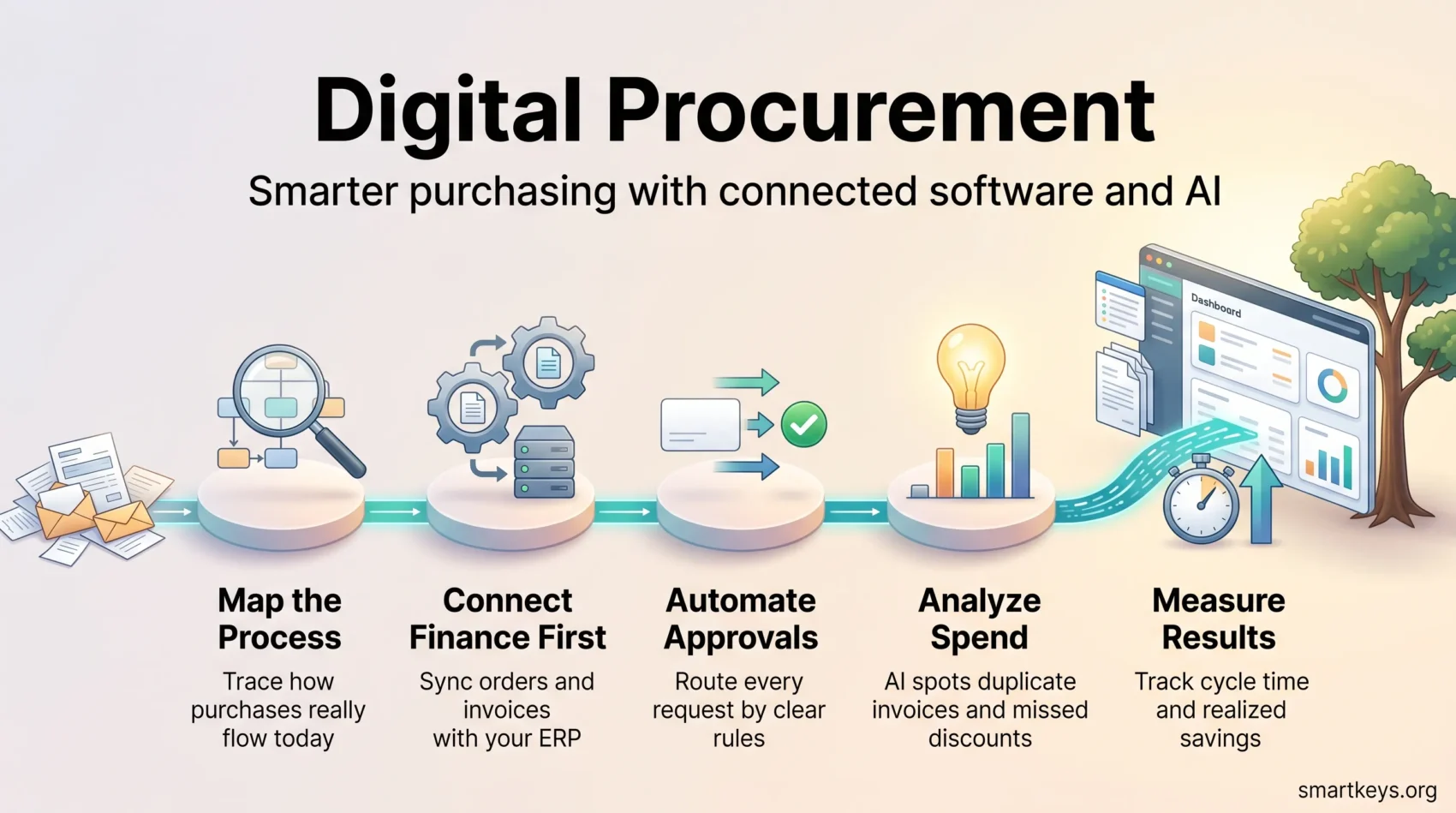
Start by mapping how purchases actually flow today, not how the policy says they should.
1. Assess the current state
List your systems and map the two or three most common buying journeys end to end. Note every point where someone retypes information or waits for a reply. Those points are your business case.
2. Set targets you can measure
Translate the goal into numbers: cut average request-to-order time from twelve days to five, move 70% of spend onto contracted suppliers, halve invoice exceptions. Vague ambitions like “improve efficiency” cannot be reported on later.
3. Integrate finance first
Connect the new system to your ERP and accounting software before adding features. If requisitions, approvals and invoices do not sync automatically, you have built a second place to type things. This is the milestone that decides whether anything else pays off, and where end-to-end automation programmes most often stall.
4. Automate approvals, and keep them simple
Every extra field lowers adoption. Design the request form so a non-specialist completes it correctly first time. Fewer approval layers usually beat more.
5. Manage the change
Train buyers, budget holders and suppliers separately, because each needs different things. Lead with a visible quick win such as automated invoice matching. Keep the old route open briefly, then close it, or people will keep using it.
Measuring success
Track a few metrics consistently rather than many occasionally.
- Cycle time. How long a request takes to become an order. The clearest signal that the process improved.
- Spend under management. The share of spending running through agreed contracts. Everything outside it is unmanaged risk.
- Realized savings. Negotiated reductions and avoided costs, validated with finance rather than self-reported.
- First-pass match rate. The share of invoices clearing matching without human help, and the best proxy for data quality.
- Supplier performance. On-time delivery, quality and responsiveness, reviewed on a fixed schedule.
Use role-based permissions, enforce single sign-on and multi-factor authentication, and run exception reports weekly so policy breaches surface while they can still be corrected. Once the core process is stable, extend automation to contract renewals and category reviews. Watch adoption as closely as savings: a workflow people bypass is not a workflow, which is one more reason to keep the digital workspace tidy.
Report results in business language. “Cycle time down 40%” means little to an executive team. “New suppliers are productive three weeks sooner, and duplicate payments have stopped” lands.
Conclusion
Digital procurement is less about buying software than about making buying repeatable.
The pattern from companies that succeed is consistent: standardize the process, connect it to finance, then apply analytics and AI to the clean data that results. Do it in the other order and you get expensive tools sitting on top of the same confusion. Start small. Take the three purchase types your company makes most often, map them, move them onto the new process, and measure what changes. With workloads rising, budgets tightening and e-invoicing deadlines approaching, the window for treating this as a future project is closing.
Found this useful?
Make SmartKeys a preferred source on Google, and our articles will surface more often in your Top Stories, AI Overviews, and AI Mode.
Add as Preferred Source