Last updated: September 2026. This review covers EcoFlow’s current lineup: the RIVER 3, the DELTA 3 series, the DELTA Pro 3, and the new DELTA Pro Ultra X that landed in 2026. It also looks at the older DELTA 2, which still sells at a discount. Prices move constantly with promotions, so treat every figure here as a snapshot and confirm on the official store before you buy.
A portable power station is a battery in a box with normal wall sockets on the front. You charge it from the mains, a car, or solar panels, then run your own devices from it when the grid is out or there is no grid at all.
You came here for a clear take on portable power that cuts through the marketing. The goal is simple: match a power station to your actual life. That might be campsite charging, jobsite tools, or backing up a house. What it should not be is a bigger unit than you need.
Here is what we cover: which model fits which job, what recharge speeds and runtimes look like in real use, and where EcoFlow genuinely leads on fast charging, app control, and modular growth. We are also direct about where it does not lead: fan noise under load, and a price premium you do not always need to pay.
Key Takeaways
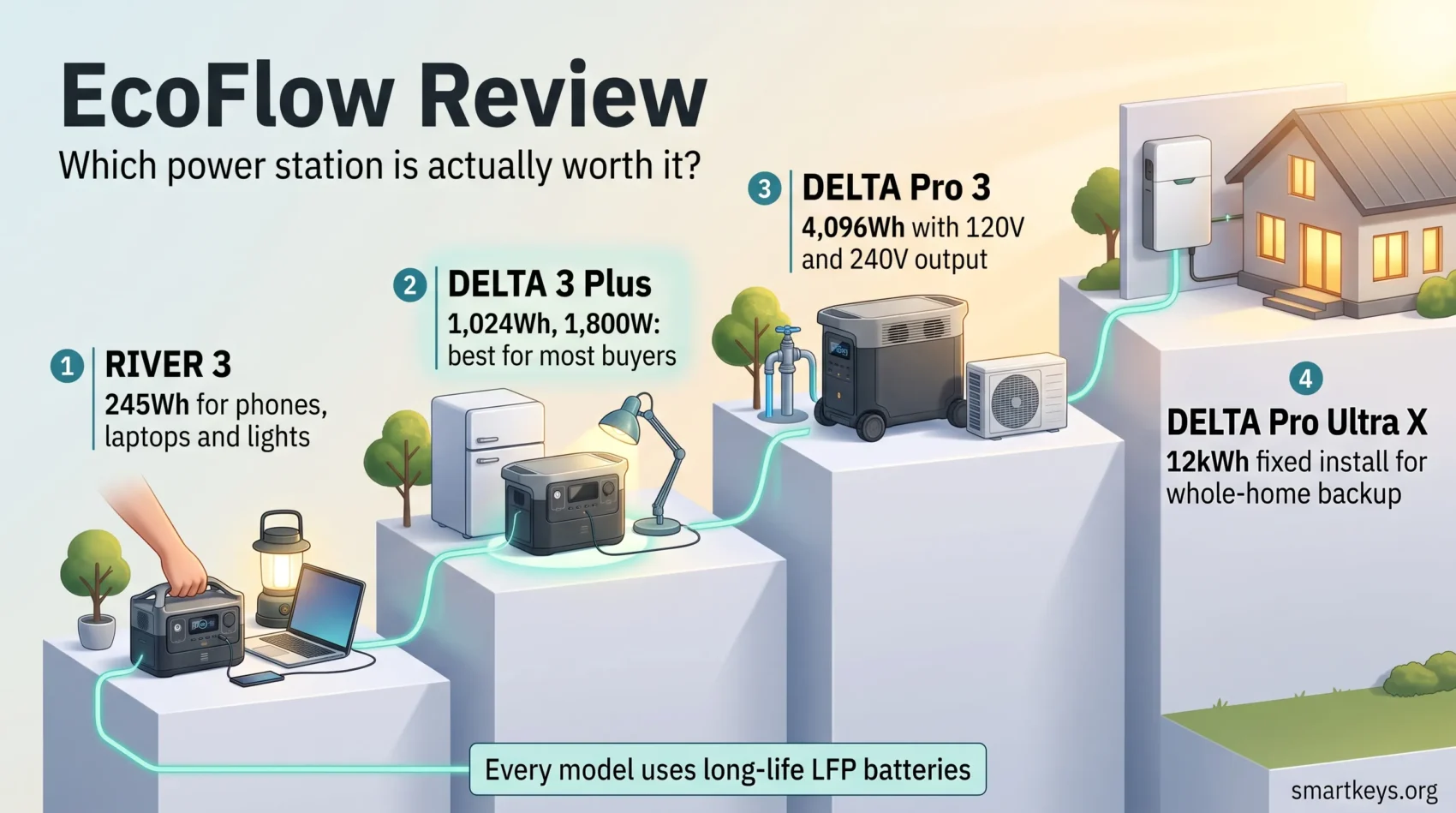
- The DELTA 3 Plus suits most buyers. It holds 1,024Wh, puts out 1,800W, and refills in roughly 56 minutes. EcoFlow lists it at $719, down from $799.
- The RIVER 3 is the cheapest way in at around $199, but treat it as a device charger, not an appliance runner.
- The DELTA Pro 3 handles big loads with 4,096Wh and both 120V and 240V output. EcoFlow lists it at $2,799, and sales have pushed it near $2,100.
- New in 2026: the DELTA Pro Ultra X is a fixed-install whole-home system, starting at $7,999 for one inverter and two batteries.
- Every current model uses LFP chemistry, a battery type that lasts far longer than the cells in older units, so lifespan is no longer a reason to hesitate.
- Size for the devices you truly need during an outage, then leave one step of headroom, not three.
EcoFlow Review at a Glance: Is It Worth It in 2026?
Short answer: yes for most people, provided you buy on promotion. EcoFlow earns its reputation on charging speed, battery safety, and an app-managed ecosystem that scales from a weekend cooler to a backed-up breaker panel. You pay a premium per watt-hour for that. It only pays off if you actually use the speed and the ecosystem.
Where it wins:
- Fast top-ups. X-Stream is EcoFlow’s name for its high-speed wall charging. It takes most DELTA models from 0-80% in under an hour, so you can refill between rolling blackouts.
- Real UPS behavior. A UPS, or uninterruptible power supply, bridges the gap when the grid drops. DELTA 3 and Pro models switch over in 10 milliseconds, fast enough that a fridge, router, or home server never notices.
- Modular growth. Start near 1kWh and add batteries later instead of rebuying a whole unit.
- Quiet at low load. The DELTA 3 Plus sits close to 30dB when it is not fast-charging, roughly the level of a quiet library.
Where it does not:
- Fans get loud during fast charge and heavy output. That is physics, not a defect, but it matters overnight.
- Branded solar panels cost far more than comparable third-party panels.
- At full list price the value case weakens quickly against Anker SOLIX and Bluetti.
Who EcoFlow Is and Why Americans Trust the Brand
EcoFlow was founded by engineers who came out of drone battery design, and that background still shows: faster charging, cleaner backup, and hardware that feels considered rather than assembled.
From drone batteries to backup power
The origin is simple. A small team set out to build quieter, faster stations for real-world use. You see that thinking in the dual handles, the legible displays, and an outlet mix that matches what people actually plug in.
LFP has become the baseline
Safety and lifespan matter more than peak specs. Every station in the current lineup ships with lithium iron phosphate cells, usually shortened to LiFePO4 or LFP. These hold their capacity far longer than the older lithium-ion chemistry used in early models.
The numbers are worth knowing. EcoFlow rates both the DELTA 3 Plus and the DELTA Pro 3 at around 4,000 charge cycles before capacity drops to 80%. If you drained and refilled the battery once a day, that is roughly eleven years.
If you are still running a first-generation DELTA, that is the single biggest reason to consider upgrading. Those early units lose capacity sooner and run their fans harder.
Solar-first, modular ecosystem
The wider system links panels, smart generators, extra batteries, transfer switches, and the Smart Home Panel 2, all managed from one app. Your first purchase does not have to be your last: a RIVER 3 today and a DELTA Pro 3 in three years still live in the same dashboard.
That matters more than it sounds. Households that keep adding solar, batteries, or an electric vehicle end up managing several systems at once, and one app beats four. It is the same consolidation logic driving connected devices in remote work, where the win comes from fewer dashboards rather than more gadgets.
EcoFlow Lineup 2026: RIVER 3, DELTA 3 Series, DELTA Pro 3 and Pro Ultra X
Match your expected use to the right tier: day trips, jobsite tools, or backing up a house. EcoFlow’s naming has grown confusing, so here is the practical map. Prices below come from EcoFlow’s US store and from tracked retailer deals in 2026, and they change often.
| Model | Capacity | AC output | Best for | Typical price |
|---|---|---|---|---|
| RIVER 3 | 245Wh | 300W (600W X-Boost) | Phones, laptops, camp lights | about $199, seen near $189 |
| DELTA 3 | 1,024Wh (to 5kWh) | 1,800W | Camping, light home backup | about $499 |
| DELTA 3 Plus | 1,024Wh (to 5kWh) | 1,800W (3,600W surge) | Most buyers | $719, list $799 |
| DELTA 3 Max | 2,048Wh | 2,400W | Serious home backup | about $700 to $950 |
| DELTA 3 Ultra Plus | 3,072Wh (3-11kWh) | 3,600W | Multi-day outages | about $1,300 to $2,000 |
| DELTA Pro 3 | 4,096Wh (to 48kWh) | 4,000W, 120V/240V | Heavy loads, partial home backup | $2,799 list, seen near $2,100 |
| DELTA Pro Ultra X | 12kWh (to 180kWh) | 12kW (36kW with three units) | Permanent whole-home backup | from $7,999 |
RIVER 3: ultra-portable power for day trips and light use
The RIVER family is built around grab-and-go weight. It keeps essentials charged, such as phones, cameras, and a small fridge on a short run, without much to carry.
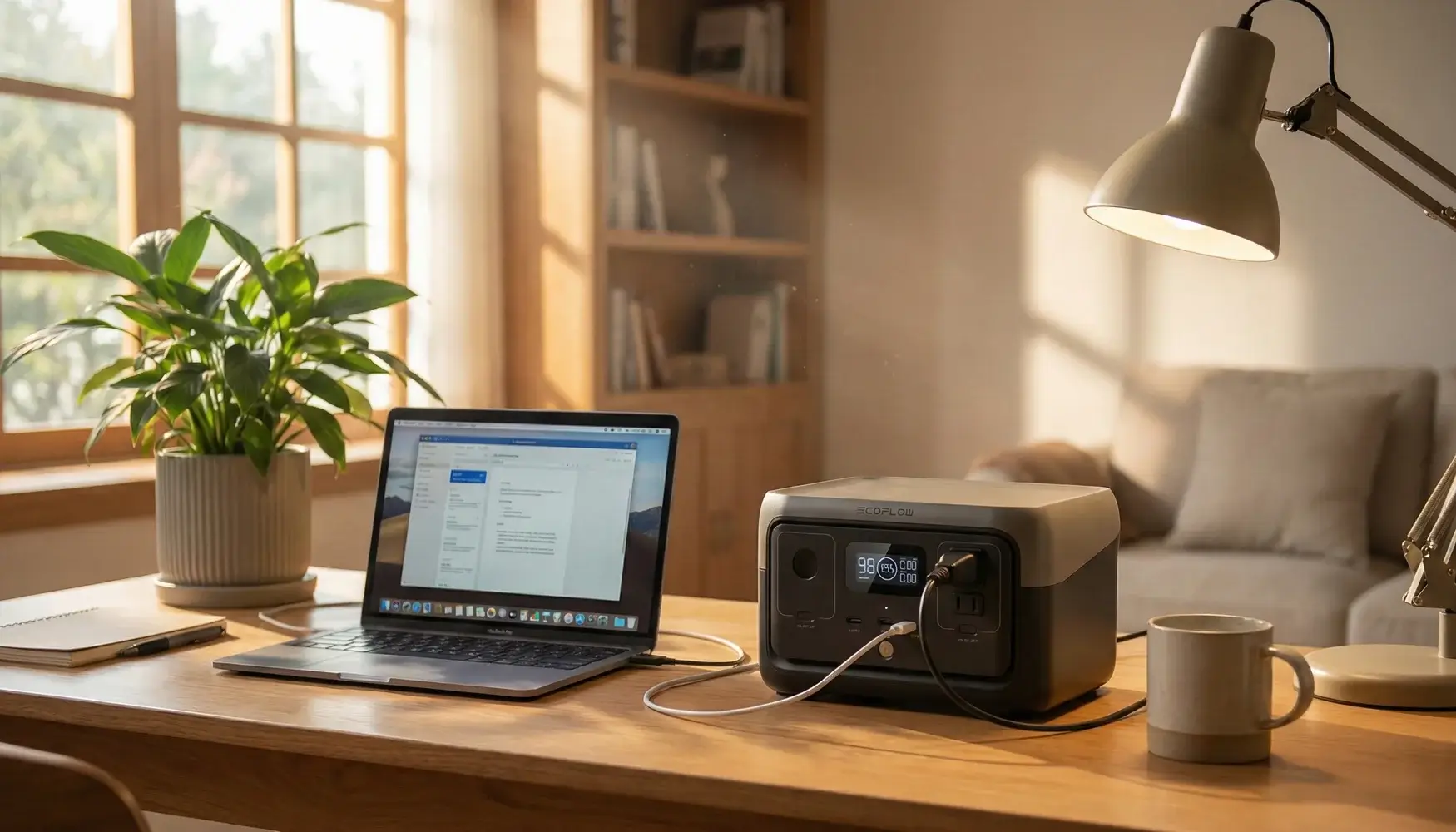
Be realistic about its ceiling. At 245Wh and 300W continuous, the RIVER 3 can technically start a mini-fridge using X-Boost, EcoFlow’s trick for briefly running appliances that draw more than the rated output. It is happiest running laptops, lights, and USB gear.
Building a compact home workstation to match? A few desk organization habits keep cables and chargers tidy. The wider principles of a productive home office apply to power just as much as to furniture.
DELTA 3 to DELTA Pro 3: expandable capacity and home backup
The DELTA line is where the ecosystem starts to earn its keep. All of them expand. The DELTA 3 and DELTA 3 Plus scale from 1kWh to 5kWh using DELTA 3, DELTA Pro 3, DELTA 2, or DELTA 2 Max extra batteries. You are buying a platform, not a fixed product.
The DELTA Pro 3 is a different category. It delivers 4,000W at both 120V and 240V, expands toward 48kWh with extra batteries and a smart generator, and connects to the Smart Home Panel 2 for app control over individual circuits. The 240V output is the part that matters: it covers appliances such as a well pump or a large air conditioner that most portable units simply cannot start.
DELTA Pro Ultra X: the new fixed-install tier
EcoFlow added a genuinely new top tier in 2026. The DELTA Pro Ultra X starts at 12kWh of storage and 12kW of output, and scales to 180kWh and 36kW when you stack three inverters and more batteries. Solar input runs into the kilowatts, and switchover takes about 20 milliseconds.
This is not a portable product. It is a permanently installed home battery, priced from $7,999 for a starter bundle of one inverter and two batteries. If you are comparing it against a conventional home battery installation rather than against a power station, you are thinking about it correctly. For most readers, the DELTA Pro 3 remains the practical ceiling.
- Choose RIVER for mobile convenience; choose DELTA for runtime and real output.
- Ports and capacity scale together, so outlets rarely become the bottleneck.
- Modular batteries mean your first buy does not cap your ceiling.
Performance and Features That Matter in Real Life
Performance is not specs on a page. It is how fast you can recharge, how quietly the unit sits in a bedroom, and how little you have to think about it.
Fast charging is the headline. EcoFlow lists the DELTA 3 Plus at 0-100% in about 56 minutes on 1,500W wall input. The larger DELTA models are in the same ballpark for a 0-80% top-up. In a rolling blackout, that is the difference between one full refill and none.
Charging inputs: wall, solar, and car
You can combine wall, solar, and vehicle input to keep power flowing. Solar ceilings follow a clear tier pattern: RIVER models top out around 110-220W, the DELTA 2 and DELTA 3 series sit in the 500-800W range, and the DELTA Pro 3 accepts kilowatts of panel. Optional alternator charging, which draws from your car’s engine while you drive, is genuinely useful on long trips.
One practical note on connectors. Most RIVER and DELTA units use a plug called XT60. Third-party panels usually ship with the MC4 plug used by rooftop solar, so budget for an MC4-to-XT60 adapter cable.
Ports, outlets, and UPS behavior
Port count is rarely the problem. Current models pair multiple wall sockets with high-wattage USB-C, USB-A, and a car socket. Pass-through power lets you run devices while the station itself charges.
The feature worth paying for is the 10 millisecond UPS switchover on DELTA 3 and Pro models. Plug in a fridge, router, and desktop, and they never register the outage. That single behavior separates a backup battery from a backup system. It is the same reasoning behind workforce contingency planning: decide in advance what is not allowed to stop.
App control and smart features
The app gives real-time energy readouts and alerts. Storm Guard watches severe weather warnings and tops the station up automatically before a storm lands. Smart Stop automates generator control so you burn fuel only when needed. Newer DELTA 3 models add output priorities, so you can have lights shut off automatically during an outage while the fridge keeps running.
Design, display, weight, and noise
Clear displays show battery percentage, remaining hours, and current load, so you are not guessing. Dual handles and a compact footprint make placement easy.
Expect fans under heavy load or fast charge. This is normal thermal behavior, not a fault. If silence matters overnight, cap the charge rate in the app and the unit stays close to 30dB.
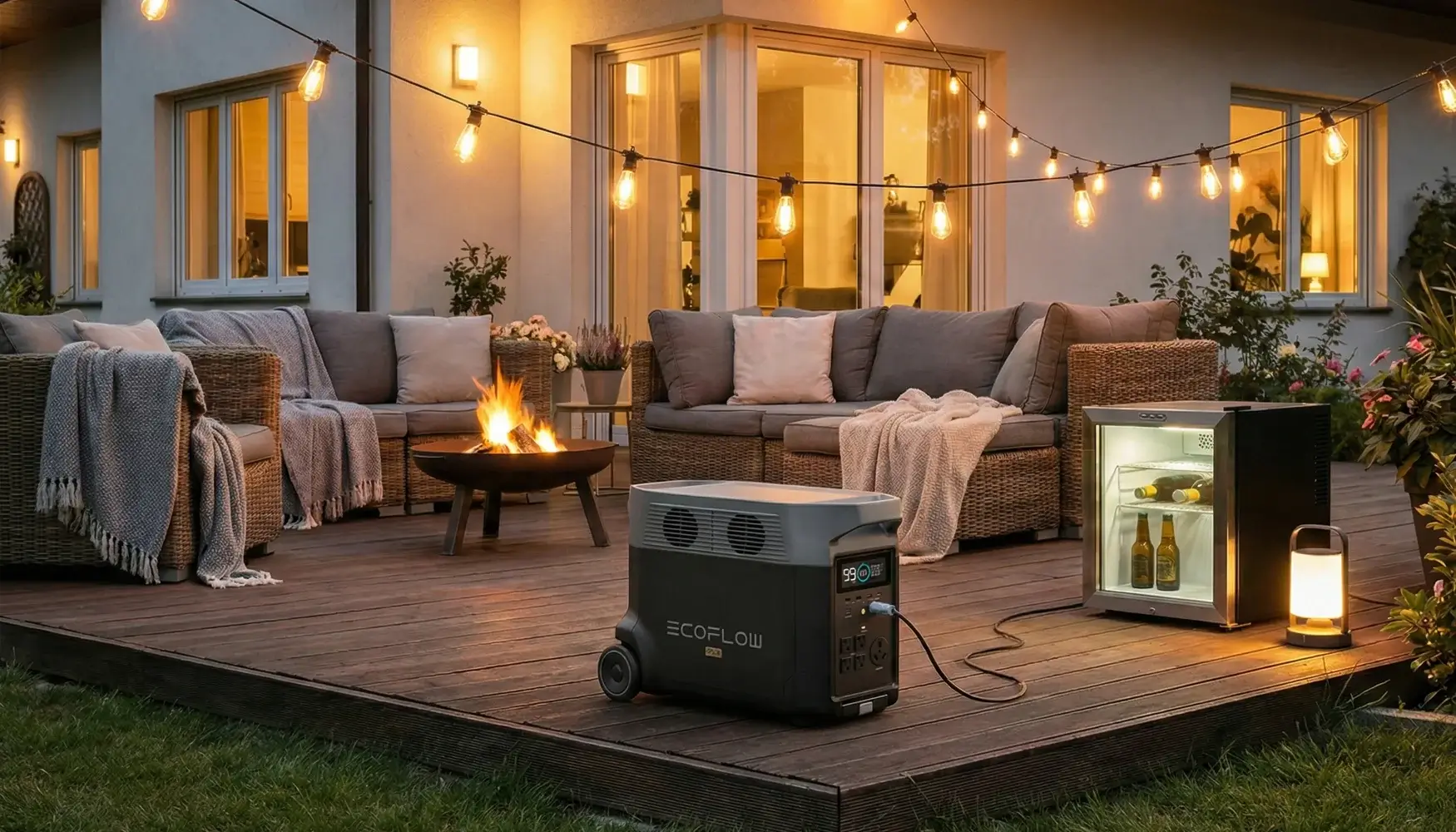
EcoFlow DELTA 3 Plus in Use: Power, Capacity, and Value
Put the DELTA 3 Plus into real chores and you see where mid-size portable power earns its keep.
Key specs: 1,024Wh LFP battery, 1,800W continuous output with 3,600W surge headroom, 1,500W wall input, and expansion to 5kWh. It weighs around 27 lbs and recharges from wall, car, or solar. EcoFlow currently lists it at $719, reduced from $799.
Practical examples and runtime
A worked example makes the capacity concrete. A mid-size fridge drawing about 120W will pull roughly 1,000Wh in a day if its compressor runs a third of the time. That is close to a full DELTA 3 Plus. Add a few LED lights and a router and you are looking at a night and a morning, not a weekend.
In everyday use it will run tool battery chargers and a box fan through a full day and still have reserve left. On a camping trip with light draw, it comfortably covers phones, a laptop, and lighting for several days.
Where it excels, and where it stops
Value: at around $719, and lower on promotion, this is the strongest all-round buy in the lineup, helped by the near-hour full recharge. LFP chemistry means the capacity you buy is roughly the capacity you still have in five years.
It will start a miter saw or an electric chainsaw, but a heavy jobsite table saw at full tilt can trip the safety cutoff. The outlet mix is generous enough that you rarely need extra power strips.
Is the older DELTA 2 still worth buying?
Yes, on discount. The DELTA 2 offers 1,024Wh, 1,800W continuous with 2,700W surge, LFP cells rated near 3,000 cycles, and 500W solar input. It launched near $999 and now regularly sells far below that.
The tradeoff is speed and expandability. The DELTA 3 Plus charges noticeably faster, runs quieter at low load, adds the 10 millisecond UPS switchover, and expands to a higher ceiling. If the DELTA 2 is deeply discounted and you do not need UPS behavior, it remains a sensible buy. If the gap is under $100, take the newer unit.
Use Cases: Backup Power, Camping, and Off-Grid Flexibility
A practical setup gives you hours of usable power without guesswork. Start by listing what genuinely matters during an outage: the fridge, a few lights, and outlets for communication or medical devices.
Power outage readiness: size the station so your fridge and lights run overnight. Estimate the fridge draw, divide usable capacity by that load, and you have your expected hours. For a household, this is the same exercise a company runs through a risk management framework: name the failure, then decide what it is worth to avoid it.
Working from home through an outage
For anyone who works remotely, an outage is a work stoppage. A laptop, a router, and a monitor together draw perhaps 150W, which a 1kWh station carries for most of a working day. That is often enough to finish calls and hand work over rather than disappear.
It also removes one of the quiet risks of distributed work. Company laptops and home routers sit outside the office. That is part of why cybersecurity in remote work now treats the home network as the weak point. An unplanned shutdown is exactly when people improvise with unsecured hotspots. If your job depends on being reachable, treat power as part of your remote work habits, alongside a backup connection.
Camping and overlanding
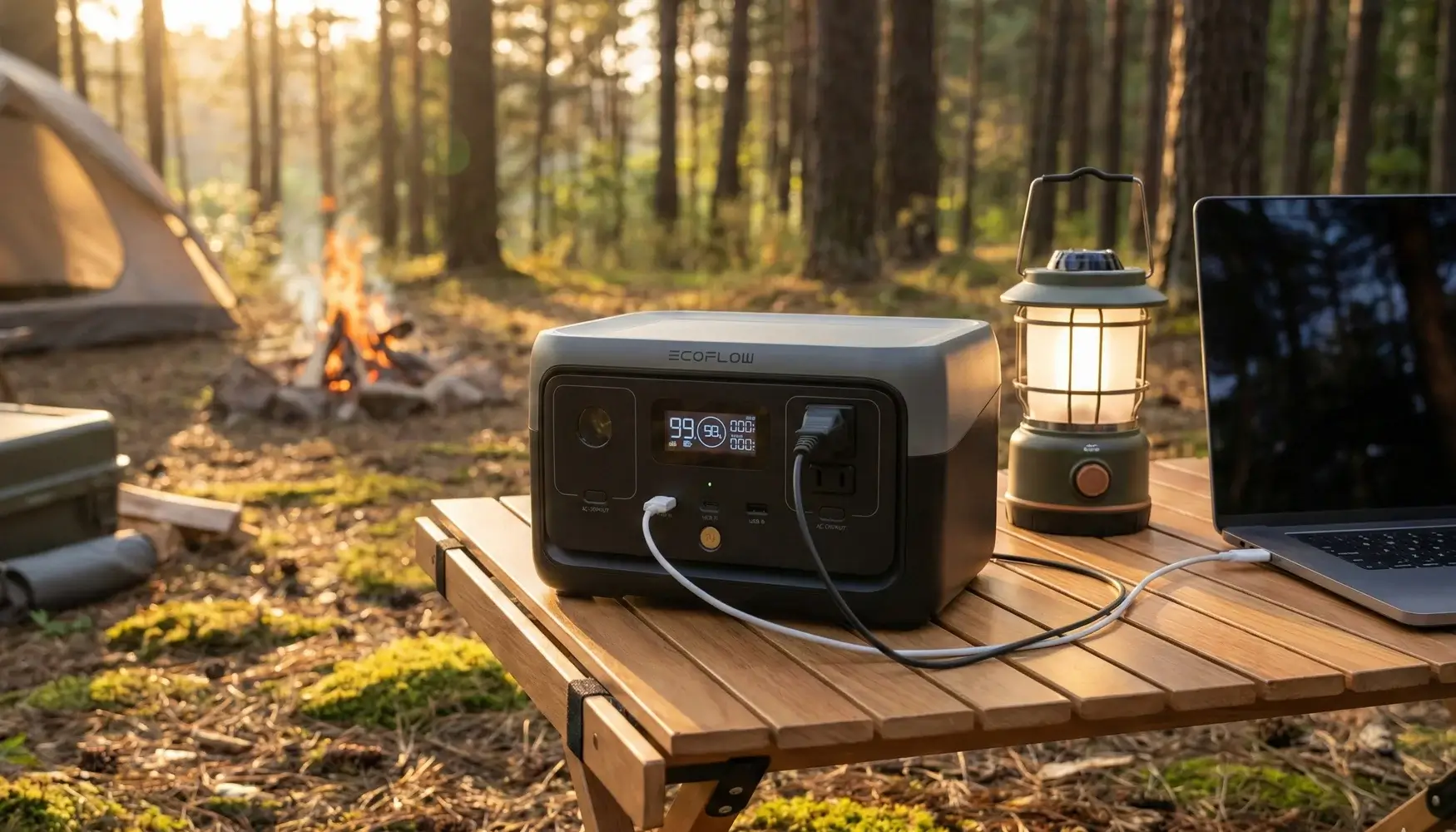
For camping, pick a station that supports fans, cameras, and USB-C charging without excess weight. Pass-through charging lets you use devices while topping the station up, which helps if you need to keep laptops and phones alive from a campsite.
This is where the practical gap between a holiday and a working trip shows. Plenty of people now plan around it deliberately. That might mean co-living arrangements for remote workers with reliable power, or the visa and tax planning covered in our guide to digital nomad visas. Power sits at the bottom of that stack: without it, nothing else on the list matters.
RV and tiny homes
Map out input and output planning: pair modular batteries with a roof array or portable panels. Solar input plus Storm Guard gives you room to top up before bad weather arrives. Off-grid living has become a realistic option for more jobs, including some field roles covered in our look at remote work in blue-collar jobs.
There is a sustainability angle too. Pairing a station with panels shifts part of your daily load off the grid. It is a small lever next to the numbers in climate tech funding or a corporate carbon neutrality roadmap. It is measurable, though, and it feeds the same debate as remote work and carbon impact. If you want the wider picture of where household energy hardware is heading, our overview of green technology trends covers the market around these products.
- Size for a fridge, lights, and key outlets before anything else.
- Check that your camping kit has the right ports and pass-through support.
- Map RV inputs and choose panels that fit your roof space or storage.
Price and Value Compared: EcoFlow vs. Anker SOLIX, Bluetti, Jackery, and Goal Zero
Dollars per watt-hour is only one of several things to check.
Paying for speed and ecosystem
You pay more per watt-hour for fast recharge technology, strong build quality, and integrated app control. That premium is justified if you value quick turnarounds and a system that grows with you.
Where rivals close the gap: Anker SOLIX and Bluetti frequently undercut EcoFlow at similar capacities. Jackery remains simpler for buyers who want one unit and no ecosystem. Goal Zero holds a loyal following but tends to lag on charging speed. At full list price, EcoFlow’s advantage narrows considerably, which is why timing a promotion matters so much here.
Solar panel pricing realities
This is where the bill quietly doubles. EcoFlow lists its 400W portable panel at $699, with a two-panel bundle at $1,099. Comparable third-party panels of similar wattage often sell for a fraction of that, so check both before you add panels to the cart.
That gap changes total system cost fast. Make sure any panel matches the station’s voltage and current window and uses compatible connectors, or budget for an adapter.
- Quick checklist: weigh price against charging speed and long-term battery life.
- Compare ports, accessories, and input flexibility (wall, solar, car), not just capacity.
- Cycle life affects real value more than day-one price if you cycle the unit often.
Who Should Skip EcoFlow
Not everyone needs this. Be honest about your situation before you spend:
- You want silence above all. Any unit with an inverter and fans will make noise under load. If near-silent overnight operation is non-negotiable, cap charging in the app or look at lower-output alternatives.
- You only charge phones and a laptop. A good 200Wh power bank costs a fraction of a RIVER 3 and fits in a backpack pocket.
- You need true whole-home autonomy for weeks. At that point a permanently installed system, whether the DELTA Pro Ultra X or a conventional home battery, makes more financial sense than stacking portable units.
- You cannot wait for a sale. Buying EcoFlow at full list price is where most value complaints come from.
Verdict
What matters most is steady power, quick top-ups, and a system that grows with you.
If you want a portable power station that recharges fast and is simple to manage, this lineup delivers. The app, the clear display, and the practical design reduce guesswork during an outage, which is exactly when guesswork is most expensive.
Pick for the feature you need most. The RIVER 3 is the low-risk entry point. The DELTA 3 Plus is the right answer for most households: fast, expandable, and quiet enough indoors. The DELTA Pro 3 is the one to buy if you intend to carry heavy 240V loads. The DELTA Pro Ultra X only makes sense if you are willing to install a fixed home battery system.
Plan your charge windows before storms, keep a fridge and lights running, and lean on pass-through power for continuous use. Then buy on promotion, not on impulse. If portable power is one part of a wider home-office upgrade, our roundup of productivity apps and our guide to coworking spaces cover the other two places that money usually goes.
Secure Your Backup Power NowFound this useful?
Make SmartKeys a preferred source on Google, and our articles will surface more often in your Top Stories, AI Overviews, and AI Mode.
Add as Preferred Source