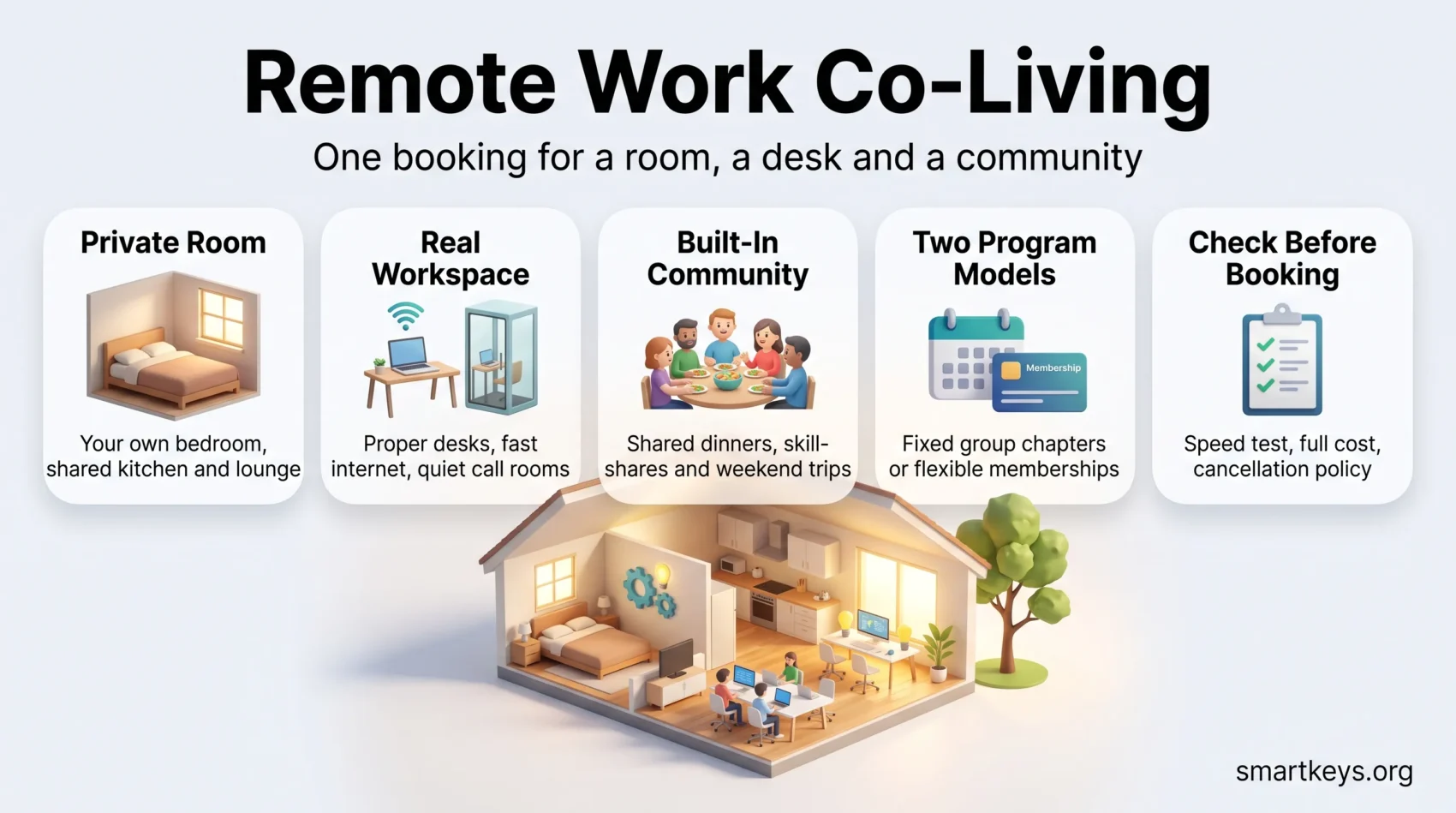
Coliving means renting a private bedroom inside a house or apartment where the kitchen, lounge and work area are shared with everyone else staying there. For remote workers it usually comes bundled with coworking, meaning proper desks, fast internet and somewhere to take a call without background noise.
That bundle is the whole point. Arriving in a new city normally costs you a week of admin: finding a flat, testing the Wi-Fi, working out where to sit. A coliving booking removes most of that, because lodging, a desk and a first set of introductions arrive together.
The audience is big enough to support a real industry. MBO Partners counted 18.5 million American digital nomads in its 2025 Digital Nomads Trends Report, a rise of 153% since 2019 and roughly 12% of the US workforce.
This guide to coliving for digital nomads covers what the model is, what the main programs charge in 2026, what a month costs by region, and how to judge a space before you book. The legal side of a longer stay, from income thresholds to tax residency, is covered in our overview of digital nomad visa rules by country.
Key Takeaways
- Coliving pairs a private room with shared kitchens, lounges and desks, so you get quiet and company from one booking.
- Programs sell community as much as lodging. The curated events and introductions are what you pay the premium for.
- Two pricing models dominate: fixed group chapters of three to eight weeks, and membership networks with rolling monthly stays.
- Monthly rates vary hugely by region, from roughly 250 to 900 euros in Southeast Asia up to 900 to 2,500 euros in Western Europe.
- Check the internet, the desk and the cancellation policy before you look at the photos.
What Coliving Is and How It Works
Think of a coliving house as a ready-made neighbourhood with the paperwork already done. You book a room, not a lease. Utilities, cleaning of shared areas and usually the internet are included in one monthly price.
The model in plain terms
A coliving space rents out private bedrooms, often with an en suite bathroom, inside a building whose kitchen, lounge and terrace belong to everyone. Some houses have a work floor on site. Others hold a partnership with a nearby coworking club and hand you a pass at check-in.
The difference from a normal flatshare is that an operator runs the place. Someone cleans, fixes the router and organises the Tuesday dinner. You are buying a managed service, not just a bed.
What a typical setup includes
Most listings cover a private room, shared kitchen, lounge, desk area and weekly cleaning of common space, with utilities and internet bundled in. Directories such as Coliving.com and Mapmelon publish room photos, Wi-Fi details and facility lists so you can compare before contacting anyone.
What is rarely included: food beyond a welcome dinner, laundry, airport transfer and a guaranteed private desk. Those vary by house, so ask.
Who it suits
- Freelancers and solo founders who want company in the evening and a quiet room during the day.
- Salaried remote employees on a long trip who need dependable infrastructure for calls. Check your employer’s rules on working abroad first; our guide to writing a digital nomad policy explains what most companies require.
- Small distributed teams using a house as a temporary base, which overlaps with how remote team building retreats are run.
It suits you badly if you need absolute silence or travel with family.
What You Actually Gain: Focus and Company
The pitch is that coliving fixes two problems at once. Whether it does depends on which of the two you actually have.
The work side
A coworking floor gives you a desk at a sensible height, a chair you can sit in for six hours, a door you can close and internet that does not drop mid-meeting. That sounds mundane until you have tried a client call from a beach cafe.
The practical gain is fewer interruptions and less time lost to logistics. Many houses also set quiet hours, which is the informal version of the focus time policy teams use to protect concentration, and it makes stretches of deep work possible in a building full of people.
Two things are worth checking. Advertised speeds are marketing until someone posts a recent test, and a shared line slows down when twenty people join calls at 3pm. Keep a mobile backup: our overview of 5G and remote work explains what a phone hotspot can carry.
The people side
Isolation is the standard complaint about working remotely, and it is not a small one. Coliving answers it with structure: shared dinners, skill-shares, a Slack group, weekend trips. You get a social calendar you did not have to build.
Loneliness tracks closely with how engaged people feel at work, a pattern we cover in remote work and mental health. A house where three people eat together every evening solves a problem no productivity app touches.
The trade-off is noise and obligation: a full events calendar can eat the hours you came to work in.
What the Main Programs Cost in 2026
Programs fall into two shapes. Chapter-based operators move a fixed group through a destination for a set number of weeks. Membership networks sell access to a portfolio of houses, booked month by month. The figures below are the operators’ own.
NOMA Collective (formerly Hacker Paradise)
NOMA runs curated editions with a local community manager, private rooms with cleaning, coworking access, skill-shares and weekend excursions. Listings on the Coworkations marketplace put the cost at about $538 per week, or $2,150 per month, with a minimum stay of three weeks.
The draw is the onboarding. A local manager, a group that arrives on the same day and a ready-made calendar mean you are settled in about 48 hours rather than two weeks.
WiFi Tribe
WiFi Tribe runs “Chapters” of four, six or eight weeks for groups of 12 to 25 people. You apply and interview first, then join the community Slack. Membership costs $490 a year and is required to book, and chapter fees run from $1,200 to $2,800.
The operator states that about 60% of chapters start at or below $1,400 for a shared room and $2,300 for a private one. The vetting produces a tighter group than an open booking platform, which is the main reason people renew.
Outsite
Outsite is membership-based: $199 a year or $499 once for lifetime access, covering member rates across more than 40 locations and a community of over 6,000 members. Houses are furnished, have community managers and support, and you book rolling stays rather than fixed cohorts.
This is the flexible option. If your plans change month to month, a membership network costs less in cancelled bookings than a fixed chapter does.
Smaller operators and independent houses
Beyond the named programs sit hundreds of independent houses, from six-bed villas in Bali to converted townhouses in Lisbon. Many quote on request rather than publishing rates. Operators such as WiFi Artists run month-long programs with and without accommodation but publish no stable price list, so treat any second-hand figure as a starting point for a quote.
If you only want the desk and not the housing, a straight coworking membership is usually cheaper. Our guide to coworking spaces covers what a desk costs on its own, and virtual coworking is the option if you want the company without the building.
What a Month Costs by Region
Individual listings change constantly, so the useful number is the regional range. The 2026 price guide from coliving.love puts typical monthly rates at roughly:
- Southeast Asia: 250 to 900 euros, with Bali at the top of that band (600 to 1,200 euros) and Thailand around 400 to 900 euros.
- Portugal: 750 to 1,500 euros, with Lisbon and Madeira holding most of the supply.
- Mexico: 600 to 1,200 euros, including hubs such as Oaxaca and Mexico City.
- Western and Northern Europe: 900 to 2,500 euros, with Germany from about 900 and Norway at the top end.
The pattern is consistent: Asia is cheapest, Southern Europe sits in the middle, Northern Europe is the premium end. A private room typically costs 50% to 100% more than a shared one in the same house.
Before you pick by price, check the time zone. A cheap room in Bali is expensive if it puts your team calls at 1am. The mechanics are worth borrowing even as a solo worker: see follow-the-sun scheduling and our guide to managing cross-border teams.
How to Choose a Coliving or Coworking Space
Three checks separate a good booking from an expensive mistake.
1. Check the work setup first
Ask for a recent speed test, not an advertised figure. Ask whether the desk is guaranteed or first-come, what the backup connection is, and whether there is a bookable room you can close for calls.
If you are handling client data on a shared network, treat the house Wi-Fi like any public network and use a VPN. Our guide to cybersecurity for remote work covers the basics. The ergonomics matter too, and the same rules apply as at home, which we set out in creating a productive home office.
2. Check the money and the exit
Get the full cost in writing: room rate, deposit, cleaning, utilities, coworking pass, membership fee. Then ask the question people forget: what happens if you leave early, or if a visa is delayed?
A clear cancellation window is worth more than a small discount. If you are unsure about a house, book two weeks rather than three months and extend.
3. Check the people
Ask how many residents there are, how long they typically stay, and what a normal week on the events calendar looks like. A house of long-stayers feels very different from one with weekly turnover.
Read recent independent reviews, not the testimonials on the operator’s own page, and look for comments about noise and cleaning.
Visas, Taxes and the Boring Logistics
The part that catches people out is not the housing. It is the paperwork.
More than 60 countries now offer some form of remote work or nomad visa, each with its own income threshold, insurance requirement and length. Booking a three-month stay on a tourist entry is a common and avoidable mistake; our overview of digital nomad visas explains what the main schemes require.
Tax residency is the second trap. Many countries treat you as tax resident after 183 days, and some count far sooner. If you are employed rather than freelance, your employer also has obligations in the country you are sitting in, which is why global payroll tends to decide how long a company will let you stay.
Timing matters too: give yourself a buffer day after a long flight before any important call, and plan around local holidays. Our guide to staying productive while travelling for work covers the routines that survive a change of city.
Is It Worth It?
Coliving is a good deal when you value speed and company more than space and privacy. You pay above the local rent rate and in exchange skip the search, the deposit, the furniture and the first lonely fortnight.
It is a poor deal if you already have a routine that works, need silence, or plan to stay six months. At that length a normal rental plus a separate coworking pass is cheaper.
Book one short stay and treat it as a test. Living and working in the same building makes the boundary harder to hold, the challenge we look at in the future of work-life balance and in the right to disconnect.
For the wider picture, see digital nomads and the future workforce and our data-led look at remote work productivity.
Found this useful?
Make SmartKeys a preferred source on Google, and our articles will surface more often in your Top Stories, AI Overviews, and AI Mode.
Add as Preferred Source