Working from a laptop in another country stopped being a novelty some time ago. In its 2025 Digital Nomads Trends Report, MBO Partners counted 18.5 million American digital nomads. That is roughly 12% of the U.S. workforce, and 153% more than in 2019. What started as a fringe experiment among freelancers is now mostly a salaried affair. Six in ten of those nomads are traditional employees who negotiated the right to work from anywhere.
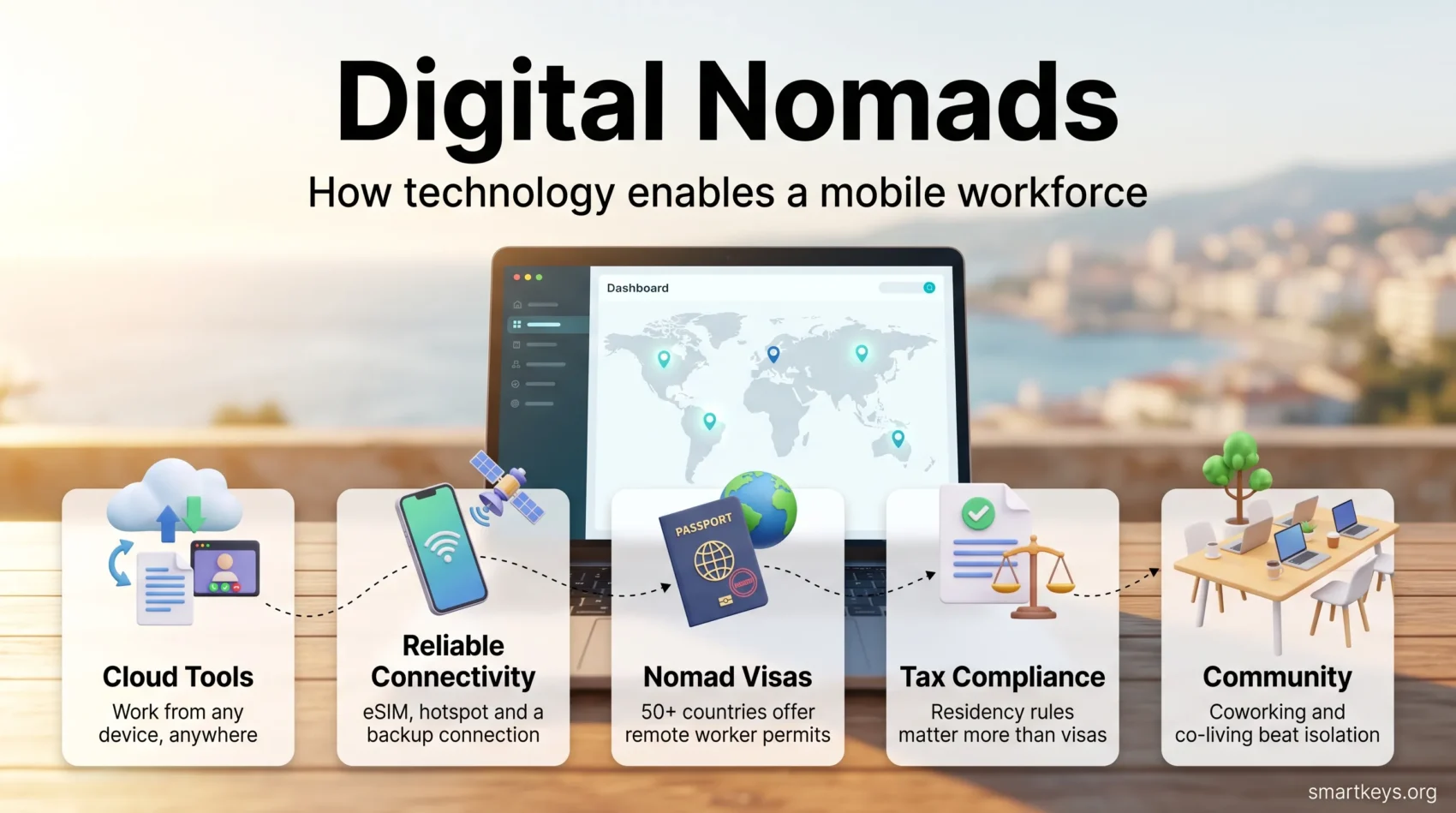
The technology caught up as well. Stable video calls and cloud storage that syncs over a hotel connection are now standard. So are eSIMs, digital SIM cards you download instead of buying a plastic one. Together they removed most of the friction that once made remote work on the move impractical. What remains is harder: visas, tax residency, time zones, and the discipline to finish your work in a place you would rather be exploring. This guide covers what the digital nomad lifestyle looks like in 2026.
Key Takeaways
- MBO Partners counted 18.5 million American digital nomads in 2025, up 153% since 2019, and 60% of them are traditional employees.
- More than 50 countries now run a dedicated digital nomad or remote worker visa, each with its own income floor.
- Connectivity is rarely the binding constraint anymore. Tax residency and visa compliance usually are.
- Coworking spaces and co-living communities solve the isolation problem better than any app does.
- A repeatable routine matters more on the road than at a fixed desk, because everything around it keeps changing.
The Rise of Digital Nomadism
The digital nomad lifestyle grew out of two things happening at once: work that no longer needed a specific building, and countries that decided mobile workers were worth attracting. It has moved well past the freelancer stereotype.
Defining the Digital Nomad Lifestyle
A digital nomad earns a living through work that travels, such as consulting, software, design, writing, sales or support, and changes location by choice rather than by assignment. The defining feature is not travel itself but the absence of a required location.
Most nomads move far less than the image suggests. MBO Partners found they spent an average of 6.4 weeks in each destination in 2025, a pattern often called “slowmading.” Settling into a city for a season is simply more sustainable than constant transit.
The category now overlaps heavily with conventional employment. Plenty of nomads are full-time employees at companies with clear rules about where staff may work, rather than contractors chasing projects on freelance talent platforms. It is also a younger group: Gen Z and millennials make up about three quarters of American nomads.

Which Jobs Suit a Nomadic Life
The work that travels best has three traits: it happens on a computer, it is judged by output rather than presence, and it does not need a fixed daily schedule with one team. MBO Partners lists information technology, creative services, sales and marketing, communications, finance and accounting, research and consulting as the most common fields.
In practice, that covers roles such as:
- Software and front-end development, data analysis and IT support.
- SEO, social media management, copywriting and content creation.
- Graphic design, photography and video editing.
- Project management, virtual assistance and business coaching.
- Online teaching and tutoring.
Pay varies enormously within each of these, depending on experience, niche and client market. A freelance copywriter serving U.S. companies can earn several times what a peer working for local clients makes. If you are going independent, the wider freelancing trends, including how AI is changing demand, matter as much as the destination. Employees have a different route: some remote-first job titles are built for distributed teams from the start.
Impact of Remote Work on Traditional Office Structures
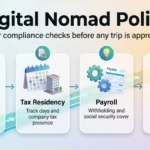
Mobile work forced a quieter change inside companies. Once staff can work from anywhere, informal permission stops scaling. Someone has to decide which countries are acceptable, for how long, and who carries the tax risk. That is why written digital nomad policies have become standard, and why some organizations now appoint a dedicated head of remote work.
Companies accept that effort because the upside is real. An employer that allows location flexibility can hire from a far wider talent pool, and it gives existing staff one less reason to leave when their life circumstances change.
Compensation is the second pressure point. If two people do identical work from different countries, does location still set pay? The argument over global pay parity is unresolved, and it shapes who can afford to become a nomad.
Technology as a Catalyst for Change
None of this works without infrastructure that is boring, cheap and reliable. Communication tools and cloud services let a nomad drop into a new city and be productive the same afternoon.
Advancements in Communication Tools
Video conferencing, shared documents and project boards are now assumed rather than negotiated. The groundwork was laid earlier than most people remember. IBM experimented with telecommuting in the 1980s. Automattic has operated as a fully distributed company since 2005, and Google Docs made real-time co-editing ordinary from 2006.
The current problem is not access but volume. Constant pings fragment the day. That is why teams working across time zones lean on written updates and clear instant messaging boundaries. When meetings do mix locations, a few deliberate habits help. Sharing an agenda in advance and letting remote participants speak first keep the person on the laptop from being talked over.
Cloud Computing and Data Accessibility
Cloud computing makes the device replaceable. Files and tools live on a server, so a stolen laptop in Lisbon is an expensive inconvenience rather than a career-ending event. Backups, password managers and multi-factor authentication matter more when you move between unfamiliar networks.
Two risks follow you across borders. The first is unapproved tools: nomads improvise, and improvised software often sits outside the company’s security perimeter. The second is legal. Data localization rules restrict where certain data may be stored or accessed from, which can quietly make a destination unworkable for anyone handling regulated information. The same connectivity also underpins immersive virtual workspaces, still a niche rather than a default.
Understanding the Digital Native Workforce
The digital native workforce, largely Generation Z and now well into their careers, has never worked without these tools. That shapes what they expect from an employer.
Characteristics of Digital Natives
- Comfortable choosing and switching tools without formal training.
- Inclined toward continuous, self-directed learning rather than scheduled courses.
- Used to written, asynchronous communication as a default rather than a fallback.
- Quick to adopt new processes, and quick to abandon ones that add friction.
Expectations for Work Flexibility
Flexibility in the workplace is a baseline expectation for this group, not a perk. Several consequences follow:
- A large share of knowledge workers have settled into hybrid or fully remote arrangements, and treat a return to fixed attendance as a downgrade.
- Flexibility now competes directly with salary in job decisions, particularly for people with caring responsibilities.
- Remote-friendly employers reach candidates that office-bound competitors cannot, including people who find a daily commute difficult.
- The trade-off is visibility. Some managers still doubt that people on the road work as hard, which is why remote career advancement depends on documented outcomes rather than presence.
Travel and Work: A New Balance
Combining work and travel is different from doing either separately. The benefits are real, and so are the failure modes.
Benefits of Combining Work and Travel
- Exposure to different markets, cultures and working styles, which tends to feed back into the work itself.
- Control over when you work, so you can schedule deep focus around your own energy rather than an office clock.
- A wider professional network built from people you would never meet in one city. For freelancers, those contacts often turn into clients.
- Lower fixed costs in many destinations, which buys runway for freelancers and founders.
Challenges Experienced by Digital Nomads
- Routines break every time the location changes, and rebuilding them costs real productive days.
- Time-zone gaps with clients or colleagues can push work into evenings indefinitely.
- Overwork is easy when there is no closing time and no commute to mark the end of the day.
- Social isolation builds gradually, especially for people who move quickly and repeatedly.
- Administrative load, meaning visas, insurance, banking and taxes, is heavier than most people expect.
Strong self-management is the skill that separates people who sustain this from people who burn out in a year. Setting achievable daily goals and leaving buffers in the schedule absorbs the delays that travel guarantees.
Keeping Work and Travel From Blurring Together
The most common failure is not too little work but too little separation. When the office is a café or a beach, neither the job nor the trip gets full attention. A few rules prevent that drift:
- Fix your working hours and share them. Agree on them with your team or clients, so nobody expects replies at midnight their time.
- Separate the devices. Keep work chat and email off your personal phone, or at least mute them outside working hours.
- Take real time off. A trip with a laptop in the bag is not a vacation. Schedule weeks with no work at all.
- Set up a proper workspace. A real chair, a laptop stand and a quiet room do more for focus than any productivity app.
Infrastructure Needs for Digital Nomads
Choosing a destination is largely an infrastructure decision; the scenery is the easy part.
Reliable Internet Connectivity
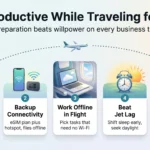
Stable bandwidth remains the first filter, but the picture has improved. Widespread mobile data, prepaid eSIMs and satellite internet mean connectivity is now a solvable problem in most places nomads actually go. The sensible approach is redundancy: a primary connection, a mobile hotspot as backup, and testing both before you commit to a client call.
Importance of Co-Working Spaces
Coworking spaces earn their fee twice over. They provide a desk, a chair and a connection that a café cannot match, and they provide the people. Most run events, and in nomad-heavy cities they are the default entry point to a local professional network. For stays longer than a couple of weeks, a monthly pass usually pays for itself.
Access to Local Amenities and Resources
Everything else decides whether a stay is pleasant or exhausting: healthcare you can actually use, a payment method that works, groceries, and transport that does not eat an hour a day. Insurance deserves particular attention, since standard travel policies often exclude work activity and long stays. Good infrastructure for digital nomads means the boring things take care of themselves.
Work and Travel: Destinations for Digital Nomads
The map of digital nomad destinations has stabilized around cities combining cost, connectivity and an existing community.
Top Cities Embracing Digital Nomads
- Lisbon: a large established scene and strong European connections, though living costs have risen sharply as a result.
- Chiang Mai: still one of the cheapest serious options, with a long-standing remote work community.
- Medellín: a mild climate year-round, good coworking supply and a convenient time zone for U.S. clients.
- Tallinn: a small, highly digitized city and the administrative home of Estonia’s nomad visa.
- Mexico City: deep infrastructure and near-total time-zone overlap with North America.
Specialized Visa Programs for Remote Workers
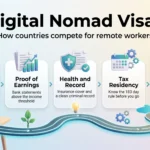
This is where the last few years changed the most. More than 50 countries now offer some form of digital nomad or remote worker permit. Governments compete for these workers because they spend money locally on rent, food and services without taking local jobs.
The permits are not interchangeable. Each sets an income floor, and most exclude work for local clients:
- Portugal (D8): valid one to two years and renewable, with a monthly income requirement of about €3,680, four times the national minimum wage.
- Estonia: a stay of up to twelve months, requiring a net income of at least €4,500 per month.
- Spain: twelve months and renewable, pegged to twice the Spanish minimum wage and updated annually.
- Italy: twelve months and renewable, with an income requirement in the region of €28,000 to €32,400 per year.
- Croatia: a residence permit of up to 18 months, with a 2026 income threshold of about €3,620 per month.
- Thailand (DTV): the Destination Thailand Visa is valid for five years with stays of up to 180 days per entry, and requires at least 500,000 baht in savings.
- Brazil: twelve months and renewable, requiring around USD 1,500 per month or USD 18,000 in savings.
- Indonesia (E33G): the Bali remote worker permit runs one year without extension and requires USD 60,000 in annual foreign income.
Requirements change frequently, so treat these as a starting point and confirm current rules with the relevant consulate before booking. Our guide to digital nomad visas in 2026 compares the programs in more detail.
Taxes and Compliance: The Part Most Nomads Underestimate
A visa grants the right to stay. It does not settle where you owe tax, and the two are decided by different rules. Many countries treat extended presence as a trigger for tax residency, and holding a residence permit can itself signal intent to reside. Indonesia’s E33G, for example, does not exempt holders from Indonesian tax obligations. Double taxation agreements exist to prevent you paying twice, but they only help if you file.
Employers face a parallel problem: an employee working abroad for long enough can create a taxable presence for the company. That is the real reason mobility policies cap the number of days per country and maintain an approved list. It is also why shifting employment legislation is worth watching if this is more than a short trip. If your situation involves meaningful income across two jurisdictions, professional advice costs far less than getting it wrong.
Maintaining Productivity on the Go
Productivity on the road is mostly a systems problem; the tools are the easy half.
Mobile Work Tools and Applications
A workable stack is small: one place for tasks, one for team communication, one for documents, and a password manager holding it together. Tools such as Trello, Asana, Slack and Zoom are common precisely because they work acceptably on a weak connection and on a phone. Being able to work properly from a phone turns airport delays and long transfers into usable time.
Download what you need before you travel. Offline access to documents, tickets and maps removes the most common cause of a wasted morning.
Time Management Strategies for Digital Nomads
Techniques such as the Pomodoro method and time blocking are popular among nomads for a simple reason: they impose structure the environment no longer provides. The method matters less than repeating the same one in every city.
Two habits do most of the work. Protect a fixed block of overlap with your team and defend the rest of the day. And book travel around your work rather than the reverse; arriving the night before a deadline is a choice, not bad luck. Consistent remote work habits keep output steady when everything else changes.
Community and Connection for Digital Nomads
The digital nomad community is hardest to replace and easiest to neglect. Isolation is the most commonly cited reason people stop.
The Importance of Networking
Platforms such as Nomad List, Citizen Remote and Remote Year shorten the gap between arriving somewhere and knowing someone. They combine practical services, such as visa guidance, eSIMs and accommodation, with the introductions that turn a city into a base. Slack groups and city-specific communities keep those connections alive between moves.
Building Supportive Communities in Different Locations
In practice, most connections form in physical spaces. Coworking spaces and co-living operators run the events and skill sessions where people actually meet, and staying somewhere long enough to become a regular beats any amount of online networking. Building supportive connections is not a side activity. For most people, it is what makes the lifestyle last.
Found this useful?
Make SmartKeys a preferred source on Google, and our articles will surface more often in your Top Stories, AI Overviews, and AI Mode.
Add as Preferred Source