The rise of remote work permanently changed what a workplace is. The pandemic forced the experiment, and the years since decided the outcome. Working from home did not take over the economy, and it did not disappear when the return-to-office memos landed. It settled.
That settlement is the story worth understanding in 2026. The Survey of Working Arrangements and Attitudes (SWAA) is a monthly survey of US workers run by the economists behind WFH Research. It found that about a quarter of all paid working days in the United States were worked from home in May 2026. That level has barely moved for roughly three years. Among full-time employees surveyed over the twelve months to May 2026, 62% work fully on-site, 26% work a hybrid schedule (some days at home, some in the office), and 12% are fully remote.
Those numbers explain more than any forecast. The future of remote work is not a race toward an all-remote economy. It is a durable new baseline, in which location became something employers and employees negotiate rather than a fixed condition of the job.
Key Insights
- Roughly one in four paid US working days is now a work-from-home day, and that share has been flat for years (WFH Research, SWAA, May 2026).
- Hybrid, not fully remote, is the dominant flexible arrangement: 26% of full-time employees are hybrid versus 12% fully remote.
- Return-to-office mandates reshaped individual companies without moving the national average much.
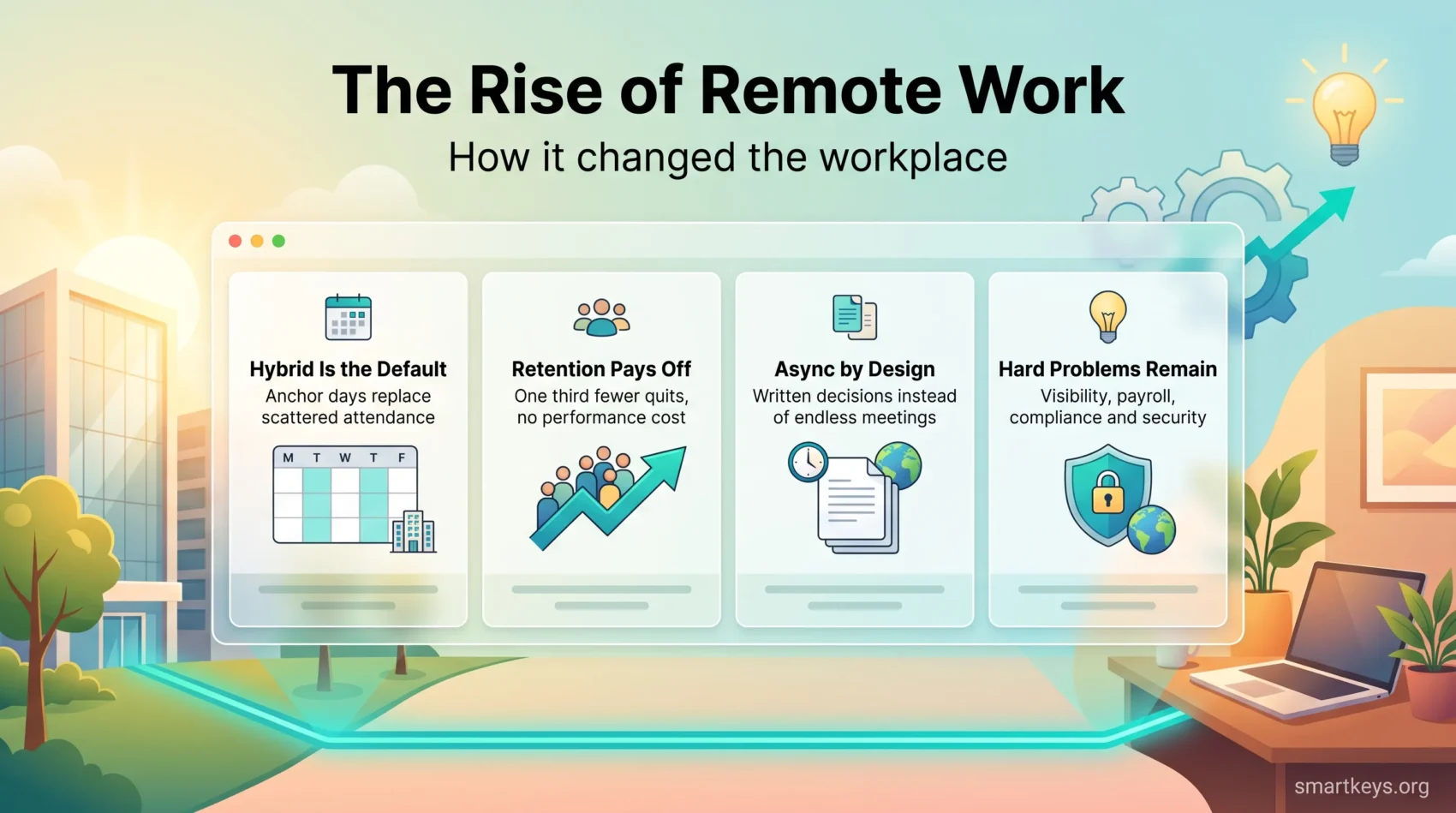
- The strongest evidence for hybrid work is about retention: a randomised trial published in Nature found a one-third drop in quit rates with no measurable performance cost.
- The hard problems left are managerial and legal (visibility, onboarding, payroll, compliance and security), not technological.
The Remote Work Revolution, Five Years On
What began as an emergency measure became an operating model. The interesting part is not that it happened but that it stopped moving. Where it stopped tells you more than any prediction about 2030.
What the Pandemic Actually Proved
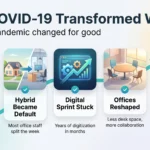
The COVID-19 period settled one question decisively: a large share of knowledge work does not require a specific building. Finance teams closed their books remotely, support queues were handled from kitchen tables, and software kept shipping. What it did not settle was whether the arrangement was better. It only proved that it was possible.
The years that followed separated those questions. Companies had to decide what they actually wanted, and employees discovered what they would trade for it. The result is today’s mixed landscape, where flexible work schedules are common but rarely unlimited.
Where the Numbers Settled
The plateau is the headline. Work-from-home days spiked in 2020, fell back through 2021 and 2022, and have since held near a quarter of all paid days. High-profile mandates changed conditions at specific large employers without pulling the national figure back toward 2019.
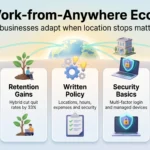
The reason is structural. Flexibility is cheap to offer and valuable to receive, which makes it an efficient part of a pay package. Smaller firms in particular use it to compete for candidates they could not otherwise afford. It is also why employers now write formal rules for where people may work. A work-from-anywhere policy that covers the legal and tax checks has become a standard HR document rather than a perk.
Remote Work Trends in 2026
The question is no longer whether remote work survives. It is which version your organisation runs, and whether that version is deliberate.
Trends Shaping the New Workforce
- Hybrid as the default: Most organisations that offer flexibility have settled on a set number of office days rather than a free-for-all. Anchor days, when the whole team is on site together, have largely replaced individual choice. Scattered attendance produced the worst of both worlds: a commute to sit on video calls.
- Asynchronous by necessity: Asynchronous work means colleagues contribute at different times instead of meeting live. Teams that span time zones cannot run on meetings, so asynchronous communication tools and written decision records have become core infrastructure.
- AI in the collaboration layer: Meeting summaries, transcription, translation and drafting are now built into the platforms teams already use. A colleague who missed a call can read a summary in two minutes instead of watching a one-hour recording.
- Secure access from anywhere: Remote access software, cloud file storage and multi-factor login (a second check, such as a code on your phone, on top of a password) let people reach company systems from home without exposing them. Immersive virtual reality offices were widely hyped but remain a niche; plain video and shared documents do most of the work.
- Wellbeing as policy, not perk: Employers have moved from wellness apps toward structural fixes: meeting-free blocks, clearer availability expectations, easier access to counselling, and support for remote work mental health.
- Lower emissions, with caveats: Fewer commutes lower carbon emissions from travel, though home energy use and extra non-work trips offset part of the gain.
The remote job market still tilts toward higher-paid, higher-educated roles. That is a real limit on how far flexibility spreads, and it is why the debate has shifted from adoption to fair access. New job types built around distributed work are also appearing; our overview of emerging remote roles shows where they cluster.
The Return-to-Office Pushback
Several large employers now require four or five office days, citing faster collaboration, easier mentoring and stronger culture. The evidence is mixed, and the costs are easier to observe than the benefits. A study of return-to-office mandates at S&P 500 firms by Yuye Ding, Mark Ma and co-authors found that mandates were followed by more departures among senior, experienced employees, the people with the most alternatives. Firm performance did not improve to match.
The practical lesson is that a mandate is a pay change. Removing flexibility takes something of value away, and unless something replaces it, some people leave. Organisations that handle it well explain what office days are for instead of counting badge swipes. Our guide to return-to-office mandates that work and those that backfire covers the policy design in detail.
The Benefits for Employees
The advantages are well established, but they are worth stating precisely.
Flexibility and Work-Life Balance
Control over your own schedule is the benefit workers rank highest, and it shows in their choices. Many accept lower pay, or stay in a job they would otherwise leave, to keep it. The gain is largest for people with fixed obligations, such as school runs, caring duties or medical appointments, that a rigid office day makes expensive.
The Commute You Do Not Take
The average one-way commute in the United States is roughly 27 minutes, according to the Census Bureau’s American Community Survey. Two of those a day, five days a week, add up to close to a full working week per year, and commuting is strongly linked to reported stress. Even a hybrid schedule recovers a meaningful share of that time.
The money adds up too. Global Workplace Analytics estimates that employees who work from home about half the time save between $600 and $6,000 a year, mostly on travel, parking and food, after subtracting higher home costs.
Access to Jobs Without Geographic Limits
Remote roles separate where you live from where you can work. That widens the market for people outside major cities and for those who cannot relocate. It also created a new legal category: dozens of countries now offer some form of digital nomad visa, which gives location-independent workers a lawful basis to stay long term.
The trade-off is competition. Remote listings attract far more applicants than local ones, so standing out depends on a visible track record rather than proximity.
The Benefits for Employers
The employer case has narrowed and strengthened at once. The vague productivity claims of 2021 gave way to a smaller set of well-supported effects.
Expanding the Talent Pool
Hiring beyond commuting distance widens the candidate pool, which matters most for specialised roles that are scarce locally. It also lets firms build cross-border teams that cover more hours of the day, provided they invest in the handover discipline that requires.
Cost Savings from Reduced Office Space
Companies with fewer people in the building each day need less building. Many have shrunk or redesigned their footprint toward meeting and project space rather than rows of desks, and plans for the office of the future now assume variable occupancy. Global Workplace Analytics puts the potential saving at around $11,000 a year for each employee who works remotely half the time, counting rent, absenteeism and turnover. Treat that as a model estimate, not a guarantee: savings only appear when leases actually change, which is why the effect lags policy by years.
Retention: The Best-Evidenced Benefit
The strongest evidence comes from a randomised controlled trial of 1,612 employees published in Nature in 2024. Employees assigned to a hybrid schedule with two work-from-home days per week quit at a rate about one-third lower than their office-based colleagues. Attrition fell from 7.2% to 4.8%, while performance reviews and promotion rates showed no measurable difference. Job satisfaction was higher in the hybrid group.
That is a narrower claim than “remote work makes people more productive”, and a more useful one. Hybrid is best understood as a retention tool that costs nothing in output. For a fuller comparison, see our analysis of remote versus office ROI.
The Changing Nature of Work
Distributed work changed the mechanics of collaboration more than the work itself. Teams that adapted treated it as a design problem.
Collaboration in a Digital Landscape
Effective distributed teams write more and meet less. Decisions live in documents rather than in the memory of whoever attended. Collaborative tools matter, but the discipline matters more. A team with excellent software and no written record of why it chose something will still lose time arguing the same decision twice.
Why Digital Literacy Decides Who Thrives
Fluency with shared documents, project boards and meeting norms is now a core professional skill rather than a technical one. Digital literacy boosts productivity and, more importantly, decides who can take full part in a distributed team. Leave it to chance and the same few people end up doing all the coordination.
Managing Distributed Teams
Managing people you cannot see takes different habits: clearer goals, more frequent written check-ins, and deliberate attention to who is being overlooked. Remote leadership skills can be trained but rarely are, which is why many distributed teams underperform for reasons that have nothing to do with the model itself.
Freelancing and the Gig Economy
Location independence and independent work grew together. Upwork’s Future Workforce Index, based on a spring 2026 survey of US workers, puts the share doing some freelance work at 39%. Definitions vary widely between studies, so treat the direction as more reliable than the exact figure.
Opportunity for Independent Contractors
Freelancers choose their hours, clients and location, and many run several income streams at once. The autonomy is real, and so are the downsides: no paid leave, no employer health cover in most markets, and income that arrives unevenly. Current freelancing trends point toward longer, more embedded engagements rather than one-off tasks, which smooths some of that volatility.
Access to On-Demand Talent
For companies, independent talent buys a specific skill for a fixed period without adding permanent staff, and online platforms made matching cheap. The limiting factor is internal: organisations that cannot describe the work clearly get poor results regardless of who they hire.
Challenges and Considerations
The open problems are no longer about whether distributed work works. They are about its side effects.
Maintaining Work-Life Boundaries
When the office is in the house, the working day tends to expand. The commute, for all its costs, was also a boundary. Replacing it on purpose works better than relying on willpower: a fixed shutdown time, a physical workspace you leave, and notifications that switch off. Sustained remote work productivity depends more on these boundaries than on any app.
Isolation and Burnout
Loneliness is the most consistently reported downside of fully remote work, and it rarely fixes itself. Some people solve it with regular in-person contact, others with coworking spaces that supply structure and casual conversation. Burnout follows a similar pattern: it grows quietly when nobody sees the late-night messages. Managers who encourage real time off and keep communication channels open catch it earlier. Treat isolation as an operational risk, not a personal failing.
Career Visibility
Being out of sight can mean being out of mind when assignments and promotions are decided. The Nature trial found no promotion penalty when a hybrid schedule applied to a whole team. That suggests the risk lies in being the exception rather than in remote work itself. If you are remote in a mostly office-based organisation, remote career advancement means making your work visible on purpose.
Legal, Payroll and Security Complexity
Employing someone in another state or country creates tax, registration and employment-law duties that multiply with every location. Most companies handle this through an employer of record (a provider that legally employs the worker on the company’s behalf) or global payroll solutions.
Security grows harder too. Home networks, personal devices and unapproved apps give attackers more ways in. The baseline controls are well known: multi-factor login on every account, company-managed devices with endpoint protection (software that detects threats on each laptop), and access limited to what each person needs. That is why cybersecurity for remote work now sits alongside HR policy rather than beneath it.
Building Culture Across Distance
Culture in a distributed company is what your processes reward, not what your handbook says. Teams that hold together share a few habits. They write things down, decide in the open, meet in person occasionally and with a clear purpose, and state availability expectations plainly.
The retention evidence points the same way. Flexibility keeps people, and that is where most of the financial return sits: replacements are expensive to recruit and train, and knowledge leaves with every departure. Companies that treat flexibility as a considered part of their offer, rather than a concession, get the most out of it.
Remote work is also only one strand of a wider shift. Automation, AI and new skills needs are reshaping jobs at the same time; our look at future of work trends toward 2030 puts remote work in that larger picture.
Found this useful?
Make SmartKeys a preferred source on Google, and our articles will surface more often in your Top Stories, AI Overviews, and AI Mode.
Add as Preferred Source